Chapter 53 An Investigation into the Risk of Construction Projects Delays in the UAE
Omayma Motaleb
The Scott Sutherland School of Architecture and Built Environment, Robert Gordon University, UK
Mohammed Kishk
The Scott Sutherland School of Architecture and Built Environment, Robert Gordon University, UK
ABSTRACT
The growing rate of delays in project delivery is considered a major criticism of the construction companies in the United Arab Emirates (UAE).
This paper aims to investigate the causes and effects behind the delays pertaining to delivery of construction projects in the UAE. The study is exploratory in nature, and incorporates a pilot questionnaire survey and interviews. An extensive literature review indicates potential factors that have possible effects on construction completion delay. The questionnaire forms were sent to 50 construction companies. Thirty-five (70%) completed responses were received. Analysis of the survey data has revealed that about 42 potential causes and effects of delay relate to various groups of stakeholders. The results show the top fifteen factors relate to clients, project managers and finance aspects. It was found that cost and time overruns are the most significant effects. These results are in partial agreement with previous studies. The paper argues that the key determinant in ensuring project control is on-time project delivery. The results of the study can provide moderate support for a suggested hypothesis, through a framework of project success factors. It should be of high concern to knowledge managers in various roles and decision-makers.INTRODUCTION
Construction delay is ubiquitous in construction business, as well as being one of the most common risks to project success. This phenomenon largely overlaps the roles and interests of various
DOI: 10.4018∕978-1-4666-6268-1.ch053
project stakeholders in a multicultural society. Construction delay can be defined as the time overrun either beyond the contract deadline or beyond the date on which the parties agree upon for the delivery (Assaf & Al-Hajji, 2006).
Project success is considered to have been achieved when it is completed within time, cost, on specification and to stakeholders’ satisfaction (Majid, 2006). Delay is considered a frequently recurring problem in many developing countries, especially those that have grown so quickly despite the recent financial crisis, for example, the UAE construction sector (Faridi & El-Sayegh, 2006; Motaleb, 2009)..
Many researchers have classified the causes of construction project delay by stakeholders in groups like clients, contractors, consultants, project managers, resources (such as labor, materials, equipment), external and financial/economic factors (Odeh & Battaineh, 2002; Ahmed et al., 2003; Assaf & Al-Hajji, 2006; Faridi & El-Sayegh, 2006; Motaleb, 2009). The literature is extensive on this phenomenon. An investigation into selected global research in Table 1 has supported the way forward and future work for UAE construction projects. They have been classified into public and private sectors according to causes of group/ category. It is reported as full/partial agreements beyond the studies, between2000 -2010to identify gaps in knowledge.
Table 1. Summary of global research (2000-2010)
| No | Research | Project | Factors (Groups) causing delay | Effects of delay |
| 1 | Al-Momani, (2000) | Public buildings, (Jordan), Public sector | Designer, External, Finance, Client, Contractor | Time overrun |
| 2 | Noulmanee et al., (2000) | Highway construction, (Thailand), Public sector | Resources, Designer | Time overrun |
| 3 | Elinwa and Jashwa, (2001) | Public works (Nigeria), Public sector | Finance, Resources, Designer, Project Manager, Contractor, Government | Time &cost overrun |
| 4 | Aibinu & Jagboro, (2002) | General construction (Nigeria), Private and Public sectors | Client | Time & cost overrun |
| 5 | Ellis and Thomas, (2002) | Highway (USA), Public sector | Project Manager, External, Contractor, Designer | Time overrun |
| 6 | Manavazhia & Adhikarib, (2002) | Highway (Nepal), Public sector | Resources | Time overrun |
| 7 | Odeh & Battaineh, (2002) | General construction (Jordan), Public and private sectors | Client, Resources, Project Manager, Contractual, External, Consultant | Time and cost overrun |
| 8 | Ahmed et.al., (2003) | Building Project (Florida, US), Private sector | External, Client, Designer, Consultant | Time & cost overrun |
| 9 | Frimpong & Oluwoye, (2003) | Groundwater Construction(Ghana), Public sector | Finance, Contractor, Resources | Cost overrun |
| 10 | Choudhury & Phatak, (2004) | Commercial construction projects, US | Client, Contractor, Finance, Design | Time overrun |
| 11 | Koukshi et al., (2004) | Residential (Kuwait) | Resources | Time &cost overrun |
| 12 | Sun et al. (2004) | Construction projects (UK) | Client | Time &cost overrun |
| 13 | Acharya et. al., (2005) | Building project(Nepal) | Resources, External, Contractor | Time overrun |
| 14 | Koushki, (2005) | Residential (Kuwait), private sector | Client, Finance, Contractor, Resources | Time & cost overrun |
continued on following page
Table 1. Continued
| No | Research | Project | Factors (Groups) causing delay | Effects of delay |
| 15 | Wiguna &Scott,, (2005) | Buildings projects (Indonesia), Private sector | Finance, Client, Designer, External, Contractor | Time & cost overrun |
| 16 | Abdu-Rahman et. al., (2006) | Construction Project(Malaysia), | Finance, Resources, Client | Time overrun |
| 17 | Aibinu & Odeyinka, (2006) | Residential &offices (Nigeria), Public and Private sectors | External | Time & cost overrun |
| 18 | Assaf & Al-Hejji, in (2006) | Construction project(Saudi Arabia),Public and Private sector | Client | Time overrun |
| Faridi & El-Sayegh, (2006) | Construction Project (UAE),Public and Private sector | Consultant, Project manager, Client, Resources | Time overrun | |
| 20 | Fong et al., (2006) | Building construction, fire installation (Hong Kong), Private sector | Project manager, Client, Governmental | Time overrun |
| 21 | Othman, (2006) | Public project (Malaysia) | Contractor | Time overrun |
| 22 | Zaneldin, (2006) | Different 124 claims of Const. projects, (UAE), Public and Private sector | Contractual | Time overrun |
| 23 | Alaghbari et al., (2007) | Building Construction Project (Malaysia) | Financial, Project Manager | Cost overrun |
| 24 | Sambasivan and Yau (2007) | Construction projects (Malaysia) | Contractor | Time &cost overrun |
| 25 | Abdel-Razek et al., (2008) | Building construction (Egypt) - Private and Public | Contractual, Financial, Client | Time overrun |
| 26 | Long L.H., (2008) | Construction project (Vietnam) | Project Manager, Resources, Designer, Financial, Governmental | Time & cost overrun |
| 27 | Sweis et al, (2008) | Residential projects(Jordan),Private sector | Client, Finance, Contractor, Resources, Project manager | Time &cost overrun |
| 28 | World Bank Iraq Trust Fund, (2008) | Schools and Rehabilitation (Iraq), Public sector | Governmental, Financial, Contractual, Resources | Time &cost overrun |
| 29 | Kaliba et. al., (2009) | Road construction (Zambia) | Financial, Designer, Project manager | Cost & time overrun |
| 30 | Motaleb,(2009) | General construction (UAE), Public and Private sectors | Client, Project manager, Finance | Time &cost overrun |
| 31 | Tumi et. al., (2009) | Construction project (Libya), N/A | Project manager | Time &cost overrun |
| 32 | Abdul-Rahman et. al., (2009) | Construction project (global study) | Finance | Time &cost overrun |
| 33 | Asnaashari, E. et al., (2009) | Construction Projects (Iran), Public and Private sectors | Resource, Governmental, Financial, External | Cost overrun |
| 34 | Enshassi et al., (2009) | General Construction,(Palestine), Public and Private sector | External, Resources, Financial, Contractor | Time &cost overrun |
| 35 | Al-Nuaimi, A., et al.(2010) | Building construction project(Oman), Public and private sectors | Client, Contractual | Time, & cost overrun, Disputes |
| 36 | Khoshgoftar, et al., (2010) | Construction Projects (Iran), Public and Private sectors | Financial, Project Manager, Contractual | Time overrun |
| 37 | UN Development, (2010) | Construction projects, schools (Iraq), Public Sector | Governmental, External | Time overrun and dispute |
| 38 | Yang, J., (2010) | BOT projects in Public Construction (Taiwan) | Contractual, Finance Governmental. | Postponement of BOT projects |
Causes of Delay
The causes are grouped into 10 categories, relating to various stakeholders and factors, namely, i consultant, ii contractor, iii client, iv project managers, v financial, vi resources, vii contractual, viii governmental, ix designer, and external factors.
This has encouraged the authors to outline the abstract of causes, to build the foundation of the methodology of construction project delay in the UAE and has helped in the development of a questionnaire.As shown in Table 1, we exposed the most significant causes of delays in different periods of time and defined them geographically. Investigation into project sectors has been considered, as well as public and private sectors. Some interesting observations have been raised in the risks of delay in construction projects, to analyze the outcomes from each category-related delay. Each category has been highlighted with either low or high exposure, and the most significant factor is related to the Client, by excessive change orders, lack of experience and slow-decision making (Al- Momani, 2000; Odeh & Battaineh, 2002; Aibinu & Jagboro, 2002; Ahmed et al., 2003; Koushki, 2005). This view is supported by Wiguna and Scott (2005), Abdu-Rahman et al. (2006), Assaf and Al-Hejji (2006), Faridi and El-Sayegh (2006), Fong et al. (2006), Sweis et al. (2008), Motaleb (2009), and Al-Nuaimi et al. (2010). The next significant factor is financial problems, possibly coinciding with the recession, such as poor cash flow and funding programme constraints, payments delays, and debt problems that are related to the economic situation (Alaghbari et al., 2007; Sweis et al., 2008; Long, 2008; World Bank Iraq Trust Fund, 2008; Motaleb, 2009; Abdul-Rahman et al., 2009; Asnaashari et al., 2009; Kaliba et al., 2009; Khoshgoftar et al., 2010; Yang, 2010). Project managers can be the cause of time delays, in terms of poor planning, poor coordination, site management, inadequate time estimation and lack of team communication (Elinwa & Jashwa, 2001;
Odeh & Battaineh, 2002; Fong et al., 2006; Faridi & El-Sayegh, 2006; Alaghbari et al., 2007; Sweis et al., 2008; Motaleb, 2009; Tumi et al., 2009; Kaliba et al., 2009; Khoshgoftar et al., 2010).
A research proposal has been developed along the lines of Morris’s work (1994), who considered construction as an industry that should be placed in project management methodologies at various life-cycle stages as a mature user. The previous research shown in Table1 highlights different projects that have dealt with different views, such as the cases of socially related effects of construction delays on the investors/developers, or any other stakeholders. The perspectives have been built up depending on the nature of each country. Therefore, differences in factors involved in the delays would explain the reason why the same projects could be considered successful by one factor and unsuccessful by another one. The criteria of project success should be considered according to different cultures and environments. For example, causes of delays in the USA were due to improper project management in relocations, procedures and fund programmes (Ellis & Thomas, 2002). In the UK, it is reported that the changes due to excessive changed orders by the client, add to delays (Sun et al., 2004).
In Ghana, monthly payments, poor contract management, material procurement, poor technical performances, and escalation of building material prices have been identified as the most important factors responsible for time and cost overrun (Frimpong, 2003). Long et al. (2008) reported that incompetent project teams, poor designers and estimations, and management problems related to site and procedural techniques have all been identified as major causes of delay in Vietnam. Koushki et al. (2005) found that the financial difficulties, changing orders, insufficient experience of clients and contractors are the main delay factors in Kuwait. Assaf and Al-Hejji, (2006) identified similar causes in Saudi Arabia. Fong et al. (2006) identified the factors of delay in Hong Kong as being due to project managers (site-coordination) and clients, slow decision making and government inspection, this is in partial agreement with causes of delay in Malaysia (Sambasivan & Yau, 2007). Sweis et al. (2008) concluded that inadequate planning, scheduling and financing by contractors, and changing orders by clients, were found to be the main factors causing delay in Jordan. Therefore, similarities and differences in the causes of delay can be seen, and this paves the way for more advanced research.
Effects of Delay
Construction delay has an adverse impact on the project’s ultimate success in terms of time, cost, quality and safety (APM, 2006; Arditi & Pat- tanakitchamroon, 2006). In addition, the most important effect that should be observed on the success criteria of the project, are the degree of influential variables that are related to the decisionmaking and variations/change orders made by the client, causing time and cost overrun, as well as other related factors (see Table 1).
Empowerment of stakeholders’ decision making has been encouraged previously in different environments in project management, but it is limited under project management authority. It is more valuable for stakeholders to set their goals and keep inventories, as such managerial functions and effective plans can be born from motivated stakeholders. Moreover, project completion on time and budget within specification (Barber & Warn, 2005) are other measures of success criteria.
Effect of Knowledge Management
Significant historical information and knowledge has been used to improve decision-making and the outcomes of project control (Albino et al., 2002).
Variations/change orders by clients increase projects delays, as do those by contractors or other stakeholders, due to a number of reasons, as identified in the literature. Therefore, the construction stakeholders have to think about the nature of these problems, using analytical approaches and case studies. Some efforts have, more recently, stated the importance of a project delay analysis approach, for example, analysis of particular time periods during the project (Theodore et al., 2009). Project managers can benefit from the outcomes of such analysis by more effective multiple baselines and resource allocation in project delay analysis (Menesi, 2007).
In fact, there is a moderating effect on the relation between knowledge management of IT and project success (Yang et al., 2011). Arain (2005) secured the base of knowledge management during the earlier stages of a project life cycle, which means the greatest requirement for effective management of variations/change orders. Therefore, having the right technology can help the project manager to get a better project lifecycle and effective decision-making to consider whether investors are willing to proceed on the business. Furthermore, due to any responding changes the organizations’ methodologies and procedures have to be supported by experts in how to manage the project rather than what has gone wrong (PMBOK, 2004).
Effects of the Financial Crisis
With reference to the construction projects situation in the UAE, and particularly in Dubai, it was published that many stakeholders have been affected by the state of project delays, the contractors and clients, the majority of them being affected by the current financial crisis (Elweshahy, 2008). As a result, clients are not able to deal with the due payments and many projects have been cancelled or postponed (Brendel et al., 2010). The effects of construction delays; however, are not confined to clients, contractors and construction companies, but could influence the overall economy of a country such as the UAE, where the construction industry plays a major role in its national development and contributes 14% to gross domestic product (GDP). This is a common occurrence worldwide, compared with the UK which contributes about 10%, and Singapore, Malaysia, Korea, New Zealand, Australia, and India contributing 3-8% (Low et al., 2009).
In the UAE, both the national and foreign investors persist to encourage people with attractive incentives to invest in their respective properties. This investment trend has generated a bubble in the construction sector, which was then severely affected by the global financial problems of2008- 2009. Moreover, the expansion in construction and infrastructure resulted in an increase in the number of the immigrant workers and expatriate population in a very short time (Abu Dhabi Chamber of Commerce and Industry, 2009).
Faridi and El-Sayegh (2006) revealed that about half of construction projects in the UAE had encountered delays. Motaleb (2009) found that the number of construction projects encountering delays increased by about one fifth in 2009. Despite the time and cost overruns there are still a huge number of construction activities in the country. According to a recent investigation into the current and future state of the construction industry in Dubai, more than half of the construction projects in real estate, infrastructure, leisure and entertainment, worth $582 billion, are now on hold (Global Real Estate News Centre, 2009).
However, there are still construction projects going ahead that are worth about US$700 billion. Therefore, it is crucial to identify the significant causes and effects of delays of construction projects in the UAE since the construction industry represents a dynamic growth-oriented sector. It is also important to critically review the methodology and validation of the measures of control delays and project success factors, according to causes and effects of projects delays. The objective of the research work that underpins this paper is to identify the significant causes and effects of construction project delays in the UAE. This is part of a PhD study aiming to develop a framework for the effective management and control of construc - tion delays in the UAE. In the next section, the research methodology is outlined. Then, results are discussed, before conclusions are drawn and future research work is proposed.
RESEARCH METHODOLOGY
This is an exploratory study and as such a pilot questionnaire survey has been designed with reference to previous research studies in Table1, on various causes of project delays in groups, and limited personal interviews have been conducted. The questionnaire form consists of three sections. The first section is intended to gather information about the respondents’ profile. The second and third sections are enquiring about the causes and effects of construction projects delays, respectively. In this study, the pilot questionnaire is used as a convenient and cost-effective tool to gather information from the target companies, which are geographically scattered in various parts of the UAE. The purpose of the pilot questionnaire was to assess the feasibility of a full-scale survey research. The questionnaire was emailed to two contractors and two consultants, whose feedback was used to modify the questionnaire contents, where appropriate, for the next stage.
Questionnaire Administration
The questionnaire was distributed to a random sample of fifty experts and proj ect managers working in the UAE-based, consulting and contracting, private companies. Thirty five (70%) responded and returned complete and usable questionnaires. The participants were 15 consultants, 12 project managers, and 8 contractors (see Table 2).
Method of Data Analysis
The data analysis was carried out in two parts using SPSS for Windows and Microsoft Excel (version 17). The survey data was manipulated in SPSS to generate the frequency (f) of the response
Table 2. Questionnaire distribution and respondents
| Description | Number of Distributed | Number of Respondents | Percentage of Respondents% |
| Consultants | 20 | 15 | 75% |
| Project managers | 17 | 12 | 70% |
| Contractors | 13 | 8 | 61% |
| Total | 50 | 35 | 70% |
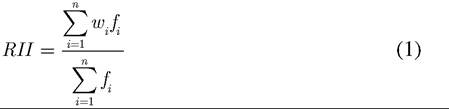
category index for the cause and effect factors. The relative importance index (RII) for each factor was calculated using the frequency data for each response category generated from SPSS. The RII is the calculation of the mean frequency of each response category index for the probability and impact. It can be calculated
RESULTS AND DISCUSSION
Causes of Delay
Forty two causes of delay were identified and grouped into 5 sets, namely,
1. Contractors,
2. Consultants,
3. Project managers,
4. Clients, and
5. Financial and other external factors respectively.
where f is the frequency of the ith response, and w is the weight assigned to the ith response.
Spearman rank correlation coefficient r was also used to determine the strength of the relationship between the consultants and project managers’ ranking for various factors. It is a measure of correlation between two series using the ranks rather than the actual values (Kottegoda, 1997; Coakes et al., 2009). It can be calculated as:
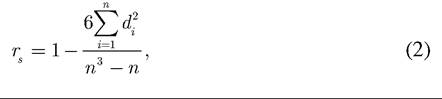
where di is the difference in ranking between consultants and project managers ith. The higher the value of r approaching 1 or -1, the stronger the association between the two sets of ranking (Odeh & Battaineh, 2002).
The top fifteen factors are summarized in Table 3.
Table 3. Topfifteenfactors based on all responses
| Factor Description | RII | Rank |
| Change orders | 4.265 | 1 |
| Lack of capability of client representative | 4.191 | 2 |
| Slow decision making by client | 4.182 | 3 |
| Lack of experience of client in construction | 4.135 | 4 |
| Poor site management & supervision | 4.130 | 5 |
| Incompetent project team | 4.110 | 6 |
| Inflation/prices fluctuation | 4.075 | 7 |
| Inaccurate time estimating | 4.042 | 8 |
| Late delivery of materials | 4.025 | 9 |
| Improper project planning/scheduling | 4.022 | 10 |
| Inaccurate cost estimating | 4.020 | 11 |
| High interest rate | 3.995 | 12 |
| Client’s financial difficulties | 3.987 | 13 |
| Unreasonable constraint to client | 3.982 | 14 |
| Inappropriate construction methods | 3.950 | 15 |
Contractors' Factors
Sixteen contractor-related, frequent causes of delay were identified; two of these causes are among the top fifteen factors included in Table
3. Late delivery of materials was ranked ninth, and inappropriate construction methods was ranked fifteenth. Contractors have to ensure that all resources such as materials are available throughout the project, whenever needed. Accurate time estimations of materials delivery require accurate project information, in terms of quality of information, and information flow, availability and supply of resources.
Consultants and Project Managers' Factors
The consultant and project Manager factors were not included among the list of the top fifteen factors as shown in the Table 3. On the other hand, it is worth noting that the consultants and the project managers put special emphasis on the time and cost estimation, which appeared in the top list to occupy the 11th and 15th rank, respectively. In addition, both the consultants and project managers contribute, to some extent, to other factors including poor site management and supervision, improper project planning and scheduling, incompetent project teams, and inappropriate construction methods.
Clients' Factors
The most important client-related causes of delay are change orders, lack of capability of client representative, slow decision making by the client, and lack of experience of the client in construction. These causes are assuming the 1st to 4th ranks among the top list as shown in Table 3. Excessive change orders can cause significant disruption to project completion, as changes consequently causes changes in schedules, increase costs through rework and decrease labor efficiency.
Accurate time and estimations of materials delivery require accurate project information in terms of information quality and flow, availability and supply of resources. Although contractors are perceived to cause some inaccurate estimates, as discussed earlier, they are the ultimate party who produce estimates. It can be argued that the clients are largely responsible as the party that issues excessive change orders. Poor estimation and change management reflect a lack of efficient and effective project management.
Financial Factors
Five financial-related causes of delay were identified. Three of these factors, namely inflation and price fluctuations, high interest rates and client financial difficulties are in the list of the top fifteen as shown in Table 3. These results are expected, given the recent high escalation of prices of steel and cement, the current credit crunch and the related economic crisis in Dubai.
External Factors
This group of causes is ranked low by consultants and project managers, and. none of these factors are among the top fifteen factors (Table 3). Problems with neighbors are not considered a serious cause of delay as it seems that affected people near sites are usually well informed about projects and satisfactory compensation is offered for their properties. Besides, environmental and social impact assessments are carried out fairly, when necessary, in the UAE. These will ensure that projects run smoothly without interruptions during the construction phases.
Conformity between Consultants and Project Managers’ Rankings
A further analysis has been done to find out the conformity between consultants and project managers, by using the Spearman rank correlation coefficient (Equation 2). This coefficient was found to be 0.918, indicating a strong conformity between consultants and project managers for the ranking of the causes of delays.
Effects of Delays
Six potential effects of delay have been identified as shown in Table 4. Time and cost overrun are the two most important effects of delays, ranked first and second respectively, by both consultants and project managers (see Figure 2). These results are in strong agreement with the results of important causes of delay. Out of the top causes of delay (see Figure 1), there are at least five factors that cause the effects of time overrun, including change orders, slow decision making by the client, and lack of capability of the client representative, construction financial difficulties and late delivery of materials. There are at least five factors that can result in cost overrun, including inaccurate cost and time estimations, poor site management, an incompetent project team, and improper project planning and scheduling. These results are also consistent with other published work related to other developing countries, e.g. Aibinu and Jag- boro (2002) in Nigeria, and Wiguna and Scott (2005) in Indonesia.
A Comparative Study
A similar study has been carried out for the construction industry in the UAE (Faridi & El-Sayegh, 2006). We have summarized, in Table 5, the rank order of the top 15 causes of delay in both the current work and their 2006 study. Ten of the top 15 factors were also reported in the 2006 study. Apart from lack of capability of the client representative, ranked 2nd in both studies, the ranking order of all other common factors changed.
Table 4. Ranking order of Effects of delay
| Rank | Effect Description | RII | ||
| Consultants | Project Manager | Overall | ||
| 1 | Time Overrun | 4.160 | 3.750 | 3.960 |
| 2 | Cost Overrun | 3.830 | 3.370 | 3.600 |
| 3 | Dispute | 2.420 | 2.750 | 2.585 |
| 4 | Arbitration | 2.200 | 2.500 | 2.350 |
| 5 | Litigation | 1.900 | 2.000 | 1.950 |
| 6 | Total Abandonment | 2.250 | 0.917 | 1.584 |
Figure 2. Effects of delay
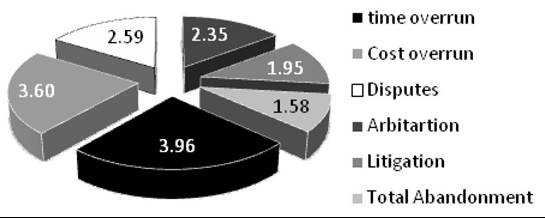
Figure 1. Top fifteen causes of construction project delay in the UAE
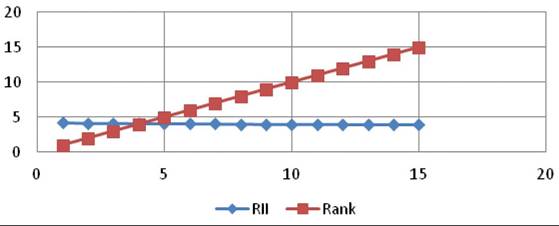
Table 5. Ranking comparison between 2011 and 2006 of top causes of delay in UAE
| Factor Description | 2010 Rank | 2006 Rank | Rank Change |
| Change orders | 1 | 27 | -26 |
| Lack of capability of client representative | 2 | 2 | 0 |
| Slow decision making by client | 3 | --- | Not applicable |
| Lack of experience of client in construction | 4 | --- | Not applicable |
| Poor site management & supervision | 5 | 19 | -14 |
| Incompetent project team | 6 | 12 | -6 |
| Inflation/prices fluctuation | 7 | --- | Not applicable |
| Inaccurate time estimating | 8 | --- | Not applicable |
| Late delivery of materials | 9 | 6 | +3 |
| Improper project planning/scheduling | 10 | 23 | -13 |
| Inaccurate cost estimating | 11 | 8 | +3 |
| High interest rate | 12 | --- | --- |
| Client’s financial difficulties | 13 | 10 | +3 |
| Unreasonable constraint to client | 14 | 17 | -3 |
| Inappropriate construction methods | 15 | 7 | +8 |
The ‘change orders’ factor has moved considerably, from 27th place to become the most important factor. This is followed by poor site management & supervision, and improper project planning/scheduling which moved up 14 and 13 places to be the top 5th and 10th, respectively. An incompetent project team moved up six places to be the top 6th factor. Inappropriate construction methods, however, moved down the list 8 places. The remaining 4 factors moved up/down by 3 places.
Interviews
In addition, typical interview results have shown that:
1. Two governmental consultants, with more than 30 years experience, explored the importance of proper classifications and categorizations of consultants based on past learning knowledge. However, they have initiated some research ideas to recover managerial defects, but validation is required for UAE construction project performance. They added. Moreover, this will assist public sector projects to evaluate the knowledge, experience, efficiency and past performance of other stakeholders (consultants, contractors and developers etc.).
2. Two consultants, from the private sector, agreed on the significant forecasting budget considering the excessive change orders/ variations by clients, as well as its effect on time and cost. It is argued that the insufficient monthly payments have affected the flexibility of the project progress recently.
3. One project manager criticized the lack of co-related technical financial details. He added, full stakeholder’s knowledge can prevent the unexpected delay and help clients in faster decision making.
4. Another consultant, with 25 years experience, criticized the pre-matured project culture that disturbs any scientific pattern searching of risk control approaches; he said “a very important point is that a positive percentage of prequalified or interested users, who apply the same approach, does not exceed 5%.”
5. Two consultants from the architecture and value chain built environment sections agreed on the project complexity due to pre-bidding analysis, so the critical mission appears in the contract management.
6. Another project manager criticized the recent client attitude towards project slow down completion by getting rid of some of the workforce and this left few posts in the recent financial crisis.
7. All interviewees agreed that proper knowledge tools and financial methods to face a crisis could lead to improvement of project performance, to be noticed that 20% of them did not recognize the difference between financial risk management and procurement.
CONCLUSION AND THE WAY FORWARD
The objective of the research work that underpins this paper was to investigate the causes and effects of construct project delays in the UAE. Data has been collected through interviews and a pilot questionnaire distributed to a group of experts working in local consulting, project management and contracting companies operating in the UAE.
Forty two potential causes of construction proj - ect delays have been identified and categorized into contractor, consultant, project managers, client, financial, and external categories. The significance of these factors has been investigated using the relative importance index method. Fifteen top causes include six client-related factors, four proj - ect manager-related factors, three financial factors, and two contractor-related factors. Client-related, project managers and financial factors seem to be the most significant causes of delay. These results are in general agreement with published previous studies in the UAE.
This exploratory study has highlighted a view of the many distress projects in the UAE and particularly in Dubai, in the financial crisis, the trade press have recently detailed how the UAE has been severely affected by the global economic downturn with reports of many project delays, and this may add the factor of the risk of financial crisis to the list of factors, although it has not yet been fully investigated.
The effects of construction delay have also been investigated. Time and cost overrun have been found to be the two most important effects. This is in strong agreement with the identified significant causes of delay. So, it is only a matter of time before the stakeholders begin to avail themselves of the phenomenon described above. However, some of the results are surprising and have implications regarding additional measures of project success, the need for knowledge management training for clients, and their representatives, but also project managers and their teams in risk management innovation.
Further future work could include conducting a well-grounded survey of construction delays analysis in the UAE to triangulate the initial approach adopted in these research findings and provide direction for IT project managers to adopt advanced techniques for project delay control. In addition, the effects of information flow between the organization levels, the importance of professional project management programmes and skills development. Accuracy of procedures and record keeping will also become indispensable, by the next decade, for IT project managers.
The problem of project control can be summarized as controlling additional measures to prevent delay, such as developing stakeholder knowledge management, as this may formulate good dependencies of relationship and interaction, rather than depending on the traditional success criteria; and predicting changes in the early stages can minimize the disruptive/risk effects. Moreover, to save time and help the project team in decision making, developing the project performance and confirming stakeholders’ expectations.
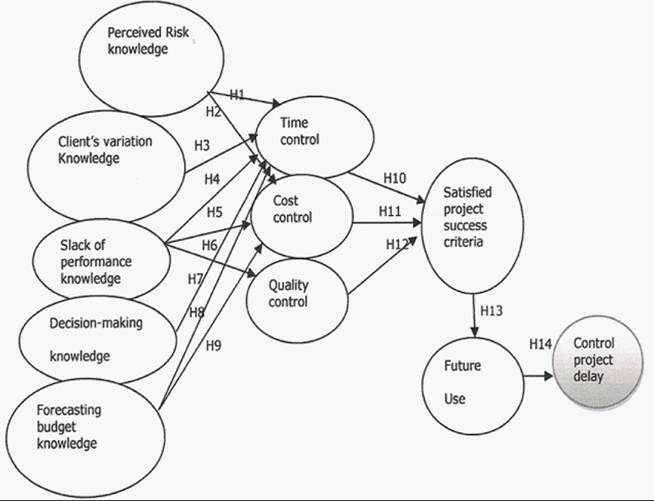
In a way of validating variables/measures in a proposed conceptual framework to control the delays, hypotheses are set in Figure 3 to resolve the great percentage of a problem related to poor knowledge of stakeholders in the preconstruction stage. Noticeably, the majority of the interviewees insisted on significant and proper knowledge management to control the risk of delay, rather than depending on local management tools only.
Figure 3. Determinant of control construction project delay in terms of specific Hypotheses (H)
There is a positive relationship between: perceived knowledge of risk in the earlier stage of construction and time (H1), perceived knowledge of risk in the earlier stage of construction and cost control (H2), appropriate client's knowledge in variations and time control at early stage (H3), there is a negative relationship between: slack of performance and time control (H4), slack of performance and cost control (H5), slack of performance and quality control (H6). There is a positive relationship between: stakeholders' decision-making (Client, contractor, developers, and governmental processor) and time control (H7). There is a negative relationship between: lack offorecasting budget knowledge and time control (H8), lack offorecasting budget knowledge and cost control (H9). There is a positive relationship between: the time control and project success criteria (H10), the time control and project success criteria (H11), the time control and project success criteria (H12), the satisfied project success criteria and time future use (H13), the future use of the success criteria and control delay (H14).
Limitations of the study are the sample size and the methodology adopted. Therefore, due to the small number of responses, further, more extensive studies are required to support the above findings.
REFERENCES
Abdel-Razek, M. E., Bassioni, H. A., & Mobarak, A. M. (2008). Causes in building construction projects in Egypt. Journal of Construction Engineering and Management, 134(11), 831-841. doi:10.1061/ (ASCE)0733-9364(2008)134:11(831)
Abdul-Rahman, H., Berawi, M. A., Berawi, A. R., Mohamed, O., Othman, M., & Yahya, I. (2006). Delay mitigation in the Malaysian construction. Industry Journal Construction Engineering and Management, 132(2), 125-133. doi:10.1061/ (ASCE)0733-9364(2006)132:2(125)
Abdul-Rahman, H., Takim, R., & Min, W. (2009). Financial-related causes contributing to project delays. Journal of Retail & Leisure Property, 8(3), 225-238. doi:10.1057/rlp.2009.11
Abu Dhabi Chamber of Commerce. (2009). Retrieved May10, 2011, from http://www.abud- habichamber.ae/
Acharya, N., Lee, Y., Kim, S. Y., & Kim, S. M. (2005). Delay in building construction projects in developing countries: A case study of Nepal. Journal of the Korean Society of Maintenance Engineers, 10(3), 81-95.
Ahmed, S., Azhar, S., Kappagantula, P., & Golla- pudi, D. (2003). Delays in construction: A brief study of the Florida construction industry. In ASC Proceeding of the 39th Annual Conference, Clemson University, Clemson, SC (pp. 257-266). Aibinu, A., & Jagboro, G. (2002). The effects of construction delays on project delivery in Nigerian construction industry. International Journal of Project Management, 20(3), 593-599. doi:10.1016/S0263-7863(02)00028-5
Aibinu, A., & Odeyinka, H. A. (2006). Construction delays and their causative factors in Nigeria. Journal of Construction and Management, 132(7), 667-677. doi:10.1061/(ASCE)0733- 9364(2006)132:7(667)
Al-Momani, A. (2000). Construction delay: A quantitative analysis. International Journal of Project Management, 18(1), 51-59. doi:10.1016/ S0263-7863(98)00060-X
Al-Nuaimi, A., Taha, R., Mohsin, M., & Al-Harthi, A. (2010). Causes, effects, benefits, and remedies of change orders on public construction projects in Oman. Journal of Construction Engineering and Management, 136(5), 615-622. doi:10.1061/ (ASCE)CO.1943-7862.0000154
Alaghbari, W., Razali, M., & Salim, A., & Ernawati. (2007). The significant factors causing delay of building construction projects in Malaysia. Engineering, Construction, and Architectural Management, 14(2), 192-206. doi:10.1108/09699980710731308
Albino, V., Pontrandolfo, P., & Scozzi, B. (2002). Analysis of information flows to enhance the coordination of production processes. International Journal of Production Economics, 75(1-2), 7-19. doi:10.1016/S0925-5273(01)00177-3
APM. (2006). APM body of knowledge (5th ed.). ISBN-1-903494-25-7.
Arain, F. (2005). A framework for developing a knowledge-based decision supports system for management of variations order for institutional buildings. Retrieved July 29, 2011, from http:// www.itcon.org/data/works/att/2006_21.con- tent.04149.pdf
Arditi, D., & Pattanakitchamroon, T. (2006). Selecting a delay analysis method in resolving construction claims. International Journal of Project Management, 24, 145-155. doi: 10.1016/j. ijproman.2005.08.005
Asnaashari, S., Farahani, S., Hoseini, A., Knight, A., & Hurst, A. (2009, May). Causes of delay in Iran construction projects. In Proceedings of the 5th International Conference on Construction in the 21st Century (CITC-V), Istanbul, Turkey.
Assaf, S. A., & Al-Hejji, S. (2006). Causes of delay in large construction projects. International Journal of Project Management, 24(4), 349-357. doi:10.1016/j.ijproman.2005.11.010
Brendel, N., Barrette, A., & El-Riachi, W. (2010). The availability in the UAE of liens to secure payment under construction contracts. Arab Law Quarterly, 24, 309-317. doi:10.1163/157302510X504953
Choudhury, I., & Phatak, O. (2004, April). Correlates of time overrun in commercial construction. In ASC Proceedings of the 40th Annual Conference, Brigham Young University - Provo, Utah.
Coakes, S. J., Steed, L., & Price, J. (2009). SPSS version 15.0 for windows: Analysis without Anguish. John Wiley.
Elinwa, A., & Joshua, M. (2001). Time-overrun factors in Nigerian construction industry. Journal of Construction Engineering and Management, 127(5), 419-425. doi:10.1061/(ASCE)0733- 9364(2001)127:5(419)
Ellis, R., & Thomas, H. (2003). The root causes of delays in highway construction. In Proceedings of the 82nd Annual Meeting of the Transportation Research Board, Washington DC.
Elweshahy, M. (2008, September). Construction management guide. Retrieved April 20, 2011, from http://cmguide.org/archives/39
Enshassi, A., Al-Najjar, J., & Kumaraswamy, M. (2009). Delays and cost overruns in the construction projects in the Gaza Strip. Journal of Financial Management of Property and Construction, 14(2), 126-151. doi:10.1108/13664380910977592
Faridi, A. S., & El-Sayegh, S. M. (2006). Significant factors causing delay in the UAE construction industry. Construction Management and Economics, 24, 1 167-1176. doi:10.1080/01446190600827033
Fong, N. K., Wong, L. Y., & Wong, L. T. (2006). Fire services installation related contributors of construction delays. Building and Environment, 41,211-222. doi:10.1016/j.buildenv.2005.01.004
Frimpong, Y., Oluwoye, J., & Crawford, L. (2003). Causes of delay and cost overruns in construction of groundwater projects in developing Countries: Ghana as a case study. International Journal of Project Management, 21, 321-326. doi:10.1016/ S0263-7863(02)00055-8
Global Real State News Centre. (2009). Retrieved May15,2011from http://www.realestatechannel. com/international-markets/residential-real-estate/ dubai-construction-uae-real-estate-emil-rade- meyer-proleads-global-alma-kadragic-429.php
Kaliba, C., Muya, M., & Mumba, K. (2008). Cost escalation and schedule delays in road construction projects in Zambia. International Journal of Project Management, 127(5), 522-531.
Khoshgoftar, M., Abu Bakar, A., & Osman, O. (2010). Causes of delays in Iranian construction projects. The International Journal of Construction Management, 10(2), 53-69.
Kottegoda, N. T., & Rosso, R. (1997). Statistics, probability, and reliability for civil and environmental engineers. New York, NY: McGraw-Hill Company Inc.
Koushki, P., Parviz, A., & Kartam, N. (2004). Impact of construction materials on project time and cost in Kuwait. Engineering, Construction, and Architectural Management, 11(2), 126-132. doi:10.1108/09699980410527867
Koushki, P. A., Al-Rashid, K., & Kartam, N. (2005). Delays and cost increase in the construction of private Residential Projects in Kuwait. Construction Management and Economics, 23, 285-294. doi:10.1080/0144619042000326710
Long, L. H., Lee, Y. D., & Lee, J. Y. (2008). Delay and cost overruns in Vietnam large construction: A comparison with other selected countries. KSCE Journal of Civil Engineering, 12(6), 367-377. doi:10.1007/s12205-008-0367-7
Low, S., Pheng, L. J., Ying, & Tan, I. (2009). PSSCOC and causes of construction delays in Singapore and four selected Asian countries. International Construction Law Review, 26(3).
Majid, I. A. (2006). Causes and effects of delay in Aceh construction industry. Unpublished Master thesis, University Technology Malaysia.
Manavazhia, M. R., & Adhikarib, D. K. (2002). Material and equipment procurement delays in highway projects in Nepal. International Journal of Project Management, 20, 627-632. doi:10.1016/S0263-7863(02)00027-3
Menesi, W. (2007). Construction delays analysis under multiple baseline updates. Unpublished Master thesis, the University of Waterloo.
Morris, P. G. (1994). The management project. London, UK: Thomas Telford. doi:10.1680/ mop.16934
Motaleb, O. H. (2009). An investigation into the causes, effects and handling of construction delays in the United Arab Emirates. Unpublished Master thesis, the Robert Gordon University, Aberdeen. Noulmanee, A., Wachirathamrojn, J., Tantichat- tanont, P., & Sittivijan, P. (2000). Internal causes of delays in highway construction projects in Thailand. Compendex Abstract.
Odeh, A. M., & Battaineh, H. T. (2002). Causes of construction delay: Traditional contracts. International Journal of Project Management, 20, 67-73. doi:10.1016/S0263-7863(00)00037-5
Othman, A. (2006). Factors influencing the construction time of civil engineering projects in Malaysia. Engineering, Construction, and Architectural Management, 13(5), 481-501. doi:10.1108/09699980610690756
PMBOK. (2004). A guide to project management body of knowledge (4th ed.). Project Management Institute, Inc.
Sambasivan, M., & Soon, Y. W. (2007). Causes and effects of delays in Malaysian construction industry. International Journal of Project Management, 25(5), 517-526. doi:10.1016/j.ijpro- man.2006.11.007
Sun, M., Sexton, M., Aouad, G., Fleming, A., Senaratne, S., & Anumba, C.... Yeoh, M. (2004). Managing changes in construction projects. Retrieved April 14, from http://www.bne.uwe.ac.uk/ cprc/publications/mcd.pdf
Sweis, G., Sweis, R., Abu Hammad, A., & Shboul, A. (2008). Delays in construction projects: The case of Jordan. International Journal of Project Management, 26, 665-674. doi:10.1016/j.ijpro- man.2007.09.009
Theodore, J., William, A., Scott, J., Mark, F., & Brian, J. (2009). Construction delay (2nd ed.). Elsevier Butterworth-Heinemann.
Tumi, S., Omran, A., & Pakir, A. (2009, November). Causes of delay in construction industry in Libya. In Proceedings of the International Conference on Economics and Administration (ICEA- FAA), University of Bucharest, Romania.
United Nations Development Group. (2010, March). (1st Quarter). Iraq Trust Fund Proj- ect#66992: C10-08. Retrieved from http://www. unesco.org/fileadmin/MULTIMEDIA/FIELD/ Iraq/pdf/Reports/Quarterly/Fiche_C10-08_Sa- mara_Al_Askari_Shrine_1st_Quarter_2010.pdf
Wiguna, I. A., & Scott, S. (2005). Analyzing the risks affecting construction delay and cost overruns in Indonesia building projects. Innovation in Architecture, Engineering and Construction, 841-849.
World Bank Iraq Trust Fund Project. (2008, March). (1st Quarter). #: P 087907. Retrieved on January 20, 2011from http://siteresources. worldbank.org/IRFFI/Resources/ConsolidatedIT- FPSSwithpagenos.pdf
Yang, J., Yang, C., & Kao, C. (2010). Evaluating schedule delay causes for private participating public construction works under the Build-Operate- Transfer model. International Journal of Project Management, 28(6), 569-579. doi:10.1016/j. ijproman.2009.10.005
Zaneldin, E. (2006). Construction claims in United Arab Emirates: Types, causes, and frequency. International Journal of Project Management, 24(5), 453-459. doi:10.1016/j.ijproman.2006.02.006
This work was previously published in International Journal of Information Technology Project Management (IJITPM), 4(3); edited by John Wang, pages 50-65, copyright 2013 by IGI Publishing (an imprint of IGI Global).