Chapter 54 Enabling Factors for Knowledge Sharing among Employees in the Workplace
Temtim Assefa
Addis Ababa University, Ethiopia
Monica Garfield
Bentley University, USA
Million Meshesha
Addis Ababa University, Ethiopia
ABSTRACT
This chapter investigates enabling factors that promote knowledge sharing among employees in the workplace.
The study was conducted on employees of Commercial Bank of Ethiopia (CBE) as a research case. Banks in particular and financial institutions in general are now becoming knowledge intensive organizations where knowledge is used as a key strategic resource to achieve their business goals as well as competitive advantage. This study uses an exploratory case study research method that allows deeper understanding and interpretation. Although there is plenty of literature on knowledge sharing, existing findings are not consistent due to the influence of contextual factors on knowledge sharing. This study identifies organizational, individual, task characteristics, and technological factors as main enabling factors that promote knowledge sharing in the workplace. Although organizations put much emphasis on technology to promote knowledge sharing in the workplace, non-technological factors (organizational and individual factors) appear more significant. As the study was conducted on a commercial bank within developing economies context, it contributes additional perspectives to confirm or extend existing findings on knowledge sharing.DOI: 10.4018∕978-1-4666-6268-1.ch054
.
1. INTRODUCTION
Knowledge is an important tool to accomplish tasks in the work place. Knowledge sharing is the daily routine activities of employees in the work place whether the organization have clear procedure on knowledge sharing or not (Award and Ghaziri, 2007). Bartol and Srivastava (2002) defined knowledge sharing as individuals sharing of organizational relevant information, ideas, suggestions, and expertise with one another.
Through knowledge sharing, individual knowledge is converted into organizational knowledge so that it is used to create value for the organization. Knowledge is used to create new products and services and increase organizational profitability (see Award and Ghaziri, 2007; Kubo, Saka and Pam, 2001; Bock et al., 2005; Alhammad et at, 2009).Knowledge is not a tangible product which can be easily transferred from knowledge owners to knowledge seekers (Hendriks, 1999; Lin et al., 2012). Most of the organization's knowledge resides in the mind and body of employees who create, recognize, archive, access, and apply knowledge to carry out their tasks (Bock et al., 2005). Knowledge is a resource for employees through which they get power and other benefits in the organizations. Supervisors cannot oblige employees to share their knowledge (Lin et al., 2012). Organizations installed different IT systems so as to promote knowledge sharing among their employees (see Yang, 2008; Al-Ma’aitah, 2008; Gupta et al, 2008). However, such effort was not successful to achieve the expected result in knowledge sharing (see Yang, 2008; Jeon et al., 2011). Effective knowledge sharing mostly depends on the positive attitude of employees who possess the knowledge. However what factors best motivate employees to share knowledge are not well known issue despite the presence of ample literature on the topic (Alhammad et at, 2009, Burgess, 2005). We found also paradoxical findings among researchers (see Jones et al, 2006; Donate and Guadamillas, 2010; Ismail et al, 2007;
Alizadeh et al., 2011). This implies that further research is required to increase our understanding about enabling factors that promote knowledge sharing in the work place. The main purpose of this research is to increase our understanding about motivational factors for knowledge sharing in the workplace. Specifically the research has addressed the following research questions
• Why employees seek knowledge from other sources?
• What factors motivate employees to share knowledge in the workplace?
The result of the research will help practitioners what interventions to undertake in their organization to create a knowledge sharing culture and develop a successful knowledge management system.
Such local research will have also a theoretical contribution to extend existing knowledge sharing theory across different socio-economic contexts.2. LITERATURE REVIEW
Knowledge as a resource has a variety of benefits for the organization. It is one of the main inputs in the production process as well as in the service delivery (Grant, 1996; Lin, 2007). It helps organizations to improve the quality of services, innovate new products, reduce operational costs, improve relationships with customers and suppliers and easily adapt to the changing environments (Kharabsheh, 2007; S aenz, Aramburu and Rivera, 2009; Gold et al., 2001). Organizations can create value from knowledge when they can integrate knowledge held by individuals (Grant, 1996). Unused stock of knowledge is not considered as a resource (Grant, 1996; Blair, 2002). Organizations which can create, capture, organize, share and use knowledge have increased capability to survive in the market. They have also a better chance to excel beyond their competitors in the long term (De Long and Fahey, 2000; Curadoand
Bontis, 2011). Generally the resource based view of knowledge implies that increasing existing stocks of knowledge and employees capability to share and use knowledge will create business value (Yang, 2010; Saenz et al., 2009).
2.1. Knowledge Management (KM)
Knowledge management is defined as an activity that deals with creating, capturing, storing, processing and dissemination of knowledge in the organization (see Alavi and Leidner, 2001; Gupta et al, 2008). Knowledge creation refers to the acquisition of new insights and ideas in the process of problem solving by individuals in the organization (Nonaka et al, 2000). It is created by integrating existing stock of knowledge in the organization or acquiring new knowledge outside the organization (Grant, 1996). Knowledge capturing refers to the identification of new and useful knowledge in the organization. An organization has abundant knowledge held by its members.
All knowledge may not be useful for the organization with regard to its objectives. Knowledge capturing includes identification and validation of knowledge that is critical to the business processes. Knowledge storage deals with preservation of existing knowledge in such a way that it can be easily accessible by all members of the organization (Oshri, 2008). Once knowledge is stored in the centralized database, it can be easily accessible by anyone in the organization. This will help the organization to avoid unnecessary efforts to collect and manage redundant information and knowledge (Tseng and Lin, 2008) and increases organizational innovation capability (Gold et al., 2001).Knowledge dissemination is communication of knowledge in the knowledge repository to potential users (see Lee and Al-Hawamdeh, 2002; Hendriks, 1999; Gold et al., 2001). Unless knowledge is communicated and applied, having an avalanche of knowledge in a knowledge repository is not considered as a resource (Grant, 1996; Bliar, 2002). Organizations promote knowledge dissemination by installing intranet, creating Expert profiles and indexes (Oshri, 2008). The purpose of knowledge storage and dissemination is to encourage knowledge reuse. It has many benefits for the organizations ranging from cost and time saving to minimization of risks in new product development (Oshri, 2008). The last cycle of knowledge is application. It refers to using knowledge to execute tasks. During application, new business value can be generated. At the same time, new knowledge can be created through the process of applying new knowledge; individuals adapt it to their context and include their personal judgments (Oshri, 2008; Nonaka, 1994). Knowledge management activities can be seen as a cyclic process. All knowledge management activities are systematically managed by the organization to exploit the benefit of knowledge to the organization. One activity is not important without the other nor is it substitutable for the other.
2.2. Knowledge Management and Financial Institutions
Banks represent a major component of the country’s financial system and play a key role in enhancing the overall economic growth of the country (Allen & Carletti, 2008; Worku, 2010). They mobilize savings from lenders and ensure availability of funds for investment. Banks fill the information gap between lenders and borrowers by developing an efficient information system to run their business. The efficiency of the financial system of a country has a direct impact on the country’s economic growth (Allen & Carletti, 2008). The banking industry in Ethiopia is at a lower level even as compared to some other African countries (Kapur & Gualu, 2012; Worku, 2010). There are no international banks operating in the country due to the fear that they will weaken the domestic banks.
Established in 1942, CBE is the oldest bank in Ethiopia (CBE, 2011). It has more than 500 branches stretched across the country. As of June 30th 2011, it had total deposits of birr 86.5 billion, about 2 million account holders and more than 8,000 employees. CBE has been growing at a fast rate since the last two years. For example, the number of branches has increased from 402 in September 10, 2011 to 516 in March 15, 2012 (an 8% growth in branches within six months) (CBE, 2012). This fast growth is due to the Ethiopian government’s initiation to extend banking services to all population groups in the county and to speed up the country’s economic growth. CBE is larger than all other banks taken together in Ethiopia with service coverage of more than 70% (CBE, 2012).
CBE has a vision to be a world class bank by the year 2025. Since April 30, 2012, the Bank has introduced a core banking system that allows the Bank to provide online banking services throughout all of its branches. The new system allows its customers to get service from any branches in the country. The Bank also started Internet banking that allows customers to check their balances, transaction details, money transfer and view checking details from their desktop computer without having to visit a CBE’s branch.
The use of the core banking system helps the Bank to capture more digital information and manage more complex systems. This again requires the Bank to use its knowledge resources more extensively than before. KMS has now become an important tool for banking business. The Governor of Bank Negara Malaysia also pointed out during the official launch of “Towards a Knowledge-Based Organization” program in October 2000:If we are to be a central bank, Withfarsightedness and an ability to face new challenges, we need to be equipped with the expertise and the means to implement appropriate policies, and have confidence in our actions. An important component of this future is that the Bank must fully embrace and employ the principles of knowledge management. Whilst the principal objectives of the central bank remain unchanged, the new knowledge management strategies refocus the Bank’s policies and practices in managing knowledge as a key corporate asset, and in leveraging and exploiting knowledge to better achieve these objectives (cited in Ali & Ahmad, 2006, pp. 2-3).
The reason why knowledge is a strategic resource for financial institutions is that the world economies became more globalized and the use of IT in organizations became ubiquitous. “The velocity and dynamic nature of the new marketplace has created a competitive incentive among many companies to consolidate and reconcile their knowledge assets as a means of creating value that is sustainable over time” (Gold, Malhotra and Segars, 2001, p. 186). Customers’ needs frequently changed due to easy access to new services. New technologies come quickly to the market that gives better competitive advantage to adopting organizations. Employee turnover is high due to fast information access for better jobs. Organizations also generate more knowledge than before due to easy access to external knowledge and use of IT tools to capture, store and process information (Ali & Ahmad, 2006). The traditional resources of labour and capital are not adequate to operate competitive in this highly volatile business environment (Chuang, 2004; Lin, Wub and Lu, 2012). Knowledge has become one of the strategic resources to achieve sustainable competitive advantage (Grant, 1996). Every organization has a unique knowledge and the ability to integrate and apply knowledge has become a key factor of differentiation for competition (Gold et al., 2001; Grant, 1996). Furthermore, knowledge is a resource whose value increases as more people use it unlike other physical assets (Cabrera & Cabrera, 2002).
2.3. Knowledge Sharing
Knowledge sharing is a part of any organization’s activity whether they have clear procedures on knowledge sharing or not (Award and Ghaziri, 2007). It is also the core activity of KMS. Knowledge sharing is basically the act of making knowledge available to others within the organization (Ipe, 2003, p.341). It is a deliberate act in which knowledge is presented in a way to be understood and absorbed by the recipient through the whole departments and organization (Hendriks, 1999; Lin, 2007). It is an exchange of organizationally relevant information, ideas, suggestions, and expertise with one another (Bartol & Srivastava, 2002). Hendriks (1999) also elaborates knowledge sharing as a process of knowledge externaliza- tion and internalization. Externalization refers to making the hidden tacit knowledge visible to others in the form of framed information by way of demonstration, codification and verbalization. Internalization is the process of assimilation of received information into new knowledge by way of rehearsal and practical actions (Nonaka, 1994; Hendriks, 1999).
A key issue in knowledge sharing is the presentation of knowledge in a way absorbable by the recipient (Ipe, 2003) and the recipient’s readiness to internalize the new information. Successful knowledge sharing is not a one way process; it is a two way dialog which involves active participation of the source and the recipient during the interaction. People who are willing to share their knowledge do not dump information but they put themselves in the seeker’s position to understand the problem and frame their knowledge in a way useful to the problem and assist construction of new knowledge by the recipient (Hendriks, 1999). Knowledge sharing results in joint ownership of the shared knowledge and is different from other material exchanges which results in the transfer of ownership (Ipe, 2003). The more people owned the same knowledge, the more opportunity is created to apply the knowledge (Cabrera & Cabrera, 2002). Knowledge sharing exists at individual as well as at organizational level. Individual level knowledge sharing involves direct sharing of knowledge through face to face interaction while organizational level knowledge sharing involves capturing, storing and making knowledge available to all members of the organization (Lin, 2007). Knowledge sharing is a process through which employees learn to acquire new skills and capability (see Gold et al., 2001; Nonak, 1994; Grant, 1996).
2.4. Enabling Factors for Knowledge Sharing
Knowledge is not a tangible product which can be easily transferred from knowledge owners to knowledge seekers (Hendriks, 1999; Lin et al., 2012). Researchers identified a list of social, organizational and technological factors that promote knowledge sharing (e.g. Ipe, 2003; Bartol & Srivastava, 2002; Lin et al., 2011; Jeon, Kim and Koh, 2011). However, knowledge sharing is still a challenging task for many organizations (see Jeon et al., 2011; Lin et al., 2012; Alizadeh, Miandashti and Fami, 2011; Burgess, 2005). Factors that promote or hinder knowledge sharing are highly dependent on its contextual factors (Jones, Cline and Ryan, 2006; Lin et al., 2012). A factor which is identified as a favorable condition in one context may not be directly replicable. For example, Alizadeh et al., (2011) identified weak association between organizational culture, ICT infrastructure and structure in the one hand and knowledge sharing on the other. However, other researchers found a strong relationship (see Jones et al, 2006; Donate and Guadamillas, 2010; Ismail et al, 2007). These paradoxical findings create confusion among practitioners what strategies to use so as to encourage their employees to effectively share knowledge. King (2008) also mentioned that the issue of identifying the best motivational factors for knowledge sharing is not yet resolved agenda even worldwide. This implies we need more empirical case study researches across different contexts to better understand knowledge sharing in the workplace (Bechina and Bommen, 2006). Knowledge sharing is also an important factor that predicts the success of organizational knowledge management system.
Most of the studies conducted on knowledge sharing uses quantitative research method which is not appropriate to understand the complex phenomena of knowledge sharing. This research will also contribute our understanding of knowledge sharing by applying a qualitative research method which is appropriate to understanding complex social constructs.
3. RESEARCH METHOD
An exploratory case study research method was used for this research. Its main intent was to gain new insights, findings and interpretations, in order to extend existing theories (Yin, 2003). Knowledge sharing is a social construct (Nonaka, 1984) which requires deep investigation from multiple perspectives (see Miles and Huberman, 1994; Yin, 2003). Knowledge sharing enabling factors among employees in developing economies (such as Ethiopia) has not been well studied so far, and the case study research method is an appropriate method to study this little known phenomenon. It is also very difficult to make a demarcation between knowledge sharing barriers and other contextual organizational variables. They are highly intertwined. Other researchers have also used the case study research method to address problems in knowledge sharing research (see Jonsson, 2007; Kubo, Saka & Pan, 2001; Azudin, Ismail & Taherali, 2009).
The data collection instrument was developed iteratively over the course of the research process. We began by asking one question: “What are the factors enabling knowledge sharing among employees in CBE?” Based on the responses of the first few respondents’ additional questions were included in the interview check lists. The interview questions were open ended and addressed individual, organizational and technological factors that act as knowledge sharing barriers in the work place. Data was collected from March 2011 to September 2011 from employees in CBE using multiple data collection methods including: interview, observation and document review. Later additional data was collected based on the information gap identified during data analysis. Respondents were purposively selected from different directorates of the Bank (see Table 1). All respondents were University graduates with different years of work experience in the Bank.
Although most of respondents are male, female respondents were also included in the interview. All interviews were recorded and the interviews took place in one of Ethiopia’s native languages (Amharic). Each interview was transcribed and translated in English by the first author. The translated versions on the interviews were validated by some of the respondents to check if there was any misinterpretation in the translation process. We found positive agreement from our respondents.
Data analysis was carried out using a qualitative data reduction method. The raw data was entered into NVIVO version 9 software. The main use of the software was to organize and store the data. It is a good tool to maintain the case database which increases the trustworthiness of the research findings (Eisenhardt, 1998). We
Table 1. Composition of respondents by department and demographic characteristics
| Directorates | Male | Female | Total Respondents |
| Customer and Accounts Transaction Service (CATS) | 7 | 0 | 7 |
| Credit Directorate | 6 | 3 | 9 |
| System Development and Application Customization (SDACD) | 4 | 1 | 5 |
| Applications Systems and Infrastructure Support (SIS) | 2 | 0 | 2 |
| Research and Development (R&D) | 4 | 0 | 4 |
| Corporate Communication | 3 | 1 | 4 |
| Human Resource Development (HRD) | 3 | 1 | 4 |
| Total | 29 | 6 | 35 |
used open coding methods (Singh & Kant, 2008) to identify concepts, categories and themes. The researchers interactively read the raw data to classify interview chunks into concepts, categories and themes. Relationships between categories were identified by assessing repetition of texts in different categories, causal relationships, and doing cross tabulation using NVIVO software. We also used NVIVO software to count the frequency of respondents for each category. This was used as one method to weigh the relative importance of one factor from other. Analytical generalizations were made by comparing empirical patterns with previous research findings to expand existing knowledge sharing theories (Yin, 2003).
4. RESEARCH RESULTS ON KNOWLEDGE SHARING IN THE WORKPLACE
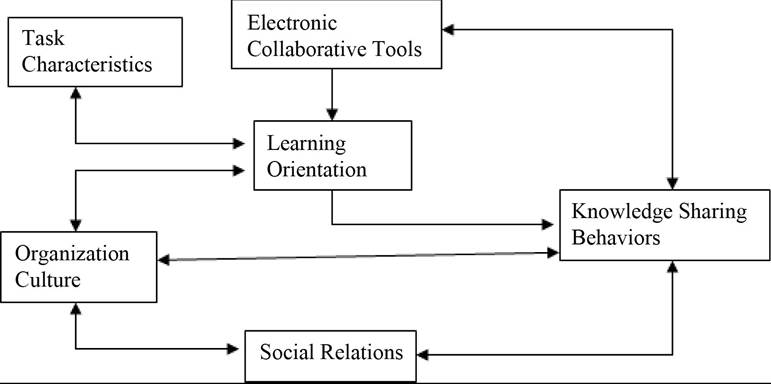
The empirical data collected through open ended interviews, observation and organization documents were stored in NVIVO Software as case database. After we organized our data into concepts, categories and themes, we found task characteristics, organization culture, social relations, learning orientations and social networking tools as factors that promote knowledge sharing in the workplace (See Figure 1). In the work place context, knowledge is a resource that helps employees to perform tasks and achieve goals (Grant, 1996; Kharabsheh, 2007). In other words, one has to own the required task knowledge to perform a standard job set out by the organization. Knowledge sharing is initiated when there is a knowledge need by one party and willingness to share by the other party. Our theoretical model includes both factors that initiate knowledge seeking and knowledge sharing.
4.1. Learning Orientation
Learning is defined here as an increase or change in knowledge or skill that occurs as a result of some experience (Maurer, 2002, p. 14). Learning orientation refers to employee’s intention to acquire new knowledge to increase their capability in the task. Deshon and Gillespie (2005) described learning orientation as employees’ intention to learn new skills and increasing their competence and abilities. As knowledge gives a competitive advantage for the organization, it also provides the same benefit for the individual employee. It is an important tool employees should possess to act competitively in the organization. Every organization has a unique knowledge that is acquired from experience and this knowledge is a key resource for employees to achieve its organization business objectives. Knowledge acquired from colleges and universities is not sufficient to do tasks in a specific organization. In fact, education helps to acquire background knowledge that helps to quickly learn on the task. Most of the knowledge required for the task in CBE is acquired by working on the task after employees joined the Bank (Kubo et al., 2001). Employees not only perform organization tasks but also learn organization knowledge as their regular duty. As the System Analyst mentioned with regard to on the job learning:
Figure 1. Enabling factors for knowledge sharing in the workplace
We learn for our own purpose. It is important for our existence. If I don’t know, I will not exist in the Bank.
Lack of experience is the main factor that motivates employees to acquire new knowledge and skills from other employees. CBE also recognized lack of experience as the main knowledge gap creators and organizes different knowledge sharing strategies (like training) to promote knowledge sharing from seniors to junior employees (Kubo et al, 2001).
Learning orientation requires commitment to acquire new knowledge and skills (Kharabsheh, 2007). Employees with high learning orientation do not satisfy by reusing existing knowledge to perform their tasks. They strive to get new knowledge to improve their competency and appear knowledgeable expert in the Bank. As the Credit Analyst explained:
The Bank has a standard guideline how one loan is processed. You do your task by that guideline. However, the Bank is dynamic, some other day, those guidelines have limitations. In order to improve those guidelines, I have to learn from different sources.
Commitment for learning has a benefit not only for the employee himself but also for the Bank. Being knowledgeable expert in the Bank, employees may have a chance to get better position and recognition by other colleagues in the Bank. They also change the image of the Bank to be competitive organization in the market. As most of the organization knowledge is created and used by employees, knowledgeable employees contribute new knowledge that expands existing stock of Bank knowledge (Ipe, 2003). Other researchers also confirmed learning orientation as one of the factors that increases employees’ interaction for knowledge sharing (Ipe, 2003; Kharabsheh, 2007; Maurer, 2002; Thompson, 2012).
4.2. Social Relations
Knowledge sharing is affected by the relationship between knowledge owners and knowledge seekers. Unless there is a good social relationship, knowledge owners will not share their valuable knowledge to other colleagues (Chow and Chan, 2008; He, Qiao, and Wei, 2009). Social relationship is very important to share tacit knowledge which is highly sticky with the knowledge owners and require more effort to share knowledge to other colleagues (He et al., 2009). The main social factors identified that affect knowledge sharing are helping others, reciprocity, interpersonal trust and social recognition. These factors are conceptualized as social relations in this literature. Social relation is defined as the level of trust, reciprocity, openness and shared norms among interacting actors (see Chow & Chan, 2008; Nahapiet & Ghoshal, 1998).
4.2.1. Reciprocity
Reciprocity is the main external driving force for knowledge sharing. When people share their knowledge, they also expect reciprocal benefit since knowledge sharing requires time and loss of exclusive ownership of the knowledge. Reciprocal benefit offsets this cost. One of frequently cited reciprocity in the CBE for sharing knowledge is to distribute task responsibility. As the Customer Service Manager mentioned:
You are working in one home. Unless you share your knowledge, everybody comes to you and you cannot work.
The Bank is risk averse organizations. Employees also do not do tasks by trial and error methods unless they are confident enough to handle the task. This implies that employees who are knowledgeable and hoard knowledge are expected to do more work in order to avoid errors by less capable employees. Therefore employees are encouraged to share their knowledge due to the immediate reciprocal benefit of sharing their task burden.
Knowledge sharing has also a reciprocal benefit of deepening one’s personal knowledge. When employees are asked, they think critically to present their knowledge in a way understandable to other colleagues. Even they do not know the response, they are motivated to further read or ask other colleague to know the requested knowledge and learn more from the interaction. As a Junior Customer Officer explained:
When I answer my colleagues’ questions, it helps me to know that knowledge deeper. IfI don ,t know it, I ask other person and I update my knowledge.
Sharing knowledge in the workplace also helps to get social recognition by other employees and promotion by the Bank. As the Credit Analyst confirmed:
Ifyou share knowledge, you can be seen as reference and recognized in the Bank. You may also get promotion.
When you share knowledge, it also creates a good work environment. Employees mentioned that if you share today, you will also get similar support when you face problem. This finding is also supported by other empirical researches (see Cropanzano and Mitchell, 2005; Ipe, 2003; Jeon et al., 2011; Bock et al, 2005)
4.2.2. Helping Others
Intrinsic motivation is stronger than extrinsic motivation as it is not contingent with external factors (Gagne, 2009). Extrinsic motivation creates a competitive environment and people may develop a knowledge hoarding habit to get more rewards. With regard to intrinsic motivation, it is the internal desire and satisfaction that motivates people to share their knowledge. The presence of shared vision among employees is one of the factors that create intrinsic motivation. As a Customer Service Manager explained:
I have to brief my junior employees how to do their task in detail. - What is to be debited and credited? I tell them step by step. We are working in one home.
The HRD Officer also mentioned similar view:
Sharing your knowledge is generally the human characteristics. You get internal satisfaction.
Other researchers also found similar finding with regard to the positive association between helping others and knowledge sharing (Chow & Chan, 2008; Nahapiet & Ghoshal, 1998).
4.2.3. Interpersonal Trust
Trust is an important factor for knowledge sharing (He et al., 2009; Kubo et al., 2001). Trust is the extent to which you believe in the good intent, competence, and reliability of others (He et al., 2009, p. 177). It also includes psychological and emotional bonds (Kubo et al., 2001). Trust also creates a favorable work environment where employees freely express their ideas and share their experiences. As Credit Manager explained:
There is a check and balance in the Bank. There are supervisor and auditor who check your work. On top of that, supporting each other makes our relationship stronger.
A Customer Service Manager also confirmed similar view:
There is an existing culture that we inherit from our seniors. It is not a simple thing. We transact such huge amount of money and we trust each other. That trust strengthens our relationship. We are working together. We drink together.
Although the Bank has good standard procedure manual, it is through interpersonal interaction employees get most of the knowledge they need from their colleagues.
Frequent interaction is the base for development of trust through which one party knows the intention of other actor. CBE organizes different forums that promotes interaction among employees and consequently builds interpersonal trust. Fluid task description within the department, training, mentoring and open office architecture are the main practices that build interpersonal trust among employees (see Kubo et al 2001; Chee-Yang Fong2011; Cabrera & Cabrera, 2005). The Bank task is risky. If one of the colleagues makes a mistake, others are also responsible for the mistake. This encourages employees to work collaboratively and openly share their knowledge. One cannot hoard knowledge to be exclusive person in the Bank. The Bank wants generalist professionals who have broader knowledge base and can handle different cases to assist customers in one contact point. Knowledge is not used as a criterion in performance appraisal to get promotion or other incentives. Other empirical research also found similar finding (see Kubo et al 2001; He et al., 2009; Chen and Cheng, 2011).
4.3. Organizational Culture
Organizational culture is the shared understanding that guides and shapes employees interpretation of events and actions (Donate and Guadamillas, 2010; Ali & Brooks, 2009; De Long & Fahey, 2000; Ipe, 2003). Employees do not act outside the overall organization framework. If the organization promotes learning, employees will also have a positive attitude to learn from their task and other colleagues and develop their capability. Organization culture is complex construct, which exists at different layers (McDermott & O’Dell, 2001). The frequently mentioned dimensions of culture are basic assumptions, norms and practices (see De Long & Fahey, 2000; Ali & Brooks,
2009). B asic assumptions are core values which are taken for granted ideas (De Long & Fahey, 2000). They are unconsciously executed by members of the organization (Ali & Brooks, 2009). They are invisible attributes of culture. Norms are social standards that specify what is right and wrong actions in the organization (Donate and Guadamillas,
2010). Practices are the most visible expression of culture (Ali & Brooks, 2009; De Long & Fahey, 2000). It includes organizational artifacts like databases, office layout, pattern of interactions, dressing styles and the likes. They are emanated from basic assumptions of the organization. If knowledge sharing is given importance in the organization culture, we observe knowledge sharing activities exercised by employees.
Human Resource Development (HRD) has core values in the Bank’s culture. The Bank undertakes different human resource development practices to promote knowledge sharing from senior to junior employees. HRD practices create conducive work environment that fosters knowledge sharing among employees in the workplace (Fong et al., 2011; Cabrera & Cabrera, 2005). HRD practices that promote knowledge sharing in the Bank are training, mentoring and job rotation.
4.3.1. Training
The Bank organizes different training programs to promote knowledge sharing from seniors to juniors so that junior employees will acquire the necessary knowledge and skills that are specifically required for the task. Training is a form of education that is designed to fill a knowledge gap on the task. Bank trainings are designed to deliver specific knowledge required to do bank tasks such as customer service and trade service. Senior staffs serve as trainers in the on job training programs. Seniors share the tacit knowledge of the Bank which is not available anywhere in the bank documents. As the Credit Manager explained
Here I am a Credit Appraisal head. I am expected to provide training to other employees, especially training on internal operations.
Training is also used as a forum to share experiential knowledge among employees at the same position. Most of the trainings are organized among employees who are at the same positions; they have many common problems that facilitate knowledge sharing. Although they have similar problems, they solve in different ways. Training helps trainees to crystallize those different ideas and develop best solutions for future actions. As HRD Officer mentioned
Instead of the trainer, we get a lot of idea from peer discussion during the training. That brings more knowledge for us.
A Loan Recover Officer also confirmed similar view:
It may not be the same. In training you discuss the problem you encountered. Others also mention their case. So we discuss and deicide which one will be best solution for the bank.
Training also creates a forum to share knowledge among employees who are at the same position. Knowledge is not always flowing from seniors to juniors but also among juniors who are at the same positions. Such knowledge is more up-to-date to solve current problems.
It was repeatedly mentioned by respondents that employees in the Bank do not have good practice to codify their knowledge. Training creates an opportunity to share knowledge through face-to-face interactions. But codification requires deeper thinking to organize one’s knowledge and present it in a way understandable by other colleagues. It also requires time organize and present to other colleagues while the Bank does not allocate time for such activities. Knowledge sharing through training does not require much effort as compared to codification and encourages knowledge sharing. It is also a two way interaction so that any ambiguity will be clarified during the interaction.
Employees are busy with their task and do not have time to interact with each other. Training gives a slack time for employees to focus on social interaction and share ideas and experiences. CBE is a large organization with many branches scattered throughout the country. Training also gives an opportunity to bring employees in one room from different locations and encourage formation of social network that serve as channel for future knowledge sharing. As the Customer Relationship Manager explained:
When we take training, we know each other. We also exchange our telephone address. Later when we have problem, we call to our training participants. The training is usually organizedfor employees who are working at the same position.
The Bank can also measure the contribution of knowledge donation by trainers and provide appropriate incentive mechanism. Of course it is difficult to measure the amount of knowledge shared through training but B ank uses training time as a measure to provide incentives for trainers. One of the main challenges to provide incentives for knowledge donation is the lack of metrics. It can be inferred that informal knowledge sharing can be rewarded by the amount of time spent for knowledge interactions.
Employees also mentioned that when they are assigned as trainer, they learn more when they prepare for the lecture and try to answer questions raised by trainees. Training also helps trainers to develop knowledge sharing self efficacy which is one of the antecedent factor for effective knowledge sharing. Fong et al (2011) also explained that training provides a platform for employees to gather and share new knowledge.
Although the Bank undertakes intensive on job training programs, it is very difficult to claim that training is an effective means of knowledge sharing. It is just used to introduce employees to new work practices. Employees get most of the knowledge by interacting with their colleagues on the task. The Bank did not make any assessment how effective its training to share knowledge among its employees.
After training, we did not do evaluation what returns it brings to the Bank. Wefeel that it necessary, we did do such evaluation due to shortage of knowledge to do the task. We don’t have comprehensive HRM strategy that leads us - Where we are, where we reach.
It was also reported by some employees they are assigned to a new position before taking any training and they could manage their task by asking their colleagues. There is an issue that needs to be investigated does the training worth than other means of knowledge sharing channels since the Bank allocates thousands of dollar for training budget.
4.3.2. Mentoring
Mentoring creates a shared mental context for sharing tacit knowledge. Although the Bank provides training and procedure manual to facilitate knowledge sharing, mentoring is also used to share knowledge on the task. Mentoring on the task allows sharing of tacit knowledge through two way dialogs after employees get basic knowledge through training or education. Researchers revealed that most knowledge is shared through informal interaction than formal knowledge sharing mechanisms (Karkoulian, Halawi and McCarthy, 2008). Mentoring is undertaken on the task and facilitates knowledge application and internalization. As Credit Relationship Officer explained:
Coaching and training are two different things. Training is used to provide basic knowledge. But coaching is used to fill a knowledge gap that arises during knowledge application. The mentorfollows your work and when he identifies a gap, he fills that knowledge gap.
Some knowledge like process knowledge is very difficult to share outside task context. In the bank context, mentoring is used to reduce risks on the task that may arise due to trial and error learning process. Karkoulian et al. (2008) also confirmed mentoring as one of the factors that promote knowledge sharing in the work place. They also remarked that informal mentoring is a better predictor of knowledge sharing than formal mentoring.
However there is a norm in the Bank that seniors know everything and juniors are expected to listen to their seniors. This has an influence in one way flow of knowledge like the traditional teaching learning method. Seniors don’t have the intention to learn from their juniors. As HRM officer confirmed:
The Bank has a culture of mentoring. A new employee learns from seniors through mentoring. Training is just to make things formalized. You learn a lot of things from other employees. The bank could not grow quickly as we see now.
Junior employees also mentioned seniors’ unwillingness to learn from their juniors. This practice does not support knowledge sharing which is a two way interaction. It is only through two way interactions knowledge is amplified and new knowledge is created that is instrumental for innovation and new product development (Nonaka, 1994). CBE is expected to change this practice to maximize the benefit of its knowledge resources.
4.3.3. Job Rotation
Other researchers also revealed similar findings (see Cabrera & Cabrera, 2005; Kubo et al, 2001; Hsu, 2006). CBE’s tasks are highly interrelated and employees need to have a general knowledge about all operational activities of the Bank. Employees with general bank knowledge can be rotated to any position where the Bank faces a manpower shortage. When employees transferred to a new position, they face a knowledge gap and are encouraged to acquire new knowledge to fill their knowledge gap. As Credit Advisor explained:
Job rotation may serve you in different ways. If you work longer time in one position, you don’t add new knowledge. You have to be rotated to a new position. When you are assigned to different positions, you learn new things to perform your new task. The Bank also trains you.
Job rotation is an effective means for tacit knowledge acquisition (Kubo et al, 2001). It supports both demonstration and observation methods of knowledge sharing. Employees acquire the knowledge by directly working on the task and interacting with seniors who have the experience on the task. People centered knowledge management is more effective to share knowledge than technology centered approach (Hsu, 2006).
Job rotation also creates opportunity to create social network and relationship through interaction on the task (Cabrera & Cabrera, 2005; Kubo et al., 2001). This relationship will also serve as channel for future knowledge sharing if employees rotate to other positions in other branches. Most of the employees in CBE are accounting, management and economics graduates who share a common educational background. When an employee rotates to a new position, he/she will not face challenge to interact with seniors. People who share common background can easily share knowledge than people with different backgrounds (Nahapiet & Ghoshal, 1998).
4.3.4. Organizational Innovativeness
CBE is characterized as innovative organization that strives to satisfy its customers. The existence of CBE depends on the service fee paid by its customers. CBE regularly introduces new products to its customers. It also develops new procedures to provide the new products. This product and process innovation creates a knowledge gap among employees and motivates them to acquire knowledge from other colleagues as well as from external sources. As a Customer Service Manager mentioned:
When a new service is introduced, it creates confusion among us. Recently we start to sell bond. That creates a knowledge gap how to sell it. We learned about bond in the University. But we did not do since we joined the bank. This knowledge gap motivates us to acquire new knowledge.
Moreover, CBE is one of the largest organizations with many branches in the country. CBE also shows innovation by branches. When CBE opens a new branch, employees in the branch face challenges to perform operational bank tasks. In addition all branches may not provide the same service. Branches in the small towns start with small services. As the town grows, the Bank also expands its services. The new service is considered as innovation for the branch and creates a knowledge gap for the employees working there. As the Customer Relationship Manager explained:
Our District provides loans for limited requests. Now we started to provide loan for agricultural projects and export. Handling such requests is new to us and it creates knowledge gap.
Although the service is new to the branch, it is not new to the Bank. The Bank supports the new branch by providing on job training. However, training is not adequate to solve all problems that arise while delivering the new service. Employees frequently interact with senior employees in other branches by making telephone calls and exchanging e-mails.
CBE uses latest technologies to improve the efficiency of its services. The Bank introduces different technologies at different times to increase its internal efficiency. The Bank undertook two big automation projects which are called Bank Master and Core Banking Projects. Core Banking Project was just implemented in April 2012. Although the Bank provides training when it introduces new technology, training may not adequate to get all knowledge required to use the new technology. Employees frequently interact with colleagues and other knowledge sources to acquire the necessary knowledge to use the new technology. Introduction of new technology is one of the organizational factors that motivate employees to seek new knowledge from other colleagues.
Therefore organizations which have innovative culture expect their employees to learn and acquire new knowledge so as to effectively execute the new task. Employees also develop intrinsic motivation to engage in knowledge sharing and develop their knowledge and skills to act according to their organization expectation. Organizational innovativeness creates a challenging work environment that promotes employees to engage in knowledge sharing and continues learning. This finding is also supported by other researchers (see McDermontt & O’Dell, 2001). Employees think critically, reflect on new knowledge and frequently interact with each other. Interaction is the main source of knowledge creation (Nonaka, 1994).
4.3.5. Monetary Incentives
Monetary incentive is considered as one of cultural practices that are targeted to promote knowledge sharing in the workplace (Al-Alawi et al., 2007). The Bank provides incentives for those employees who participated as trainer on job training programs. Monetary reward is one of the factors that influence employees’ behavior to share their valuable knowledge to other colleagues (Cabrera & Cabrera, 2002; Bartol & Srivastava, 2002). The Bank also provides incentives for those who published to Bank’s Mudaye Nuwaye Magazine. Although employees complain the lack of incentive for knowledge sharing, the Bank is willing to provide incentives for measurable knowledge contributions.
Although the Bank provides incentives for article contributes to Bank’s publications, employees’ contribution is not encouraging. There are different reasons why employees are not willing to donate knowledge despite the presence of monetary incentives. First, most of the employees lack the necessary skills to share their knowledge through codification. Second, the amount of monetary incentive is not sufficient to compensate the effort required to contribute knowledge through publishing articles. Unless reward is proportional to the knowledge contribution effort, employees may not be encouraged to contribute their knowledge just to get a monetary reward (Cabrera & Cabrera, 2002; Yang and Wu, 2008).
4.3.6. Open Office Architecture
The physical location of employees is an important factor for knowledge sharing. Closed office does not promote knowledge sharing. On the other hand open office architecture encourages knowledge sharing. It allows employees meet accidentally on the corridor and share ideas and experiences. Most of the tacit knowledge is shared through informal interaction than formal interactions. Open architecture is an alternative means to encourage knowledge sharing in the same building where there is no good technological support to share knowledge. The Bank does not encourage blocked offices. We have also observed when employees encounter problem on the task; they easily interact to nearby colleagues without leaving their chairs. Other researchers confirmed that the role of open office layout to promote knowledge sharing in the work place (Bechina and Bommenm, 2006; Riege, 2005). Bechina and Bommenm (2006) further remarked the negative impact of open office layout for employees who need concentration to create new knowledge. We also observed the problem of open office layout to create disturbances through noisy telephone calls and conversation where telephone is the main means of office communication tools in Ethiopia. Employees in R&D and system development department are not happy with open layout office.
Open office architecture also encourages supervisor and subordinate interaction. Although we repeatedly heard that managers work as coachers to their subordinates, the closed office for managers indicates that managers are not easily accessible for subordinates. However we have seen open offices for managers in service delivery departments where supervisors are required to provide immediate solutions when subordinates face problem. We can claim that organizations who are customer oriented should adapt open office layout architecture to quickly share knowledge and solve problems.
4.4. Task Characteristics
Task is one of the contextual factors that affect employee’s knowledge sharing behavior (Kim, 2008). It is a challenge that encountered on the task that motivate employees to acquire new knowledge from other colleagues. Task has different dimensions which have different impact on employee’s knowledge sharing behavior. More frequently cited task dimensions that have direct impact on employees’ knowledge sharing are task variety, task uncertainty and task interdependence (Kim, 2008; Bin, 2009).
Task uncertainty implies a lack of specificity in task structure, inputs and processes. Tasks with high uncertainty are solved using personal experiences than explicit knowledge of the organization. They are very dynamic whose inputs and process changes depending on the situations. Although CBE develops standard procedure manual for all tasks, employees mostly use their experience based tacit knowledge to accomplish tasks with high uncertainty characteristics. Tasks like managerial positions, customer promotion and research on new product development are mentioned as tasks with high uncertainty characteristics. On the other hand, structured tasks have definite inputs, processes and outputs. The required knowledge can be codified as explicit knowledge for later retrieval. Employees working on tasks with low uncertainty frequently interact with colleagues until they internalize the standard procedures manuals. Once employees internalize the task knowledge, the task becomes boring as it does not initiate employees to seek new knowledge and learn new skills. We find such tasks in the service delivery area like CATS and Trade Service Directorates. The Bank normally assigns new graduates and unqualified employees in these areas. As employees get more experience, they are promoted to senior level positions that require personal creativity and judgment. Therefore, tasks which have high uncertainty creates a challenge for employees and promote employees frequently interact with each other to acquire new knowledge and solve task related problems.
Task variety refers to the number of components included within the task. The more components the task has, the broader knowledge base it requires to accomplish the task. Employees are normally trained in one specialization and face a knowledge gap when they are assigned on such tasks. Task variety is the main knowledge gap creators and directly influences employees to seek knowledge from other sources so as to accomplish their task within the deadline and accepted quality.
Task interdependence refers to the extent of input and output exchange between or among different task components. Organization is a system, which contains interacting tasks or components through exchange of inputs and outputs. Employees who work on interdependent tasks have many opportunities to interact with each other and share knowledge. As the Credit Analyst mentioned:
I studied biological science in the University. I am hired for agriculture loan position. But I work on manufacturing, agriculture and export. Most of my task also involves financial matters. I also work as accountant. I do everything.
Task interdependency also exists among supervisors and subordinates. When subordinates encounter some challenge on their task, they ask their supervisors for solutions. Interdependent tasks create a context for knowledge sharing among employees. As employees interact to exchange task inputs and outputs, they develop close social relationship. Interaction is the main process that leads for the formation of social relationship among people. Through the interaction they are able to know the expertise level of other colleagues and can quickly loc ate when they need new knowledge from other colleagues.
4.5. Electronic Collaborative Tools
Electronic collaborative tools appear as one of enabling factors for knowledge sharing in our open coding data analysis. Electronic collaborative tools are software products that support collaboration over IT networks among groups of people or employees who share a common task or goal (Al-Ma’aitah, 2008).
Knowledge sharing involves an effort, which is usually expressed in terms of time. Electronic collaborative tools promote knowledge sharing by reducing knowledge sharing efforts. In CBE, employees don’t have slack time to share knowledge unless they are assigned as trainer. Under such pressure of time constraint, it is less likely employees are motivated to share their knowledge. Likewise, knowledge seekers may not be promoted to acquire new knowledge if the process takes long time rather they complete their task with easily available knowledge. In this regard, technologies will have great role in reducing knowledge sharing efforts and encourage employees to engage in knowledge sharing activities. The three important dimensions of electronic communication media that facilitate knowledge sharing are usefulness, ease of use and access.
Employees in the Bank mentioned different cases how Internet is useful to acquire new knowledge their task. As System Analyst explained:
Our main source of knowledge is Internet. There are different services on Internet like discussion forums, online help and latest documents. When we encounter new problem, we check on Internet.
A Manager from R&D Directorate also reflected similar view
Without Internet, we cannot do anything. We get most of information for our work from Internet. Especially information about other organizations.
Business environments are very dynamic and organizations can cope up with this change by integrating internal and external knowledge sources. In this regard, Internet reduces efforts to acquire new knowledge by clicking a button on their desktop computer. It also creates new opportunity to access new knowledge which would not be possible without the presence of Internet. Knowledge acquired from Internet is also used to extend existing knowledge of the Bank by integrating with its internal knowledge.
Internet is more important for employees who engaged in tasks with high uncertainty. Those tasks are very dynamic from time to time depending on the external environmental factors. For example, employees in Promotion Directorate want to learn from other banks and competitors how they promote their customers. Such knowledge can be easily acquired from Internet and adapt to revise their promotion strategy. In the absence of technology, getting external source of knowledge is difficult and expensive. Therefore Internet has a contribution for on job learning.
The Bank also appreciates the role of technology to promote information exchange even within the organization. Electronic communication tools offer an easy way to share knowledge. The Bank installed Intranet in all branches of the Head office. IT Directorates properly utilized the Intranet services to share information. As Officer in the IT Vise President explained:
Now we started a new service on Open Ticket Request System. It is new service for our Bank. When system administrators have problem, they post their problem. Someone in the network responds to the request. They also use it to exchange message.
Employees in Credit Directorate also use Intranet to share files. As the Credit Analyst explained:
We use local Intranet to share files and exchange messages. Our supervisors also send message through Intranet. This practice comes as a result of BPR study recommendation. It has a lot of benefit like saving cost to print papers.
However Intranet is not used in all offices to share files. In most offices, there is no Intranet system. The existing Intranet is not connected to offices in other buildings. The role of communication technologies is to overcome distance and time barriers. For employees who work in the same building, communication technologies may not appear as important as face to face interaction and paper based document exchange. The Bank does not have also any explicit procedure what should be the mode of document exchange. Normally the Bank is very sensitive to risks. Every employee of the Bank wants to keep hardcopy document as witness for any risks.
In addition, employees use e-mail to send documents to colleagues in remote branches. Although telephone is the traditional type of communication, it is the most frequently used technology to share knowledge in the Bank. Telephone is easy to use technology and it is not frequently interrupted due to power interruption and technical failure. Employees also get immediate feedback to solve their problems up on request. The implication is that more adaptable technology is the one that is more dependable, easy to use and provides immediate feedback. E-mail and other online chatting services are not as popular as the telephone service. Other researchers also mentioned the importance of technology to enhance knowledge sharing practice among employees (Al-Ma’aitah, 2008; McDermott and O’Dell, 2001; Riege, A. 2005).
5. SOLUTIONS AND RECOMMENDATIONS
Knowledge sharing is a complex phenomenon which is composed of knowledge seeking and knowledge sharing. In order for an effective knowledge sharing to take place, there must be willingness to use and share knowledge. This study identified individual, organizational, task characteristics and technological factors that influence knowledge sharing behavior in the workplace. With regard to individual factors, we found learning orientation and social relation as immediate predictors of knowledge sharing. Knowledge is used to increase employees’ capability to accomplish a task and achieve goals. This implies that organizations should create a work environment that facilitate on job learning.
Although employees acquire knowledge by working on the task, some tasks are very dynamic and complex which cannot be mastered through experience. They are always changing quickly to respond to the changing external environment. Tasks like customer promotion, research and development and IT systems are challenging tasks that require employees to regularly update their knowledge. Of course organization innovativeness has also an impact on employees learning behavior. Unless the organizations are ready for changes, employees may not be encouraged to learn and create new ideas that support organizational level innovation.
On the other hand, organization culture is the most important contextual factor that influence employees attitude towards knowledge sharing. With regard to organizational culture, human resource development practice that encourages on job learning, monetary incentives and open office layout structure are identified as elements of organization culture that promote knowledge sharing in CBE. CBE organizes different on job training, mentoring and different level meetings to promote knowledge sharing from seniors to juniors as well as employees at the same level. In the absence of organizational support, knowledge sharing remains an individual responsibility. Organizational level knowledge sharing promotes conversion of individual level knowledge into organization knowledge where it create value to the organization.
Although technological factor is important for knowledge sharing, it is not as important as organizational and individual factors. The Bank adapts people centered knowledge management approach. Such approach is important to share tacit knowledge of the organization but not effective to share explicit knowledge. Employees usually tend to share their knowledge in personal communication. They may not see codification as alternative way of knowledge sharing. The Bank has valuable explicit knowledge that is accumulated through its long year banking experience. This knowledge is not properly organized and stored in such a way that it can easily facilitate knowledge retrieval and integration. Access to existing knowledge resources is important to avoid reinventing and speed up new innovation when it is integrated with the tacit knowledge of employees.
The current effort of knowledge sharing in the Bank is to develop individual employee competency. Most of the knowledge sharing is designed to promote one way flow of knowledge from seniors to juniors. Although individuals are the main knowledge creators and users of knowledge in the organization, the Bank can benefit more by creating a collective shared knowledge among employees. Collective knowledge is a synergy to quickly create new ideas and products and services.
Although the Bank devises different knowledge sharing strategies, the Bank does not know which knowledge sharing strategy is more effective to share its experiential knowledge. For example the Bank invests more than half a million dollar for training. The Bank does not know the contribution of training to achieve its business objectives. Employees mentioned that they get most knowledge through informal personal interaction than training. Organization should reassess the different knowledge sharing strategies and pay attention on a strategy that brings more benefit. Although the Bank pays much emphasis on the traditional means of knowledge sharing channels, there is a need to support the current practice with the state of the art knowledge sharing tools such as case based reasoning system and e-learning.
6. FUTURE RESEARCH DIRECTIONS
This research is conducted on single case study. The study proposed a theoretical framework that is used as lens to investigate knowledge sharing in the workplace. It is necessary to undertake similar study in other organizations to come up with a formal knowledge sharing theory. Qualitative research is good to build new theories grounded on empirical data but it lacks standard instrument to measure the explanatory power of the new theory. We recommend undertaking similar study with quantitative research method to quantify the amount of variation explained by variables that are identified as knowledge sharing behavior predictors. Knowledge Management Systems (KMS) are mentioned as one of the tools organizations use to promote on job learning by facilitating knowledge sharing among employees. However, the Bank does not have a knowledge management system. It supports on job learning by organizing different training programs. Training cost is one of the significant expenses of the Bank but the Bank does not measure the relevance of training to achieve its business objectives. We recommend researchers to undertake research that develop instrument to measure the effectiveness of different knowledge sharing strategies and recommend the best one for future practice. In our research we found that individual and organizational factors are mentioned as important factor that promote knowledge sharing. We argue that technology is not mentioned by our respondent because there is no KMS in the Bank. We also recommend other researchers to prove our research finding by doing similar research on organization which have a well developed KMS.
7. CONCLUSION
Knowledge sharing is a complex phenomenon which is composed of knowledge seeking and knowledge sharing. In order for an effective knowledge sharing to take place, there must be willingness to apply knowledge and share knowledge. The study identified individual, organizational, technological factors and task characteristics as the main factors that influence knowledge sharing in the work place. With regard to individual factor, learning orientation is a driving force to seek knowledge from other colleagues. Job rotation and task characteristics influence employees’ attitude to have high learning orientation and engage in knowledge sharing activities. Tasks with high uncertainty and complex components create a knowledge gap which is an indicator of high learning orientation. Employees with high learning orientation are those employees who identified their knowledge gap and willing to engage in knowledge sharing to fill their knowledge gap. Internet is also found as one of the factors that form a high learning orientation behavior. It creates new opportunities to access knowledge which would not be possible without it. In the absence of Internet, employees may not be motivated to think out of the box and try new things.
Knowledge sharing is a social interaction. Employee’s relationship with other colleagues has strong influence to share their knowledge to their colleagues or not. Employees who have closer relationship share knowledge freely and openly. When the social relationship is low, employees tend to use other source of knowledge rather than asking other colleagues. Organizational culture has also strong influence on knowledge sharing in the workplace. It creates an opportunity for employees to interact with others and share valuable task knowledge. It has also an impact on development of social relationship and social network among employees which is found one of the antecedent factors for knowledge sharing.
Although there is unresolved issue with regard to monetary incentives on knowledge sharing, this research found that monetary incentive has an influence on employees’ attitude to engage in knowledge sharing. Employees are willing to participate in the on job training programs mainly because of the presence of monetary incentive. However, monetary incentive should be proportional or better than the effort one puts on knowledge sharing. Open office layout also encourages development of social relationship and frequent interaction among employees to solve problems. Most of knowledge in the workplace is shared through informal interaction than formal interaction. Our research also found similar result. Although the Bank has a standard procedure manual for each task, employees acquired most of the knowledge through informal interaction with their colleagues.
REFERENCES
Al-Alawi, A. I., Al-Marzooqi, N. Y., & Mohammed, Y. F. (2007). Organizational culture and knowledge sharing: Critical success factors. Journal of Knowledge Management, 11(2), 22-42. doi:10.1108/13673270710738898
Alhammad, L. S., Al Faori, S., & Hussan, L. S. A. (2009). Knowledge sharing in the Jordanian universities. Journal of Knowledge Management Practice, 10(3). Retrieved on March 10, 2011, from http://www.tlainc.com/articl199.htm
Ali, H. M., & Ahmad, N. H. (2006). Knowledge management in Malaysian banks: A new paradigm. Journal of Knowledge Management Practice, 7(3). Retrieved on November 4, 2011 from http://www. tlainc.com/articl120.htm
Allen, F., & Carletti, E. (2008). The roles of banks in financial systems. Retrieved on November 29, 2010 from http://fic.wharton.upenn.edu/fic/ papers/08/0819.pdf
Award, E. M., & Ghaziri, H. M. (2007). Knowledge management. New Delhi, India: Dorling Kindersley Ltd.
Bartol, K. M., & Srivastava, A. (2002). Encouraging knowledge sharing: The role of organizational reward systems. Journal of Leadership & Organizational Studies, 9(1), 64-76. doi:10.1177/107179190200900105
Bechina, A. A., & Bommen, T. (2006). Knowledge sharing practices: Analysis of a global Scandinavian consulting company. Electronic Journal of Knowledge Management, 4(2), 109-116.
Blair, D. C. (2002). Knowledge management: Hype, hope or help? Journal of the American Society for Information Science and Technology, 53, 1019-1028. doi:10.1002/asi.10113
Bock, G., Zmud, R. W., Kim, Y., & Lee, J. (2005). Behavioral intention formation in knowledge sharing: Examining the roles of extrinsic motivators, social-psychological forces, and organizational climate. Management Information Systems Quarterly, 29(1), 87-111.
Cabrera, A., & Cabrera, E. (2002). Knowledgesharing dilemmas. Organization Studies, 23(5), 687-710. doi:10.1177/0170840602235001
Cabrera, E. F., & Cabrera, A. (2005). Fostering knowledge sharing through people management practices. International Journal of Human Resource Management, 16(5), 270-295. doi:10.1080/09585190500083020
Chee-Yang, F., Keng-Boon, O., Boon-In, T., Voon- Hsien, L., & Alain, Y. C. (2011). HRM practices and knowledge sharing: an empirical study. International Journal of Manpower, 32(5), 704-723.
Chow, W. S., & Chan, L. S. (2008). Social network, social trust and shared goals in organizational knowledge sharing. Information & Management, 45, 458-465. doi:10.1016/j.im.2008.06.007
Curado, C., & Bontis, N. (2011). Parallels in knowledge cycles. Computers in Human Behavior, 27, 1438-1444. doi:10.1016/j.chb.2010.09.011
De Long, D. W., & Fahey, L. (2000). Diagnosing cultural barriers to knowledge management. The Academy of Management Executive, 14(4), 113-127.
Donate, M. J., & Guadamillas, F. (2010). The effect of organizational culture on knowledge management practices and innovation. Knowledge and Process Management, 17(2), 82-94. doi:10.1002/kpm.344
Gagne, M. (2009). A model of knowledge sharing motivation. Human Resource Management, 48(4), 571-589. doi:10.1002/hrm.20298
Gold, A., Malhotra, A., & Segars, A. (2001). Knowledge management: An organizational capabilities perspective. Journal of Management Information Systems, 18(l), 185-214.
Grant, R. M. (1996). Source prospering in dynam- ically-competitive environments: Organizational capability as knowledge integration. Organization Science, 7(4), 375-387. doi:10.1287/orsc.7.4.375
He, W., Qiao, Q., & Wei, W. (2009). Social relationship and its role in knowledge management systems usage. Information & Management, 46, 175-180. doi:10.1016/j.im.2007.11.005
Hendriks, P. (1999). Why share knowledge? The influence of ICT on the motivation for knowledge sharing. Knowledge and Process Management, 6(2), 91-100. doi:10.1002/ (SICI)1099-1441(199906)6:23.0.CO;2-M
Hsu, B., Chen, W., Wang, M., & Yu, H. (2007). How human resource practices impact knowledge sharing in R&D teams. In Proceedings of PICMET, (pp. 2618-2625). PICMET.
Ipe, M. (2003). Knowledge sharing on organizations: A conceptual framework. Human Resource Development Review, 2(4), 337-359. doi:10.1177/1534484303257985
Jeon, S., Kim, Y., & Koh, J. (2011). Individual, social, and organizational contexts for active knowledge sharing in communities of practice. Expert Systems with Applications, 38, 12423-12431. doi:10.1016/j.eswa.2011.04.023
Jones, M. C., Cline, M., & Ryan, S. (2006). Exploring knowledge sharing in ERP implementation: An organizational culture framework. Decision Support Systems, 41, 411-434. doi:10.1016/j. dss.2004.06.017
Kharabsheh, R. A. (2007). A model of antecedents of knowledge sharing. Electronic Journal of Knowledge Management, 5(4), 419-426.
King, W. R., & Marks, P. V. (2008). Motivating knowledge sharing through a knowledge management system. International Journal of Management Science, 36, 131-146.
Kubo, I., Saka, A., & Pan, S. L. (2001). Behind the scenes of knowledge sharing in a Japanese bank. Human Resource Development International, 4(4), 465-485. doi:10.1080/13678860010025418 Lin, J. (2007). Knowledge sharing and firm innovation capability: An empirical study. International Journal of Manpower, 28(3/4), 315-332. doi:10.1108/01437720710755272
Lin, T., Wub, S., & Lu, C. (2012). Exploring the affect factors of knowledge sharing behavior: The relations model theory perspective. Expert Systems with Applications, 39, 751-764. doi:10.1016/j. eswa.2011.07.068
McDermott, R., & O’Dell, C. (2001). Overcoming cultural barriers to sharing knowledge. Journal of Knowledge Management, 5(1), 76-85. doi:10.1108/13673270110384428
Nahapiet, J., & Ghoshal, S. (1998). Social capital, intellectual capital, and the organizational advantage. Academy of Management Review, 23, 242-266.
Nonaka, I. (1994). A dynamic theory of organizational knowledge creation. Organization Science, 5(1), 14-37. doi:10.1287/orsc.5.1.14
Nonaka, I., Toyama, R., & Konno, N. (2000). SECI, ba and leadership: A unified model of dynamic knowledge creation. Long Range Planning, 33, 5-34. doi:10.1016/S0024-6301(99)00115-6
Olokoyo, F. O. (2011). Determinants of commercial banks’ lending behavior in Nigeria. International Journal of Financial Research, 2(2), 61-72. doi:10.5430/ijfr.v2n2p61
Riege, A. (2005). Three-dozen knowledgesharing barriers managers must consider. Journal of Knowledge Management, 9(3), 18-35. doi:10.1108/13673270510602746
Spender, J. C. (1996a). Organizational knowledge, learning and memory: Three concepts in search of a theory. Journal of Organizational Change Management, 9, 63-79. doi:10.1108/09534819610156813 Sveiby, K. E., & Simons, R. (2002). Collaborative climate and effectiveness of knowledge work-An empirical study. Journal of Knowledge Management, 6(5), 420-433. doi:10.1108/13673270210450388
Weir, D., & Hutchings, K. (2005). Cultural embeddedness and contextual constraints: Knowledge sharing in Chinese and Arab cultures. Knowledge and Process Management, 12(2), 89-98. doi:10.1002/kpm.222
Yang, H., & Wu, T. C. T. (2008). Knowledge sharing in an organization. Technological Forecasting and Social Change, 75, 1128-1156. doi:10.1016/j. techfore.2007.11.008
Yang, J. (2010). The knowledge management strategy and its effect on firm performance: A contingency analysis. International Journal of Production Economics, 125, 215-223. doi:10.1016/j. ijpe.2010.03.012
Yin, R. (2003). Case study research: Design and methods (3rd ed.). Thousand Oaks, CA: Sage Publishing.
ADDITIONAL READING
Ali, H. M., & Ahmad, N. H. (2006). Knowledge management in Malaysian banks: A new paradigm. Journal of Knowledge Management Practice, 7(3).
Ali-Hassan, H. (2008). Corporate social computing taxonomy development. Retrieved on December 26, 2009 from http://positivedesign.mty.hesm. mx/positive_statements/Hossam_AliHassal.pdf
Allameh, M., Zamani, M., Mohammad, S., & Davoodi, R. (2011). The relationship between organizational culture and knowledge management. Procedia Computer Science, 3, 1224-1236. doi:10.1016/j.procs.2010.12.197
Andriessen, J. H. E. (2006). To share or not to share, that is the question: Conditions for the willingness to share knowledge. Delft Innovation System Papers. Delft, The Netherlands: University of Technology.
Andriessen, J. H. E., & Fahlbruch, B. (Eds.). (2004). Knowledge sharing and learning in organizations. Amsterdam: Elsevier.
Ardichvili, A., Page, V., & Wentling, T. (2003). Motivation and barriers to participation in virtual knowledge-sharing communities of practice. Journal of Knowledge Management, 7(1), 64-77. doi:10.1108/13673270310463626
Aulawi, H., Sudirman, I., Suryadi, K., & Govin- daraju, R. (2009). Knowledge sharing behavior, antecedent and their impact on the individual innovation capability. Journal of Applied Sciences Research, 5(12), 2238-2246.
Baker, K. A. (2002). Innovation. Retrieved on June 13, 2010 from http://www.au.af.mil/au/awc/ awcgate∕doe∕benchmark∕ch14.pdf
Bartholomew, D. (2005). Sharing knowledge how does ICTsupport knowledge sharing? Retrieved on May 10, 2010 from http://www.nwo.nl/files. nsf/pages/NWOP_6CYH2K/$file/ICT_Wen- neker1.pdf
Bellinger, G. (2001). Knowledge managementEmerging perspectives. Retrieved on June 10, 2010 from http://www.outsights.com/systems/ kmgmt/kmgmt.htm
Bhirud, S., Rodrigues, L., & Desai, P. (2005). Knowledge sharing practices in KM: A case study in Indian software subsidiary. Journal of Knowledge Management Practice. Retrieved on April 20 2010 from http://www.tlainc.com/articl103.htm
Binz-Scharf, M. C. (2003). Exploration and exploitation: Toward a theory of knowledge sharing in digital government projects. (Unpublished Doctoral dissertation). University of St. Gallen, St. Gallen, Austria.
Blau, P. M. (1964). Exchange and power in social life. New York: Wiley.
Brown, J. S., & Duguid, P. (1998). Organizing knowledge. California Management Review, 40(3), 90-111. doi:10.2307/41165945
Brown, J. S., & Duguid, P. (2001). Structure and spontaneity: Knowledge and organization. In I. Nonaka, & J. D. Teece (Eds.), Managing Industrial Knowledge: Creation, Transfer and Utilization. London: SAGE Publications. doi:10.4135/9781446217573.n3
Burgess, D. (2005). What motivates employees to transfer knowledge outside their work unit? Journal of Business Communication, 42(4), 324-348. doi:10.1177/0021943605279485
Chatzoglou, P. D., & Vraimaki, E. (2009). Knowledge-sharing behavior of bank employees in Greece. Business Process Management Journal, 75(2),245-266. doi:10.1108/14637150910949470
Chaudhry, A. B. (2005). Knowledge sharing practices in Asian institutions: A multi-cultural persepective from Singapore. In Proceedings of IFLA 2005. Oslo, Norway: IFLA.
Cropanzano, R., & Mitchell, M. S. (2005). Social exchange theory: An interdisciplinary review. Journal of Management, 37(6), 874-900. doi:10.1177/0149206305279602
Daegeun Hong, D., Suh, E., & Koo, C. (2011). Developing strategies for overcoming barriers to knowledge sharing based on conversational knowledge management: A case study of a financial company. Expert Systems with Applications, 38, 14417-14427. doi:10.1016/j.eswa.2011.04.072
Daft, R. L., & Lengel, R. H. (1984). Information richness: A new approach to managerial behavior and organization design. In B. M. Staw, & L. L. Cummings (Eds.), Research in organizational behavior (Vol. 6, pp. 191-233). Greenwich, CT: JAI. Davenport, T. H., De Long, D. W., & Beers, M. C. (1998). Successful knowledge management projects. Sloan ManagementReview, 39(2), 43-57.
Dooley, L. (2002). Case study research and theory building. Advances in Developing Human Resources, 4(3), 335-354.
Drucker, P. F. (1999). Knowledge worker productivity: The biggest challenge. California Management Review, 41(2), 79-94. doi: 10.2307/41165987
Erik Andriessen, J. H., & Fahlbruch, B. (2004). Knowledge management of success and errors. In E. Andriessen, & B. Fahlbruch (Eds.), How to Manage Experience Sharing: From Organizational Surprise to Organizational Knowledge. Amsterdam: Elsevier Science.
Esenhardt, K. M., & Graebner, M. E. (2007). Theory building from cases: Opportunities and challenges. Academy of Management Journal, 50(1), 25-32. doi:10.5465/AMJ.2007.24160888
Foss, N. J., Husted, K., & Michailova, S. (2010). Governing knowledge sharing in organizations: Levels of analysis, governance mechanisms, and research directions. Journal of Management Studies, 47, 455-482. doi:10.1111/j.1467- 6486.2009.00870.x
Gold, A. H., Malhotra, A., & Segars, A. (2001). Knowledge management: An organizational capabilities perspective. Journal of Management Information Systems, 18(l), 185-214.
Hall, H. (2003). Borrowed theory applying exchange theories in information science research. Library & Information Science Research, 25, 287-306. doi:10.1016/S0740-8188(03)00031-8
Hansen, M. T., Nohria, N., & Tierney, T. (1999). What’s your strategy for managing knowledge? Harvard Business Review, 11, 106-116. PMID:10387767
Hatch J. M., & Cunliffe L. A. (n.d.). Organization theory: Modern, symbolic and postmodern perspectives (2nd ed.). London: Oxford Press.
He, W., Qiao, Q., & Wei, W. (2009). Social relationship and its role in knowledge management systems usage. Information & Management, 46, 175-180. doi:10.1016/j.im.2007.11.005
Hollingshead, A. B. (2000). Perceptions of expertise and transactive memory in work relationships. Group Processes & Intergroup Relations, 3(3), 257-267. doi:10.1177/1368430200033002
Homans, G. C. (1958). Social behavior as exchange. American Journal of Sociology, 63(6), 597-606. doi:10.1086/222355
Huysman, M. (2004). Organizaitonal learning and knowledge management. In E. Andriessen, & B. Fahlbruch (Eds.), How to Manage Experience Sharing: From Organizational Surprises to Organizational Knowledge. Amsterdam: Elsevier Ltd.
Jung, W. (1986). Financial development and economic growth: International evidence. Economic Development and Cultural Change, 34(2), 333-346. doi:10.1086/451531
Kogut, B., & Zander, U. (1992). Knowledge of the firm: Combinative capabilities, and the replication of technology. Organization Science, 3(3), 383-397. doi:10.1287/orsc.3.3.383
Krebs, V. (2008). Social capital: The key to success for the 21st century organization. IHRIM Journal, 12(5).
Laegaard, J., & Bindslev, M. (2006). Organizational theory: Free textbook. Retrieved on November 25, 2010 from http ://www.bookboon.com
Lam, A. (2000). Tacit knowledge, organizational learning and societal institutions: An integrated framework. Organization Studies, 18(6), 973-996. doi:10.1177/017084069701800604
Lin, T., Wu, S., & Lu, C. (2011). Exploring the affect factors of knowledge sharing behavior: The relations model theory perspective. Expert Systems with Applications, 39, 751-764. doi:10.1016/j. eswa.2011.07.068
McInerney, C. (2002). Knowledge management and the dynamic nature of knowledge. Journal of the American Society for Information Science and Technology, 53(12), 1009-1018. doi: 10.1002/ asi.10109
Michailova, S., & Hutchings, K. (2006). National cultural influences on knowledge sharing: A comparison of China and Russia. Journal of Management Studies, 43(3), 383-405. doi:10.1111∕j.1467- 6486.2006.00595.x
Polanyi, M. (1966). The tacit dimension. London: Routledge Kegan Paul.
Rehman, S., & Marouf, L. (2008). Communication channels and employee characteristics: An investigation. Singapore Journal of Library & Information Management, 37, 13-34.
Renzl, B. (2008). Trust in management and knowledge sharing: The mediating effects of fear and knowledge documentation. Omega, 36, 206-220. doi:10.1016/j.omega.2006.06.005
Saenz, J., Aramburu, N., & Rivera, O. (2010). Exploring the links between structural capital, knowledge sharing, innovation capability and business competitiveness: An empirical study. In D. Harorimana (Ed.), Cultural Implications of Knowledge Sharing, Management and Transfer: Identifying Competitive Advantage. Hershey, PA: IGI Global.
Smit-Bakker, M. (2010). Enabling knowledge sharing: A multi-theory perspective on knowledge sharing in new product development consortia. (Unpublished Doctoral dissertation). University of Groningen, Groningen, The Netherlands.
Staples, D. S., & Webster, J. (2008). Exploring the effects of trust, task interdependence and virtualness on knowledge sharing in teams. Information Systems Journal, 18, 617-640. doi:10.1111/j.1365-2575.2007.00244.x
Tan, J. (2009). Higher education students ’ learning and knowledge sharing: A grounded theory study of blog use. (Unpublished Doctoral dissertation). University of Sheffield, Sheffield, UK.
KEY TERMS AND DEFINITIONS
Bank: A financial institutions that handles financial transactions among and between organizations and people.
Data Mining: Is a software tool that is used to extract hidden knowledge in the database.
Electronic Collaborative Tools: Is a set of technological tools that includes online databases, Intranet, wikis, blogs and Internet that facilitate knowledge sharing across distance and time.
Explicit Knowledge: Is knowledge that is that is stored in documents and databases. It is more structured than tacit knowledge.
Information: Is data that is organized in a way to be meaningful for its end users.
Knowledge: Is information integrated with experience. It is a capability to apply information to solve problems and make decisions.
Knowledge Management System: A system that is designed and implemented to capture, organize, store, disseminate knowledge to facilitate value creation.
Knowledge Sharing: Is a process of two-way interactions to share ideas and experiences. It results in joint ownership of knowledge by the knowledge owners and knowledge seeker.
Knowledge-Based Society: Is a society whose main source of income comes from knowledge creation, dissemination, and use.
Organization Culture: Is a shared understanding or shared knowledge that is acquired from problem solving experiences and that shapes future interpretation and actions by the members of the organization.
Social Capital: Is a shared resource that exists among members of a group that share common goals. It is usually expressed through social relationship, social network and shared language.
Tacit Knowledge: Is knowledge that acquired from experience. It is sticky with the knowledge owner and difficult to share through codification.
This work was previously published in Building a Competitive Public Sector with Knowledge Management Strategy, edited by YousifAl-Bastaki andAmani Shajera, pages 246-271, copyright 2014 by Business Science Reference (an imprint of IGl Global).