Chapter 55 Establishing the Linkage between Internal Market Orientation and Service Innovation
Gurjeet Kaur
University of Jammu, India
Shruti Gupta
University of Jammu, India
ABSTRACT
This chapter proposes that internal intelligence generation and dissemination are significantly correlated and have substantial impact on responsiveness.
In addition, responsiveness determines the success of internal market orientation and its effect on various employee-related outcomes. The study examines the extent of internal market orientation in Indian banking and its consequences as perceived by the employees of a highly successful private bank that has a wide network of branches in a northern city of India. Structural model was proposed and structural equation modelling was used to test the research hypotheses. The findings reveal that internal intelligence generation and dissemination are correlated to the extent of 0.89 and have significant impact on a bank’s responsiveness to employees’ needs and wants. Results of the study reveal that internal market orientation ought to be considered as an important strategy for retaining internal customers. Internal market orientation has an indirect significant impact on service innovations in terms of new product/service development, technology advancement, and process innovation through greater staff compliance, strong team work, and greater moral responsibility.Introduction
As developed nations emerge from the financial turmoil and economic retrenchment of recent years, they are relying more on the developing
DOI: 10.4018/978-1-4666-6268-1.ch055
economies to serve as the engine of global growth. Emerging economies, despite the turbulence, have managed stronger and more sustained economic expansion. These economies have been bolstered by a record of improved financial and fiscal stability. The main driver of accelerated success by financial organizations in emerging markets is product and service innovation.
Innovation is critical to accelerate progress and expand the market for financial services, through lower barriers to entry, increased productivity, and transformed economics of service delivery. Many economies are characterized as service economies, yet little attention is devoted to analyze service innovation and value creation (Ostrom et al., 2010). In this regard, Burgess and Steenkamp (2006) argued that the current knowledge of marketing phenomena derives almost exclusively from research conducted in western developed economies (industrialized nations such as the US or UK), and it is critical for marketing scholars to pay greater attention to emerging economies. While considering the views of Burgess and Steenkamp (2006) and Ostrom et al. (2010) about the gaps in the services research and the lack of research in emerging economies, O’Cass and Sok (2013) explored innovation driven value creation in B2B service firms in Cambodia. Many studies in the area of service innovation demonstrate a primary focus on single country analysis with the focus on developed economies, including North America (e.g., Scheuing & Johnson, 1989), Europe (e.g., Edvardsson, Haglund, & Mattson, 1995) and Australia (e.g., Alam & Perry, 2002). Aside from two studies (viz., Alam, 2007; Song et al., 2000), comparative research of service innovation concepts between developed and emerging economies is lacking. The emerging-market financial institutions rising into the top ranks of global market capitalization (ranking came mostly from China). More recently, institutions from Brazil, Chile, Indonesia, Thailand, Malaysia, Turkey, India, and South Africa have made their way up the rank. With increasing consumer awareness and global connectedness, the competitive picture has changed and thus today new emerging-market and service innovation strategies are required. Research on service innovation is regarded as being of significant importance by marketing practitioners and scholars due to the large proportion of wealth created by the service sector in both developed (e.g., U.S., Canada, & UK among others) and emerging (India, Brazil & others) economies (Chapman et al., 2003; Tidd & Hull, 2003) especially in financial sector. Previously Indian firms had little need or incentive for innovation, before the period of economic liberalization particularly in the service industry, because India was a protected and inward-looking economy lacking intense competition (Krishnan, 2003). Also Dutz (2007) posited that stronger competition among enterprises unleashes innovation in emerging economies like India. Dutz’s study also indicates that businesses in India should focus on increasing competition that will drive innovation. Deregulation and heightened competition in India force companies to innovate (Alam, 2007). As a result, innovation becomes a key activity in the service industry in India..
Employees, constituting an internal market of an organisation, play a very significant role in bringing service innovations. They are the ones who bring forward new ideas, concepts, and successful innovations. Facing the intensive competition, service firms in almost all industries need not only deliver superior service quality but also create new approaches to service (Lovelock & Wirtz, 2004). The key to the well-implemented new service lies in the attitude and competence of the employees (Varey, 1995). In this regard, internal marketing is used to develop and maintain a service culture and to introduce new products and new marketing activities (Tansuhaj et al., 1988). While many other factors could determine the success of a new service (e.g., de Brentani, 1989; Edvardsson, Haglund, & Mattsson, 1995; Martin & Horne, 1995), internal marketing is expected to help the employees gain awareness and acceptance of new services being developed and offered to the market (Gronroos, 2000). Thus, the two concepts, viz., internal market orientation and innovation are of utmost importance. The present study is an effort towards establishing the linkage between these two concepts in the area of financial services.
REVIEW OF LITERATURE
The concept of internal customers emerged in the literature on services marketing (Sasser & Arbeit, 1976; Berry, 1981) and subsequently in the services management literature (Gronroos, 1981).
The term internal marketing (IM) has been first used by Berry et al. (1976) and later by George (1977), Thompson et al. (1978, p. 243) and Murray (1979). However, it was not until the publication of Berry’s (1981, p. 25) article in which the term entered popular discourse, where he defined internal marketing as “viewing employees as internal customers, viewing jobs as internal products that satisfy the needs and wants of these internal customers while addressing the objectives of the organization.” Internal marketing uses a marketing perspective for managing an organization’s human resources (George & Gronroos, 1991). It is based on the philosophy of viewing organization’s jobs as internal products and employees as internal customers (Sasser & Arbeit, 1976) as also indicated by Berry (1981). Internal marketing (IM) becomes important because it has a role in ensuring that everyone in the organization embraces appropriate marketing principles. It has been defined variedly in the marketing and the organizational behaviour literature. Gronroos (1981) defined internal marketing as “selling the firm to its employee.” George and Gronross (1991) suggested that “internal marketing of employee is best motivated for service-mindedness and customer-oriented behavior by an active, marketing like approach, where marketing like activities are used internally.”Arndt (1979) identified three major tasks for IM;
1. The dissemination of information to and from all internal groups involved in or affected by the marketing activities, for the efficient implementation of marketing decisions;
2. The development of competence, especially important where “the organization is the product” (i.e., in service business); and
3. The development and maintenance of incentive and motivation system which reward marketing performance.
Three components have been conferred on IM (Foreman & Money, 1995), viz.,
1. Development (items having to do with developing employees),
2.
Rewards (items having to do with rewarding employees), and3. Vision (giving employees something to believe in).
These factors closely mirror three of the essential aspects of IM practice identified by Berry and Parasuraman (1991), viz., participation in decision making, empowerment and open communication. Lings (2004) has normatively referred to internal market orientation (IMO) as suggesting three core dimensions comprising the notion of internal market intelligence generation, internal-market communications and internal-market response. Specifically, Lings and Greenley (2005) took as reference the market orientation (MO) of Kohli and Jaworski (1990), thus identifying five components of IMO (being implementation of internal marketing) in their scale:
1. The informal generation of internal information not previously planned by the managers;
2. The formal generation of internal written information, through questionnaires, surveys, etc.;
3. The formal face to face generation of internal information, through interviews and meetings planned in advance by managers;
4. The dissemination or communication by managers to their employees of the internal information generated; and
5. The design and implementation of the managers’ response in accordance with the internal information generated and communicated.
The first dimension, viz., internal-market intelligence generation, relates to such activities as the identification of exchanges of value for the employees, the comprehension of the labor market conditions, the recognition of specific internal segments of employees with different characteristics and needs, and the designing of strategies for the internal market. Information generation within the internal market appears to have three main foci:
1. To identify employees’ perceptions of their inputs to their jobs;
2. To identify employees perceptions of outputs (i.e., what that they receive); and
3. To identify employees’ perceptions of the equity of this exchange (Huseman & Hatfield, 1990).
According to Lings and Greenley (2005), there are three modes of information generation, based on different types of interactions between managers and front-line staff. These are formal written information generation, formal face-to- face information generation, and informal face-to- face information generation. Formal approaches to information generation are manifested in two modes; the use of written media, e.g., questionnaires and job satisfaction surveys and formal face- to-face interactions, e.g., interviews, appraisals and meetings (Cobb et al., 1998). Further, the close physical proximity of managers and their frontline staff provides scope for informal day-to-day, face-to-face interactions. This offers additional opportunities for information generation. Thus, IMO contains elements that help in the collection of information from employees with regard to knowledge about exchange items, internal market segment and competitors’ activities (Lings, 2004).
Information dissemination is a second important pre-requisite to align employees’ attitudes and behaviours with the organization’s goals (Boswell & Boudreau, 2001; Guest & Conway, 2002). Internal communications is a key in this process by which an organization transfers information from one entity to another, i.e., disseminate information throughout the organization (Johlke & Dale, 2000). The close physical proximity between managers and employees increases opportunities for such communication, providing the chance to disseminate information. Elements of IMO including information generation, information dissemination and responsiveness to information are centred around communication or dissemination (Lings & Greenley, 2005; Gounaris, 2006, 2008) and assist in the creation of a workplace culture (climate) in which bi-directional communication is valued and encouraged. This process fosters communication between employees not only within their own departments, but also on an interdepartmental and cross-functional level.
The last dimension of IMO involves responding to the information generated about the wants and needs of employees. Responding to information about the internal market may take several forms and appropriate responses have been suggested as the design of jobs (Sasser & Arbeit, 1976; Berry & Parasuraman, 1991), the manipulation of financial rewards (incentives) (Sasser & Arbeit, 1976); and the administration of nonfinancial rewards and desirable outcomes (Varey, 1995), including management consideration (Johnston et al., 1990), and training (Van Haastrecht & Bekkers, 1995). The HRM literature also identifies several responses to internal market research information. Gomez-Mejia (1988) suggested that this information should be used to develop appropriate reward systems for employees. Briscoe (1980) suggested that there are four main responses that organizations may adopt, viz., change the people, change the organization, change the interface between the people and the organization, and individualize the organization.
Consequently, it is assumed that successful internal marketing programmes can lead to important payoffs for an organization (Arnett et al.,
2002), such as customer satisfaction. Literature empirically supports the IMO link with the end customers’ satisfaction (Tansuhaj et al., 1988). It enables managers to demonstrate a caring attitude and also a sense of responsibility and pride in belonging to an organisation in which all departments and employees work as a team and provide consistent services. IMO is thought to influence employee attitudes and behaviours, in particular employee motivation to provide good customer service (Tansuhaj et al., 1988).
As service industry becomes more and more important in the economic life, innovation plays a critical role in the increasingly competitive business environment in which firms operate. The service innovation happens frequently in the service delivery process as the process of service production is often synchronized with the process of service delivery. The service innovation is a new service or a renewal of existing service, which is put into practice and provides benefit to the organization; the benefits usually derived from the added value that the renewal provides to the customers (Toivonen & Tuominmen, 2006). Defined broadly, innovation is an idea, practice, or object that is perceived as new by an individual or organization (Rogers, 2003). While the definition set forth by Rogers can be applied to the service context, a distinct definition for service innovation is warranted to recognize its unique nature. Service innovation is the development of a new service that is perceived as new and helpful to a particular focal audience (Flint et al., 2005).
Despite the long-standing recognition of the importance of satisfying employees to create successful service outcomes for customers (e.g., Bitner, Booms, & Mohr, 1994; George, 1990), limited empirical research in IMO has examined employee-level outcomes in the form of service innovation. While relating IMO with innovations, Gupta and Rogers (1991) suggested that internal marketing is a mechanism to overcome the difficulties of getting new ideas and new ways adopted. The association between innovation and the market-orientation of a firm has been examined to be both positive and significant (Agarwal et al.,
2003). In other words, a more market-oriented firm is more likely to consider innovation, which ultimately leads to superior firm performance (Agarwal et al., 2003; Han et al., 1998). But, the research question is- whether internal market orientation of a firm leads to service innovation or not? As limited work has been done in this area, the present study attempts to systematically integrate two related concepts of internal market orientation and service innovation. Thus, the study aims to conceptualize the relationship between an organization’s level of IMO and the success of its service innovations.
The study has been carried out in the Indian banking context, which is still in its developing stage. It shall provide useful insights to other emerging economies as well, particularly those sharing similar characteristics with India. This work is quite relevant for Indian banking industry primarily due to two reasons, viz., banking sector in India is confronting acute competition from national as well as foreign banks; and there is high level of employee switching from one bank to another, more specifically among private banks. In order to retain the intellectual capital and lock their employees, banks have to properly understand employees’ wants and needs from respective organization and respond to them most efficiently and effectively. Proper implementation of market orientation can also be made possible only through serious endeavours for initiating IMO efforts. Market orientation coupled with IMO can ensure better pay offs to any organization (Sanchez-Hernandez & Miranda, 2011). Indian banks can face competition both at national and international upfront only if they update their strategies according to the changes in internal as well as external markets. IMO inculcates a sense of commitment and identification, which would help a bank in introducing new services/schemes. Banking environment encouraging participation of employees in decision making, open/free flow of communication both horizontally and vertically and empowering employees, shall guarantee lower level of employee switching (Asif & Sargeant, 2000). Moreover, customers shall also give their maximum business to that bank, which shall be able to provide additional value. Thus, service innovations shall help retain the market share.
The rest of the paper is organized as follows. First, we present an overview of the literature on IMO and service innovation. Second, we explain our research method and data collection process. Next, we finalize IMO scale using confirmatory factor analysis. Finally, we discuss managerial implications of the study, its limitations and future research directions.
HYPOTHESES FORMULATION
Organisations that have developed or in the process of developing an IMO are generally interested in the views of their employees, as IMO involves the generation and dissemination of intelligence pertaining to the wants and needs of employees. Information generation is relevant to the internal market as it relates to employees’ perceptions of the inputs to their jobs, the outputs (what they receive) and the equity of this exchange; information dissemination between management and employees and among managers relates to information generated internally about the needs of employees and their requirements, which is shared and communicated across departments (Rodrigues & Pinho, 2012). Consequently, one would anticipate that the more the information is generated about employees’ wants and needs, the more likely the organisation is to communicate this information to appropriate decision makers (Lings & Greenley, 2009). In context to external market orientation, Kohli and Jaworski (1990) note that for an organization to adapt to market needs, market intelligence must be communicated, disseminated and perhaps even sold to relevant departments and individuals in the organization. Similarly, with regard to IMO, information pertinent to the internal market must be communicated and disseminated by an organization to adapt to the needs of the internal market. One of the future lines of research enunciated by Lings and Greenley (2005) centres on the need to corroborate the possible causal order of the dimensions of internal market orientation. On the lines of the several studies on market orientation, in which the dimensions of MO (generation and dissemination of the information) have been found to be related to each other, following a causal order (Diamantopoulos & Hart, 1993; Kohli & Jaworski, 1990; Slater & Narver, 1995), Lings and Greenley (2005) proposed that such a causal link can also be established for the dimensions of IMO. In order to examine the causal relationships between internal information generation and dissemination, we offer the following hypothesis-
H1: There is a positive association between internal intelligence generation and internal intelligence dissemination.
Stauss and Schulze (1990) suggest that internal marketing refers to the management of exchange processes with internal members and assert that one of the challenges of internal marketing is to generate information about things of value that are exchanged, specifically what the employee seeks from the job, what they are prepared to give up to get it and what competitors are offering in terms of employment. They further recognized that generating and understanding information about the internal exchange will allow employers to formulate appropriate responses to the internal market. Lings and Greenley (2005) report five managerial activities associated with IMO: three
related to generating information about the internal market (i.e. employees’ wants and needs, using informal methods, formal face to face methods and formal written methods), one related to disseminating information, and one to implementing the response to this information (i.e. the development of job products to satisfy the wants and needs of employees). This conceptualisation of IMO as internal market sensing and responding activities was later confirmed by Gounaris (2006). Following the logic of Jaworski and Kohli (1993), it appears probable that these internal market sensing and responding dimensions are causally related. Generating information about the internal market (no matter which mechanism is utilised to obtain it) is likely to precede dissemination of this information. Both information generation and dissemination are likely to precede value creating responses to the internal market. This makes both logical and intuitive sense that information is required to be collected prior to any dissemination effort and consequently, the collection of information must precede its dissemination in the process of IMO. Thus, above discussion led to the following hypothesis-
H2: Both internal intelligence generation and dissemination leads to internal responsiveness.
Developing and enacting appropriate internal market responses to enhance the value of employment for employees has been reported to have several important consequences for the organisation. The adoption of effective response mechanism within the organisation results in employees being better informed and motivated to carry out the strategic responses of the firm to its market (Wasmer & Brunner, 1991). Elements of the internal marketing, which have been identified by several studies include: selecting right personnel (Berry, 1984; Tansuhaj et al., 1988; Gronroos, 2000), effects of training (Harrell & Fors, 1992; Cahill, 1995; Gronroos 2000), considerations of empowerment (Shostack, 1987; Brown et al., 1994; Gronroos, 2000), and effects of teamwork. Motivating employees to deliver exception service is thought to be a key determinant of customer satisfaction. From an internal marketing perspective, many researchers have argued that by responding to the needs of their internal customers, firms enhance their ability to satisfy the needs of their external customers. However, both customers and employees need to be seen as part of a virtuous circle in which attention given to one reinforces attention given to the other. Thus, satisfaction of the internal customer is of critical importance as satisfaction will ultimately affect the satisfaction of the external market (B allantyne, 1997; Heskett et al., 2008). The internal market of a business encompasses its employees, so this market is continuously being influenced by the ability of employees to work together as a unit to reach and maintain the objectives of the business. The internal marketing concept emphasises that teamwork amongst the employees of the business is a key factor in the development and retention of a successful business strategy (Kale, 2006). Previously, Davis (2001) suggested that internal marketing can bridge the gap between the different internal constituencies and establish cooperation among them. Thus, successful implementation of internal marketing can lead to better teamwork. The rationale for the adoption of IMO is to ensure that employees feel that management cares about them and their needs are met. It empowers employees and gives them accountability and responsibility. It can be concluded that IMO is a tool that harnesses the employee power and creates an environment where every member acts as both a client and customer in order to create responsibility (Mishra, 2010). It is sometimes difficult for an organization to maintain consistency in performance and keep the motivation levels high especially when the work is monotonous, thus IMO breaks the monotony and brings consistency both in employee decision making and performance. Employees are the 'strength of any business success since their value to the organization is essentially intangible and not easily replicated (Meaghan & Bontis, 2002); therefore managers in various organizations must ensure that there is employee continuity (consistency) in their organization to enhance organizational competitiveness.
Thus, quitting intentions and staff retention are the consequences of IMO, as happy and motivated employees are less likely to seek alternative employment (Ozment & Keller, 1999; Taylor & Cosenza, 1998). Employees are also likely to have positive attitude and comply with organizational strategies aiming at creating customer satisfaction (Piercy & Morgan, 1990). Through employee satisfaction and commitment, IMO constitutes a core competency and capability of the organization, creating a sustainable competitive advantage through more satisfied and loyal customers, which in turn amount to increased profitability (Greene, Walls, & Schrest, 1994; Lings & Greenley, 2005).
H3: Internal responsiveness leads to increased customer satisfaction, esprit-de-corps, sense of responsibility, staff attitude and staff compliance.
Though the basic processes for developing new products or services depend mostly on technology, but there are other aspects also which are equally important as technology (Tidd et al., 2001; Nijssen et al., 2006). In particular, IMO is especially relevant for innovation in services, since success depends on how the employees deal with it. According to Edvarsson and Olsson (1996), the main task in service innovation is to create the prerequisites for services, which the customer perceives as having an attractive added value. In this sense, IMO creates co-operative and enthusiastic employees (Ballantyne, 2000); Ahmed et al., 2003), commitment (Hogg, 1996), coordination and cooperation among employees and departments (Ahmed & Rafiq, 2003) and participative management (Davis, 2001). Johnston et al. (1990) highlighted the important part managers can play in IMO by developing a working climate of psychologic al support, mutual trust and respect, thus improving customer satisfaction. IMO is considered to be a critical factor for success in all three stages of the service innovation process. In the planning stage, employees have long been identified as an important source of winning ideas (McGuire, 1973) and better the IMO, the more successful ideas one may expect. The active involvement of frontline personnel in particular is essential for the success of the innovation since they possess invaluable information about the needs of the targeted customers (Lievens et al., 1999). In the development stage, communication flow among project team members must be suitably managed throughout the project’s life-cycle (Lievens et al., 1999) to enable them to reduce uncertainty (Souder & Moenaert, 1992). And in the market launch stage, it is well known that the efforts put in by the team are linked to success (Calantone & Di Benedetto, 1988) and that the training and in-house selling of the new service (de Brentani & Cooper, 1992) during the launch help to validate the internal customers approval of the innovation (Abramovici & Bancel-Charensol,
2004). Blazevic et al. (2003) established a dependence relationship between the speed in developing a service innovation project and the knowledge generated by the interactions of the team members. In this context, Foote et al. (2005) found that employees’ attitudes (affect and cognition) toward self directed work teams were positively related to their commitment to implement a team concept. Innovation in services typically results from increased customer satisfaction, i.e., if customer is satisfied with the present services, the service provider would definitely introduce service innovation in order to increase its satisfied customer base. Within the strategic model, employee-driven innovation appears particularly important for services (Sundbo, 1998, 2008). In a sense, employees are equivalent to technology in manufacturing; they carry out the acts that constitute the service “product” and they have the knowledge needed to perform those actions. In executing an innovative strategy, firms can identify the ideal process blueprint for the organization and secure the best technology money can buy, but it takes people to make it all work (McKnight & Hawkrigg, 2005). From this review, it is clear that organizations that do not focus on employee commitment, understanding, and capabilities at the beginning of a strategic change run the risk of wasting time and money trying to resolve internal problems later (Averett, 2001). In case of a service innovation, the role of frontline employees in successful implementation can be especially important because employees often “are the service” in services context (Zeithaml et al. 2009, p. 352). As such, service innovations will succeed only if the employees embrace, execute, and promote them. However, task autonomy also may change employees’ feelings toward and beliefs about the task. Service firms classify the innovation with customer satisfaction, quality improvement and so on (Liu & Lu, 2006). The implications of IMO for service innovation are clear; in addition to training for consistent service quality, managers need to make employees responsible and flexible enough to handle heterogeneous customers and to keep the end goal of customer satisfaction in mind. Firms have innovation resources in the form of employee competencies (creativity, involvement, customer insight, project work discipline etc.) and the employees’ knowledge about customers and their interpretation of this knowledge and managers’ abilities to organise and lead innovation processes based on their experiences. According to Zhou and Wu (2010) existing organizational people, processes and routines influence innovations that constitute new ideas and practices.
This discussion has led to formation of the following hypothesis:
H4: IMO resulting into perceived customer satisfaction, esprit-de-corps, sense of pride and responsibility, staff attitude and staff compliance, finally leads to service innovation through these outcomes.
RESEARCH METHODS
The items under three dimensions of internal market orientation, its consequences and service innovation, were generated from different sources, like discussion with managers and employees of the bank, experts in the area of marketing and a perusal of relevant literature like Jaworski and Kohli (1993); Kohli and Jaworski (1990); Lings (2004); Lings and Greenley (2005); Narver and Slater (1990); Russell and Russell (1999); Singh (2000); Singh (2003); etc, on the basis of which an instrument was framed for the collection of requisite data. Some items were kept in negative form so as to have internal cross checking and to ensure the active involvement of respondents. The negatively worded items were reversed before data processing.
Items pertaining to the variables of three sub-constructs of IMO, staff compliance, staff attitude and perceived customer satisfaction, have been extracted from Lings and Greenley (2005). Items relating to sense of pride, responsibility and esprit-de-corps have been adapted from Kohli and Jaworski (1990). Intelligence generation contained items pertain to formal intelligence generation in the form of formal written information generation and formal face-to-face information generation, informal information generation and segmentation of internal market. Intelligence dissemination comprised of items focusing on the relationship between management and employees, attitude of managers, organisation climate, relationship among employees and wants and needs of employees. Responsiveness contained items relating to strategies for each segment, job design to meet wants and needs of employees, incentives in the form of bonus, salary, loan and other allowances, management considerations and training and social element (Refer Annexure-1).
A successful Private Bank located in the northern India (hereafter referred to as PvtBank for brevity) was selected to achieve the objective of the present study. Rationale for the selection of this bank lies in the fact that only profit making firms can employ internal market orientation as their strategic endeavour. In fact, this bank is the oldest profit making private bank amongst other private banks. It has a wider coverage through branch network all over J ammu and Kashmir State of India and the entire country. Also according to an unpublished report of Reserve Bank of India (2008), this bank ranks among the largest and strongly profitable private sector bank, with strong retail presence in the northern region of India (i.e., with large and diverse branches) when compared with other banks. The rational for selecting this bank was the long-run profitability of the bank. Being the most successful bank, it is in a position to adopt and implement IMO in an effective manner. Pre-testing was performed in three discernible stages, viz., self administered instrument to the employees of bank branches located in a northern city of India, vetting of the instrument and further, qualitative assessment of instrument items by the consultative panel. An initial instrument was pre-tested with 30 internal customers of 10 PvtBank branches, selecting three from each branch A prior consent was obtained from 30 internal customers of these branches before they were approached for pilot testing the instrument. The instrument was also pre-tested for qualitative assessment by the consultative panel formed, i.e., marketing executives of Zonal office and other practitioners, in order to make it more reliable. The final instrument comprised of three dimensions of IMO, staff compliance, staff attitude, sense of pride and responsibility, esprit-de-corps, and perceived customer satisfaction. Coefficient alpha values ranged from 0.578 to 0.919 (Table 1), implying higher internal consistency in the data for the constructs under consideration. A five-point Likert scale was used for the instrument ranging from ‘highly satisfied’ (5) to ‘highly dissatisfied’ (1). In all there were 37 branches of PvtBank in J ammu city of J ammu and Kashmir state and there were 194 internal customers working in these 37 branches, who were finally approached for the collection of requisite data. Respondents were middle level employees of the bank in different branches. Out of 194 instruments distributed among these internal customers, 162 instruments respectively were completely filled in by the respondents, thereby constituting 84% response rate.
ANALYSIS AND DISCUSSION
The study used structural equation modelling (SEM) as a technique for maximum likelihood estimation in examining the proposed hypotheses using AMOS (16.0). Most commonly used method of analysis for SEM is a two-step approach suggested by Anderson and Gerbing (1988). Confirmatory factor analysis (CFA) was performed for all the major constructs, viz., internal intelligence generation, internal intelligence dissemination, responsiveness, staff compliance, staff attitude, sense of pride and responsibility, esprit-de-corps, perceived customer satisfaction and service innovation. Composite reliability, Cronbach’s alpha and construct validity were checked to judge the consistency and authenticity of the data.
We performed CFAs on all the scales used in the study to determine whether the items actually reflected the underlying latent constructs. All the scales exhibited adequate fit with the data, coefficient alpha value more than 0.7 for most of the scales, average variance extracted (AVE) exceeding 0.5. All the items loaded high on their respective constructs, suggesting convergent validity (Table 1). To find evidence of discriminant validity, we compared the constrained model (covariance between two measurement models was constrained to one) with the unconstrained model (covariance was freely estimated) for every pair of the constructs used in the study. Using the chi-square difference test, we found that all the unconstrained models significantly reduced the chi-square value over the constrained models (Anderson & Gerbing, 1988).
Table 1. Descriptive statistics: mean, standard deviation, average factor loading, cronbach alpha, average variance extracted and composite reliability
| Construct | Mean | SD | AFL | Alpha | AVE | CR |
| IG-FIG | 2.139 | .764 | .618 | .847 | .533 | .967 |
| IG-IIG | 3.932 | .717 | .733 | .671 | .548 | .947 |
| IG-SEG | 3.887 | .493 | .628 | .729 | .570 | .975 |
| ID-BME | 2.532 | .577 | .624 | .759 | .511 | .961 |
| ID-AM | 3.850 | .680 | .679 | .807 | .602 | .976 |
| ID-OC | 3.834 | .968 | .583 | .696 | .486 | .906 |
| ID-EE | 4.282 | .336 | .640 | .772 | .504 | .988 |
| R-INC | 4.207 | .469 | .594 | .782 | .492 | .970 |
| R-MC | 3.953 | .557 | .706 | .842 | .540 | .988 |
| R-TRAN | 3.981 | .678 | .763 | .909 | .602 | .991 |
| R-JD | 3.748 | .597 | .724 | .789 | .563 | .974 |
| Staff Attitude | 4.271 | .688 | .813 | .888 | .669 | .989 |
| Staff Compliance | 3.621 | .586 | .599 | .618 | .541 | .940 |
| Esprit-de-Corps | 3.096 | .499 | .572 | .578 | .466 | .979 |
| Perceived Customer Satisfaction | 4.485 | .509 | .714 | .810 | .539 | .987 |
| Pride and Responsibility | 4.162 | 1.009 | .726 | .738 | .543 | .962 |
| Service Innovation | 3.129 | .821 | .923 | .919 | .853 | .964 |
Abbreviations used: IG- intelligence generation; ID- intelligence dissemination; R- responsiveness; FIG- formal intelligence generation; IIG- informal intelligence generation; SEG- segmentation of internal market; BME- relationship between management and employees; AM- attitude of management; OC- organization climate; EE- relationship among employees; INC- incentives; MC- management consideration; TRAN- training; JD- job design; SD- standard deviation; AFL- average factor loading; AVE- average variance extracted; CR- composite reliability.
Proposed hypotheses were tested through structural model (Figure 1). SEM results reveal that internal intelligence generation is best represented by formal intelligence generation, informal intelligence generation and segmentation of internal market. These results are consistent with the study of Lings and Greenley (2005). Internal intelligence dissemination comprises of attitude of management toward employees’ needs, organizational climate, relationship between managers and employees, and among employees. Responsiveness consists of management consideration, incentives, training and effective job design. Internal intelligence generation and dissemination are highly correlated (b=.89), which signifies their interdependency. Hence, first hypothesis (H1) stands accepted, i.e., the quality of information generation shall determine the extent to which this information has to be disseminated effectively. Both intelligence generation (b=.61) and dissemination (b=.42) are significantly influencing the response design and implementation of the information so generated and disseminated, therefore accepting H2. Effective response design and implementation result into sense of pride and responsibility (b=.51), esprit-de-corps (b=.61), staff compliance (b=.51), staff attitude (b=.75) and perceived customer satisfaction (b=.52). This leads to the acceptance of H3. Thus, responsiveness toward the needs and wants of employees consequents into more responsible and committed work force, who can ultimately contribute significantly toward
Figure 1. Conceptual model of internal market orientation and service innovation
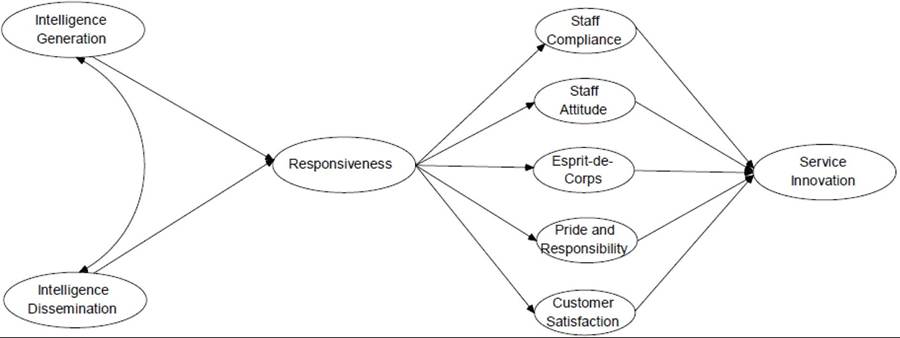
generating new ideas. These outcomes of IMO bring innovations, as employees feel motivated and satisfied toward assuming greater responsibilities and exerting extra for the overall growth of an organization. In context to banking sector, three outcomes of IMO, viz., sense of pride and responsibility (b=.63), esprit-de-corps (b=.13) and staff compliance (b=.14) seem predicting service innovation, where sense of pride and responsibility has greater prediction for service innovation. Hence, H4 is partially accepted. Thus, inculcating a sense of pride and responsibility and generating team efforts among employees is the crux of innovation.
Besides chi-square, additional fit indices, such as the Goodness of Fit Index (GFI), the Comparative Fit Index (CFI), the Normed Fit Index (NFI), the Tucker-Lewis Index (TLI), the Root Mean Square Residual (RMSR) and the Root Mean Square Error of Approximation (RMSEA) have been used to determine the fit of the tested model. These fit indices proved to be robust to sample size effects. Model fitness reveals that CMIN/df (1.172) is non-significant (p=.123); RMSR (.020) and RMSEA (.033) are below 0.08; GFI (.928), CFI (.986), TLI (.980) and NFI (.915) respectively are above the threshold of.90. Hence, the data fit the model very well.
CONCLUSION
The study finds that IMO is represented by internal intelligence generation, internal intelligence dissemination and responsiveness, where intelligence generation and dissemination are positively correlated and significantly predict responsiveness. Thus, the greater the degree of intelligence generation and dissemination, the greater shall be the response toward its implementation. Internal marketing programmes aim at empowering employees, ensuring open communication and effective participation in decision making, ultimately consequent into motivated and committed work force. IMO through its three components has positive outcomes in the form of sense of pride and responsibility, caring attitude, teamwork spirit, compliance and perceived customer satisfaction. Hence, market-oriented attitudes and behaviours of management toward internal market is the bottom line of the market orientation of employees. S atisfied and motivated staff tends to think favourably toward the success and long-term growth of their organization. IMO results into employees’ commitment for and identification with the organization. They feel encouraged to efficiently perform both in-role and extra-role behaviours so as to help an organization achieve its objective.
IMO finally ensures employees’ lesser intentions to quit their job, therefore they think seriously about the growth oftheir organization. Such a growth can be guaranteed if these employees introduce new products, process, technology etc. Thus, novel ideas can be expected from the employees’ if their wants and needs are taken care of by the management. IMO encourages employees’ to perform beyond the task assigned to them. They feel responsible and accountable toward the success and survival of their company. The study also reveals that the outcomes of IMO lead to innovation, particularly for banking services. More specifically, sense of responsibility, esprit-de-corps and staff compliance amount to innovations in the service sector. Hence, attitudes and behaviours of management have significant impact on the attitudes and behaviours of the employees. If management feels responsible toward meeting internal market’s expectations, then employees shall deliver quality services to achieve success in the external market.
MANAGERIAL IMPLICATIONS
The study has important implications for managerial practice. The model provides a framework within which a clear relationship between IMO and service innovation gets established. More particularly, the bank in question has a long history of new product/service development, novel process ideas and technology breakthrough resulting from employee participation, empowerment and free communication. Bank managers need to recognize the critical roles that employees play during the innovation process. To bring innovation in services, managers must work to gain and maintain internal aspects of performance - employee satisfaction, retention and commitment. Thus, management should focus on internal market research by conducting surveys at least once a year to gather information about the job requirements of internal customers. Managers need to enhance their listening skills and learn to generate information about the wants and needs of employees using both formal and informal techniques. The process of designing jobs to meet the needs of employees (i.e. by adopting an IMO) involves gaining a better understanding of the things that employees’ value in their employment. Such information can be acquired through formal internal market research, but due to the close physical and psychological proximity of service managers and their employees, information about wants and needs may be obtained through informal routes as well such as conversations and ‘hall talk’ (Lings, 2004). Service organisations also need to facilitate the dissemination of this information throughout the organisation and to encourage debate regarding the most appropriate response design to employees’ wants and needs and how best to balance these with the objectives of the firm. Management has to understand that internal responsiveness depends upon the internal marketing intelligence and dissemination activities. Management must use internal market information in designing the jobs that can better meet the needs of employees, satisfy and motivate them to perform better service encounter with the external customers. The surveys relating to internal customer orientation need to focus more on creating awareness about internal service quality, the identification of internal customers’ expectations in terms of financial and non-financial incentives, generating and understanding the information for formulating an appropriate response to the internal marketing in terms of job products etc. (Lings & Greenley, 2005).
Employees share the need to be trusted and empowered to take a greater level of responsibility and autonomy in their service roles. Customer satisfaction (internal and external) should be more important than adhering to rigid rules and policies. Since banks implement internal marketing in order to develop and maintain a workforce that is customer oriented and focus on delivering quality, they need to accept the proposition that employee empowerment can significantly contribute to the creation of a “climate for service.” The emphasis placed on training and development contributes to developing service-oriented employees, improves their competencies and leads to employee satisfaction and hence, enhances the motivational level of employees, which ultimately lead to new service development.
The findings of the present study indicate that internal marketing practices aim at enabling banks to bring innovation in services through the ‘people’ element of their marketing mix. To achieve good service innovation, it is paramount that internal service providers have the freedom and flexibility to adapt the service delivery to meet the needs of their internal customers. A formalised strategy for implementing internal marketing procedure needs to be drawn up by head office staff. This includes both training programmes and a system of post-training feedback to ensure that the lessons of training are actually being transferred to the workplace. The adoption of a supportive management style is required, which shall encourage the development and motivation of staff. Managers need to pay significantly more attention to the communication of marketing (and other organizational) strategies and objectives to employees so that they understand their role and importance in the implementation of the strategies and achievement of marketing and organizational objectives (Gronroos, 1981). Service innovation requires managerial guidance, which demands a firm strategy or business model as a guideline, as long as it is based on the customer encounter and customer values. The results also support the value of providing employees choice and independence regarding implementation of new strategy innovations so that they believe they have autonomy, which in turn leads to greater motivation to participate. Training and incentives that give employees a sense that they have choices in innovation implementation are likely to result in more positive feelings, beliefs, and behaviours related to the innovation. The leadership at all levels is responsible for steering the organization’s attitude toward innovation, creativity and new ideas. If the directors of a company fail to recognize new ideas, recognize and reward both incremental and radical innovations and to provide support, the possibilities for innovation to occur are limited. Encouraging front-line employee involvement in the new service development increases the likelihood of positive implementation of innovative services. The service firms should introduce innovation centres for different service innovation function teams according to the degree they possess information of innovation. For employees, the firms should adopt the incentive mechanism of authority distribution, encouragement plan of service innovation and so on. Briefly, management requires understanding of the variables that can affect aspects such as levels of internal marketing orientation, a managerial issue that goes beyond the traditional functional approach because banks today face the challenge not only of designing innovative customer-focused service strategies to compete and grow but also of translating such strategies into results through successful execution. Thus, IMO can convert internal customers into brand ambassadors for promoting banking services and introducing new service developments. Employees shall sell the brand of their organization only if they feel motivated and satisfied with the internal market environment. Hence, banks have to formulate market-oriented strategies, which require proper understanding of the wants and needs of its employees so that the ultimate objective of achieving success in the external market can be accomplished.
Particularly in context to emerging economies the concept of being market-oriented is not so forthcoming. Hence, it becomes imperative for firms to first become market oriented so that implementation of internal marketing concept is more effective. An organization should have broader objective of serving the external market so that proper understanding of the needs and wants of internal customers from organizational offerings becomes essential. Service innovations in the emerging economies can be made possible only when a firm has satisfied and motivated employees who can contribute whole-heartedly and exhibit citizenship behaviour toward accomplishing the goal of superior profitability through introducing new ideas and successfully implementing them. Thus, an organization has to ensure a team of satisfied, committed and motivated staff who can take the responsibility of bringing innovations in the existing processes and developing new products/services.
LIMITATIONS AND FUTURE RESEARCH AGENDA
India, being an emerging economy, possesses peculiar features, resources and capabilities, which may not be prevalent in other developing nations in the same proportion. India itself is a nation with diversity of cultures among different states and cities. Hence, before generalizing the findings of the present study, a proper thought is highly solicited toward drawing comparisons between two nations/two country states. In addition, certain IMO activities are institutional-specific. Few services demand continuous updating of the latest information, like telecommunications whereas others may not require intensive training programmes like railways and postal services. Thus, the competitive intensity, nature of the service, labor market conditions, market dynamism, technological turbulence etc shall also determine the level of IMO required. Extent of IMO needed may differ for different services as well as settings, which would ultimately determine the innovations required.
Future studies can draw significant differences in the present level of IMO in public as well as private banks, so as to determine the extent of innovations desired by these banks. Similar study can also be replicated for other services like telecommunication, insurance, education etc. Further research work can be carried out to examine the mediating role of IMO in the market orientation-innovation link. Same relationship can be analyzed for entrepreneurial orientation and innovation link.
Also a comparative analysis of the role of IMO in generating service innovations can also be initiated between two competing private sector banks or a successful private and public sector bank. In India competitive intensity, market turbulence and technological advancement in the area of financial services have been introduced by private sector banks and thus, it makes sense to examine the extent of IMO in these banks and its impact on bring innovations, may it be in terms of new products/services, new processes, improved technology, etc.
REFERENCES
Abramovici, M., & Bancel-Charensol, L. (2004). How to take customers into consideration in service innovation projects. Service Industries Journal, 24(1), 56-78. doi:10.1080/026420604 12331301132
Agarwal, S., Erramilli, M. K., & Dev, C. S. (2003). Market orientation and performance in service firms: Role of innovation. Journal of Services Marketing, 17(1), 68-82. doi:10.1108/08876040310461282
Ahmed, P. K., & Rafiq, M. (2003). Internal marketing issues and challenges. European Journal of Marketing, 37(9), 1177-1186. doi:10.1108/03090560310498813
Ahmed, P. K., Rafiq, M., & Saad, N. M. (2003). Internal marketing and the mediating role of organisational competencies. European Journal of Marketing, 37(9), 1221-1241. doi:10.1108/03090560310486960
Alam, I. (2007). New service development process: Emerging versus developed markets. Journal of Global Marketing, 20, 43-55. doi:10.1300/ J042v20n02_05
Alam, I., & Perry, C. (2002). A customer oriented new service development process. Journal of Service Management, 16(6), 515-534.
Anderson, J. C., & Gerbing, D. W. (1988). Structural equation modeling in practice: A review and recommended two-step approach. Psychological Bulletin, 103(3), 411-425. doi:10.1037/0033- 2909.103.3.411
Arndt, J. (1979). Towards a concept of domesticated markets. Journal of Marketing, 43, 69-75. doi:10.2307/1250272
Arnett, D. B., Laverie, D. A., & McLane, C. (2002). Using job satisfaction and pride as internal-marketing tools. The Cornell Hotel and Restaurant Administration Quarterly, 43(2), 87-96. doi:10.1016/S0010-8804(02)80035-0
Asif, S., & S argeant, A. (2000). Modelling internal communication in the financial services sector. European Journal of Marketing, 34(il4), 299-318. doi:10.1108/03090560010311867
Averett, P. (2001). People: The human side of systems technology. Journal for Quality and Participation, 24(2), 34-37.
Ballantyne, D. (1997). Internal networks for internal marketing. Journal of Marketing Management, 13(5), 343-366. doi:10.1080/026725 7X.1997.9964479
Ballantyne, D. (2000). Internal relationship marketing: A strategy for knowledge renewal. International Journal of Bank Marketing, 18(6), 274-286. doi:10.1108/02652320010358698
Berry, L. L. (1981). The employee as customer. Journal of Retail Banking, 3, 25-28.
Berry, L. L. (1984). The employee as customer. In C. Lovelock (Ed.), Services marketing (pp. 271-278). Englewood Cliffs, NJ: Prentice Hall.
Berry, L. L., Hensel, J. S., & Burke, M. C. (1976). Improving retailer capability for effective consumerism response. Journal of Retailing, 52(3), 3-14.
Berry, L. L., & Parasurman, A. (1991). Marketing services: Competing through quality. New York: The Free Press.
Bitner, M. J., Booms, B. H., & Mohr, L. A. (1994). Critical service encounters: The employee’s viewpoint. Journal of Marketing, 58(10), 95-106. doi:10.2307/1251919
Blazevic, V., Lievens, A., & Klein, E. (2003). Antecedents of project learning and time-to-market during new mobile service development. International Journal of Service Industry Management, 14, 120-147. doi:10.1108/09564230310466010
Boswell, W. R., & Boudreau, J. W. (2001). How leading companies create, measure and achieve strategic results through line of sight. Management Decision, 39(10), 851-860. doi:10.1108/ EUM0000000006525
Briscoe, D. R. (1980). Organizational design: Dealing with the human constraint. California Management Review, 23(1), 71-80. doi: 10.2307/41164906
Brown, S. W., Fisk, R. P., & Bitner, M. J. (1994). The development and emergence of services marketing thought. International Journal of Service Industry Management, 5(1), 21-48. doi:10.1108/09564239410051894
Burgess, S. M., & Steenkamp, J. E. M. (2006). Marketing renaissance: How research in emerging markets advances marketing science and practice. International Journal of Research in Marketing, 23, 337-356. doi:10.1016/j.ijresmar.2006.08.001 Cahill, D. J. (1995). The managerial implications ofthe learning organisation: A new tool for internal marketing. Journal of Services Marketing, 9(4), 43-51. doi:10.1108/08876049510094513
Calantone, R. J., & Di Benedetto, C. A. (1988). An integrative model of the new product development process: An empirical validation. Journal of Product Innovation Management, 5(3), 201-215. doi:10.1016/0737-6782(88)90023-9
Chapman, R., Soosay, C., & Kandampully, J. (2003). Innovation in logistic services and the new business model. International Journal of Physical Distribution & Logistics Management, 33(7), 630-650. doi:10.1108/09600030310499295
Cobb, J. C., Samuels, C. J., & Sexton, M. W. (1998). Alignment and strategic change: A challenge for marketing and human resources. Leadership and Organization Development Journal, 19(1), 32-43. doi:10.1108/01437739810368811
Davis, T. R. V. (2001). Integrating internal marketing with participative management. Management Decision, 39(1), 121-132. doi:10.1108/ EUM0000000005418
de Brentani, U. (1989). Success and failure in new industrial services. Journal of Product Innovation Management, 6(6), 239-258. doi:10.1016/0737- 6782(89)90077-5
de Brentani, U., & Cooper, R. G. (1992). Developing successful new financial services for businesses. Industrial Marketing Management, 21,231-241. doi:10.1016/0019-8501(92)90020-T
Diamantopoulos, A., & Hart, S. (1993). Linking market orientation and company performance: Preliminary evidence on Kohli and Jaworski’s framework. Journal of Strategic Marketing, 1(2), 93-121. doi:10.1080/09652549300000007
Dutz, M. A. (2007). Unleashing India’s innovation: Toward sustainable and Inclusive growth. Washington, DC: World Bank. doi:10.1596/978- 0-8213-7197-8
Edvardsson, B., Haglund, L., & Mattson, J. (1995). Analysis, planning, improvisation and control in the development of new services. International Journal of Service Industry Management, 6(2), 24-35. doi:10.1108/09564239510084923
Edvarsson, B., & Olsson, J. (1996). Key concepts for new service development. Service Industries Journal, 16(2), 140-164. doi:10.1080/02642069600000019
Flint, D. J., Larsson, E., Gammelgaard, B., & Mentzer, J. T. (2005). Logistics innovation: A customer value-oriented social process. Journal of Business Logistics, 26(1), 47-113. doi:10.1002/j.2158-1592.2005.tb00196.x
Foote, D. A., Seipel, S. J., Johnson, N. B., & Duffy, M. K. (2005). Employee commitment and organizational policies. Management Decision, 43(2), 203-219. doi:10.1108/00251740510581920
Foreman, S., & Money, A. (1995). Internal marketing: Concepts, measurement and application. Journal Marketing Management, 11, 755-768. doi:10.1080/0267257X.1995.9964388
George, W. R. (1977). The retailing of services: A challenging future. Journal of Retailing, 53(3), 85-98.
George, W. R. (1990). Internal marketing and organizational behavior: A partnership in developing customer-conscious employees at every level. Journal of Business Research, 20, 63-70. doi:10.1016/0148-2963(90)90043-D
George, W. R., & Gronroos, C. (1991). Developing customer-conscious employees at every level: Internal marketing. In C. A. Congram (Ed.), The AMA handbook of marketing for the service industries (pp. 85-100). New York, NY: American Management Association.
Gomez-Mejia, L. R. (1988). The role of human resources strategy in export performance. Strategic Management Journal, 9(5), 493-505. doi: 10.1002/ smj.4250090508
Gounaris, S. (2006). Internal market orientation and its measurement. Journal of Business Research, 59(4), 432-448. doi:10.1016/j. jbusres.2005.10.003
Gounaris, S. (2008). The notion of internal market orientation and employee job satisfaction: Some preliminary evidence. Journal of Services Marketing, 22(1), 68-90. doi:10.1108/08876040810851978
Greene, W. E., Walls, G. D., & Schrest, L. J. (1994). Internal marketing: The key to external marketing success. Journal of Services Marketing, δ(4), 5-13. doi:10.1108/08876049410070682
Gronroos, C. (1981). Internal marketing: An integral part of marketing theory. In J. H. Donnelly, & W. E. George (Eds.), Marketing of services (pp. 236-238). American Marketing Association.
Gronroos, C. (2000). Service management and marketing: A customer relationship management approach. London: John Wiley & Sons.
Guest, D. E., & Conway, N. (2002). Communicating the psychological contract: An employer perspective. Human Resource Management Journal, 12(2), 22-38. doi:10.1111∕j.1748-8583.2002. tb00062.x
Gupta, A., & Rogers, E. (1991). Internal marketing: Integrating R&D and marketing within the organization. Journal of Services Marketing, 5(2), 55-68. doi:10.1108/08876049110035558
Han, J. K., Kim, N., & Srivastava, R. K. (1998). Market orientation and organizational performance: Is innovation a missing link? Journal of Marketing, 62(4), 30-45. doi:10.2307/1252285
Harrell, G. D., & Fors, M. F. (1992). Internal marketing of service. Industrial Marketing Management, 21(4), 299-306. doi:10.1016/0019- 8501(92)90038-U
Heskett, J. L., Jones, T. O., Loveman, G. W., Sasser, W. E., & Schlesinger, L. A. (2008, July-August). Putting the service-profit chain to work. Harvard Business Review, 118-129.
Hogg, C. (1996). Selling your soul. Human Resources, 96(25), 88-90.
Huseman, R. C., & Hatfield, J. D. (1990). Equity theory and the managerial matrix. Training and Development Journal, 44(4), 98-102.
Jaworski, B. J., & Kohli, A. K. (1993). Market orientation: Antecedents and consequences. Journal of Marketing, 57(3), 53-70. doi:10.2307/1251854
Johlke, M. C., & Dale, F. D. (2000). Testing competing models of sales force communication. Journal of Personal Selling & Sales Management, 21(4), 265-277.
Johnston, M. W., Parasuraman, A., Futrell, C. M., & Black, W. C. (1990). A longitudinal assessment of the impact of selected organizational influences on salespeople’s organizational commitment during early employment. JMR, Journal of Marketing Research, 27(8), 333-344. doi:10.2307/3172590
Kale, S. H. (2006). Internal marketing: An antidote for Macau’s labor shortage. Journal of UNLV Gaming Research Review, 11(1), 1-11.
Kohli, A. K., & Jaworski, B. J. (1990). Market orientation: The construct, research propositions, and managerial implications. Journal of Marketing, 54, 1-18. doi:10.2307/1251866
Krishnan, R. (2003). The evolution of a developing country innovation system during economic liberalization: The case of India. Paper presented at the First Globelics Conference. Rio de Janeiro, Brazil.
Lievens, A., & Moenaert, R. K., & S’Jegers, R. (1999). Linking communication to innovation success in the financial services industry: A case study analysis. International Journal of Services Industries Management, 10(1), 23-47. doi:10.1108/09564239910255361
Lings, I. N. (2004). Internal market orientation: Constructs and consequences. Journal of Business Research, 57(4), 405-413. doi:10.1016/S0148- 2963(02)00274-6
Lings, I. N., & Greenley, G. E. (2005). Measuring internal market orientation. Journal of Service Research, 7(3), 290-305. doi:10.1177/1094670504271154
Lings, I. N., & Greenley, G. E. (2009). The impact of internal and external market orientations on firm performance. Journal of Strategic Marketing, 17(1), 41-53. doi:10.1080/09652540802619251
Liu, D. W., & Lu, R. Y. (2006). Optimized authority centralization design of service innovation with employees’ participation in uncertain environment. International Conference of Service System and Service Management, 1, 681-686.
Lovelock, C., & Wirtz, J. (2004). Services Marketing (5th ed.). Englewood Cliffs, NJ: Prentice Hall.
Martin, C., & Horne, D. (1995). Service innovation: Successful vs. unsuccessful firms. International Journal of Service Industry Management, 4(1), 49-65.
McGuire, E. P. (1973). Evaluating new product proposals. New York, NY: The Conference Board.
McKnight, R., & Hawkrigg, J. (2005). Leading the human side of change. Canadian HR Reporter, 18(21), 17-19.
Meaghan, S., & Bontis, N. (2002). Voluntary turnover: Knowledge management-friend or foe? Journal of Intellectual Capital, 3(3), 303-322. doi:10.1108/14691930210435633
Mishra, S. (2010). Internal marketing: A tool to harness employees’ power in service organisations. International Journal of Business and Management, 5(1), 185-193.
Murray, J. G. (1979, July/August). The importance of internal marketing. Bankers Magazine, 38-40.
Narver, J. C., & Slater, S. F. (1990). The effect of a market orientation on business profitability. Journal of Marketing, 54(10), 20-35. doi:10.2307/1251757
Nijssen, E. J., Hillebrand, B., Vermeulen, P., & Kemp, R. (2006). Exploring product and service innovation similarities and differences. International Journal of Research in Marketing, 23(3), 241-251. doi:10.1016/j.ijresmar.2006.02.001
O’Cass, A., & Sok, P. (2013). Exploring innovation driven value creation in B2B service firms: The roles of the manager, employees, and customers in value creation. Journal of Business Research, 66(8), 1074-1084. doi:10.1016/j. jbusres.2012.03.004
Ostrom, A. L., Bitner, M. J., Brown, S. W., Burkhard, K. A., Goul, M., & Smith-Daniels, V. (2010). Moving forward and making a difference: Research priorities for the science of service. Journal of Service Research, 13(1), 4-36. doi:10.1177/1094670509357611
Ozment, J., & Keller, S. B. (1999). Exploring dispatcher communication effectiveness: Implications for retaining drivers in the trucking industry. Journal of Managerial Issues, 11(1), 94-109.
Piercy, N. F., & Morgan, N. A. (1990). Internal marketing: Making marketing happen. Marketing Intelligence & Planning, 8, 4-6. doi:10.1108/ EUM0000000001069
Reserve Bank of India. (2008). Unpublished report. Regional Office-Jammu, Jammu & Kashmir, India: Author.
Rodrigues, A. P., & Pinho, J. C. (2012). The impact of internal and external market orientation on performance in local public organisations. Marketing Intelligence & Planning, 30(3), 284-306. doi:10.1108/02634501211226276
Rogers, E. M. (Ed.). (2003). Diffusion of innovations. New York: Free Press.
Russell, A., & Russell, J. (1999). Relationship marketing in private banking in South Africa. International Journal of Bank Marketing, 17(1), 5-19. doi:10.1108/02652329910254000
Sanchez-Hernandez, M. I., & Miranda, F. J. (2011). Linking internal market orientation and new service performance. European Journal of Innovation Management, 14(2), 207-226. doi:10.1108/14601061111124894
Sasser, W. E., & Arbeit, S. F. (1976, June). Selling jobs in the service sector. Business Horizons, 61-62. doi:10.1016/0007-6813(76)90053-7
Scheuing, E., & Johnson, E. (1989). A proposed model for new service development. Journal of Services Marketing, 3(2), 25-34. doi:10.1108/ EUM0000000002484
Shostack, G. L. (1987). Service positioning through structural change. Journal of Marketing, 51(1), 34-42. doi:10.2307/1251142
Singh, J. (2000). Performance productivity and quality of frontline employees in service organizations. Journal of Marketing, 64, 15-34. doi:10.1509/jmkg.64.2.15.17998
Singh, K. (2003). Strategic HR orientation and firm performance in India. International Journal of Human Resource Management, 14(4), 530-543. doi:10.1080/0958519032000057574
Slater, S., & Narver, J. (1995). Market orientation and the learning organisation. Journal of Marketing, 59(3), 63-74. doi:10.2307/1252120
Song, X. M., Di Benedetto, A., & Song, L. Z. (2000). Pioneering advantage in new service development: A multi-country study of managerial perceptions. Journal of Product Innovation Management, 17(5), 378-392. doi:10.1016/ S0737-6782(00)00054-0
Souder, W. E., & Moenaert, R. K. (1992). Integrating marketing and R&D project personnel within innovation projects: An information uncertainty model. Journal of Management Studies, 29(4), 485-512. doi:10.1111/j.1467-6486.1992. tb00675.x
Stauss, B., & Schulze, H. S. (1990). Internes marketing. Marketing ZFP, 12(3), 149-158.
Sundbo, J. (1998). The organisation of innovation in services. Copenhagen: Roskilde University Press.
Sundbo, J. (2008). Innovation and involvement in services. In L. Fuglsang (Ed.), Innovation and the creative process: Towards innovation with care (pp. 25-47). Cheltenham, UK: Edward Elgar.
Tansuhaj, T., Randall, D., & McCullogh, J. (1988). A services marketing management model: Integrating internal and external marketing functions. Journal of Services Marketing, 6(2), 193-203.
Taylor, S. L., & Cosenza, R. M. (1998). Reducing turnover in public accounting firms: An internal marketing strategy. Journal of Professional Services Marketing, 17(2), 135-147. doi:10.1300/ J090v17n02_10
Thompson, T. W., Berry, L. L., & Davidson, P.
H. (1978). Banking tomorrow: Managing markets through planning. New York, NY: Van Nostrand Rein-hold.
Tidd, J., Bessant, J., & Pavitt, K. (2001). Managing innovation: Integrating technological, market and organisational change. Chichester, UK: Wiley. Tidd, J., & Hull, F. (2003). Service innovation: Organizational responses to technological opportunities and market imperatives. London: Imperial College Press.
Toivonen, M., & Tuominen, T. (2006). Emergence of innovations in services: Theoretical discussion and two case studies. Paper in International ProACT Conference: Innovation Pressure - Rethinking Competitiveness, Policy and the Society in a Globalised Economy. Tampere, Finland.
Van Haastrecht, R., & Bekkers, M. (1995). Marketing of change: The added value of internal marketing to change management. In Proceedings of the 24th EMAC Conference, (pp. 1243-1261). EMAC.
Varey, R. J. (1995). Internal marketing: A review and some interdisciplinary research challenges. International Journal of Service Industry Management, 6(1), 40-63. doi:10.1108/09564239510078849
Wasmer, D. J., & Brunner, G. C. I. (1991). Using organizational culture to design internal marketing strategies. Journal of Services Marketing, 5(1), 35-46. doi:10.1108/08876049110035468
Zeithaml, V. A., Bitner, M. J., & Gremler, D. D. (Eds.). (2009). Services marketing: Integrating customerfocus across the firm. Boston: McGraw- Hill.
Zhou, K. Z., & Wu, F. (2010). Technological capability, strategic flexibility, and product innovation. Strategic Management Journal, 31, 547-561.
ADDITIONAL READING
Anosike, U. P., & Ahmed, P. K. (2009). Internal marketing: Focus on practice. International Journal of Management Practice, 3(4), 369-382. doi:10.1504/IJMP.2009.026962
Atuahene-Gima, K. (1996). Market orientation and innovation. Journal of Business Research, 35(2), 93-103. doi:10.1016/0148-2963(95)00051-8
Audhesh, P., Derrick, D. S., & Ali, M. Z. (2009). Toward a contextually anchored service innovation typology. Decision Sciences, 3(40), 513-540.
Conduit, J., & Mavondo, F. T. (2001). How critical is internal customer orientation to market orientation? Journal of Business Research, 51(1), 11-24. doi:10.1016/S0148-2963(99)00044-2
Den Hertog, P., Van der, A., & De Jong, M. (2010). Capabilities for managing service innovation: Towards a conceptual framework. Journal of Service Management, 21(4), 490-514. doi:10.1108/09564231011066123
Den Hertog, P., Rubalcaba, L., & Sergers, J. (2008). Is there a rationale for services innovation policies? International Journal of Service Technology and Management, 9(3/4), 334-354. doi:10.1504/ IJSTM.2008.019710
Drejer, I. (2004). Identifying innovation in surveys of services: A Shumpeterian perspective. Research Policy, 33(3), 551-562. doi:10.1016/j. respol.2003.07.004
Foreman, S., & Money, A. (1995). Internal marketing: Concepts measurement and application. Journal of Marketing Management, 11, 755-768. doi:10.1080/0267257X.1995.9964388
Gounaris, S., Papastathopoulou, P., & Avloni- tis, G. (2003). Assessing the importance of the development activities for successful new services: Does innovativeness matter? International Journal of Bank Marketing, 21(5), 266-276. doi:10.1108/02652320310488448
Greene, W. E., Walls, G. D., & Schrest, L. J. (1994). Internal marketing: The key to external marketing success. Journal of Services Marketing, 8(4), 5-13. doi:10.1108/08876049410070682 Harrell, G. D., & Fors, M. F. (1992). Internal marketing of a service. Industrial Marketing Management, 21(4), 299-306. doi:10.1016/0019- 8501(92)90038-U
Hipp, C., Gallego, J., & Rubalcaba, L. (in press). Services and organisational innovation: The right mix for value creation. Management Decision.
Hipp, C., Tether, B., & Miles, I. (2000). The incidence and effects of innovation in services: Evidence from Germany. International Journal of Innovation Management, 4, 417-453.
Kim, C., & Mauborgne, R. (1997). Value innovation: The strategic logic of high growth. Harvard Business Review, 75, 103-112. PMID:10174449
Lin, L., & Wu, G. S. (2005). Service innovation: Research summarization, concept and its characters. Science Research Management, 26(2), 1-6.
Lyons, R., Chatman, J., & Joyce, C. (2007). Innovation in services: Corporate culture and investment banking. California Management Review, 50, 174-191. doi:10.2307/41166422
Martin, C. R., Horne, D. A., & Schultz, A. M. (1999). The business-to-business customer in the service innovation process. European Journal of Innovation Management, 2(2), 55-62. doi:10.1108/14601069910269772
Martin, J. H., Martin, B. A., & Grbac, B. (1998). Employee involvement and market orientation in a transition economy: Importance, problems and a solution. Journal of Managerial Issues, 10(4), 485-502.
Miles, I. (2000). Services innovation: Coming of age in the knowledge-based economy. International Journal of Innovation Management, 4(4), 371-389.
Mohr, L. B. (1969). Determinants of innovation in organizations. The American Political Science Review, 63, 111-126. doi:10.2307/1954288 Mohr-Jackson, I. (1991). Broadening the market orientation: An added focus on internal customers. Human Resource Management, 30(4), 455-467. doi:10.1002/hrm.3930300403
Nijssen, E., Hillebrand, B., Vermeulen, P., & Kemp, R. (2006). Exploring product and service innovation similarities and differences. International Journal of Research in Marketing, 23, 241-251. doi:10.1016/j.ijresmar.2006.02.001
Ordanini, A., & Parasuraman, A. (2011). Service innovation viewed through a service-dominant logic lens: A conceptual framework and empirical analysis. Journal of Service Research, 14(1), 13-23. doi:10.1177/1094670510385332
Sergeant, A., & Frenkel, S. (2000). When do customer contact employees satisfy customers? Journal of Service Research, 3(1), 18-34. doi:10.1177/109467050031002
Sood, A., & Tellis, G. J. (2005). Technological evolution and radical innovation. Journal of Marketing, 69, 152-168. doi:10.1509/ jmkg.69.3.152.66361
Sundbo, J. (1997). Management of innovation in services. Service Industries Journal, 17(3), 432-455. doi:10.1080/02642069700000028
KEY TERMS AND DEFINITIONS
Indian Banking: Indian banking industry is presently confronting a very healthy and intense competition between government-owned, private sector banks and foreign banks. Indian banking is passing through a fast moving and competitive environment where changes are taking place at a much faster speed than ever in the history of Indian banking sector. Today Indian banking industry is one of the largest in the world. It is characterised by a large number of banks with mixed ownership. The commercial banking segment comprises 27 public sector banks in which government has a majority ownership of over 51%, 40 private sectors banks and 33 foreign banks.
Intelligence Dissemination: The extent to which information is communicated, distributed, shared, and discussed among marketing department and other departments through formal and informal tools.
Intelligence Generation: It is the extent to which a firm gathers primary and secondary data from every obtainable source, mainly from the organizations stakeholders such as customers, competitors, suppliers, and intermediaries in addition to market forces like social, cultural, economical, political, legal, technological and many other forces.
Internal Market Orientation:-: It may be defined as treating employees as internal customers, viewing jobs as internal products that satisfy the needs and wants of these internal customers while addressing the objectives of the organization.
Responsiveness: It is the behaviours and activities taken as a reaction to generated and disseminated intelligence, there are two phases, viz., response design and response implementation.
Service Innovation: Service innovation comprises new or significantly improved service concepts and offerings. Irrespective of whether they are introduced by service companies or manufacturing companies, innovation can be in the service process, service infrastructure, customer processing, business models, commercialisation (sales, marketing, delivery), service productivity and hybrid forms of innovation serving several user groups in different ways simultaneously. It can be considered as an organizational value, which includes both innovation in organization for existing service products as customers request or to fulfill organization’s goals and innovation in processes.
This work was previously published in Innovations in Services Marketing and Management, edited by Anita Goyal, pages 238264, copyright 2014 by Business Science Reference (an imprint of IGI Global).
APPENDIX
Table 2. Survey instrument for measuring internal market orientation and service innovation
| INTELLIGENCE GENERATION | |
| FIG | Formal Intelligence Generation |
| FWIG | Formal Written Information Generation |
| 1. | Management conducts survey to identify major influence on employees’ behaviour. |
| 2. | Management frames questionnaires to identify your wants and needs. |
| 3. | Bank conducts survey with employees at least once a year to assess the quality of employment. |
| 4. | Regular staff appraisal is conducted by the management. |
| FFIG | Formal Face-to-Face Information Generation |
| 1. | Management conducts regular staff appraisal to discuss what employees want. |
| 2. | Management meets employees at least once a year to find out what expectations they have for future jobs. |
| 3. | Management interacts directly with employees to find out how to make them more satisfied. |
| 4. | Several departments together plan work periodically. |
| 5. | Focus group discussions are held regularly to identify your wants and needs. |
| IIG | Informal Information Generation |
| 1. | Managers frequently talk with the staff about their work. |
| 2. | Manager tries to solve the problems causing change in the behaviour of employees. |
| 3. | Information regarding employee needs is generated independently through various sources. |
| SEG | Segmentation of Internal Market |
| 1. | Bank has sound working relationship between departments. |
| 2. | Departments look after different segments. |
| 3. | Staff welfare is looked after satisfactorily by Human Resource Development department. |
| 4. | Goals of respective department are in harmony. |
| 5. | Protecting one ,s own department is a prime concern. |
| 6. | One department generally dislikes interacting with other. |
| 7. | Ample opportunities are available for informal talks among different departments. |
| 8. | Employees are accessible to those in other departments. |
| INTELLIGENCE DISSEMINATION | |
| BME | Between Management and Employees |
| 1. | Management regularly meets employees and discusses issue relating to the organisation. |
| 2. | Management shares your work progress. |
| 3. | Bank consults employees on managerial issues. |
| 4. | Data on employees’ satisfaction is disseminated at all levels on regular basis. |
| 5. | Group interaction between management and employees is satisfactory. |
| 6. | Management trusts employees to exercise good judgement. |
| 7. | Management allows a high degree of initiative. |
| 8. | Management permits you to use own judgement in solving problems. |
Table 2. Continued
| 9. | Management regularly reports back to you about issues that affect working environment. |
| 10. | Regular staff appraisal and meetings are conducted at all levels. |
| 11. | Top executives are easily accessible. |
| 12. | Communication from manager to employees is routed through proper channel. |
| AM | Attitude of Managers |
| 1. | Managers make sure that employees are happy with their jobs. |
| 2. | Bank considers employees as important resource for service delivery. |
| 3. | Keeping employees satisfied is as important as keeping customers satisfied. |
| 4. | Managers understand all factors that affect employees’ satisfaction. |
| 5. | Managers help employees in official problems. |
| OC | Organisation Climate: The organization for which I work |
| 1. | Is genuinely concerned with the welfare of all its employees. |
| 2. | Tries to accommodate different personal needs of all its employees. |
| 3. | Does not recognise the importance of its employees. |
| 4. | Treats all employees in a way that they are valued. |
| BEE | Between Employees and Employees |
| 1. | You are friendly with other employees in bank. |
| 2. | You get respect from them. |
| 3. | Employees develop friendly relationship with each other. |
| 4. | Employees are co-operative. |
| 5. | Your colleagues feel jealous when you get appreciation letter. |
| 6. | You financially help each other. |
| 7. | You prevent your colleagues from doing wrong things. |
| 8. | You help each other at the time of need without being prejudiced by caste or religion etc. |
| 9. | There is mutual trust and understanding between employees. |
| 10. | You help your colleagues in improving themselves. |
| 11. | Your colleagues feel happy when you get appreciation letter. |
| 12. | Employees communicate out of concern for one another. |
| RESPONSIVENESS | |
| JD | Job Design |
| 1. | You are satisfied with your job. |
| 2. | Your work is both interesting and challenging. |
| 3. | You work as much in the bank as is expecied from you. |
| 4. | You are satisfied with rules and conditions of the job. |
| 5. | You are asked to work more than fixed hours. |
| 6. | Corrective action is ensured when employees express unhappiness with supervisors. |
| 7. | Activities of different departments are well coordinated to modify the conditions of employment. |
| 8. | Management makes changes in job when employees feel dissatisfied. |
| 9. | Employees have enough opportunities for advancement. |
Table 2. Continued
| 10. | Bank regularly plans for career development of its employees. |
| 11. | Employees are provided with adequate job security. |
| 12. | Bank provides sound working conditions to its employees. |
| INC | Incentives |
| 1. | Your bank is giving best salary. |
| 2. | Your salary commensurate with work. |
| 3. | Salary is revised from time to time. |
| 4. | Salary is an important element in job design. |
| 5. | Bank charges minimum interest rates on loans. |
| 6. | You get housing loans at nominal rate of interest. |
| 7. | You get loans for purchasing new consumer durable items. |
| 8. | You get medical aid in case of serious ailment. |
| 9. | Bank provides attractive retirement benefits to its employees. |
| 10. | Organisation has a mechanism to reward for good work done by employees. |
| 11. | Promotion policy is logical and fair. |
| 12. | Management sanctions leave when needed. |
| 13. | Bank provides remuneration compensation. |
| 14. | The interest rate structure differs from one bank to other. |
| MC | Management Consideration |
| 1. | Manager develops a work climate of psychological support. |
| 2. | Supervisors recognise employees as an individual and treat them with respect and dignity. |
| 3. | Manager develops a work climate of helpfulness. |
| 4. | Management respects your individuality. |
| 5. | Manager develops mutual trust and respect with employees. |
| 6. | Management uses restriction and threat to control employee behaviour. |
| 7. | Management allows employees complete freedom in their work. |
| 8. | Management permits you to do the work the way you think the best. |
| TR | Training |
| 1. | Bank arranges regular training both on and off the job. |
| 2. | Training meets the needs of both employees and bank. |
| 3. | Training helps increase your efficiency in job. |
| 4. | Financial assistance is provided during the period of training. |
| 5. | Training is required for satisfactory performance. |
| 6. | Personal biases of a manager influence the selection of employee for training. |
| 7. | Training methods are tailored through your development. |
| 8. | Bank arranges adequate training facilities for its employees. |
| 9. | Employees are regularly sponsored for various need-based training courses and conferences. |
| 10. | Employees are constantly acquainted with the changing procedure and regulation through refresher courses. |
| 11. | Development of employees is given due recognition in this bank. |
Table 2. Continued
| SA | Staff Attitude |
| 1. | Staff members are generally happy working here. |
| 2. | Staff members are happy to put extra efforts when needed. |
| 3. | Employees are well motivated. |
| 4. | Employees have positive thoughts towards management. |
| 5. | Employees are happy to take more responsibility. |
| SC | Staff Compliance |
| 1. | Employees act in a way that is consistent with the image the bank wishes to develop. |
| 2. | Management checks employees’ work regularly. |
| 3. | Employees are smart and well presented. |
| 4. | Manager often tells employees how to improve their performance. |
| CS | Customer Satisfaction |
| 1. | Customers are satisfied with bank services. |
| 2. | Customers receive a very friendly service from bank staff. |
| 3. | Bank prides on friendliness attitude of staff. |
| 4. | Customer service is the key factor to differentiate from competitors. |
| RES | Responsibility |
| Employees are well paid for assuming greater responsibilities. | |
| 2. | Employees are treated well for inducing a sense of responsibility. |
| 3. | Growth opportunities are open to every employee, which motivate them for higher responsibility. |
| TW | Team Work |
| 1. | Management-employees relations are cordial. |
| 2. | Management takes appropriate steps to ensure that employees cooperate with each other. |
| 3. | Employees have developed good understanding. |
| 4. | There is a fair compatibility among employees. |
| SI | Service Innovation |
| 1. | Employees feel motivated in introducing new schemes and services. |
| 2. | There is a continuous improvement in the technology. |
| 3. | Employees try to bring changes in the existing processes and procedures. |
Note: Items in italics got deleted during CFA.
More on the topic Chapter 55 Establishing the Linkage between Internal Market Orientation and Service Innovation:
- Internal Justification
- Transport Team Training and Program Orientation
- Market Research: What Your Customer Wants