Formal Representation of the ConceptualModel
The research hypotheses can be integrated to form a set of structural equations. Since the moderator effects of perceived ease of use, trust, subjective norm, perceived risk, and bank image on the relationship between perceived benefit and intention to use have not been clearly tested in the literature, we create six competing structural models from the conceptual model illustrated in Figure 1.
Model A is without any moderator effects. Model B is Model A plus the moderator effect of perceived ease of use on the relationship between perceived benefit and intention to use. Model C is Model B plus the moderator effect of trust. Model D is Model C plus the moderator effect of subjective norm. Model E is Model D plus the moderator effect of perceived risk. Model F is Model E plus the moderator effect of bank image. The following abbreviations are used for simplicity: bank image (BI), perceived risk (PR), perceived ease of use (PEU), perceived benefit (PB), trust (T), subjective norm (SN), and intention to use (IU).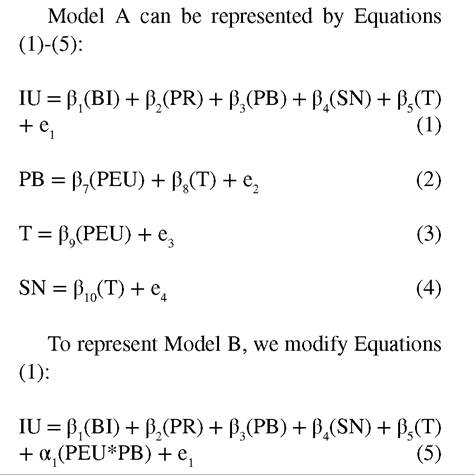
Equations (2)-(4) are kept unchanged.
Model C can be represented:
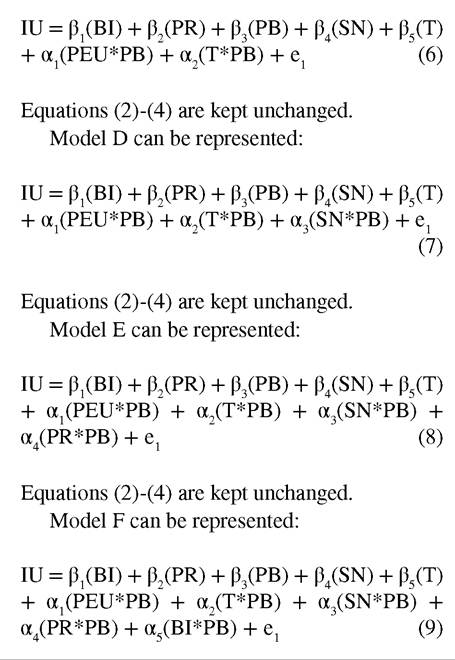
Equations (2)-(4) are kept unchanged.
We suggest that these alternative structural models (Model A, Model B, Model C, Model D, Model E, and Model F) need to be tested independently and their results need to be compared and contrasted.
More financial literature on Economics.Studio
More on the topic Formal Representation of the ConceptualModel:
-
Conflictology -
Ecology -
Economy -
Finance -
History -
Law -
Medicine -
Philosophy -
Religious studies -