INITIATING A PROJECT
Initiation Process for a Project3
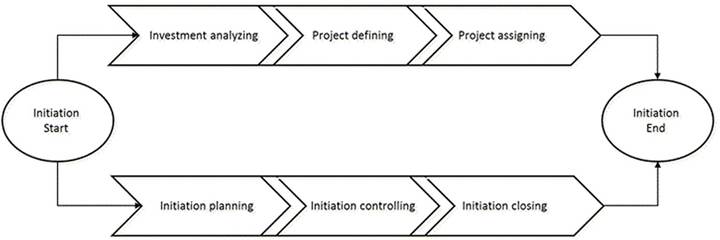
The initiation process of a project starts with the investment analysis and ends with the development of the project charter. The main objectives of the initiation process are to make a decision regarding the realization of an investment, to generate information about the investment and to define the project.
Figure 2 shows the initiation process for a project after Gareis et al. (2013).The description of the investment idea or the problem formulation lays the basis for the investment analysis. For the investment analysis, different methods exist, such as the business case analysis, cost benefit analysis, social cost benefit analysis, and environmental impact analysis. These methods are briefly described later.
The results of the investment analysis and the definition of the investment idea are the basis for the development of an investment proposal. The investment proposal is an important communication document. The customer, the company board, and other important stakeholders achieve central information from this document (Robb 2007). This document set the ground for the investment decision.
A positive investment decision represents the start point for the development of the project proposal. One important step in the development of the project proposal is the project definition. A project must be differentiated from its context (Gareis 2005). The project definition determines what a project includes and is very important for a successful performance of a project (Cano/Lidon 2011; Kahkonen 1999). This method provides a common understanding of the project boundaries (Wijnen/Kor 2000). In the project proposal, general structures of the project become clear and are the basis for the initiation of a project (Steyn 2003). Furthermore the project proposal lays the basis for the project decision.
If the project decision is yes, the project charter is developed. This document is a further development of the project proposal and is a formal summary of important project information between the project manager and the project owner. Signing the project assignment is the start event for the project that initializes the investment (Gido/Clements 2008).
Investment Analysis as Central Method of Project Initiation
As described previous the investment analysis lays the basis for the decision regarding the realization of an investment. Different investment methods exist such as:
Business Case Analysis
A business case analysis is a very traditional and only economic based analysis method. It considers the cash in-flows and out-flows and possible an investment calculation or a simulation. Only cash-effective consequences of the investment are considered and typically analyzed as well as rated with static or dynamic investment calculations such as net present value, internal rate of return or the annuity method. In contrast to static investments methods dynamic investment methods are payment flow oriented and consider a wider investment period (Hirth 2008).
Figure 2. Initiation process for a project (Gareis, et al., 2013)
Cost Benefit Analysis
The main objective of the cost benefit analysis is to find the investment with the best costs and benefits relation (Drews/Hillebrand 2007). It is important to analyze at least one alternative to each investment. In this analysis method different types of costs and benefits are analyzed. These are direct costs and benefits; indirect costs and benefits; tangible costs and benefits; intangible costs and benefits.
Social Cost Benefit Analysis
The social cost benefit analysis is a further development of the original cost benefit analysis. Brent (2006) describes the social cost benefit analysis as more holistic in comparison to a traditional cost benefit analysis as it is more long-term oriented and prefers future generations in the social discount factor.
Environmental Impact Analysis
Ecologic aspects are not considered in the previously described analysis methods. It is the main focus of the environmental impact analysis to consider the environmental impact which is caused by the investment. To cover environmental impacts of the investment in the planning phase and minimize their negative impact is the main objective of this analysis (Morris/Therivel 1995).
Consideration of SD Principles in Investment Analysis Methods
The investment analysis methods described before consider SD principles in different degrees. Table 1 gives a short summary about the relation of SD principles to different investment analysis methods. Traditional methods, such as the business case analysis or the cost benefit analysis, focus only on economic principles and are short to mid-term oriented. The social cost benefit analysis is a more holistic further development of the classic cost benefit analysis and considers also social principles. Furthermore, a wider investment period and a social discount factor are considered. Ecologic principles are not considered in the social cost benefit analysis. The environmental impact analysis considers ecologic as well as social factors and is mid to long term oriented.
Companies often use traditional investment analysis methods. Therefore, most investment decisions are based on economic and short-term aspects.