INVESTMENT AND PROJECT
Investment
Different definitions of the term investment exist. Traditionally, the finance sectors defines investments very narrowly as “the purchase of a financial product or other item of value with an expectation of favorable future returns.
In general terms, investment means the use of money in the hope of making more money (Webfinance 2010). The business sector describes it as the purchase or development of a product or service with the hope of improving future business (Investorwords 2011). Investments are characterized by a number of payments and can be perceived as long-term investigation in real assets e.g. investments in buildings, machines and also in customer relationships or products (Gareis 2005). Organizations invest in objects because they expect the financial returns from the investment to be greater than the money they invested initially (Mills/Turner 1995: 3).Responsible and Ethical Investment
In the 1970s the concept of responsible investments was developed by societal and environmental activists in the United States. Responsible investments are defined as “[...] the integration of Environmental, Societal, and Governance (ESG) issues into investment decision-making” (Louche/ Lydenberg 2011: 2). This approach is mostly used by the finance sector for monetary investments. The key characteristics of responsible investments can be defined as following (Louche/Lydenberg 2011: 17)
• Responsible investment encourages a long-term perspective [...]
• RI adopts a stakeholder perspective [.]
• Responsible investment encourages interaction between society and corporation [.]
Furthermore Louche and Lydenberg (2011) defined four different motivations for using the concept of responsible investments. The first motivation is avoiding profiting from unethical behavior, the second is to encourage corporations to enter positive business lines or to develop strong stakeholder relations.
Furthermore responsible investments avoid underperforming stocks and seek to change the corporate behavior.In 2005 UN General Secretary Kofi Annan invited representatives of the biggest global investors to develop responsible investment principles (PRI). The principles were developed between 2005 and 2006 in workshops and individual works. The result of this development process was a list of principles that are used as guiding principles for responsible investments. These are (UN Global Compact/UNEP Finance Initiative 2006: 6):
• We will incorporate ESG2 issues into investment analysis and decision-making processes.
• We will be active owners and incorporate ESG issues into our ownership policies and practices.
• We will seek appropriate disclosure on ESG issues by the entities in which we invest.
• We will promote acceptance and implementation of the Principles within the investment industry.
• We will work together to enhance our effectiveness in implementing the Principles.
• We will each report on our activities and progress towards implementing the Principles.
For all principles different actions and measures were defined. The use of these guiding principles is optional for companies but increased attention is observable in the business sector.
In addition to the concept of responsible investments the concept of ethical investments was developed. Ethical investment combines the model of sustainability, environment, responsibility and ethics in its overall process and in the investment methods (O’rourke 2003). These investments are defined as “[...] the integration ofpersonal values, social considerations and economic factors into the investment decision” (Michelson et al. 2004: 1).
The concepts of responsible investment as well as ethical investment focuses both on the integration of SD in the investment analysis method as well as in its overall processes. The concept of responsible investment is more holistic and should be integrated in all organizational units of a company.
While responsible investments focus on environmental, social and governance issues the concept of ethical investment focuses also on the integration of personal values such as fairness in the investment decision. Furthermore ethical investments have a big focus on responsibility (regarding stakeholder, the environment, etc.) and ethics. One big difference is that UN Global Compact developed responsible investment principles and therefore made them more visible for the business sector. Companies can use the principles as guiding principles for the integration of responsible investments in the company. Furthermore they can use these guiding principles for the realization of more sustainable investments initiated by projects.Both concepts can be used as basis for the integration of SD principles into the project initiation.
Differentiating Investment and Project
In literature different understandings of projects exist. We use the definition provided by Gareis (2005: 41) who defines a project is a temporary organization for the performance of a relatively unique, short to medium term strategic business process of medium or large scope. It is perceived as a social system and social construct.
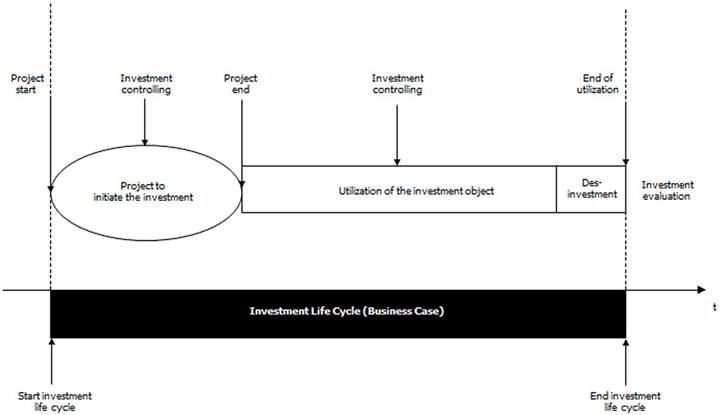
In project management literature the project and the investment is often not differentiated. This differentiation is important because the management of the investment and the management of a project require different processes, roles and methods. Furthermore this differentiation allows to clearly differentiating between the project initiation process, the project management process and the investment life cycle. In general the project initiation process includes two main decisions. First, a decision regarding the realization of an investment and second the decision regarding the organization form in which the investment is to be initiated (Gareis 2005). Both processes (project initiation and project management) are business processes. These processes fulfill different objectives, require different tasks for their performance, and different organizations are responsible for their performance. Furthermore different stakeholders are important for the investment and the project. The long term orientation of investments contradicts with the short term orientation of projects. Further it is important to clearly differentiate investment and project costs and benefits. Investment costs include in addition to the costs for investment initiation also costs for operating and maintain the investment.
Figure 1 shows how project and investment can be differentiated and related to each other.
Investments can be initiated by a single project, a chain of projects or by programs (Gareis 2005).
Figure 1. Investment and project (Gareis, 2005, p. 456)
More on the topic INVESTMENT AND PROJECT:
- Qatar
- Incomplete contracts and market dynamics
- The Danish colonial project on the Gold Coast
- Background Context
- AN OVERVIEW OF CULTURAL ECONOMICS AND RELATED TOPICS
- Introduction
- Malta
- Zimbabwe Village Savings and Loan Associations
- Oman
- THEORETICAL CONSIDERATIONS