Innovation and COMPETITIVE ADVANTAGE
Since the traditional strategies started to lose their significance, they have started to give way to global approaches in the rapidly changing business world. Therefore, organizations consider it necessary to continuously revise their core strategies (Karabay, 2010, v-2).
Innovation represents today’s competitive advantage supported by strong capabilities of corporations in quality, efficiency, speed and flexibility (Lawson and Samson, 2001, 380-381). Acquiring a competitive advantage and providing its sustainability particularly depends on the managerial competence. If the managers are to become more effective, there is a need to change from traditional management approaches to an approach that focuses on processes, R&D, cost savings and stand-alone improvements. This places a strong emphasis on the value of knowledge and innovation. Moreover, innovative efforts foster faster new product development and increased cost-effectiveness if managerial strategies are entirely aligned with the corporate objectives (Terziovski and Morgan, 2006, 546). If the senior management supports the innovation process and creates favorable climate within the company, then it will be much easier to gain a sustainable competitive advantage.The innovation performance, therefore, is a concept particularly linked directly to the innovative aspect of a firm (Yavuz, 2010, 147-152). Competitive advantage also rests on distinctive processes, shaped by the firm’s asset positions and the evolutionary paths followed (Lawson and Samson, 2001, 379).
Firms competing in the global markets face challenges as well as opportunities of change in the markets and technologies. One of the most important functions of competition appears to be the stimulation of innovation and technical progress (Arican et al, 2011, 37-38). Corporations will have to consider different stages in the process through efficient management of innovation.
In order to begin the process, new ideas should be developed within the organization (Orucu et al, 2011, 63).In the literature, the issue of the stages of innovation is investigated in a number of phases (Rothwell, 1994; Galanakis, 2006). Rothwell’s five generations of innovation explaines the stages of innovation in five phases. The first stage is referred to as the stage of “technology push,” which assumes that “more R&D in” results in “more successful new products out.” The second-generation stage is explained through market pull model of innovation, where the market is the source of ideas for directing R&D, which has a merely reactive role in the process. The third phase is associated with the coupling model of innovation. According to this phase, innovation is rarely the outcome of technology push or market pull forces, but rather the result of the combination of the two. On the other hand, the fourth stage is accompanied by a growing awareness of the strategic importance of the evolving generic technologies, with increased strategic emphasis on technological accumulation. The final stage of the generation phase is the process of systems integration and networking (SIN) in which the technology of technological change is itself changing (Rothwell, 1994, 7-15).
According to Adams et al (2006), the innovation process is complex, comprising a myriad of events and activities some of which can be identified as a sequence and some of which occur concurrently. So, it is clearly possible that innovation processes differ, to some degree, across organizations and even within organizations on a project-by-project basis (Adams et al, 2006, 36).
Again, Veugelers and Cassiman (1999) state in their study that the innovation process consists of a complex sequence of strategic decisions. First, the firm decides whether or not to innovate and second, the firm decides which innovation strategy to develop and how to acquire the necessary technology to accomplish its innovation goals.
For the first step, the firm and industry characteristics influencing innovativeness play a vital role (Veugelers and Cassiman, 1999, 64). In this sense, firm-level innovation occurs not in a simple process but in a process where there are important feedbacks obtained from complex interactions between people, organizations and the media in which they exist (systemic innovation model) (Elςι et al, 2008, 29). Furthermore, the process of innovation, created by technical, economic and social processes, requires the implementation of openness to change and request for innovation in society and individuals with a long-term, cooperative, collaborative and participatory approach. In order to satisfy this requirement, it is necessary to examine the relationship between innovation and strategic management of an enterprise, the discovery of the points adding value, and managing of this association (Sati and I§ik, 2011, 538-539).Strategy is critical because it determines the configuration of resources, products, processes and systems that the firm adopts so as to deal with the uncertainty in their environment. In this sense, the firm is required to make decisions about what businesses and functions it should be performing and in which markets. So, successful innovation requires a clear articulation of a common vision and powerful expression of the strategic direction. This is an essential step in institutionalising innovation. Without a strategy for innovation, interest and attention will become probably too dispersed (Lawson and Samson, 2001, 389).
In terms of businesses each activity has to be understood as a process since innovation has a dynamic structure in its nature, consisting of various stages. Furthermore, a corporation that does not have an effective strategy may not be able to take the necessary steps for innovation management. In this regard, strategy becomes an administrative tool in controlling the changes that take place by providing, first of all, innovation progress and continuous adaptation to the environment so as to be mutually compatible (Cormican and O’sullgvan, 2004, 819; Sati and I§ik, 2011, 538-539).
Innovation increasingly emerges from a network of companies interacting in a variety of ways (Cassiman and Veugelers, 1999, 63). High-performing innovators are able to bring new high quality products to the market faster, more frequently and at a lower cost than their competitors. So, they become more competent to achieve an outstanding performance (Lawson and S amson, 2001, 378). As mentioned above, corporations have much to do with more than traditional strategies. They have to organize and implement new strategies different from their competitors. In the following section, the strategies that turn up to be the innovative strategies are explained.
Innovation Strategies
As mentioned above, innovation is about creating economic value from new ideas (Bercovits and Feldman, 2005, 3). Organizations have to explicitly articulate a strategy to induce innovative activities (Elgi et al, 2008, 29). Firms determine an innovation strategy depending on the expectations related to innovation. The basic strategies of enterprises and innovation strategies are highly dependent on each other so the process of determining is like that of the managerial strategy of enterprises (Sati and I§ik, 2011, 538-539). Then what is an innovation strategy?
The innovation strategy consists of financial goals and growth area related to a novel product or service. It is a set of strategic roles in defining the strategic mission of new products or services and a set of criteria with a series of filters in which the new products or service ideas must pass through (Sati and I§ik, 2011, 545-546). In principle, innovations and innovation strategies have to be separated analytically since firms can attempt to pursue, say, an offensive innovation strategy (Freeman and Soete, 1997, 268).
In distinguishing innovation strategies, the corporations take into consideration the key dimensions connected to the strategic issues and to broader aspects of economic coordination and control, including the role of ownership as well as other forms of integration (Whitley, 2000, 865).
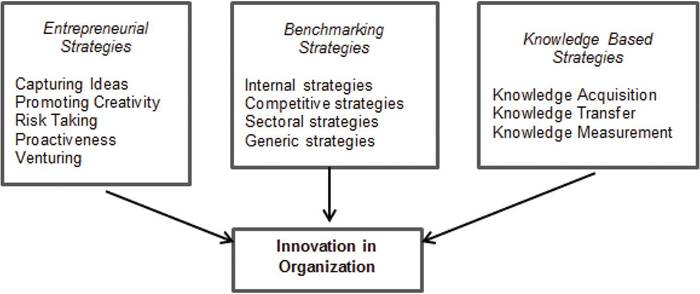
Differences between firms in the same industry are said to be the essence of innovation strategy (Bercovits and Feldman, 2005, 4).In the given literature, there is still a lack of consensus regarding the types of innovation strategies. In this study, I will categorize the emerging types of innovation strategies as entrepreneurial strategies, benchmarking strategies, imitative strategies, and knowledge based strategies. (see Figure 1)
Entrepreneurial Strategies
Entrepreneurship and innovation are positively related to each other and often complementary which help an organization flourish (Zhao, 2005,25). The basis for effective innovation in an organization is initially the adoption of an entrepreneurial strategy determined by the executive level (Saleh and Wang, 1993, 14). More specifically, this type of strategy entails three main components: promoting, risk taking, proactiveness, and persistent commitment to innovation (Saleh and Wang, 1993, 14).
Benchmarking Strategies
As mentioned above, organizations have been forced to consider and in many cases adopt or implement a wide variety of innovative management techniques. One of them is known as the benchmarking (Yasin, 2002, 217). The goal of benchmarking is to provide employees in charge of processes with an external standard for measuring the quality and cost of internal activities and to help identify where opportunities for further improvement stand (Alstete, 2000, 200). Benchmarking strategies can be industrial, internal, and generic strategies.
Figure 1. Strategies of innovation
Knowledge Based Strategies
As the market conditions vary continuously, increasing pressure of competition and customers’ expectations also appear to be the elements which define the knowledge as a factor providing strategic competitive advantage (Karabay, 2010, v-2). Fostered by the new economic developments, knowledge has begun to be an intangible asset and a valuable resource for corporations.
So, managing knowledge as an asset within an organization has raised the importance of knowledge-based strategies. Knowledge-based strategies are essential for the success of a business on organizational competencies or on the operational performance improvement (Grant and Grant, 2005, 3). Developing a knowledge management strategy enables a firm to leverage the different types of knowledge, to identify competencies required to become a innovator with capability to provide sustainability. As Renko et al (2001) suggest young firms may develop social capital as a competitive strategy to aid in acquiring new knowledge (Renko et al, 2001, 589). Another component of knowledge strategy is the knowledge transfer that happens in organizations as a process through which one unit (e.g., group, department, or division) is affected by the experience of another (Argote and Ingram, 2000, 151). Knowledge measurement is also vital for companies to ensure that they are achieving their goals. Measurement provides an important mechanism to evaluate, control and improve upon existing performance (Ahmed et al, 1999, 310).In the innovation literature, there is also a type of strategy called imitative strategy. Also known as the copycat strategy, corporations that follow this innovation strategy try to use the available technology and information usually following the innovations at a distance. In innovations protected by patents, waiting for the expiration of the patent is the result in such a strategy. In this way there is no need for business to pay any license fee. If such businesses may reach new markets, they may achieve more profit from innovations than their competitiors (Orucu et al, 2011, 63). Innovations in financial services and products are easily copied and, as a result, it is difficult for organizations to maintain a competitive advantage through product differentiation (Devlin, 1995, 25).
Besides the strategies mentioned above, external innovation strategies like mergers and acquisitions (Saleh and Wang, 1993, 14) have become significantly appropriate in scope. This is especially true for knowledge-based and high-tech industries. As a matter of fact, innovation activities carried out in cooperation with foreign institutions as well as competitors bring a wide variety of advantages such as reducing risks, ensuring economies of scale, and shortening the duration of innovation (Elςι et al, 2008, 13). Moreover, as countries move into the innovation-driven stage, owing to the higher wages, the standard of living can only be improved only if the companies are able to compete with new and/or unique products, services, models and processes (Schwab, 2012, 9). According to Gadrey et al (1994), the primary concern about the innovations in “service products” is to develop a new service which many firms tend to call a new “product.” A new service product is a new formula for managing the financial problems of a client or group of clients. This is often associated with a new contract. The second concern is the innovations in processes and organization for an identical (or almost identical) service (Gadrey et al, 1994, 7-8). This is mostly true for the financial services like banks, insurance companies and other financial intermediaries.