PROPOSE RESEARCH MODEL AND HYPOTHESES
This section examines the proposed conceptual framework and defines the associated factors, as well as hypothesized relationships. Figure 3 illustrates the Conceptual model for online stock trading based on TPB and TAM (Figure 3 illustrates the research model):
Perceived Usefulness (PUS)
Perceived Usefulness can be defined as “the degree to which an individual believe subjectively that using a particular IT device would enhance his or her job performance” (Davis, et al., 2000, p.98) Also, it can be expressed in terms of investor’s belief about using Internet stock trading, as having beneficial impact.
An individual’s perception on the extent to which the use of a particular system would improve his/her performance, is referred to as perceived usefulness (Davis et al. 1989). Empirical studies have confirmed perceived usefulness as a significant antecedent for user’s attitude towards online stock trading (Ramayah et al., 2009; Gopi et al., 2007; Ming, 2009a). Thus, it is hypothesized that:Figure 3. Proposed conceptual framework
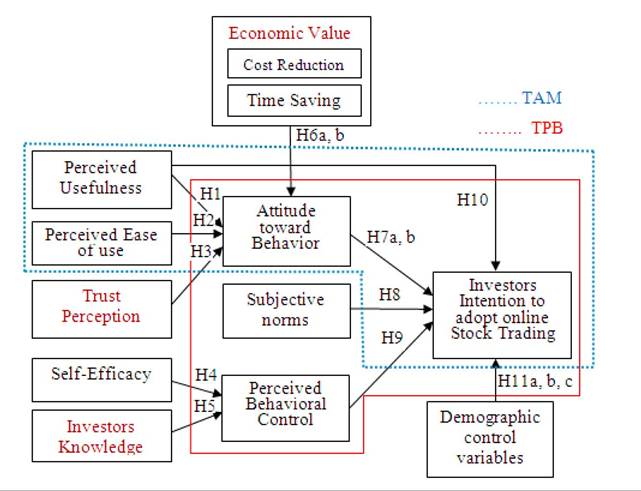
H1: Investors’ perception on the usefulness of online stock trading will be positively related to their attitude towards online stock trading.
Perceived Ease of Use (PEU)
PEU is “the degree to which a person believes that using a particular system would be free of physical and mental effort” (Davis 1989, p.214.). It is the extent of effortlessness a user perceives concerning a system (Davis et al., 2000). In the online trading service domain, it can be considered as the simplicity of the process required in learning, comprehending and using the online platform (Siriluck, 2006). Consequently, a system that is easy to operate, in turn leads to improve performance (Davis, 1989; Venkatesh et al., 2000).
Ramayah et al (2006) demonstrated that the perception of ease about a system has a direct effect on attitude towards adopting the system.H2: Perceived ease of use of online stock trading will be positively related to attitude towards online stock trading.
Trust Perception
Researchers (Gefen et al., 2003a; Pavlou, 2003; Ming-Chi, 2009b) have investigated the nature of relationship between trust and attitude towards online applications in banking and finance domains. Additional research conducted, revealed that
Equally, Ming-Chi (2009b) and Williams (2008) found significant positive relationship between trust and the confidentiality of online trading services. This study also proposes that an investor might be more willing to perform trading transactions via the online platform, when he/she places a high level of trust on the security of his/ her transactions. Therefore, it is hypothesized that:
H3: Investors’ trust perceptions in online stock trading will be positively related to their attitudes towards adopting online stock trading.
Perceived Self -Efficacy (SE)
A person’s belief in his or her ability and cognitive skills as adequate enough to cope with a given events is termed ‘Perceived self-efficacy’. According to Ajzen (2002) PBC evaluates the extrinsic factors, which influence the performance of behaviour based on one’s capability, while perceived selfefficacy evaluates one’s behaviour with respect to a variety of extrinsic variables. Basically, individuals’ with high self-efficacy are expected to possess better cognitive ability and excel under various situations, which demand quick decision making and motivation (Bandura, 1997). The effect of self efficacy has been realized in earlier studies on the acceptance of computer technology. For instance, researchers have confirmed the existence of a positive relationship between self efficacy and intention towards technology adoption (Bandura, 1997; Chou, Lee, et al., 2004; Eastin et al., 2000; Hsu et al., 2004; Taylor & Todd, 1995b).
Consequently, this study proposes that:H4: Investors self-efficacy on online stock trading service will be positively related to their perceived behavioural control.
Investors' Knowledge for Investment
Perceived knowledge can be described as an individual’s perception on his or her capability to understand new technology (Michelle, 2005). Knowledge is expected to have an influential impact on a person’s decision to use online trading service (Ramayah et al., 2009). Based on the extension of the TPB model, the level of consumer’s knowledge was shown to have a significant effect on PBC, and can also be considered as a good indicator of intention (Abroud et al., 2010). In essence, an individual who lacks confidence in handling a new challenge might resent change. Conversely, an investor who is confident in his/ her ability in conducting online transaction will exercise control over the use of online platform.
H5: Investors perception of their knowledge in online stock trading is positively related to PBC to use online stock trading service.
Economic Value (Time Saving and Cost Reduction)
Keeney (1999) describes cost reduction and time saving as functions of economic value of e-finance as well as the two important components for transaction costs in micro-economics. Transaction cost theory (TCT) proposes that a buyer will continue to obtain information until the point where the average cost of attaining extra information is equal to or more than the average benefit expected (Steiger, 1990; Urbany 1986). Expressing this in the light of economic theories of consumer behavior, it could be suggested that the economic value of e-commerce has a positive influence on online consumer behavior. Also, research model based on TAM, considers both cost reduction and time saving as the external belief which direct consumers’ attitude towards online trading service. Following the above, it is hypothesized that:
H6a: Investors perception on cost reduction will be positively related to their attitude towards online stock trading.
H6b: Investors perception on time saving will be positively related to their attitude towards online stock trading.
Attitude towards Online
Stock Trading
Individual’s attitude towards technology is the only common variable across the three theories of TRA, TAM and TPB. According to Fishbein et al, (1975, p.77) attitude represents “a person’s general feeling of favorableness or unfavourableness towards some stimulus object.” This variable has been established to have a direct effect on behavioural intention as well as indirect effect on the actual behaviour (Fishbein & Ajzen, 1975; Ajzen, 2001; Davis et al., 1989). Further studies have proven the significant effect of investors’ attitude on their intention to adopt online trading service (Fan, 2001); Kim et al., 2004; Park et al., 2003; Ramayah et al., 2009). Accordingly, the below hypothesis is suggested.
H7a: Investors attitude toward using Internet stock trading will be positively related to their intention to accept Internet stock trading platform.
Attitude as a Mediator
This study considers attitude as the mediator of the direct relationship between the PUS and the behavioral intention. Attitude may be considered as a mediator to the extent to which it has an influence on the effect which the independent variable (i.e. intention) has on the dependent variable (i.e. PUS). Cheng, Lam, and Hsu (2004) confirmed the mediating effect of attitude on the relationship between past behavior and customer dissatisfaction. Prior works in electronic learning, competency management have also revealed that the relationship between perceived usefulness and behavioural intention is mediated by individual’s attitude. (Hanneke Heinsman, Hoogh, & Koop- man, 2007). Therefore, the hypothesized relationship is stated as:
H7b: Attitude towards online stock trading mediates the relationship between the perceived usefulness and investors’ intention to adopt online stock trading.
Subjective Norms (SN)
This construct is actually related to the social pressure that directs an individual to exhibit certain behaviour as well as the individual’s perception of this pressure.
It is based on the philosophy that the behaviour of an individual is affected by his/ her attitude as well as idea on the social group to which he/she belongs (Ajzen, 1991). For the purpose of this research, subjective norm is defined as the extent to which the family, friends, competitors and peers acknowledge the use of online trading service. Several empirical research have confirmed the effect of subjective norm on the intention to use online trading (Ruben, Gerard, & Roberto, 2010; Ramayah et al., 2009). Thus, it is hypothesized that:H8: Investors subjective norm regarding Internet stock trading will influence their intention to adopt Internet in stock trading.
Perceived Behavioural
Controls (PBC)
Ajzen (1989) expressed behavioural controls as the perception of one’s belief about the capability to exhibit a specific behaviour. Generally, it can be defined as, ‘the extent to which an individual has the ability to perform (how much of the behaviour is under his control) a specific behavior’. This research recognized the control of perceived behaviour based on the level of difficulty that is involved in order to execute trading transactions over the Internet. Extant literature suggests that perceived behavioural control will have positive effect on the intention to use online stock trading (Gopi et al., 2007; Hsing, 2005; Lau, 2002). Thus, it is hypothesized that:
H9: Investors perceived behavioural control will be positively related to their intention to use online stock trading.
Perceived Usefulness and Intention
Individual’s intention can be defined as “the degree to which a person has formulated conscious plans to perform or not to perform some specified future behaviour” (Davis et al., 1992,p. 134). Prior studies did not find any evidence to support the relationship between perceived usefulness and intention to use online stock trading service, however studies in other context like Internet banking, e-service, and online shopping (Liao et al., 2001; Venkatesh et al., 2000; Ming-Chi, 2009b) have confirmed this relationship.
Consequently, as usefulness is one of the main elements of attitude, the present study further proposes the possibility of a direct relationship between investors’ PUS and their intention to use online stock trading platform. The related hypothesis is presented as follows:H10: Investors’ perceived usefulness of online stock trading will have a positive effect on their intention to adopt online stock trading.
Demographic Variables
Demographic analysis examines the effect of differences in gender and age on individual’s intention to adopt technology, like e-commerce (Morris et al., 2000). Apparently, differences in gender, age, and education will likely have significant influence, as the determinants of individual’s behavioural intention. Prior studies revealed that customers demographic can be deployed in understanding their needs and effectively delivery offering to meet such specific needs (Bellman et al., 1999; Bhatnagar et al., 2000; Chan et al., 2004). Consequently, it is hypothesized that:
H11a: The Age of investors will have positive relationship with their intention to adopt online stock trading platform.
H11b: Investors gender will have positive relationship with their intention to adopt online stock trading platform.
H11c: The educational level of investors will have positive relationship with their intention to adopt online stock trading platform.