Effective Writing and Drafting
An advocate will need to communicate with the client as well as communicating the client's case to other legal professionals and the court. Writing in an organised and logical manner will ensure that important information is presented in a way that is easy for others to read and digest.
This means that the information that you have previously gathered must be recorded and presented accurately and clearly. In addition, following procedural rules will ensure that documents are drafted in a way that will avoid errors or render a document legally invalid. When drafting legal documents for the court it is acceptable to use legal terms and include references to cases. However, the court encourages the use of simple and concise language when drafting documents. Just as your planned arguments will need to identify the main issues and disputed facts, your court documentation will also need to clearly set out your client's case in a concise and logical way.How to Draft Legally Effective Documents to Achieve Objectives
3.2.1 Drafting Case Documents (‘Statements of Case')
Drafting is a preparatory skill that all advocates will need to become proficient in, particularly when drafting skeleton arguments and consent orders. One of the most common documents that an advocate will draft is a skeleton argument. The court provides guidance on how skeleton arguments and other written submissions should be submitted to the court. For example, the guidance covers font size, paper size, line spacing, length and content (see, for example, Criminal Practice Direction Division XII D.17 for criminal proceedings). You will find an example of skeleton arguments in a civil case in Part B of this guide.
Drafting documents from scratch or using precedents in the form of pre-drafted documents will help to ensure that you set out your arguments clearly and in a way that reflects your client's goals.
It is important to use precedents with care as the precedents may not precisely reflect the nature of the case that you need to argue. Do not copy precedents verbatim but instead use them as an aid to create your own arguments. Precedents can be found on legal databases such as Westlaw, Lawtel and Practical Law.
Court proforma documents are different from a precedent in that they are templates for court forms and determine the layout, look, and to some degree, the content of the documents to be used in court proceedings. These should be followed as required by the form itself. An example can be found in form N244. This is the application notice, a form used to commence most interim hearings in the civil court. Another example is the claim form (form N1) in which the claimant sets out particulars of their claim. These forms, and others, can be found on the government website (www.gov.uk).
In civil proceedings, the court usually prescribes the content of documents and how documents should be formatted and bound. Advocates should familiarise themselves

with the requirements under the Civil Procedure Rules (‘CPR’) Practice Direction 5A para 2.2 which includes the requirement that all documents are legible, and pages numbered consecutively.
In civil proceedings, all documents setting out the nature of the case and the nature of the defence (known collectively as statements of case) are to be drafted following the requirements set out in CPR Part 16. For example, one of the documents that will set out the claimant’s case is known as the particulars of claim. Part 16 and its accompanying practice direction states that this document must contain certain information and headings such as the name of the court, the claim number, the title of the proceedings and the claimant’s address for service. The document must also contain a statement to the effect that the facts mentioned in the particulars of claim are true (this is required by Part 22).
It is important for an advocate to understand how statements of case and other court documentation should be drafted as it may be possible to argue at an interim hearing that the opponent’s application should fail because of procedural errors in the drafting of documentation or the failure to follow other procedural rules.
Drafting Example 1
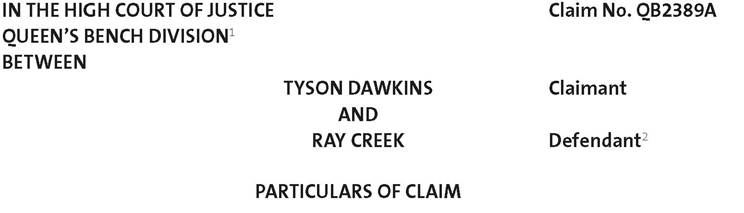
Below you will find an example of a particulars of claim document relating to a personal injury road traffic accident claim in the civil courts. This document is matched with the procedural requirements (see footnotes) under the Civil Procedure Rules.
1. On the 14th August [year] the Claimant was driving his Mini Electric motor vehicle registration number RE75RDT 765R along Crescent Road, Anytown, Landshire when a BMW Roadster motorcycle registration number BM56XED driven by the
[1] The name of the court and the claim number are required under CPR PD 16 para 3.8 (1)).
[1] The name of the parties forms part of the title of the proceedings and is required under CPR 16 PD para 3.8 (3)). See CPR PD 7A para 4.1 for the full details of the headings for a statement of case such as a particulars of claim.

Defendant emerged from a side road known as Pheasant Walk and collided with the motorcycle.
2. The above accident was caused by the negligence of the Defendant.
Detailed Allegations of Negligence of the Defendant
a) Driving too fast
b) Failing to stop at a stop sign
c) Failing to give priority to the Claimant
d) Emerging from the junction when it was not safe to do so
e) Ignoring or inadequately observing the signs, markings and layout of the junction
f) Failing to exercise sufficient care and attention by giving consideration to other traffic on the road
g) Failing to adequately observe or notice the claimant and/or the claimant’s motor vehicle at all or in time
h) Having emerged from the junction, failing to slow down, swerve or avoid the claimant’s motor vehicle
i) Carelessly managing or controlling his motorcycle so as to cause the accident.[4]
Further on the 30th September [year] at the Landshire Magistrates Court the Defendant was convicted of the offence of careless and inconsiderate driving under section 3 Road Traffic Act 1988.[5] This conviction is relevant to the issue of negligence in this matter and the Claimant intends to rely upon it as evidence in this action.
As a result of the Defendant’s negligence, the Claimant has suffered injury in the form of a broken hip and bruising to his face, legs and arms as well as loss and damage.[6]
Details of Consequential Loss
See attached Schedule of Loss. Further the Claimant claims interest upon such damages pursuant to section 35A of the Senior Courts Act 1981.[7]
Details of Injury
The Claimant whose date of birth is 11th April 2000 [8]was caused pain, suffering and loss of amenity. Further information is contained in the attached medical report.
Details of the Basis of the Claim for Interest
Interest is claimed under section 35A of the Senior Courts Act 1981.[9]
Special Damages
Interest is claimed on each and every item of quantifiable and consequential loss incurred from the date the loss occurred and to be assessed under the provisions of the Court Fund Rules 2011 (as amended) at half the prescribed full special account rate.[10]
General Damages
The Claimant claims interest on general damages at the rate of 2% from the date of service of the claim form in this case until the date of judgment.
AND the Claimant claims:
1. Damages exceeding £50,000[11]
2. Interest pursuant to section 35A of the Senior Courts Act 1981
3. STATEMENT OF TRUTH
The claimant believes that the facts stated in this particulars of claim are true. The claimant understands that proceedings for contempt of court may be brought against anyone who makes, or causes to be made, a false statement in a document verified by a statement of truth without an honest belief in its truth.[12]
Signed...Tyson Dawkins...............
Dated this 30th day of October [year]
FairLaw LLP
30 Market Square Any Town Landshire
Solicitors for the Claimants who will accept service of proceedings at the above address.[13]
Note the wording for the Statement of Truth in the sample document above.
A statement of Truth must also be incorporated into other case documents, including av expert's report (although the wording differs slightly). See the list below for examples of documents that should contain a Statement of Truth:1. Particulars of Claim
2. Acknowledgement of Service (Part 8 Claims only)
3. Certificate of Service
4. Defence
5. Defence and Counterclaim
6. Reply
7. Request for Further Information
8. Witness Statements
9. Expert's Report
It is important to ensure that all documents that you draft comply with court requirements. In the case of Gould and Others v R [2021] EWCA Crim 447 technical errors occurred in the drafting of charges in four conjoined appeal cases, Edis LJ noted that “it is the duty of the prosecution to stop making basic procedural errors” [3]. The errors included typographical errors resulting in the wrong dates being used on indictments, failure to properly particularise multiple charges in terms of identifying the victims and failure to note that the date the offence was committed meant it did not come under new provisions for sentencing made by a change in the law. The court noted that such errors could, in certain circumstances, lead to the proceedings being rendered null and void where the procedure to correct the errors was in itself defective and led to convictions being quashed in the case of the defendant Gould.
Accuracy, conciseness, preciseness and quality are therefore all to be regarded as important drafting skills needed by a competent advocate.