Legal Research
An advocate will ordinarily use their existing legal knowledge to identify the legal issues involved as the client begins to tell their story. However, an advocate should always check that their understanding of the law is up to date and research any areas of law that they are unfamiliar with.
Recognising when legal research is needed is essential to good preparation. The purpose of using sources of authority is to enable an advocate to present a reasoned case with solutions that have previously been accepted by the court as sound and rational.An advocate should be able to identify the correct resources to use to undertake the research. This may be in the form of court procedural rules, cases, legislation, or other sources of law such as books of authority.
When referring to procedural rules, an advocate must always identify the specific rule (and where applicable) the subsection of the rule that they are relying on in making or opposing the application.
Sometimes the paragraphs or sub-paragraphs must be read in conjunction with another in order to fully understand what is required. It is important to pay attention to whether sub-sections use the words ‘or’ or ‘and’ to connect other sub-sections. Let us take the example of the Civil Procedure Rules (‘CPR’) Part 24.2. This rule provides that:
The court may give summary judgment against a claimant or a defendant on the whole of the claim or on a particular issue if:
(a) It considers that
(i) that claimant has no real prospects of succeeding on the claim or issue; or
(ii) that defendant has no real prospect of successfully defending the claim or issue; and
(b) there is no compelling reason why the case or issue should be disposed of at trial.
An application under CPR 24.2 can therefore rely on either ground 24.2(a)(i) or 24.2(a) (ii) but both grounds must also establish (b) that there is no compelling reason why the case or issue should be disposed of at trial.
We will look at this particular procedural rule in more detail in Part B.
Using Cases as Precedent
2.4.1 ResearchingCases
Legal research will involve an advocate finding appropriate cases (often referred to as ‘common law') to support the factual and legal arguments that they wish to make. Once they have found the names of useful cases, they will then read the full case in the relevant law report. The reason why it is vital that law reports are read in full is that only a portion of a court's decision is binding:
ratio decidendi - This is the reason for deciding the case and is where the legal principle arising from the case is to be found. It is essentially the statement of law that has been applied in deciding the legal problem raised by the facts of the case.
obiter dicta - This can be loosely defined as ‘things said by the way'. These are additional legal statements made by judges in the case but do not form part of the final decision. Such statements are not binding and are simply the opinion of the judge, though they may be persuasive in arguing a different point of view to show a different approach could or should be taken.
Judgments do not always distinguish between what is the ratio and the parts that form obiter only. It requires skill in ascertaining this from reading the cases. This is because a panel of judges can each give different reasons for the decision of the court.
If we take the example of theft in criminal law, we find the ratio decidendi in the case of R v Morris [1984 AC 320 [332] in the judgment of Lord Roskill. The ratio decidendi provides an interpretation of the meaning of ‘appropriation' in s. 3 of the Theft Act 1968. The meaning is taken to include the usurpation or interference of the ‘right' (singular) or ‘rights' (plural) of the owner. Therefore, any of the rights of an owner could be appropriated.
However, Lord Roskill also included further commentary, which for some time was believed to be part of the ratio decidendi and this was that usurpation or interference of those rights could only occur in the absence of the consent of the owner.
This part of the decision however conflicted with a previous House of Lords decision in R vLawrence [1972] AC 626 which stated that appropriation could occur even with the consent of the owner.It took another House of Lords decision in R v Gomez [1993] AC 442 to add clarity to the law by stating that Lord Roskill's comment about consent in R v Morris was obiter dicta whilst the decision about the meaning of appropriation remained the ratio decidendi.
However, an advocate who is arguing an appeal can make use of obiter dicta comments in previous decisions to try to persuade the judges that the time has come to consider a point of law afresh.
Cases may also be important in setting out a test that needs to be applied to for example, establish criminal liability or obtain a civil remedy. For example, in the case of American Cyanamid Co (No 1) v Ethicon Ltd [1975] UKHL 1 the court set out a guideline test to be met before the granting of an injunction which has become known as the ‘American Cyanamid Principles’. This requires the court to consider whether:
1. the claimant has a strong or arguable case (this means there must be a serious issue to be determined),
2. whether damages would be an adequate remedy,
3. whether the so-called ‘balance of convenience’ has been met (this involves weighing the inconvenience or loss to each party of the injunction either being granted or refused) and,
4. whether or not the status quo should be maintained instead.
An advocate’s reading of the law can be greatly assisted by the use of what we can term a ‘synopsis case’. This can be defined as a case that surveys and summarises the different previous court decisions affecting an area of law and then either clarifies the importance of certain decisions or adds a new principle. An example of a ‘synopsis’ case would be R vJogee [2016] UKSC 8, which clarified the criminal law in the area of accomplices. The decision in Jogee corrected previous case law which had wrongly concluded that foresight was proof of intent rather than merely evidence towards the proof of intent.
You will find a helpful list of ‘synopsis cases’ in Table B in Chapter 5.2.4.2 Research Trail
Legal research often starts with one case leading to the reading of another in order to establish how a legal principle has developed. If we return to Case Example 2 for example, conducting further legal research about the use of medical evidence to prove diminished responsibility would, as stated, take us to cases such as R vDix. This case tells us that medical evidence is necessary to establish a defence of diminished responsibility. Further research might lead us to cases such as R v Brennan [2014] EWCA Crim 2387. This case establishes that an expert who is a forensic psychiatrist might be able to go further and give evidence on the ultimate issue of guilt and that unchallenged medical evidence that supports the defence should be accepted.
In terms of deciding the evidence that might be needed to establish substantial impairment, researching cases such as R v Golds [2016] UKSC 61 would help to clarify the extent of the direction that a judge can give to the jury on this issue. The word ‘substantial’ is a matter of degree but should be regarded as ‘weighty’ or ‘important’ and there is no need to define it for the jury beyond what is commonly understood.
There are also resources available that will highlight cases that have placed a particular interpretation on a procedural rule. For example, in civil cases you can find cases that relate to the relevant civil rule that you are searching by using the White Book (Sweet & Maxwell), The Civil Court Practice: The Green Book (LexisNexis). In criminal cases you can find cases that relate to the relevant rule that you are searching by using books such as Stone's Justices' Manualfor Magistrates' Court (Butterworths) or Blackstone's Criminal Practice (Oxford University Press). The court rules themselves can also be accessed online (www.gov.uk). The Supreme Court has its own set of rules known as the Supreme Court Rules and these can be found on the Supreme Court website (www.supremecourt.uk).[II]
2.4.3 Citing Cases
As stated earlier, it is important to note that the court appreciates brevity, therefore, when using cases it is important to use cases that establish a legal principle rather than merely being illustrative of that principle or merely restating it.
This is set out in court practice directions - see, for example, the Criminal Practice Direction 2015 (as amended).However, it may be relevant to also cite cases that follow a similar fact pattern as the facts in your own case.
When citing cases in a skeleton argument, an advocate should always provide the neutral citation followed by the law report reference. A neutral citation is the unique number that HM Courts and Tribunals Service has given to a case and this will first appear when the judgment is first published by the court.
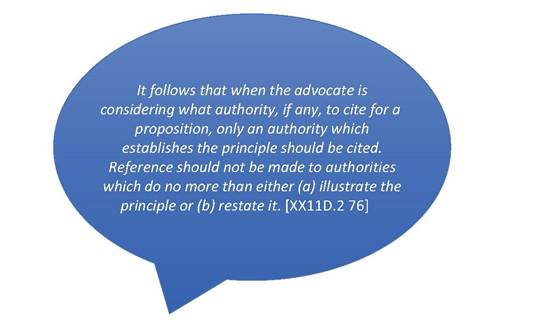
Figure 2.4 Citing Authorities.
If, for example, we take the case of R v Dowds from Scenario 2, the neutral citation given is R v Dowds [2012] EWCA Crim 281. ‘EW’ is an abbreviation for England and Wales and ‘CA’ is an abbreviation for the Court of Appeal. ‘Crim 281’ tells us that it is criminal case number 281 for the year 2012.
This neutral citation should then be followed by whatever law report is being used by the advocate (assuming the case has been reported in a law report). For example, the same case can be found reported in the All England Law Reports at [2012] 3 All ER 154. The full case citation required would therefore be R vDowds [2012] EWCA Crim 28, [2012] 3 All ER 154.
The Practice Direction: Citation of Authorities 2012 states that where a case is reported in the official law reports of the Incorporated Council of Law Reporting (AC, QB, ch, fam) then those reports must be cited as they are regarded as the most authoritative reports.
Neutral citations were introduced in 2001 by the Practice Directions (Judgments: Form and Citation). Therefore, not all cases will have a neutral citation, although some older cases have been given neutral citations. If a case does not have a neutral citation then in those circumstances you should simply cite the law report reference using the official law reports first (AC, QB, ch, fam).
For details of a full list of law reports and their abbreviations you can use resources from websites such as BAILII, Incorporated Council of Law Reporting or Cardiff Index to Legal Abbreviations.
Some examples of law report abbreviations can be found in the table below:
| All ER | All England Law Reports |
| WLR | Weekly Law Reports |
| AC | Law Reports: Appeal Cases |
| QB | Law Reports: Queen’s Bench Division |
| ECR | European Court Reports |
| EHRR | European Human Rights Report |
| Cr App R | Criminal Appeal Reports |
| UKSC | Law Reports: Supreme Court |
| CA | Court of Appeal |
| M & W | Meeson and Welsby’s Exchequer Reports |
| Exch | Exchequer Reports |
| Ll LR | Lloyd’s Law Reports |