Researching Legislation
Cases are not the only legal authorities that can be used to support arguments. There are other sources of law that an advocate can draw upon. These include legislation and conventions (such as the European Convention on Human Rights 1950).
Legislation represents the laws that govern the behaviour of society. Its function is to identify wrongdoing and then to punish or offer remedies or guidance to offer protections to citizens and ensure the proper functioning of justice.
Legislation will also help an advocate to determine the legal basis for their arguments. Legislation broadly comprises statute (primary legislation), statutory instruments, regulations, orders and rules (secondary legislation) and codes of practice, e.g. codes of practice to the Police and Criminal Evidence Act 1984, the sentencing code to the Sentencing Act 2020 or the codes of practice to the Mental Capacity Act 2005 (quasi-legislation). It is always important to read the legislation in conjunction with any existing codes of practice. It is also important to read legislation in conjunction with court procedural rules.
The role of an advocate will involve reading, analysing, and evaluating legislation in the context of how it applies to their case. However, legislation is not always easy to read, particularly if it is capable of having alternative meanings applied to certain sections.
2.5.1 Statutory Interpretation
Even if legislation represents the existing law, it may be possible to argue that the legislation is incompatible with changing values and behaviour of society. An example might be found in legislation that accords certain rights to individuals based on an assumption of gender without recognising that gender can be reassigned.
Statutes/Acts of Parliament will have a commencement date after they have received Royal Assent and passed through both Houses of Parliament (House of Commons and House of Lords).
After going through a rigorous process of ‘First Reading' (formal presentation of the Bill of Parliament) the Bill progresses to ‘Second Reading' (the debate stage where the purpose of the legislation is expressed and tested) and then the ‘Committee Stage' (where a committee considers each clause of the Bill), followed by the ‘Report Stage' (where the amendments of the Bill by the committee are formally considered by the House).Finally, the Bill reaches the ‘Third Reading' (review of amendments and decision as to whether the Bill should proceed). The Parliament Act 1949 allows a Bill that has been
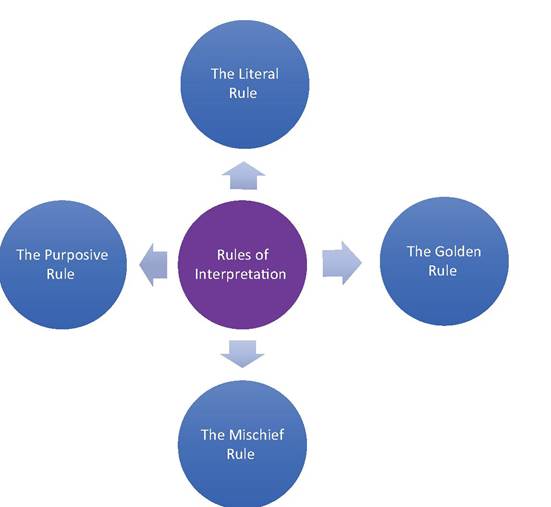
Figure 2.5 Rules of Interpretation.
passed in the House of Commons (but not in the House of Lords), to still become law, in some circumstances after a one-year delay.
An advocate can therefore learn a lot about the original intention and purpose of a statute by referring to the reported parliamentary debates in Hansard (official report of the proceedings in the House of Commons and House of Lords). This is a helpful starting point when seeking to interpret the main purpose of a piece of an Act of Parliament.
The court uses a number of established rules to help them to interpret legislation. These are shown in Figure 2.5.
2.5.2 The Literal Rule
This is where the judges give the words of the statute its ordinary, literal and plain meaning. As stated by Lord Diplock in DuportSteel vSirs [1980] 1 WLR 142 “where the meaning of a statute is plain and unambiguous it is not for the judges to invent fancied ambiguities for failing to give effect to its plain meaning because they consider the consequences of doing so would be inexpedient, or even unjust or immoral”. Such an approach arguably promotes certainty in the law and avoids usurping parliamentary sovereignty.
2.5.2 The Golden Rule
This is where the courts look at whole sentences or the statute as a whole in order to construe the true meaning of the words in order to avoid what might otherwise lead to an absurd result.
As Lord Blackburn stated in the case of River Wear Commissioners v Adamson (1876-77) 2 App Cas 743:[W]e take the whole statute together and construe it all together, giving the words their ordinary signification unless when so applied they produce an inconsistency, or an absurdity or inconvenience so great as to convince the court that the intention could not have been to use them in their ordinary signification.
This is an approach that is effectively an extension of the literal rule and therefore only operates if to give the words of the statute its ordinary meaning would produce absurdity. The words are modified to remove the absurdity or the risk of absurdity but not beyond this. The advantage of this approach is that it allows the courts to take into account public policy considerations that Parliament themselves might have taken into account if the legislation went before Parliament again.
2.5.3 The Mischief Rule
This approach involves looking behind the words of the statute to ascertain the true purpose and intention of Parliament in passing the Act and what remedy Parliament had intended to provide in order to deal with that mischief (wrongdoing). The case of Pepper v Hart [1992] UKHL 3 held that the previous rule preventing the use of parliamentary materials to interpret statute could be departed from if it would help clarify ambiguous or obscure sections of a statute or prevent the interpretation of the words of the statute leading to an absurd result. The mischief rule was intended to be used where neither the literal rule nor golden rule were appropriate. Extrinsic material such as Hansard can be used to assist the court in the interpretation of the statute. The case of Three Rivers District Council v Bank of England (No 2) (1996) 2 All ER 363 extended the use of Hansard to not just ambiguous legislation but also where the legislation might be considered to be ineffective in its intention to give effect to a particular European Directive where the issue is about the object of the statute.
2.5.4 The Purposive Rule
This is the approach most commonly associated with the Court of the European Union (also commonly referred to as the ECJ) and is used when interpreting EU law. Like the mischief rule it looks at the purpose behind the legislation. However, unlike the mischief rule it is not constrained by only being used if the literal and golden rules have first been ruled out as inappropriate to use. The courts in England and Wales have also used the purposive approach to interpret EU law. An example can be seen in R v Secretary of Statefor Health ex parte Quintavalle [2003] UKHL 13 where the court took the view that the use of this method of statutory interpretation was not necessarily restricted to interpreting EU law. In this case the issue was the

interpretation of the national law relating to cell nuclear replacement (s. 1(1) of the Human Fertilisation and Embryology Act 1990). The court held that the use of the purposive approach might be necessary for the construction of statutes generally depending on the context. In this case, the courts were asked to look at a new scientific development, which had not been in place at the time of the 1990 Act.
Sales (2017) argues that the courts now take a very modern approach to statutory interpretation that is based on a mixture of legal values and expectations from statute, established local value systems and judicial reasoning.
In 1969 the Law Commission and the Scottish Law Commission carried out a review of the efficacy of the established rules on the interpretation of statute, namely the Literal Rule, the Golden Rule and the Mischief Rule. They concluded that the starting point should always be to give a statute the meaning it was intended to have in the context of the background to which it was enacted by drawing on the setting, the language used and the assumptions of the legislator. The Law Commissions were however reluctant to lay down any legislative requirements about how statutory interpretation should take place and felt that this should be left flexible enough for the courts to be able to clarify or relax some aspects of statute to, for example, comply with international obligations.
They also recommended the revision of the Interpretation Act 1889, which was eventually replaced by the Interpretation Act 1978.The Interpretation Act 1978 is a useful starting point when interpreting words and expressions in statute as it provides some basic definitions. For example, the Act tells us that the use of the word “writing” should be defined as including typing, printing, lithography, photography and any modes capable of representing or reproducing words.
The Act also confirms that words importing the masculine gender will also include the female gender and that words in the singular will include the plural. The Act also reminds us that where an Act that has repealed a previous Act is itself repealed, this will not revive the original Act repealed unless this is expressly stated. The Interpretation Act 1978 therefore provides some helpful presumptions for the interpretation of statute.
An advocate need not therefore be constrained by the literal meaning of statute and can argue new interpretations if these are based on rational and logical arguments using rules of interpretation.
It is also worth noting that the Human Rights Act 1998 requires legislation to be interpreted in conformity with rights under the European Convention on Human Rights 1950 (s. 3 of the 1998 Act) and the courts are also expected to decide cases in a way that is compatible with the Convention (s. 2 of the 1998 Act). The Convention
rights are set out in section one of the 1998 Act and include the right to a fair trial (Article 6). A court may make a ‘declaration of incompatibility' on the basis that legislation is incompatible with Convention rights. This can result in changes to the law. For example, in R (on the application of Anderson) v Secretary of Statefor the Home Department [2002] UKHL 46, the House of Lords held that s. 29 of the Crime (Sentences) Act 1997 which allowed the Home Office to set the minimum period that had to be served under a mandatory life sentence was incompatible with Article 6 of the 1950 Convention. This was because it denied a defendant the right to have his/her sentence imposed by an independent and impartial tribunal. As a result, s. 29 of the 1997 Act was repealed by the Criminal Justice Act 2003.[3]