Maintaining Effective and Professional Relationships with the Court
It is not enough for an advocate to be knowledgeable about the subject matter of a case and to know how to present arguments in court, an advocate will also be expected to understand the inner workings of the judicial system and how to operate within it.
Acquiring the necessary skills needed to build relationships with people in a court setting is an essential part of an advocate’s work and also involves the skill of assimilation into new environments. In this section we will also look at how the advocate can learn much about the application of the law, the use of discretion and interpretation of rules constructed to ensure fairness and prevent injustices by learning from others within the court system and understanding how the judicial system is structured.4.4.1 Rights of Audience
Legal professionals are permitted to appear at court to represent clients and present cases, as long as they meet certain qualification requirements. The Legal Services Act 2007, Part 3, s. 12 and Schedule 2 reserve certain legal activities to trained and qualified practitioners and these include the exercise of a right of audience (appearing and speaking in court) and the conduct of litigation (issuing proceedings, conducting, defending or prosecuting proceedings or taking action that is linked to these activities).
Legal professionals must be authorised to carry out these ‘reserved activities’ (see s. 13(2) of the Legal Services Act 2007). Individuals admitted to the ‘Roll of solicitors’ or who are registered are authorised by the SRA automatically gain rights of audience in the lower courts (see SRA Authorisation of Individuals Regulations 2021). Registered European Lawyers must also exercise certain rights under supervision (see the European Communities (Lawyer’s Practice) Regulations 2000, s. 11 and the Services of Lawyers and Lawyer’s Practice (Revocation etc.) (EU Exit) Regulations 2020.
4.4.1.1 Rights OfAudience in the Lower Courts
Trainee solicitors or those undertaking Qualifying Work Experience must show that their work includes assisting in the conduct of proceedings and that they are supervised. They will be regarded as employees with limited rights of audience as permitted under Schedule 3, para 1(7)(a)-(c) of the Legal Services Act 2007 and can conduct
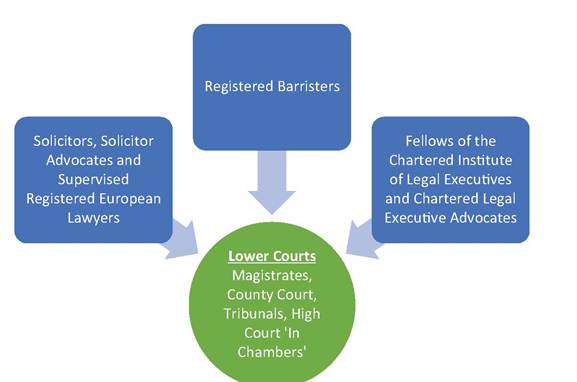
Figure 4.3 Rights of Audience in the Lower Courts.
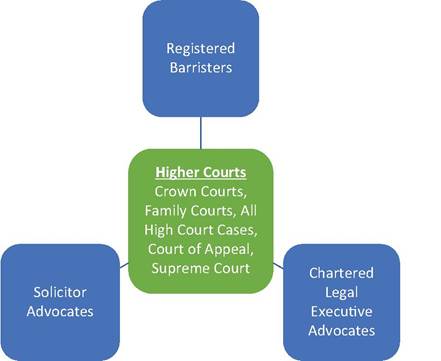
Figure 4.4 Higher Rights of Audience.
interim hearings that are held in chambers. This is a private hearing in the judge's room and does not take place in open court. ‘In Chamber' applications can take place in the County Court as well as the Family Court and the High Court.
4.4.1.2 Higher Rights of Audience
Solicitors and RELs can only exercise the right to appear in the higher courts once they have undertaken further assessment to meet the Solicitors' Regulation Authority's (‘SRA') Rights of Audience Competence Standards (this is in order to comply with the SRA Authorisation of Individuals Regulations). They will then become ‘Solicitor Advocates' with the right to appear before judges in the higher courts.

Figure 4.5 Status of ‘Solicitor Agents'.
It is a criminal offence for someone who does not have rights of audience or the right to conduct litigation to exercise that right (see Legal Services Act 2007, s. 14). The penalty is a maximum sentence of 12 months in the Magistrates' Court or two years in the Crown Court. However, it will be a defence if the person did not know or could not have known that they were committing such an offence.
Always ensure that you have checked whether you have the right to appear in a particular court and before a judge of a particular level of seniority.
An unqualified solicitors' ‘agent' will not be regarded as having rights of audience because unlike a solicitor's clerk, legal executive or paralegal, they will not usually have assisted with the preparation of the case (see Figure 4.5).Not only will you be in breach of professional regulations and the law, but if you fail to observe when you have rights of audience, you will also invite the ire of the court as such a mistake will be considered to be disrespectful to the operation and traditions of the court.
4.4.2 Courtroom Etiquette
Advocates will be expected to respect the seniority and rank of judges by following certain traditions such as standing when the judge enters the courtroom (the court usher will usually say ‘all rise' to signal when the judge is entering the courtroom). Advocates should not sit until the judge has taken his/her seat and should only stand to address the judge when it is their turn to speak. If it is necessary for an advocate to leave the courtroom before the session has finished, an advocate should bow to the judge before leaving the courtroom.
For applications that are heard in private chambers the judge will already be seated in the room across a table when the parties enter. There is no usher in the room and no need to adhere to the tradition of rising unless the judge rises during the proceedings. Rowden and Others (2018) argue that the increasing use of technology in courtrooms, such as video conferencing affects the image that advocates and the public have of the judiciary and acts to break down barriers. Judges now work more in partnership with others affecting the traditional style of judging and moving it towards a more collaborative rather than separatist style. The collaborative approach can be seen, for example, in agreed practices such as the judge seeking counsel's input into the phrasing of wording in judgments and orders or the wording of jury directions and warnings. Hollingsworth (2013), argues the collaborative approach should go further in the Youth Courts to bridge a ‘theory gap' that exists and this can be achieved by judges drawing on theory and empirical research from academics to address some of the embedded deficiencies in children's rights within the criminal justice system.
4.4.2 Advocate's Responsibilities to the Court
An advocate has a number of responsibilities to the court. For example, the SRA Standards and Regulations Code 2 sets out the standard of professionalism expected from advocates when they are involved in legal proceedings. These include refraining from misusing or tampering with evidence (2.1), or attempting to bribe witnesses (2.3), or putting forward false statements or making false representations to the court or others (2.4) or wasting the court's time (2.6). Therefore, the relationship that an advocate is expected to have with the court is both a professional and an ethical one.
In addition, in criminal proceedings CrimPR 3.3(2) explicitly places a duty on parties to actively assist the court by maintaining communication with the court officer to relay important information such as the likely plea of the defendant, the likely issues in agreement and in dispute in the proceedings, the nature of materials disclosed to the other party and whether any particular court directions are likely to be needed.
The overriding objective in Part 1 of both the CrimPR and the CPR (discussed below) places further obligations on advocates to assist the court in managing cases.
4.4.3 Upholding Undertakings Given to the Court
An undertaking is a promise to do something or refrain from doing something. Unlike a simple promise, undertakings can have repercussions if the promise is broken. In order to be considered an undertaking, the promise must be given by a lawyer in their professional capacity rather than in a personal or business capacity. Solicitors will give undertakings as part of practice, for example in a conveyancing transaction they may undertake on receiving mortgage monies from a lender to use the monies for the purchase price and not to release the monies directly to the client.
Failure to honour an undertaking can lead to disciplinary proceedings by the SRA. The court will usually request that undertakings are given in writing by an individual lawyer.
Honouring an undertaking is considered to be part of the trust and integrity that is important to the legal profession as a whole. In Briggs v The Law Society [2005] EWHC 1830 Smith LJ explained that “[t]he recipient of an undertaking must be able to assume that once given it will be scrupulously performed” [35].An advocate may give an undertaking to the court during proceedings at some point in their career. An undertaking to the court is considered to be serious and if broken can lead to the court exercising its ‘supervisory powers' over a solicitor. This might include making wasted costs orders that impose costs on the solicitors' firm as a means of punishment for poor professional conduct in court. Alternatively, the court might make contempt of court orders with the threat of a short period of imprisonment in more serious cases. Failure to honour a court undertaking is therefore viewed as serious professional misconduct.
An advocate should therefore be very careful about wording a promise as an undertaking and consider whether an undertaking is necessary and can realistically be adhered to.
In Assaubayev v Michael Wilson and Partners Ltd [2014] EWCA Civ 1491 the Court of Appeal held that the court's supervisory jurisdiction to punish for failure to honour an undertaking only extends to powers over solicitors as officers of the court and does not extend to limited liability partnerships or companies through which a solicitor practices. This was reconfirmed in Harcus Sinclair LLP and Another v Your Lawyers Ltd [2021] UKSC 32 in which the Supreme Court noted that the Legal Services Act 2007 had widened the legal market to permit different types of providers to enter the market and the Limited Liability Partnership Act 2000 further enabled partnerships to be incorporated as LLPs. However, the supervisory powers over these new bodies were lacking in legislation in terms of remedies for failures to honour undertakings. This had created a ‘lacuna' (gap) in terms of the court's authority over these new entities and will require future legislation.
4.4.4 The Overriding Objectives
The Civil and Criminal Procedure Rules impose a duty on those participating in cases to adhere to principles of fairness and transparency and to assist the court at all stages of the litigation process. As such, each of the procedural rules that govern criminal and civil cases begins with an overriding objective. These are to be found in Part 1 of each set of procedural rules. These objectives also govern how an advocate will deal with other people involved in court cases.
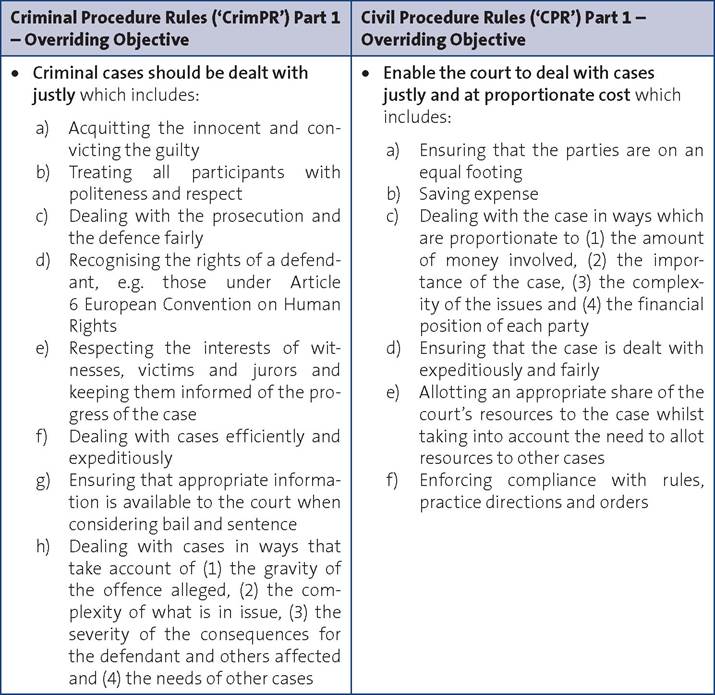
When conducting litigation, an advocate should always be mindful of whether they are adhering to the overriding objective during case preparation and case presentation.
4.4.6 Adhering to Time Limits
An advocate needs to have a good grasp of any procedural time limits imposed by the criminal and civil procedure rules because any documents which have not been served or issued within set time limits may render a prosecution or action invalid or the court may impose sanctions for a failure to observe the rules. In R (Hysai) v Secretary of Statefor the Home Department [2014] EWCA Civ 1633 Moore-Bick LJ gave a stern reminder that ',[i]gnorance of the rules will rarely, if ever, provide a good reason for failing to comply with them, especially where professionals are involved” [52].
Time limits punctuate the procedural rules. For example, in criminal proceedings, the time limit for issuing warrants, summonses and applications is set out in s. 1 and s. 127 of the Magistrates’ Court Act 1980. Unless legislation exists to the contrary, application to start a prosecution would normally be issued within six months of when the offence was committed, or a complaint arose (e.g. from the date of charging the defendant with the offence).
Civil proceedings have similar stringent rules about starting proceedings. For example, when starting proceedings, a claimant will set out the nature of their case in a ‘claim form'. The claim form can give brief details of the claim with fuller details given later in a document known as the ‘particulars of claim'. A claim form that is to be served on an opponent within the court's jurisdiction (England and Wales) must be served within four months of being issued by the court. The time period is extended to six months for claims served out of the jurisdiction (see CPR 7.5(2)). If a particulars of claim has not been set out within the claim form itself but is to be served separately then the claimant has an additional 14 days from service of the claim form to serve any particulars of claim (see CPR Part 7.4(1)(b)).
Each of the procedural rules has its own guidelines as to when a served document will be deemed to have been received. This is contained in CrimPR 4.11 in the case of criminal proceedings and in the case of civil proceedings CPR 6.14 and 6.26. Other examples of important civil time limits include preparation and service of trial bundles in civil proceedings. These must be filed in court not more than seven days and not less than three days before the trial (see CPR 39.5).
In criminal proceedings an advocate can expect to receive service of the prosecution evidence within a particular time period when a Magistrates' Court sends the defendant to the Crown Court for trial. Under CrimPR Part 3.19 this will be no more than 50 days after sending for trial (if the defendant is in custody) or no more than 70 days after sending for trial (if the defendant is on bail).
The rules contain sanctions for failure to comply with any of the procedural rules including time limits. The sanctions may include a wasted costs order or the striking out of a claim. However, the procedural rules do include provisions for time limits to be varied by the court or by agreement between the parties. In criminal proceedings this is contained within CrimPR Part 3.7 and in civil proceedings in CPR Part 3.8 (4). The sanctions contained in the rules for failure to comply with a particular rule will apply unless a party applies for relief from those sanctions.
In Denton v TH White Ltd [2014] EWCA Civ 906 the court gave guidance on the factors a judge should consider when deciding whether to grant relief from sanctions in civil proceedings. These are to be found at para 24 of the judgment. The court is expected to:
1. Identify and assess the seriousness and significance of the failure to comply with the rules, practice direction or court order that is in question.
2. Consider why the failure to comply occurred. And
3. Evaluate all the circumstances of the case that would enable the judge to deal justly with the case (this involves taking account of CPR Part 3.9(a) and (b) which relate to the need for litigation to be conducted efficiently and at proportionate cost) and to enforce compliance with rules, practice directions and orders.
Certain causes of action must be litigated within particular time periods as set out in the Limitation Act 1980. For example, in the case of personal injury actions the limitation period is three years which runs either from the date of the accident or the date of knowledge. However, sometimes an accident may happen very close to the beginning of the next day in which case there is an issue about when to start counting the time period. In Matthew and Others v Sedman and Others [2021] UKSC 19 the Supreme Court confirmed an earlier Court of Appeal decision that a fraction of a day is not recognised for the purposes of counting the limitation period and the counting must start on the following day. In ‘midnight deadline' cases the cause of action will arise at midnight and not the day after as there cannot be said to be an issue about the calculation of a fraction of a day.
In criminal proceedings, an advocate should observe time limits relating to when defendants may be held on ‘remand' (placed in custody whilst awaiting trial). These time limits are set out in the Prosecution of Offences (Custody Time Limits) 1987 as amended by the Prosecution of Offences (Custody Time Limits) (Amendment) Regulations 2000.
Confidence Exercise
Try This One on Your Own
Fill in the following time limits and limitation periods that apply under the various procedural rules and Limitation Act 1980 in the table below:
| Source/Authority | Description | Time/Limitation Period |
| Limitation Act 1980, s. 2 | Bringing a tort action | ? |
| Criminal Procedure Rules Part 10.4 | Serving a draft indictment on the Crown Court after sending a case from the Magistrates' Court | ? |
| Civil Procedure Rules Part 31.5 (3) | Disclosure report to the Court | ? |
| Criminal Practice Directions IX 39F.2 | Serving appellant's skeleton arguments for an appeal | ? |
| Limitation Act 1980, s. 9 | Recovering sums under statute | ? |
Under the Limitation Act 1980, a discretion is given to the court to dis-apply certain time limits and this discretion can be found in s. 32 of the 1980 Act (for defamation and malicious falsehood claims) and s. 33 (for personal injury or death claims). An advocate who has missed an important time limit under the Act may therefore be able to apply for the court to dis-apply the time limit so that the action can proceed.
As well as any time limits imposed by procedural rules or legislation, it is also important for an advocate to keep to any timetable imposed by the court. For example, in civil proceedings the court may direct that witness statements, experts' reports and other evidence is filed in court and served on the opposing party within a given period of time. Failure to adhere to this could lead to the court making an ‘unless order'. This is an order that provides that if the action is not taken by the extended deadline, then certain consequences will arise such as the court striking out a statement of case. CPR Part 2.9 provides that compliance by taking particular steps must be expressed by a calendar date and include the time of day rather than being loosely expressed as, for example, “within seven days”. In the case of an unless order, if it is not expressed as a calendar time and date it should be expressed with reference to the date of the unless order. For example, “within seven days of service of this order” (see CPR PD Part 40B para 8.1 and 8.2). The recent case of Poule Securities Limited v Howe and Others [2021] EWCA Civ 1373 confirms that ‘unless orders' must be clearly worded.
Both the civil and criminal courts do of course have case management powers to extend time limits as we have discussed previously.
4.4.5 Privilege and Public Interest Immunity
Whilst court proceedings involve an investigation of the truth and disclosure of information between the parties is encouraged, there are instances when information can be legitimately withheld. An advocate may claim that documents or information are subject to privilege or public interest immunity (‘PPI').
Privilege means that the document is protected due to confidentiality and may arise in three ways: (1) the information is subject to the privilege against self-incrimination where to provide information or evidence as a witness would then expose that witness to criminal charges, other penalties or forfeiture under UK law, (2) the information is subject to ‘legal professional privilege' - this may relate to communications between the client and their legal adviser, regardless of whether litigation is contemplated (known as ‘legal advice privilege') or between the client and third parties or the legal adviser and third parties where litigation is in progress or is pending (known as ‘litigation privilege') or (3) the information is protected as a ‘without prejudice' communication which arose in an effort to negotiate or reach a settlement. A claim to privilege can be made by any party before or at the trial itself.
For the purposes of legal professional privilege, the communication can be both oral or in writing and can include emails and memorandums sent internally within a company if an employee is asked to send such documents to receive legal advice or in contemplation of proceedings (see Three Rivers District Council & Others v The Governor and Company of the Bank of England (No. 5) [2003] EWCA Civ 474). In the case of legal advice privilege the dominant purpose of the correspondence must be legal advice (see Civil Aviation Authority v The Queen on the Application of Jet2.Com Limited and the Law Society of England and Wales [2020] EWCA Civ 35).
Privilege is a personal right of the originator of the information and this right can be waived and disclosure can be voluntarily made.
An advocate will normally rely on the duty of confidentiality that exists between them and the client. Such communications and information will also be protected by privilege. Whilst the client can waive that privilege from disclosure, the legal adviser cannot. The case of R v Seaton [2010] EWCA Crim 1980 clarifies that where the defendant waives his privilege to give evidence about what was said between him and his solicitor at the police station, this does not mean that the defendant is waiving the privilege to all the communications that have occurred between him and his solicitor in the course of their dealings. The facts of this case involved a defendant who alleged in his evidence-in-chief that he had made a witness statement to his solicitor which initially contained an error of identification. He alerted his solicitor to this fact. He maintained that the subsequent correct identification that he gave in his evidence at court was not a recent fabrication because he had made this same corrected identification to his solicitor before the trial. The judge held this evidence could amount to a waiver of the legal privilege between himself and his solicitor on this point alone and that the trial judge had been entitled to invite the jury to draw their own conclusions from the fact the solicitor had not been called to give evidence.
There is another instance in which disclosure may be refused and this is public interest immunity. This is where evidence is withheld or excluded on the grounds of public policy, for example, because the evidence might adversely affect the interests of the state (e.g. national security) or the administration of justice. Such documents or communications have an element of secrecy.
According to Conway v Rimmer [1968] AC 910 it is for the court to decide whether public interest immunity can be claimed and this will usually involve adopting the ‘Bangs' procedure in court of (a) identifying exactly what material or parts of materials a public interest immunity claim is sought, (b) the basis for that claim and (c) whether the material is relevant to the issues in the case (see Commissioner of the Police of the Metropolis v Bangs [2014] EWHC 546).
Even the identity of a witness can be withheld on public interest immunity grounds, for example, if a witness in a criminal trial is on a witness protection programme and their name and address cannot be revealed in open court. An advocate will therefore need to understand and identify questions of confidentiality and secrecy when dealing with clients and experts to ensure that communications and information are not inadvertently disclosed where they would ordinarily be covered by privilege or public interest immunity. We will look at privilege and public interest immunity in more detail in Part B.
4.4.6 Observing Evidential Rules in Court
In Part B we will discuss some of the key evidential rules that an advocate will come across at trial. It is important that an advocate is mindful of these rules and the judge's discretionary powers when deciding what evidence to bring before the court.
The trial judge's decision to admit or exclude a piece of disputed evidence can have a crucial influence on the outcome of a case. For example, if the trial judge decides to let the jury hear a defendant's confession to the police or lets the jury hear about a defendant's previous convictions then the defence position is seriously weakened - yet this is what happens regularly in Crown Court trials. An advocate must know when it is appropriate to ask the judge to exercise their discretion to exclude or admit evidence and in what circumstances this is permitted. This is a further example of the collaborative relationship between the judge and the advocate. A trial judge has obligations placed upon them to provide written reasons for some decisions on admissibility. We will discuss this further in Chapters 5, 6 and 7.
4.4.7 Respecting the Hierarchy of the
Courts and their Precedents
We discussed in Chapter 2 the importance of legal research in the preparation of a case, particularly in relation to the use of case law. To ensure justice, the UK legal system functions on a fundamental principle that similar cases should be treated in a similar way. In this section we will begin by considering the hierarchical structure of the court system and then consider how an advocate would be expected to work within that system.
The court structure in England and Wales is divided in three main ways:
1. By Authority (the ability to bind other courts through a hierarchical structure).
2. By Jurisdiction (depending on the type and complexity of the case).
3. By Determination (ability to hear and decide cases and/or appeals).
The use of cases as precedent relies upon an efficient system of law reporting. As discussed in Chapter 2, there are several different law reports. However, the Practice Direction: Citation of Authorities 2012 states that where a case is reported in the official law reports of the Incorporated Council of Law Reporting (AC, QB, ch, fam reports) then those reports must be cited as they are regarded as the most authoritative reports. The doctrine known as ‘stare decisis' (meaning let the decisions stand) provides that a decision made by a court in one case is binding on other courts in later cases that involve similar facts.
The doctrine of stare decisis is also subject to the level of seniority of the court making the original decision. Only decisions made in certain courts of a particular seniority will bind the decisions made in lower courts. The higher the court in terms of its place of seniority in the court structure, the more weight its decisions will have in terms of being authoritative and capable of binding the lower courts that must follow those decisions. However, the question as to whether a senior court should be bound by its own earlier decisions has been more problematic. As we will see in the section below, some of the senior courts have developed their own exceptions as to when they are bound by their own decisions.
The senior court structure in England and Wales can be illustrated by the diagram in Figure 4.6.
The lower court structure in England and Wales can be illustrated by the diagram in Figure 4.7.
4.4.10 The Courts' Jurisdiction
It is important to ensure that proceedings are brought in the correct court and that the judge has the necessary powers and jurisdiction to deal with the case. This ensures an efficient working relationship between the advocate, the judiciary and court staff.
In civil proceedings, CPR PD 7A para 2 sets out details of when a case should be brought in the County Court or the High Court. In criminal cases all cases start their
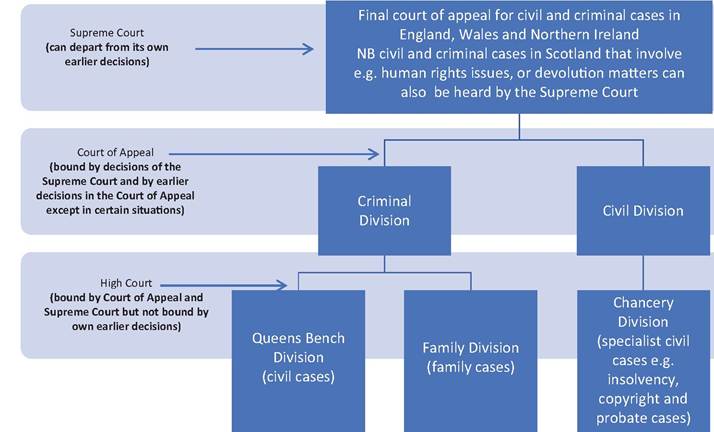
Figure 4.6 The Senior Court Structure.
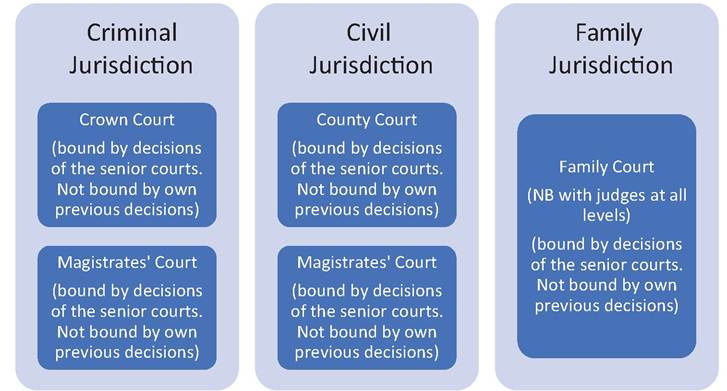
Figure 4.7 The Lower Court Structure.
journey in the Magistrates’ Court regardless of the complexity and seriousness of the charges. After the first hearing in the Magistrates’ Court (where the defendant will usually enter a plea of guilty or not guilty) a process then takes place to determine the correct criminal court based on the severity of the charges. The less serious charges are known as ‘summary only’ and will be tried in the Magistrates’ Court, including sentencing (see s. 2 of the Magistrates’ Courts Act 1980). Examples of ‘summary only’ offences are most road traffic offences.
Offences that are regarded as of medium seriousness are known as ‘triable either way offences’ because they can be tried in either the Magistrates’ or Crown Courts and the defendant is given a right to choose their preferred jurisdiction (known as ‘a right of election’) in a ‘Mode of Trial’ procedure that takes place in the Magistrates’ Court (see s. 17A and s. 18 of the Magistrates’ Courts Act 1980). The offences that are ‘triable either way’ are set out in s. 17 and schedule 1 of the Magistrates’ Courts Act 1980 and include the common law offence of outraging public decency, as well as certain offences under the Offences Against the Person Act 1861 such as threats to kill, assault occasioning bodily harm (‘ABH’) and concealing the birth of a child.
Finally, ‘indictable only’ offences are the most serious offences and include murder and rape. These cases will be sent to the Crown Court for trial and sentencing in accordance with the procedure in s. 51 of the Crime and Disorder Act 1998 (as amended by the Criminal Justice Act 2003). The transfer procedure can take place in the absence of the defendant if the court grants permission as confirmed in the case of R v Umerji [2021] EWCA Crim 598. The Magistrates’ Courts also have powers to hear an indictable case involving a child under 18 as if it were a summary trial (see Magistrates’ Courts Act 1980, s. 24).
In the criminal courts, non-magistrate court judges can constitute their own courts into Magistrates’ Courts and assume the role and function of a District Judge in the Magistrates’ Court. This is the interpretation given in the case of Gould and Others v R [2021] EWCA Crim 447 to the powers conferred on judges by s. 66 of the Courts Act 2003. However, if a judge decides to constitute their own court into a Magistrates’ Court to correct technical errors that were made in the documents before a Magistrates’ Court, they must follow the entire procedure that would have taken place in the Magistrates’ Court. They must then restore the case back to their own court’s jurisdiction. The court in question must also according to the Gould principles record what has taken place and inform the relevant Magistrates’ Court (see CrimPR Part 5.4(3).
Whilst normally in the civil courts an advocate will appear before either a District Judge or a Circuit Judge in the County Courts, other judges have the right to sit as County Court judges including the Master of the Rolls, the Lord Chief Justice and the President of the Family Division (see s. 5 of the County Courts Act 1984). As such, an advocate should always check the rules governing jurisdiction before starting or defending proceedings. If in doubt, contact the court for clarification.
4.4.8 The Role of the Jury
Lord Devlin (1956) described the jury as having the important function of assisting the judge to reach the correct decision and as fundamental to the principles of freedom in a democracy. This has been echoed by Bingham (2010) who considers jury trials to be fundamental to the rule of law. The right to a fair trial is also considered an important aspect of a defendant’s human rights and involves a determination by an independent and impartial tribunal under Article 6.1 of the European Convention on Human Rights 1950 as enshrined in the Human Rights Act 1998.
As stated in R v Pope [2012] EWCA Crim 2241 jury primacy means that the ultimate responsibility for findings of innocent or guilt rest with the jury rather than the trial judge. In this case the Court of Appeal observed “[I]t is not open to the Court to set aside the verdict on the basis of some collective, subjective judicial hunch that the conviction is or may be unsafe” [14].
Each member of the jury must swear an oath or affirm in the same way that witnesses are expected to do. However, the wording of the oath/affirmation is slightly varied (see CrimPR Part 25.6(9)):
“I swear by (include religious beliefs e.g. 'Almighty God') that I will faithfully try the defendant and give a true verdict according to the evidence”.
OR
"I do solemnly, sincerely and truly declare and affirm that I will faithfully try the defendant and give a true verdict according to the evidence”.
The jury makes their determination in secret in the sense that the parties and judge are not permitted to ask what happened in the jury room. However, research by Thomas (2010) found that despite the secretive nature of jury determinations they were fair overall, although geographical factors meant that the pool for selection of juries could affect whether there was a sufficient mix of diversity amongst jurors. In addition, Thomas found from her study that most trials did not require a jury deliberation because defendants pleaded guilty during the trial or trials were halted for technical reasons. 59% of all charges result in a guilty plea according to the research.
Developing a relationship of trust with the jury will be important to any appearance in a Crown Court for criminal cases (and for some civil disputes). It is important to note that a jury trial is not available routinely. For example, s. 17 of the Domestic Violence Crime and Victims Act 2004 limits the use of jury trials in indictable criminal cases involving multiple counts and it would be impracticable to hold a trial by jury. Section 22 of the same Act removes the role of the jury to determine the question of a defendant’s fitness to plead in a criminal case. Sections 45 and 46 of the Criminal Justice Act 2003 provide that jury trials are not to be used in the criminal courts where there is a perceived danger or evidence of the possibility of jury tampering in an indictable case. Section 11 of the Defamation Act 2013 exempts defamation cases from trial by jury unless the court orders otherwise. Under s. 69 of the Senior Courts Act 1981, certain civil cases, for example, fraud, malicious prosecution and false imprisonment cases heard in the High Court can be tried with a jury.
This tribunal of fact comprises 12 men and women who have the responsibility to determine questions of fact and the ‘ultimate issue’ of guilt, innocence or liability. A jury is also responsible for evaluating the evidence that is heard in court to decide on its reliability, accuracy and truthfulness and how much ‘weight’ (reliance, value, credence) to place on such evidence. Its role, function and responsibilities are set out in the Juries Act 1974. The jury decides whether the evidence taken as a whole is enough to convict the defendant beyond a reasonable doubt in criminal cases and on a balance of probabilities in civil cases. In assessing the weight of evidence, the jury will use their logic and experience. Typical ways of assessing evidence include evaluating whether the piece of evidence contains internal inconsistencies or is inconsistent with undisputed facts or contains glaring omissions or inaccuracies. With the testimony of live witnesses, it is also possible to assess their demeanour whilst giving evidence or being cross-examined. This observation of a witness is a means of testing the reliability of their testimony.
The jury is encouraged to reach a unanimous verdict but the 1974 Act does permit a judge to accept a majority verdict where the jury has been unable to reach a unanimous one. A majority verdict will consist of ten out of 12 jurors being in agreement. If there are only ten jurors (because the numbers have been reduced for example by death or discharge of a juror) then a majority verdict will be nine out of ten of those remaining jurors who are in agreement - see s. 17 of the Juries Act 1974 and the Criminal Practice Direction VI 26C-26M).
An advocate will need to apply the communication skills of persuasion (discussed in Chapter 3) to influence the jury into seeing the strengths of their case. Whilst taking on the role of the storyteller, an advocate must avoid making themselves the centre of the story. The jury should remain focused on the facts and the evidence to support those facts, not on the advocate. The role of the advocate is to serve the information to the jury artfully, even creatively but always in a reasoned way. This is not to say that the personality of the advocate is unimportant. An advocate’s exuberant personality may mean that they are the one who is remembered by the jury at the end of submissions. However, this should be for positive and not negative reasons. It is the advocate’s words that must find their way into the jurors’ memory.