Maintaining Effective and Professional Relationships with Witnesses
Witnesses can win or lose a case for an advocate depending on their performance on the day of the trial. Whilst witnesses should never be ‘coached’ into what to say, they should not present any surprises at trial either.
All witnesses who are to be called should be ‘proofed’ beforehand by taking a detailed summary of the evidence that they intend to give at court. The SRA Standards and Regulations provide that witnesses should not be offered inducements or other benefits to testify (2.3). It is permissible to discuss with a witness what to expect at court in terms of court formalities and the various orders of questioning. In order for a witness to give evidence they must be competent and compellable to attend court.4.5.1 Competent and Compellable Witnesses
Competency refers to the ability of a witness to testify. If a witness is not competent, they will be barred from testifying. Testimony takes place either on oath or, in some cases, unsworn (e.g. in the case of children under 14 and mentally defective adults).
In criminal proceedings there is a general test for competency which can be found in s. 53 of the Youth Justice and Criminal Evidence Act 1999. The starting point is that all witnesses (regardless of age) are competent to give evidence in court (see s. 53(1)). However, this presumption is rebuttable if the witness is not able to understand questions put to him/her as a witness or give intelligible answers (see s. 53(3) of the Act).
A competent witness will also be compellable which means that the witness can be forced to attend court to testify. A witness summons can be issued to force a witness to come to court. Failure to abide by a witness summons will be regarded as contempt of court and a witness could therefore ultimately be sent to prison for this breach.
An advocate will need to undertake their own initial assessment as to whether a witness can be regarded as competent and decide whether expert evidence should be called on this issue.
A challenge can be made to a witness's competency either before or during the trial. An advocate will also need to assess whether the lack of competency of a witness can be corrected by offering ‘special measures' (see below) and discuss this with the judge at a case management conference or specially arranged ‘ground rules' hearing.All witnesses (unless they are a party, or in some cases an expert) are expected to wait outside the courtroom until called to give evidence so that their evidence is not influenced by the evidence they have heard in court (see for example CrimPR Part 24.4(2)).
Witnesses must also take an oath or affirm unless legislation provides otherwise. An oath requires a witness to swear on their holy book and repeat the words:
I swear by (insert according to religious belief e.g. 'Almighty God') that the evidence I shall give shall be the truth the whole truth and nothing but the truth.
In the case of an affirmation (for those without a particular religious belief) the wording is usually:
I do solemnly, sincerely and truly declare and affirm that the evidence I shall give shall be the truth the whole truth and nothing but the truth.
In the youth court, a child between 14 and 18 can give an oath but it will be known as a promissory oath and will usually follow the wording below:
I promise before (insert according to religious belief e.g. 'Almighty God') that the evidence I shall give shall be the truth the whole truth and nothing but the truth.
Similarly, a child can choose to give an affirmation as follows:
I do solemnly, sincerely and truly declare and affirm that the evidence I shall give shall be the truth the whole truth and nothing but the truth.
Children under 14 can give unsworn evidence. An advocate should ensure a witness understands these formal procedures by explaining what will happen in court, including the court layout and traditions.
4.5.2 VulnerableWitnesses
In the same way that an advocate should be sensitive to the needs of a vulnerable client (see discussion in 4.3.1), an advocate should also be attuned to whether a witness might have a vulnerability both seen and unseen.
This is important as it may make it difficult for them to fully participate in a trial. This can usually be determined in a meeting with the person concerned and a full discussion should take place about how they could be assisted in court.There are certain categories of witnesses who are given special protection and treated differently during the course of a trial because their vulnerability may impact their ability to fully participate or may affect the quality of their evidence. These categories of witnesses include minors (those under 18) and those suffering from a physical or mental disability as well as witnesses who are ‘in fear'. Such witnesses may be entitled to give their evidence with special assistance known as ‘special measures' (see discussion in 4.5.3).
In criminal proceedings, a ‘ground rules hearing' is also routinely held in the case of vulnerable witnesses and this is covered by CrimPR Part 3.9. This is a pre-trial case management hearing where the court will decide on the appropriate level of questioning and treatment of a vulnerable witness at the trial.
In civil proceedings, CPR PD 1A provides that the court and advocates should identify any vulnerable witnesses at an early stage and decide whether appropriate orders or directions are needed. The category of witnesses who may be regarded as ‘vulnerable' is much wider, as under para 4 of the Practice Direction it includes not just age and physical and mental condition but also the impact that the subject matter of the trial might have on the witness, any social, domestic, and cultural circumstances and the witness's relationship to a party or another witness in the proceedings.
The civil courts can also hold a ‘ground rules' hearing (see para 8 CPR PD 1A) to determine the nature of a witness's vulnerability before they give evidence and to decide what directions to make. CPR Part 32.1(1)(c) gives the court the power to control the way in which the court receives evidence, and this includes making special measures for witnesses.
As discussed in Chapter 3, when questioning vulnerable witnesses an advocate will need to be flexible and move away from traditional styles of questioning. It is important for an advocate to avoid what is known as ‘tag' questions which are questions that are too long or complex in nature. Questions should be non-confrontational, and an advocate should avoid distressing a witness or using leading questions.
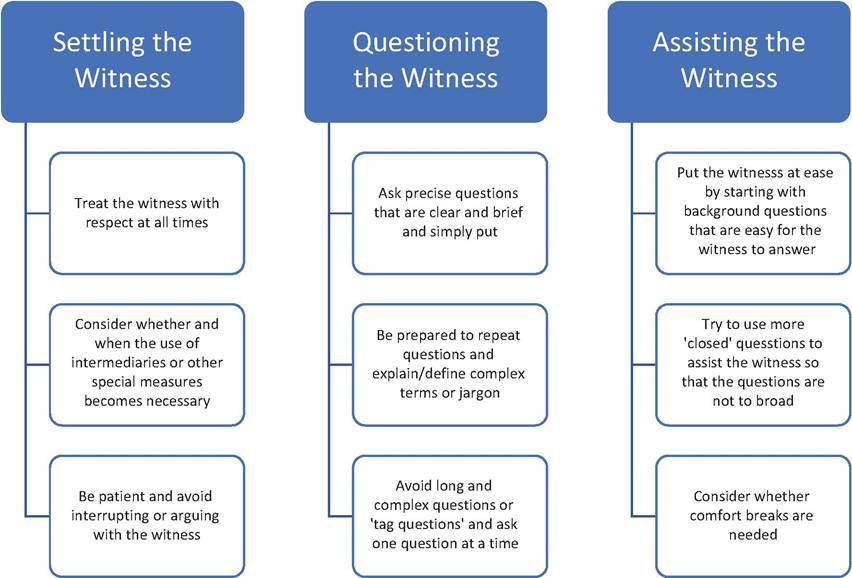
Figure4.8 HandIingWitnesses.
Building Relationships
4.5.3 Special Measures
A criminal court can make a ‘special measures direction' under s. 19 of the Youth Justice and Criminal Evidence Act 1999. This is possible if a witness is eligible for such measures due to age or mental incapacity (s. 16) or because they would otherwise be unable to testify due to fear or distress (s. 17).
4.5.3.1 Vulnerable Witnesses
Various special arrangements can be put in place for a witness and these are set out in ss. 23-30 of the 1999 Act. For example, under s. 27 of the Act a court can grant ‘special measures' to enable a child witness to give their oral evidence-in-chief by way of a video recording if it is in the interests of justice to do so. Under s. 30 of the same Act a court can order that a person suffering from a particular disability or disorder is provided with an appropriate device in court to enable questions and answers to be communicated to that witness. An advocate should be prepared in these circumstances to ensure that their vulnerable witness receives an appropriate special measures order (where applicable) and this will involve persuasive arguments about why the quality of the evidence might be diminished by the witness's vulnerability.
For Crown Courts in certain geographical areas such as Durham, Harrow, Isleworth and Wood Green, the court also has the power to make a special measures direction for video-recorded cross-examination (see s.
28 of the Youth Justice and Criminal Evidence Act 1999 brought into effect on 30 September 2021 by the Youth Justice and Criminal Evidence Act 1999 (Commencement No. 22) Order 2021).Special measures are not usually available for defendant witnesses in criminal proceedings although the court can exercise its inherent jurisdiction (power of the judge to make a decision where there is no applicable law) to order any special measures that might accommodate any special needs of a defendant. An example might be permitting the use of an interpreter or reading documents out loud if a defendant is unable to read.
Special measures can however be made for child defendants who are under the age of 18 or an adult defendant who suffers from a mental disability. They may be permitted to give their evidence by live video link (see s. 33A of the Youth Justice and Criminal Evidence Act 1999 as inserted by the Police and Justice Act 2006, s. 47). The process under CrimPR Part 18.14-17 should be followed to apply for permission from the court to put in place special measures at the trial for a vulnerable defendant.
Special measures have also been used in civil proceedings, for example, in Polanski v Conde Nast Publications [2005] UKHL10 the House of Lords confirmed that where a witness was unable to travel to the UK due to a fear of being extradited, a video conferencing order could be made to hear the witness's testimony.
Even if a witness does not fall into the category of witnesses eligible for a special measures direction under ss. 16 and 17 of the 1999 Act, an advocate can still argue that the court should use its inherent jurisdiction under s. 19(6) of the 1999 Act to make a special measures direction.
4.5.3.2 A Witness in Fear
A witness may also be regarded as vulnerable because they are ‘in fear' and will only testify if their identity is concealed. This may be because of fear of the defendant or his/her associates. In those circumstances, a court also has powers to grant an ‘anonymity order' under the Coroners and Justice Act 2009 (see CrimPR Part 18.18-22).
An advocate should be prepared in these circumstances to ensure that their witness receives an appropriate anonymity order (where applicable) and this will again involve persuasive arguments but this time about why the quality of the evidence might be diminished by the witness's fear or distress. The criteria set out in s. 88 of the 2009 Act must be met in addition. These involve showing, for example, that the order is necessary to protect the safety of a witness or another person or to prevent serious damage to property or harm to the public interest (‘condition A'), that making an order would be consistent with the defendant receiving a fair trial (‘condition B') and that it is in the interests of justice for the witness to testify and they would not testify unless an order is made or there would be a risk of harm to the public interest if the witness were allowed to testify without an anonymity order being made (‘condition C').