Professionalism and Ethics
Ethics can be loosely defined as an understanding of what society would consider ‘right’ or ‘wrong’ or ‘good’ or ‘bad’. Ethics affects how individuals make decisions because they are dependent on the definition of others.
Different people may have differing views about what is to be regarded as right or wrong behaviour. This can make decision-taking difficult. Professionalism has been defined in various ways such as belonging to a knowledgeable group with an obligation to provide a public service (Pound, 1953), characterised by individuals having autonomy, independent
judgment, or being bound by ethics (Hoyle and John, 1995) and self-governing (Lester, 2014). Boon and others (2005) argue that a profession is defined and legitimised by its control over knowledge.
Regardless of differing definitions, what most professions will have in common is that their activities and behaviour will be governed by a code of conduct based on ethics.
Professional ethics can be thought of as shared principles and values that govern professional practice. It is an expectation of how a professional person will conduct himself or herself and will usually be based on principles of fairness and transparency.
Advocates are required to follow the professional rules and codes of conduct set out by their governing body in order to help them to maintain competency. In the case of solicitors these are contained in the Solicitors Regulation Authority's Standards and Regulations Handbook. The SRA refer to ethical behaviours in the seven ‘Principles' (see below) as well as setting out the standards expected in conducting work in practice (Code of Conduct) and rules relating to holding client monies and monies from third parties (Solicitors' Accounts Rules).
1.2.1 SRA Principles
The SRA Standards and Regulations set out seven mandatory Principles that solicitors must follow.
These are:• Principle 1 - act in a way that upholds the constitutional principle of the rule of law, and the proper administration of justice. This means respecting the laws passed by Parliament and following legal processes including complying with court orders and avoiding wasting the court's time or causing unavoidable delays.
• Principle 2 - act in a way that upholds public trust and confidence in the solicitors' profession and in legal services provided by authorised persons. This principle extends beyond the solicitor-client relationship and involves protecting the reputation of the legal profession including your firm or organisation.
• Principle 3 - act with independence. This means that you should not allow your independence to be compromised by others as this will weaken your ability to remain objective.
• Principle 4 - act with honesty. This means that you must avoid being dishonest and instead act in a way that will enable others to place their trust in you.
• Principle 5 - act with integrity. This means holding yourself to a higher standard than ordinary members of the public and being careful to ensure your behaviour will withstand scrutiny.
• Principle 6 - act in a way that encourages equality, diversity and inclusion. These values are contained in legislation such as the Equality Act 2010 and should be observed in your treatment of others and in the service that you provide as an advocate.
• Principle 7- act in the best interests of each client. There is a fiduciary relationship between a solicitor and a client. The best interests of the client may relate to how you prepare their case to meet their goals and objectives but can also be reflected in your duty of confidentiality to the client and your duty to avoid conflicts of interest.
The Principles extend to life in practice but can also extend to an advocate’s social and personal life if, for example, they engage in behaviour that is likely to damage public trust in the profession (Principle 2).
Ethical behaviour towards others also helps to maintain effective and professional relationships with clients (C2) and others (C3).1.2.2 Ethics, Professionalism and Judgment
Ethics should be the heart of every action and decision-making process taken by an advocate. This is important because poor standards and unethical behavior by an advocate can impact the public at large. It can also lead to a loss of trust and faith in the legal profession, especially if poor advocacy leads to miscarriages of justice with wrongful convictions or a failure to uphold the rule of law. In the case of Medcalf v Weatherill and Another [2002] UKHL 27, Lord Hobhouse summarised the rationale for this high standard of behaviour as follows:
A Professional advocate is in a privileged position. He is granted rights of audience. He enjoys certain immunities. In return he owes certain duties to the court and is bound by certain standards of professional conduct in accordance with the code of conduct in his profession.
/M
Ethical behaviour will also help to ensure professional behaviour.
Let us now consider three principles that have commonly been the subject of cases going before the Solicitors’ Disciplinary Tribunal: Principle 2 (public trust and confidence), Principle 4 (honesty) and Principle 5 (integrity).
1.2.3 Public Trust and Confidence (Principle 2)
The key focus here is the need for the public to trust the profession as a whole and therefore the rules place all solicitors under a duty to ensure that this trust continues. The principle can be best summed up in the quote in Figure 1.3.
The protection of the reputation of the profession is regarded as so important that the obligation to protect the profession’s reputation can extend to conduct within and outside an advocate’s working life, particularly when using social media. This can be illustrated by the case of SRA v Lewis [2018] SDT Case No. 11856-2018 where a high- profile solicitor who had received anti-Semitic abuse on Twitter and subsequently issued death threats to his abusers was fined £2,500 plus costs (this was reduced from £7,500 after taking into account the abuse the solicitor had received himself).
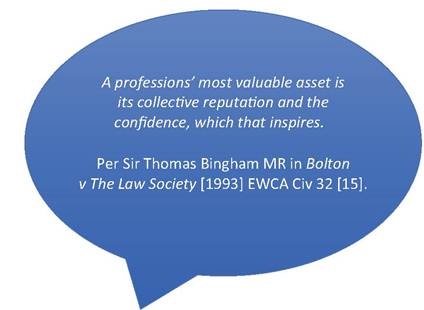
Figure 1.3 Public Trust and Confidence in the Profession.
In Beckwith v SRA [2020] EWHC 3231 (Admin) the court stated that the principle of public trust and confidence “may reach private life only when conduct that is part of a person's private life realistically touches on...the standing of the profession” [54]. As an example, the principle of public trust and confidence was said by the courts to be capable of applying to “seriously abusive conduct by one member of the profession against another” [44].
The facts of Beckwith concerned allegations of sexual misconduct by a male senior partner towards a female solicitor in a morejunior role. One of the questions in the original hearing before the Solicitors Disciplinary Tribunal (‘SDT') was whether a senior solicitor's behaviour towards a junior solicitor could be said to amount to serious misconduct. The SDT found that it did not. The appeal itself related to an earlier ruling by the SDT that the appellant, who was a partner in a city law firm, had acted without integrity and in a way likely to breach public trust and confidence by engaging in sexual behaviour following an after-work drinks gathering. The appellant was alleged to have initiated and/or engaged in sexual activity with the junior associate solicitor who had consumed a large amount of alcohol. Whilst the SDT did not accept there had been an abuse of the appellant's position of seniority it did find that the public would not have expected a solicitor to conduct himself in that way (this was a failure to uphold public trust and confidence). The SDT found that the solicitor had acted inappropriately by engaging in sexual activity in those circumstances and therefore his conduct fell below expected standards (lack of integrity). The SDT imposed a fine of £35,000 plus costs.
The matter was referred to the High Court by way of appeal. The court was asked to consider whether integrity and upholding public confidence should apply to private sexual conduct or be confined to ‘professional misconduct'.
The court held that each profession's code of conduct had to be applied as written and this varied from profession to profession. The SRA Handbook (this has now been replaced by the SRA Standards and Regulations) did not extend integrity to private sexual misconduct and confined it to matters that could be said to relate to or affect professional practice as a solicitor. In terms of upholding public trust and confidence, the court accepted that this could extend to a person's private life if it touched on how the public would expect solicitors to treat each other. However, as the SDT in its own ruling had accepted that the sexual encounter in this case was consensual and that there had not been an abuse of a position of seniority, it could not be said that the public would lose trust or confidence in the profession as a result of the appellant's conduct. The appellant had affected his own reputation (for which he had been disciplined at work) but not the reputation of the profession as a whole.It is important to note that this case is not authority to say that sexual misconduct or harassment that takes place outside work can never be caught by the rules. The SRA subsequently amended the rules after the decision in Beckwith and the guidance accompanying the SRA Standards and Regulations includes sexual harassment as an example of a breach of Principle 2. In addition, the decision in Beckwith confirmed that each case would have to be judged on a case-by-case basis. This should be done in a way that achieves a fair balance between the right to respect for private and family life and the public interest in ensuring regulation of the solicitors' profession.
1.2.4 Honesty (Principle 4)
The requirement for honesty can be found under Principle 4 of the SRA Principles. This is a relatively new addition to the Principles, for the first time it is a requirement rather than merely an unexpressed expectation. However, honesty is not defined in any of the SRA rules but implicitly it can be considered to be the opposite of dishonesty.
Whilst honesty connotes truthfulness, this is only one aspect of honesty. As Hughes LJ explained in the case of Ivey v Genting Casinos (UK) Ltd (t/a Crockfords) [2017] UKSC 67 “truthfulness is indeed one characteristic of honesty, and untruthfulness is often a powerful indicator of dishonesty, but a dishonest person may sometimes be truthful about his dishonest opinion” [75].In Bolton v The Law Society [1993] EWCA Civ 32, the courts indicated that disciplinary Tribunals will hold solicitors to a very high standard of honesty in order to “maintain the reputation of the solicitors' profession as one in which every member, of whatever standing, may be trusted to the ends of the earth” [15]. Honesty therefore connotes trustworthiness, not just truthfulness.
In this case, Mr Bolton was found to have behaved in a naive and foolish manner, but his conduct was not considered dishonest. In fact, the Solicitors Disciplinary Tribunal went so far as to accept that Mr Bolton was an honest man and the Court of Appeal also accepted this view. Nonetheless the Solicitors Disciplinary Tribunal found that Mr Bolton's action was serious enough to warrant his suspension from practising as a solicitor. Why? It was because he had not been truthful. This is because he acted on a conveyancing matter in relation to the sale of a house owned by his wife. The house was to be sold to her brother. Mr Bolton acted for all the parties in this transaction, his wife, her brother and the mortgage company, even though there were clearly potential conflicts of interest. Instead of holding the mortgage monies in the client account, Mr Bolton used some of it to pay tax due on the sale of the property and to also pay out some of the monies to his wife. In the event, Mr Bolton's brother-inlaw failed to pay the remaining £20,000 needed to complete the purchase price. The sale was never completed and the shortfall to the mortgage company was eventually remedied and repaid. The accounting error only came to light after an investigation by the regulator about an unrelated matter and Mr Bolton's accounts were inspected. Mr Bolton was found to have breached the Solicitors' Accounts Rules.
An advocate would be expected to be honest in terms of how they relay information to others, in particular, not to deliberately mislead or lie or withhold important information. This is important, not just in dealings with the client but also with the court and third parties such as experts. It may be more difficult to say no to a family member and for this reason an advocate should avoid acting for family and close relatives.
1.2.5 Integrity (Principle 5)
Integrity has been defined in the case of Hoodless and Another v Financial Services Authority [2003] UKFTT 007 (FSM) to mean “moral soundness, rectitude and adherence to an ethical code. A person lacks integrity if unable to appreciate the distinction between what is honest or dishonest by ordinary standards” [19].
In the case of Wingate and Evans v Solicitors Regulation Authority; Solicitors Regulation Authority vMalins [2018] EWCA Civ 366 (Admin) Jackson LJ summarised integrity as “a useful shorthand to express the higher standards which society expects from professional persons and which the professions expect from their own members” [97].[1]
Principle 5 of the SRA Principles requires solicitors (including trainee solicitors) and registered European lawyers and registered foreign lawyers to act with integrity. This will also ensure competency levels in terms of applying good business practice, especially in accounting and financial matters (D3).
The definition of integrity does not mean that saintliness is expected from the professional person. As noted in Wingate and Evans v Solicitors Regulation Authority; Solicitors Regulation Authority v Malins [2018] EWCA Civ 366 (Admin): “The duty of integrity does not require professional people to be paragons of virtue. In every instance, professional integrity is linked to the manner in which that particular profession professes to serve the public”[104]. The case of Wingate gives some useful examples of lack of integrity taken from previous case law, such as ‘making false representations on behalf of the client' or ‘recklessly, but not dishonestly allowing a court to be misled' [101].
The facts in Wingate provide an illustration of how it can be easy to fall into behaviour that might be considered to amount to a lack of integrity. In this case two solicitors (Mr Wingate and Mr Evans) were partners practising in a small firm, W.E. Solicitors LLP, which had fallen into financial hardship. They were unable to repay a bank loan, even after the bank agreed to take a reduced amount.
Mr Wingate therefore sought an alternative source of funding and turned to a fund called Axiom which agreed to lend £900,000. The fund specialised in funding the cost of litigation for the clients of firms. Mr Barnett, who was a member of the Council of the Law Society and also a solicitor, managed the fund. The partners thought that they could trust Mr Barnett and relied on oral statements made by him to the effect that the loan of the monies was not restricted to litigation funding but could be used for general purposes. However, the loan agreement stated that the monies could only be used for the specified purpose of litigation funding. Mr Wingate stated in evidence that he had been told by Mr Barnett the terms of the loan agreement would be varied to make it less restrictive. However, before this could happen, Axiom went into receivership and Mr Barnett was eventually struck off the Roll of Solicitors.
W.E. Solicitors were unable to repay the loan and were investigated by the Solicitors Regulation Authority. As the firm had used the funds to pay debts, including the bank repayment and sums owed to HM Revenue and Customs, they were in clear breach of the funding agreement. Mr Wingate and Mr Evans were found to be in breach of the Solicitors Accounts Rules (these are found in the SRA Standards and Regulations) as well as other professional misconduct. The Solicitors Disciplinary Tribunal originally imposed a fine of £3,000 on both Mr Wingate and Mr Evans for breach of the Solicitors Accounts Rules. The SRA appealed on the basis that this sanction was too lenient. The matter went to the High Court, which allowed the appeal, and Mr Wingate and Mr Evans then appealed to the Court of Appeal. The Court of Appeal found that Mr Wingate (who dealt with the negotiations with Axiom) should have appreciated the “highly dubious” nature of the transaction as the agreement signed by the parties did not set out the true nature of the parties' understanding of how the monies would be spent. His appeal failed. Mr Evans's appeal was allowed on the basis that his failure to obtain and read the funding agreement did not of itself mean that he lacked integrity or that he was dishonest.
Similarly, in the conjoined appeal of Malins, the court held that backdating a notice of funding arrangements by creating a letter after the event stating that such a notice was enclosed, could amount to dishonesty and therefore a breach of the principle that a solicitor should act with integrity. However, as Mr Malins had, on the facts of this case, created the letter but had not sent it, he was only acting without integrity but not dishonestly.
Whilst a lack of integrity might occur due to an act of dishonesty, dishonesty is not an essential requirement for Principle 5 to be breached. The case of Scott v Solicitors Regulation Authority [2016] EWHC 1256 illustrates why it is important to draw a distinction between dishonesty and integrity. In this case the appellant solicitor brought an appeal in the High Court against a decision made by the Solicitors’ Disciplinary Tribunal (‘SDT’). The SDT had made a finding that the solicitor appellant had acted without integrity. The original charges against the solicitor related to breaches of the Solicitors Accounts Rules and failure to cooperate with the SRA. The SDT held that the solicitor had not been dishonest in the use of client accounts. However, on the question of integrity, the court held that the solicitor did lack integrity by being reckless as to how he dealt with client money. Sharp LJ held that “a person can lack integrity without being dishonest” [48].
According to cases such as Williams v Solicitors Regulation Authority [2017] EWHC 1478 (Admin) and Newell-Austin v Solicitors Regulation Authority [2017] Med LR 194, lack of integrity (when it does not involve dishonesty) is to be judged objectively rather than subjectively and is therefore measured by the standards of the reasonable person.
Whilst integrity is to be judged objectively, dishonesty is judged both objectively and subjectively. Disciplinary tribunals such as the SDT will often align the test to the criminal test of dishonesty set out in the case of Ivey v Genting Casinos (UK) Ltd (t/a Crockfords) [2017] UKSC 67. This is a two-stage test:
1. The jury must find that the actual state of the defendant’s mind was dishonest based on the defendant’s knowledge and belief as to the facts (SUBJECTIVE li mb). Any question of the reasonableness of that belief is simply a matter of evidence, what matters is whether the belief is genuinely held by the defendant.
2. The jury must then consider whether the act itself was dishonest according to the ordinary standards of reasonable and honest people (the OBJECTIVE limb). If the answer is no, then the defendant is not to be regarded as dishonest.
Confidence Exercise
Try This One on Your Own!
Consider the following behaviours, could any of these be said to breach the above SRA Principles? If so, which one(s)?
1. You agree to lend your name to an investment fund managed by a friend. You know that the fund’s claim that investors will receive high returns is a dubious claim in the current economic circumstances. You also know that lending your name will add credibility to the scheme. You feel that this is the right thing to do to help your friend who is in financial difficulties. You have not used your firm's name in your association with the investment fund.
2. You have a private Twitter account in which you occasionally give your own political thoughts and opinions. You have a follower who opposes your ideology and repeatedly responds to your posts by leaving insulting comments. You have tried to ignore the insults but are unable to ignore a response posted by the follower as it uses derogatory comments to describe your appearance. You post a Tweet threatening to find and destroy the follower and anyone close to them.
In considering the above scenarios, remember the following:
• An advocate is expected to be trustworthy and to protect and maintain public trust.
• An advocate is expected to avoid behaviour that might be regarded as dishonest, offensive, threatening, abusive or an abuse of their position.
• Advocates have a responsibility to protect the collective reputation of the legal profession and this is more important than the interests of the advocate.
• Helping other people to act in an improper or dishonest way can also be regarded as misconduct by an advocate.
The responsibility to be ethical requires managing behaviours and this is recognised within the SRA Statement of Solicitor Competence (see SoSC A). Competency implies ethical behaviour through proficiency and meeting standards.