Chapter 40 The Appeal of Parallel Distributed Processing James L McClelland, David E. Rumelhart, and Geoffrey E. Hinton
What makes people smarter than machines? They certainly are not quicker or more precise. Yet people are far better at perceiving objects in natural scenes and noting their relations, at understanding language and retrieving contextually appropriate information from memory, at making plans and carrying out contextually appropriate actions, and at a wide range of other natural cognitive tasks.
People are also far better at learning to do these things more accurately and fluently through processing experience.What is the basis for these differences? One answer, perhaps the classic one we might expect from artificial intelligence, is “software." If we only had the right computer program, the argument goes, we might be able to capture the fluidity and adaptability of human information processing.
Certainly this answer is partially correct. There have been great breakthroughs in our understanding of cognition as a result of the development of expressive high-level computer languages and powerful algorithms. No doubt there will be more such breakthroughs in the future. However, we do not think that software is the whole story.
In our view, people are smarter than today's computers because the brain employs a basic computational architecture that is more suited to deal with a central aspect of the natural information processing tasks that people are so good at. We will show through examples that these tasks generally require the simultaneous consideration of many pieces of information or constraints. Each constraint may be imperfectly specified and ambiguous, yet each can play a potentially decisive role in determining the outcome of processing. After examining these points, we will introduce a computational framework for modeling cognitive processes that seems well suited to exploiting these constraints and that seems closer than other frameworks to the style of computation as it might be done by the brain.
We will review several early examples of models developed in this framework, and we will show that the mechanisms these models employ can give rise to powerful emergent properties that begin to suggest attractive alternatives to traditional accounts of various aspects of cognition. We will also show that models of this class provide a basis for understanding how learning can occur spontaneously, as a by-product of processing activity.Multiple Simultaneous Constraints
The mutual influence of syntax and semantics Multiple constraints operate... strongly in language processing.... Rumelhart (1977) has documented many of these multiple constraints. Rather than catalog them here, we will use a few examples from language to illustrate the fact that the constraints tend to be reciprocal: The example shows that they do not run only from syntax to semantics—they also run the other way.
It is clear, of course, that syntax constrains the assignment of meaning. Without the syntactic rules of English to guide us, we cannot correctly understand who has done what to whom in the following sentence:
The boy the man chased kissed the girl.
But consider these examples (Rumelhart 1977; Schank 1973):
I saw the grand canyon flying to New York.
I saw the sheep grazing in the field.
Our knowledge of syntactic rules alone does not tell us what grammatical role is played by the prepositional phrases in these two cases. In the first, "flying to New York" is taken as describing the context in which the speaker saw the Grand Canyon—while he was flying to New York. In the second, "grazing in the field" could syntactically describe an analogous situation, in which the speaker is grazing in the field, but this possibility does not typically become available on first reading. Instead we assign "grazing in the field" as a modifier of the sheep (roughly, "who were grazing in the field"). The syntactic structure of each of these sentences, then, is determined in part by the semantic relations that the constituents of the sentence might plausibly bear to one another.
Thus, the influences appear to run both ways, from the syntax to the semantics and from the semantics to the syntax.In these examples, we see how syntactic considerations influence semantic ones and how semantic ones influence syntactic ones. We cannot say that one kind of constraint is primary.
Mutual constraints operate, not only between syntactic and semantic processing, but also within each of these domains as well. Here we consider an example from syntactic processing, namely, the assignment of words to syntactic categories. Consider the sentences:
I like the joke.
I like the drive.
I like to joke.
I like to drive.
In this case it looks as though the words the and to serve to determine whether the following word will be read as a noun or a verb. This, of course, is a very strong constraint in English and can serve to force a verb interpretation of a word that is not ordinarily used this way:
I like to mud.
On the other hand, if the information specifying whether the function word preceding the final word is to or the is ambiguous, then the typical reading of the word that follows it will determine which way the function word is heard. This was shown in an experi- ment by Isenberg, Walker, Ryder, and Schweikert (1980). They presented sounds halfway between to (actually ∕t7) and the (actually ∕itself to one until all of the constraints are taken into account.
Understanding through the interplay of multiple sources of knowledge It is clear that we know a good deal about a large number of different standard situations. Several theorists have suggested that we store this knowledge in terms of structures called variously: scripts (Schank 1976), frames (Minsky 1975), or schemata (Norman and Bobrow 1976; Rumelhart 1975). Such knowledge structures are assumed to be the basis of comprehension. A great deal of progress has been made within the context of this view.
However, it is important to bear in mind that most everyday situations cannot be rigidly assigned to just a single script.
They generally involve an interplay between a number of different sources of information. Consider, for example, a child's birthday party at a restaurant. We know things about birthday parties, and we know things about restaurants, but we would not want to assume that we have explicit knowledge (at least, not in advance of our first restaurant birthday party) about the conjunction of the two. Yet we can imagine what such a party might be like. The fact that the party was being held in a restaurant would modify certain aspects of our expectations for birthday parties (we would not expect a game of Pin-the-Tail-on-the-Donkey, for example), while the fact that the event was a birthday party would inform our expectations for what would be ordered and who would pay the bill.Representations like scripts, frames, and schemata are useful structures for encoding knowledge, although we believe they only approximate the underlying structure of knowledge representation that emerges from the class of models we consider elsewhere. Our main point here is that any theory that tries to account for human knowledge using script-like knowledge structures will have to allow them to interact with each other to capture the generative capacity of human understanding in novel situations. Achieving such interactions has been one of the greatest difficulties associated with implementing models that really think generatively using script- or frame-like representations.
Parallel Distributed Processing
In the examples we have considered, a number of different pieces of information must be kept in mind at once. Each plays a part, constraining others and being constrained by them. What kinds of mechanisms seem well suited to these task demands? Intuitively, these tasks seem to require mechanisms in which each aspect of the information in the situation can act on other aspects, simultaneously influencing other aspects and being influenced by them. To articulate these intuitions, we and others have turned to a class of models we call Parallel Distributed Processing (PDP) models.
These models assume that information processing takes place through the interactions of a large number of simple processing elements called units, each sending excitatory and inhibitory signals to other units. In some cases, the units stand for possible hypotheses about such things as the letters in a particular display or the syntactic roles of the words in a particular sentence. In these cases, the activations stand roughly for the strengths associated with the different possible hypotheses, and the interconnections among the units stand for the constraints the system knows to exist between the hypotheses. In other cases, the units stand for possible goals and actions, such as the goal of typing a particular letter, or the action of moving the left index finger, and the connections relate goals to subgoals, subgoals to actions, and actions to muscle movements. In still other cases, units stand not for particular hypotheses or goals, but for aspects of these things. Thus a hypothesis about the identity of a word, for example, is itself distributed in the activations of a large number of units.PDP Modek: Cognitive Science or Neuroscience?
One reason for the appeal of PDP models is their obvious "physiological" flavor: They seem so much more closely tied to the physiology of the brain than are other kinds of information-processing models. The brain consists of a large number of highly interconnected elements which apparently send very simple excitatory and inhibitory messages to each other and update their excitations on the basis of these simple messages. The properties of the units in many of the PDP models we will be exploring were inspired by basic properties of the neural hardware.
Though the appeal of PDP models is definitely enhanced by their physiological plausibility and neural inspiration, these are not the primary bases for their appeal to us. We are, after all, cognitive scientists, and PDP models appeal to us for psychological and computational reasons.
They hold out the hope of offering computationally sufficient and psychologically accurate mechanistic accounts of the phenomena of human cognition which have eluded successful explication in conventional computational formalisms; and they have radically altered the way we think about the time-course of processing, the nature of representation, and the mechanisms of learning.Examples of PDP Models
In what follows, we review a number of recent applications of PDP models to problems in perception, memory, and language. In many cases, as we shall see, parallel distributed processing mechanisms are used to provide natural accounts of the exploitation of multiple, simultaneous, and often mutual constraints. We will also see that these same mechanisms exhibit emergent properties which lead to novel interpretations of phenomena which have traditionally been interpreted in other ways.
Perception
Perceptual completion of familiar patterns Perception, of course, is influenced by familiarity. It is a well-known fact that we often misperceive unfamiliar objects as more familiar ones and that we can get by with less time or with lower-quality information in perceiving familiar items than we need for perceiving unfamiliar items. Not only does familiarity help us determine what the higher-level structures are when the lower-level information is ambiguous; it also allows us to fill in missing lower-level information within familiar higher-order patterns. The well-known phonemic restoration effect is a case in point. In this phenomenon, perceivers hear sounds that have been cut out of words as if they had actually been present. For example, Warren (1970) presented Iegi # Iature to subjects, with a click in the location marked by the #. Not only did subjects correctly identify the word legislature; they also heard the missing ∕s∕ just as though it had been presented. They had great difficulty localizing the click, which they tended to hear as a disembodied sound. Similar phenomena have been observed in visual perception of words since the work of Pillsbury (1897).
Two of us have proposed a model describing the role of familiarity in perception based on excitatory and inhibitory interactions among units standing for various hypotheses about the input at different levels of abstraction (McClelland and Rumelhart 1981, Rumelhart and McGelland 1982). The model has been applied in detail to the role of familiarity in the perception of letters in visually presented words, and has proved to provide a very close account of the results of a large number of experiments.
The model assumes that there are units that act as detectors for the visual features which distinguish letters, with one set of units assigned to detect the features in each of the different letter-positions in the word. For four-letter words, then, there are four such sets of detectors. There are also four sets of detectors for the letters themselves and a set of detectors for the words.
In the model, each unit has an activation value, corresponding roughly to the strength of the hypothesis that what that unit stands for is present in the perceptual input. The model honors the following important relations which hold between these "hypotheses" or activations: First, to the extent that two hypotheses are mutually consistent, they should support each other. Thus, units that are mutually consistent, in the way that the letter T in the first position is consistent with the word TAKE, tend to excite each other. Second, to the extent that two hypotheses are mutually inconsistent, they should weaken each other. Actually, we can distinguish two kinds of inconsistency: The first kind might be called between-level inconsistency. For example, the hypothesis that a word begins with a T is inconsistent with the hypothesis that the word is MOVE. The second might be called mutual exclusion. For example, the hypothesis that a word begins with T excludes the hypothesis that it begins with R since a word can only begin with one letter. Both kinds of inconsistencies operate in the word perception model to reduce the activations of units. Thus, the letter units in each
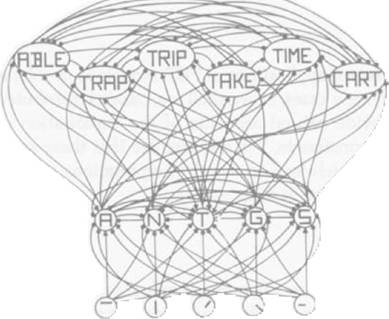
Figure 40.2.
The unit for the letter T in the first position of a four-letter array and some of its neighbors. Note that the feature and letter units stand only for the first position; in a complete picture of the units needed from processing four-letter displays, there would be four full sets of feature detectors and four full sets of letter detectors. (From "An Interactive Activation Model of Context Effects in Letter Perception: Part I. An Account of Basic Findings" by J. L McClelland and D. E. Rumelhart, 1981, Psychological Review, M, p. 380. Copyright 1981 by the American Psychological Association. Reprinted by permission.).
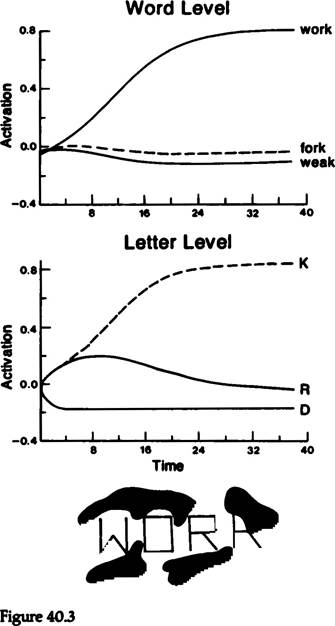
A possible display that might be presented to the interactive activation model of word recognition, and the resulting activations of selected letter and word units. The letter units are for the letters indicated in the fourth position of a four-letter display.
position compete with all other letter units in the same position, and the word units compete with each other. This type of inhibitory interaction is often called competitive inhibition. In addition, there are inhibitory interactions between incompatible units on different levels. This type of inhibitory interaction is simply called between-level inhibition.
The set of excitatory and inhibitory interactions between units can be diagrammed by drawing excitatory and inhibitory links between them. The whole picture is too complex to draw, so we illustrate only with a fragment: Some of the interactions between some of the units in this model are illustrated in figure 40.2.
Let us consider what happens in a system like this when a familiar stimulus is presented under degraded conditions. For example, consider the display shown in figure 40.3. This display consists of the letters W, O, and Rt completely visible, and enough of a fourth letter to rule out all letters other than R and K. Before onset of the display, the activations of the units are set at or below 0. When the display is presented, detectors for the features present in each position become active (i.e., their activations grow above 0). At this point, they begin to excite and inhibit the corresponding detectors for letters. In the first three positions, W, O, and R are unambiguously activated, so we will focus our attention on the fourth position where R and K are both equally consistent with the active features. Here, the activations of the detectors for R and K start out growing together, as the feature detectors below them become activated. As these detectors become active, they and the active letter detectors for W, O, and R in the other positions start to activate detectors for words which have these letters in them and to inhibit detectors for words which do not have these letters. A number of words are partially consistent with the active letters, and receive some net excitation from the letter level, but only the word WORK matches one of the active letters in all four positions. As a result, WORK becomes more active than any other word and inhibits the other words, thereby successfully dominating the pattern of activation among the word units. As it grows in strength, it sends feedback to the letter level, reinforcing the activations of the W, Ot R, and K in the corresponding positions. In the fourth position, this feedback gives K the upper hand over Rt and eventually the stronger activation of the K detector allows it to dominate the pattern of activation, suppressing the R detector completely.
This example illustrates how PDP models can allow knowledge about what letters go together to form words to work together with natural constraints on the task (i.e.. that there should only be one letter in one place at one time), to produce perceptual completion in a simple and direct way.
Completion of novel patterns However, the perceptual intelligence of human perceivers far exceeds the ability to recognize familiar patterns and fill in missing portions. We also show facilitation in the perception of letters in unfamiliar letter strings which are wordlike but not themselves actually familiar.
One way of accounting for such performances is to imagine that the perceiver possesses, in addition to detectors for familiar words, sets of detectors for regular subword units such as familiar letter clusters, or that they use abstract rules, specifying which classes of letters can go with which others in different contexts. It turns out, however, that the model we have already described needs no such additional structure to produce perceptual facilitation for word-like letter strings; to this extent it acts as if it "knows" the orthographic structure of English. We illustrate this feature of the model with the example shown in figure 40.4, where the nonword YEAD is shown in degraded form so that the second letter is incompletely visible. Given the information
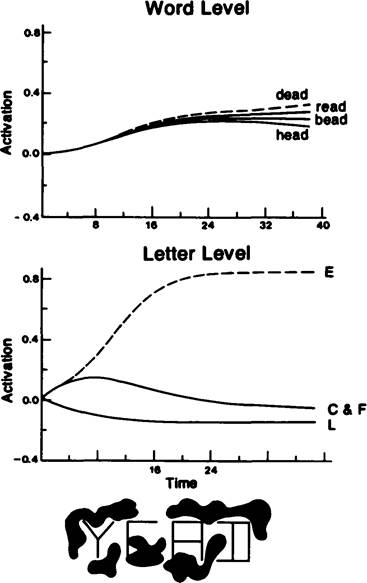
Figure 40.4
An example of a nonword display that might be presented to the interactive activation model of word recognition and the response of selected units at the letter and word levels. The letter units illustrated are detectors for letters in the second input position.
about this letter, considered alone, either E or F would be possible in the second position. Yet our model will tend to complete this letter as an £.
The reason for this behavior is that, when YEAD is shown, a number of words are partially activated. There is no word consistent with Y, £ or F, A, and D, but there are words which match Y£A_ (YEAR, for example) and others which match -EAD (BEAD, DEAD, HEAD, and READ, for example). These and other near misses are partially activated as a result of the pattern of activation at the letter level. While they compete with each other, none of these words gets strongly enough activated to completely suppress all the others. Instead, these units act as a group to reinforce particularly the letters £ and A. There are no close partial matches which include the letter F in the second position, so this letter receives no feedback support. As a result, £ comes to dominate, and eventually suppress, the F in the second position.
The fact that the word perception model exhibits perceptual facilitation to pronounceable nonwords as well as words illustrates once again how behavior in accordance with general principles or rules can emerge from the interactions of simple processing elements. Of course, the behavior of the word perception model does not implement exactly any of the systems of orthographic rules that have been proposed by linguists (Chomsky and Halle 1968, Venesky 1970) or psychologists (Spoehr and Smith 1975). In this regard, it only approximates such rule-based descriptions of perceptual processing. However, rule systems such as Chomsky and Halle's or Venesky's appear to be only approximately honored in human performance as well (Smith and Baker 1976). Indeed, some of the discrepancies between human performance data and rule systems occur in exactly the ways that we would predict from the word perception model (Rumelhart and McClelland 1982). This illustrates the possibility that PDP models may provide more accurate accounts of the details of human performance than models based on a set of rules representing human competence—at least in some domains.
Retr. Information From Memory
Content addressability One very prominent feature of human memory is that it is content addressable. It seems fairly clear that we can access information in memory based on nearly any attribute of the representation we are trying to retrieve.
Of course, some cues are much better than others. An attribute which is shared by a very large number of things we know about is not a very effective retrieval cue, since it does not accurately pick out a particular memory representation. But, several such cues, in conjunction, can do the job. Thus, if we ask a friend who goes out with several women, "Who was that woman I saw you with?", he may not know which one we mean—but if we specify something else about her—say the color of her hair, what she was wearing (insofar as he remembers this at all), where we saw him with her—he will likely be able to hit upon the right one.
It is, of course, possible to implement some kind of content addressability of memory on a standard computer in a variety of different ways. One way is to search sequentially, examining each memory in the system to find the memory or the set of memories which has the particular content specified in the cue. An alternative, somewhat more efficient, scheme involves some form of indexing—keeping a list, for every content a memory might have, of which memories have that content.
Such an indexing scheme can be made to work with error-free probes, but it will break down if there is an error in the specification of the retrieval cue. There are possible ways of recovering from such errors, but they lead to the kind of combinatorial explosions which plague this kind of computer implementation.
But suppose that we imagine that each memory is represented by a unit which has mutually excitatory interactions with units standing for each of its properties. Then, whenever any property of the memory became active, the memory would tend to be activated, and whenever the memory was activated, all of its contents would tend to become activated. Such a scheme would automatically produce content addressability for us. Though it would not be immune to errors, it would not be devastated by an error in the probe if the remaining properties specified the correct memory.
As described thus far, whenever a property that is a part of a number of different memories is activated, it will tend to activate all of the memories it is in. To keep these other activities from swamping the "correct" memory unit, we simply need to add initial inhibitory connections among the memory units. An additional desirable feature would be mutually inhibitory interactions among mutually incompatible property units. For example, a person cannot both be single and married at the same time, so the units for different marital states would be mutually inhibitory.
McClelland (1981) developed a simulation model that illustrates how a system with these properties would act as a content addressable memory. The model is obviously oversimplified, but it illustrates many of the characteristics of the more complex models that will be considered in later chapters.
The Jets and The Sharks
| Name | Gang | Age | Edu | Mar | Occupation |
| Art | Jets | 40’s | J.H. | Sing. | Pusher |
| Al | Jets | 30’s | J.H. | Mar. | Burglar |
| Sam | Jets | 20’s | COL. | Sing. | Bookie |
| Clyde | Jets | 40’s | J.H. | Sing. | Bookie |
| Mike | Jets | 30’s | J.H. | Sing. | Bookie |
| Jim | Jets | 20’s | J.H. | Div. | Burglar |
| Greg | Jets | 20’s | H.S. | Mar. | Pusher |
| John | Jets | 20’s | J.H. | Mar. | Burglar |
| Doug | Jets | 30’s | H.S. | Sing. | Bookie |
| Lance | Jets | 20’s | J.H. | Mar. | Burglar |
| George | Jets | 20’s | J.H. | Div. | Burglar |
| Pete | Jets | 20’s | H.S. | Sing. | Bookie |
| Fred | Jets | 20’s | H.S. | Sing. | Pusher |
| Gene | Jets | 20’s | COL. | Sing. | Pusher |
| Ralph | Jets | 30’s | J.H. | Sing. | Pusher |
| Phil | Sharks | 30’s | COL. | Mar. | Pusher |
| Ike | Sharks | 30’s | J.H. | Sing. | Bookie |
| Nick | Sharks | 30’s | H.S. | Sing. | Pusher |
| Don | Sharks | 30’s | COL. | Mar. | Burglar |
| Ned | Sharks | 30’s | COL. | Mar. | Bookie |
| Karl | Sharks | 40’s | H.S. | Mar. | Bookie |
| Ken | Sharks | 20’s | H.S. | Sing. | Burglar |
| Earl | Sharks | 40’s | H.S. | Mar. | Burglar |
| Rick | Sharks | 30’s | bgcolor=white>H.S.Div. | Burglar | |
| Ol | Sharks | 30’s | COL. | Mar. | Pusher |
| Neal | Sharks | 30’s | H.S. | Sing. | Bookie |
| Dave | Sharks | 30’s | H.S. | Div. | Pusher |
Figure 40.5
Characteristics of a number of individuals belonging to two gangs, the Jets and the Sharks. (From "Retrieving General and Specific Knowledge From Stored Knowledge of Specifics" by J. L McClelland, 1981, ProcαΛM∣gs o/ the Third Annual Conference of the Cognitive Science Society, Berkeley, CA. Copyright 1981 by J. L McClelland. Reprinted by permission.)
Consider the information represented in figure 40.5, which lists a number of people we might meet if we went to live in an unsavory neighborhood, and some of then- hypothetical characteristics. A subset of the units needed to represent this information is shown in figure 40.6. In this network, there is an "instance unit" for each of the characters described in figure 40.5, and that unit is linked by mutually excitatory connections to all of the units for the fellow's properties. Note that we have included property units for the names of the characters, as well as units for their other properties.
Now, suppose we wish to retrieve the properties of a particular individual say Lance. And suppose that we know Lance's name. Iben we can probe the network by activating Lance's name unit, and we can see what pattern of activation arises as a result. Assuming that we know of no one else named Lance, we can expect the Lance name unit to be hooked up only to the instance unit for Lance. This will in turn activate the property units for Lance, thereby creating the pattern of activation corresponding to Lance. In effect, we have retrieved a representation of Lance. More will happen than just what we have described so far, but for the moment let us stop here.
Of course, sometimes we may wish to retrieve a name, given other information. In this case, we might start with some of Lance's properties, effectively asking the system, say "Who do you know who is a Shark and in his 20s?" by activating the Shark and 20s units. In this case it turns out that there is a single individual, Kea who fits the descrip-
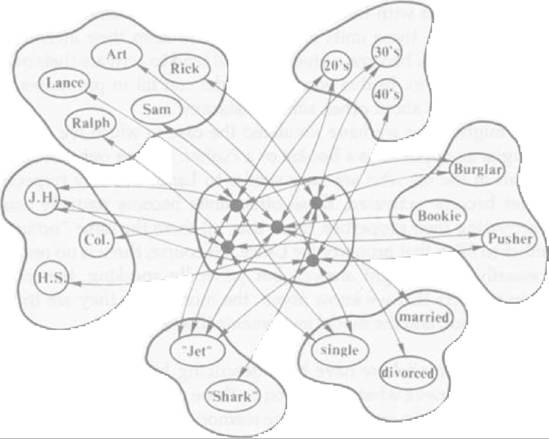
Figure 40.6
Some of the units and interconnections needed to represent the individuals shown in figure 40.5. The units connected with double-headed arrows are mutually excitatory. All the units within the same cloud are mutually inhibitory. (From "Retrieving General and Specific Knowledge From Stored Knowledge of Specifics" by J. L McClelland, 1981, Proceedings of the Third Annual Conferenceofthe Cognitive Science Society, Berkeley, CA Copyright 1981 by J. L McClelland. Reprinted by permission.)
Hon. So, when we acHvate these two properties, we will acHvate the instance unit for Ken, and this in turn will acHvate his name unit, and fill in his other properties as well.
Graceful degradation A few of the desirable properties of this kind of model are visible from considering what happens as we vary the set of features we use to probe the memory in an attempt to retrieve a particular individual's name. Any set of features which is sufficient to uniquely characterize a particular item will acHvate the instance node for that item more strongly than any other instance node. A probe which contains misleading features will most strongly acHvate the node that it matches best. This will clearly be a poorer cue than one which contains no misleading informaHon—but it will still be sufficient to acHvate the “right answer" more strongly than any other, as long as the introducHon of misleading informaHon does not make the probe closer to some other item. In general, though the degree of acHvation of a particular instance node and of the corresponding name nodes varies in this model as a function of the exact content of the probe, errors in the probe will not be fatal unless they make the probe point to the wrong memory. This kind of model's handling of incomplete or partial probes also requires no special error-recovery scheme to work—it is a natural by-product of the nature of the retrieval mechanism that it is capable of graceful degradaHon.
Default assignment It probably will have occurred to the reader that in many of the situations we have been examining, there will be other acHvaHons occurring which may influence the pattern of acHvaHon which is retrieved. So, in the case where we retrieved the properties of Lance, those properties, once they become acHve, can begin to acH- vate the units for other individuals with those same properties. The memory unit for Lance will be in competition with these units and will tend to keep their activation down, but to the extent that they do become active, they will tend to activate their own properties and therefore fill them in. In this way, the model can fill in properties of individuals based on what it knows about other, similar instances.
To illustrate how this might work we have simulated the case in which we do not know that Lance is a Burglar as opposed to a Bookie or a Pusher. It turns out that there are a group of individuals in the set who are very similar to Lance in many respects. When Lance's properties become activated, these other units become partially activated, and they start activating their properties. Since they all share the same “occupation," they work together to fill in that property for Lance. Of course, there is no reason why this should necessarily be the right answer, but generally speaking, the more similar two things are in respects that we know about, the more likely they are to be similar in respects that we do not, and the model implements this heuristic.
Spontaneous generalization The model we have been describing has another valuable property as well—it tends to retrieve what is common to those memories which match a retrieval cue which is too general to capture any one memory. Thus, for example, we could probe the system by activating the unit corresponding to membership in the Jets. This unit will partially activate all the instances of the Jets, thereby causing each to send activations to its properties. In this way the model can retrieve the typical values that the members of the Jets have on each dimension—even though there is no one Jet that has these typical values. In the example, 9 of 15 Jets are single, 9 of 15 are in their 20s, and 9 of 15 have only a junior high school education; when we probe by activating the Jet unit, all three of these properties dominate. The Jets are evenly divided between the three occupations, so each of these units becomes partially activated. Each has a different name, so that each name unit is very weakly activated, nearly cancelling each other out.
In the example just given of spontaneous generalization, it would not be unreasonable to suppose that someone might have explicitly stored a generalization about the members of a gang. The account just given would be an alternative to "explicit storage" of the generalization. It has two advantages, though, over such an account. First, it does not require any special generalization formation mechanism. Second, it can provide us with generalizations on unanticipated lines, on demand. Thus, if we want to know, for example, what people in their 20s with a junior high school education are like, we can probe the model by activating these two units. Since all such people are Jets and Burglars, these two units are strongly activated by the model in this case; two of them are divorced and two are married, so both of these units are partially activated.1
The sort of model we are considering, then, is considerably more than a content addressable memory. In addition, it performs default assignment, and it can spontaneously retrieve a general concept of the individuals that match any specifiable probe. These properties must be explicitly implemented as complicated computational extensions of other models of knowledge retrieval, but in PDP models they are natural by-products of the retrieval process itself.
Representation and Learning in PDPModels
In the Jets and Shades model, we can speak of the model's active representation at a particular time, and associate this with the pattern of activation over the units in the system. We can also ask: What is the stored knowledge that gives rise to that pattern of activation? In considering this question, we see immediately an important difference between PDP models and other models of cognitive processes. In most models, knowledge is stored as a static copy of a pattern. Retrieval amounts to finding the pattern in long-term memory and copying it into a buffer or working memory. There is no real difference between the stored representation in long-term memory and the active representation in working memory. In PDP models, though, this is not the case. In these models, the patterns themselves are not stored. Rather, what is stored is the connection strengths between units that allow these patterns to be re-created. In the Jets and Sharks model, there is an instance unit assigned to each individual, but that unit does not contain a copy of the representation of that individual. Instead, it is simply the case that the connections between it and the other units in the system are such that activation of the unit will cause the pattern for the individual to be reinstated on the property units.
This difference between PDP models and conventional models has enormous implications, both for processing and for learning. We have already seen some of the implications for processing. The representation of the knowledge is set up in such a way that the knowledge necessarily influences the course of processing. Using knowledge in processing is no longer a matter of finding the relevant information in memory and bringing it to bear; it is part and parcel of the processing itself.
For learning, the implications are equally profound. For if the knowledge is the strengths of the connections, learning must be a matter of finding the right connection strengths so that the right patterns of activation will be produced under the right circumstances. This is an extremely important property of this class of models, for it opens up the possibility that an information processing mechanism could leam, as a result of tuning its connections, to capture the interdependencies between activations that it is exposed to in the course of processing.
In recent years, there has been quite a lot of interest in learning in cognitive science. Computational approaches to learning fall predominantly into what might be called the "explicit rule formulation" tradition, as represented by the work of Winston (1975), the suggestions of Chomsky, and the ACT* model of J. R. Anderson (1983). All of this work shares the assumption that the goal of learning is to formulate explicit rules (propositions, productions, etc.) which capture powerful generalizations in a succinct way. Fairly powerful mechanisms, usually with considerable innate knowledge about a domain, and/or some starting set of primitive propositional representations, then formulate hypothetical general rules, e.g., by comparing particular cases and formulating explicit generalizations.
The approach that we take in developing PDP models is completely different. First, we do not assume that the goal of learning is the formulation of explicit rules. Rather, we assume it is the acquisition of connection strengths which allow a network of simple units to act as though it knew the rules. Second, we do not attribute powerful computational capabilities to the learning mechanism. Rather, we assume very simple connection strength modulation mechanisms which adjust the strength of connections between units based on information locally available at the connection.
Local vs. distributed representation Before we turn to an explicit consideration of this issue, we raise a basic question about representation. Once we have achieved the insight that the knowledge is stored in the strengths of the interconnections between units, a question arises. Is there any reason to assign one unit to each pattern that we wish to leam? Another possibility—one that we explore extensively in this book—is the possibility that the knowledge about any individual pattern is not stored in the connections of a special unit reserved for that pattern, but is distributed over the connections among a large number of processing units. On this view, the Jets and Sharks model represents a special case in which separate units are reserved for each instance.
Models in which connection information is explicitly thought of as distributed have been proposed by a number of investigators. The units in these collections may themselves correspond to conceptual primitives, or they may have no particular meaning as individuals. In either case, the focus shifts to patterns of activation over these units and to mechanisms whose explicit purpose is to Ieam the right connection strengths to allow the right patterns of activation to become activated under the right circumstances.
In the rest of this section, we will give a simple example of a PDP model in which the knowledge is distributed. We will first explain how the model would work, given pre-existing connections, and we will then describe how it could come to acquire the right connection strengths through a very simple learning mechanism. A number of models which have taken this distributed approach have been discussed in Hinton and J. A. Anderson's (1981) Parallel Models OfAssociatioe Memory. We will consider a simple version of a common type of distributed model, a pattern associator.
Pattern assodators are models in which a pattern of activation over one set of units can cause a pattern of activation over another set of units without any intervening units to stand for either pattern as a whole. Pattern assodators would, for example, be capable of assodating a pattern of activation on one set of units corresponding to the appearance of an object with a pattern on another set corresponding to the aroma of the object, so that, when an object is presented visually, causing its visual pattern to become active, the model produces the pattern corresponding to its aroma.
How a pattern associator works For purposes of illustration, we present a very simple pattern assodator in figure 40.7. In this model, there are four units in each of two pools. The first pool, the A units, will be the pool in which patterns corresponding to the sight of various objects might be represented. The second pool, the B units, will be the pool in which the pattern corresponding to the aroma will be represented. We can pretend that alternative patterns of activation on the A units are produced upon viewing a rose or a grilled steak and alternative patterns on the B units are produced upon sniffing the same objects. Figure 40.8 shows two pairs of patterns, as well as sets of interconnections necessary to allow the A member of each pair to reproduce the B member.
The details of the behavior of the individual units vary among different versions of pattern assodators. For present purposes, we'll assume that the units can take on positive or negative activation values, with 0 representing a kind of neutral intermediate value. The strengths of the interconnections between the units can be positive or negative real numbers.
The effect of an A unit on a B unit is determined by multiplying the activation of the A unit times the strength of its synaptic connection with the B unit. For example, if the connection from a particular A unit to a particular B unit has a positive sign, when the A unit is exdted (activation greater than 0), it will exdte the B unit. For this example, we'll simply assume that the activation of each unit is set to the sum of the exdtatory and inhibitory effects operating on it. This is one of the simplest possible cases.
Suppose, now, that we have created on the A units the pattern corresponding to the first visual pattern shown in Figure 40.8, the rose. How should we arrange the strengths of the interconnections between the A units and the B units to reproduce the pattern
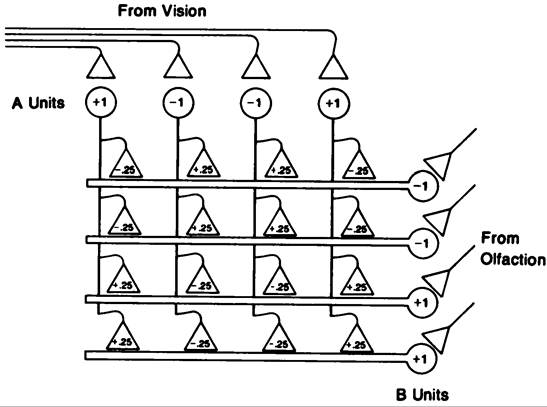
Figure 40.7
A simple pattern assodator. The example assumes that patterns of activation in the A units can be produced by the visual system and patterns in the B units can be produced by the olfactory system. The synaptic connections allow the outputs of the A units to influence the activations of the B units. The synaptic weights linking the A units to the B units were selected so as to allow the pattern of activation shown on the A units to reproduce the pattern of activation shown on the B units without the need for any olfactory input.
| -.25 | +.25 | +.25 | —.25 |
| -.25 | +.25 | +.25 | -.25 |
| +.25 | -.25 | -.25 | +.25 |
| +.25 | -.25 | -.25 | +.25 |
-1 -1 + 1 + 1
-1 +1 -1 +1
| +.25 | -.25 | +.25 | -.25 |
| -.25 | +.25 | -.25 | +.25 |
| -.25 | +.25 | -.25 | +.25 |
| +.25 | -.25 | +.25 | -.25 |
-1
+1
+ 1
Figure 40.8
Two simple assodators represented as matrices. The weights in the first two matrices allow the A pattern shown above the matrix to produce the B pattern shown to the right of it. Note that the weights in the first matrix are the same as those shown in the diagram in figure 40.7.
corresponding to the aroma of a rose? We simply need to arrange for each A unit to tend to exdte each B unit which has a positive activation in the aroma pattern and to inhibit each B unit which has a negative activation in the aroma pattern. It turns out that this goal is achieved by setting the strength of the connection between a given A unit and a given B unit to a value proportional to the product of the activation of the two units. In figure 40.7, the weights on the connections were chosen to allow the A pattern illustrated there to produce the illustrated B pattern according to this principle. The actual strengths of the connections were set to ±.25, rather than ± 1, so that the A pattern will produce the right magnitude, as well as the right sign, for the activations of the units in the B pattern. The same connections are reproduced in matrix form in figure 40.8A.
Pattern associators like the one in figure 40.7 have a number of nice properties. One is that they do not require a perfect copy of the input to produce the correct output, though its strength will be weaker in this case. For example, suppose that the associator shown in figure 40.7 were presented with an A pattern of (1, — 1,0,1). This is the A pattern shown in the figure, with the activation of one of its elements set to 0. The B pattern produced in response will have the activations of all of the B units in the right direction; however, they will be somewhat weaker than they would be, had the complete A pattern been shown. Similar effects are produced if an element of the pattern is distorted—or if the model is damaged, either by removing whole units, or random sets of connections, etc. Thus, their pattern retrieval performance of the model degrades gracefully both under degraded input and under damage.
How a pattern associator teams So far, we have seen how we as model builders can construct the right set of weights to allow one pattern to cause another. The interesting thing, though, is that we do not need to build these interconnection strengths in by hand. Instead, the pattern associator can teach itself the right set of interconnections through experience processing the patterns in conjunction with each other.
A number of different rules for adjusting connection strengths have been proposed. One of the first—and definitely the best known—is due to D. O. Hebb (1949). Hebb's actual proposal was not sufficiently quantitative to build into an explicit model. However, a number of different variants can trace their ancestry back to Hebb. Perhaps the simplest version is:
When unit A and unit B are simultaneously excited, increase the strength of the connection between them.
A natural extension of this rule to cover the positive and negative activation values allowed in our example is:
Adjust the strength of the connection between units A and B in proportion to the product of their simultaneous activation.
In this formulation, if the product is positive, the change makes the connection more excitatory, and if the product is negative, the change makes the connection more inhibitory. For simplicity of reference, we will call this the Hebb rule, although it is not exactly Hebb's original formulation.
With this simple learning rule, we could train a 'blank copy" of the pattern associator shown in figure 40.7 to produce the B pattern for rose when the A pattern is shown, simply by presenting the A and B patterns together and modulating the connection strengths according to the Hebb rule. The size of the change made on every trial would, of course, be a parameter. We generally assume that the changes made on each instance are rather small, and that connection strengths build up gradually. The values shown in figure 40.8A, then, would be acquired as a result of a number of experiences with the A and B pattern pair.
It is very important to note that the information needed to use the Hebb rule to determine the value each connection should have is locally available at the connection. AU a given connection needs to consider is the activation of the units on both sides of it. Thus, it would be possible to actuaUy implement such a connection modulation scheme IocaUy, in each connection, without requiring any programmer to reach into each connection and set it to just the right value.
It turns out that the Hebb rule as stated here has some serious limitations, and, to our knowledge, no theorists continue to use it in this simple form. More sophisticated connection modulation schemes have been proposed by other workers; most important among these are the delta rule, the competitive learning rule, and the rules for learning in stochastic paraUel models. AU of these learning rules have the property that they adjust the strengths of connections between units on the basis of information that can be assumed to be IocaUy avaUable to the unit. Learning, then, in aU of these cases, amounts to a very simple process that can be implemented IocaUy at each connection without the need for any overaU supervision. Thus, models which incorporate these learning rules train themselves to have the right interconnections in the course of processing the members of an ensemble of patterns.
Learning multiple patterns in the same set of interconnections Up to now, we have considered how we might teach our pattern associator to associate the visual pattern for one object with a pattern for the aroma of the same object. Obviously, different patterns of interconnections between the A and B units are appropriate for causing the visual pattern for a different object to give rise to the pattern for its aroma. The same principles apply, however, and if we presented our pattern associator with the A and B patterns for steak, it would Ieam the right set of interconnections for that case instead (these are shown in figure 40.8B). In fact, it turns out that we can actually teach the same pattern assodator a number of different associations. The matrix representing the set of interconnections that would be learned if we taught the same pattern associator both the rose association and the steak association is shown in figure 40.9. The reader can verify this by adding the two matrices for the individual patterns together. The reader can also verify that this set of connections wiU allow the rose A pattern to produce the rose B pattern, and the steak A pattern to produce the steak B pattern: when either input pattern is presented, the correct corresponding output is produced.
The examples used here have the property that the two different visual patterns are completely uncorrelated with each other. This being the case, the rose pattern produces no effect when the interconnections for the steak have been established, and the steak pattern produces no effect when the interconnections for the rose association are in
Figure 40.9
The weights in the third matrix allow either A pattern shown in figure 40.8 to recreate the corresponding B pattern. Each weight in this case is equal to the sum of the weight for the A pattern and the weight for the B pattern, as illustrated.
effect. For this reason, it is possible to add together the pattern of interconnections for the rose association and the pattern for the steak association, and still be able to associate the sight of the steak with the smell of a steak and the sight of a rose with the smell of a rose. The two sets of interconnections do not interact at all.
One of the limitations of the Hebbian learning rule is that it can Ieam the connection strengths appropriate to an entire ensemble of patterns only when all the patterns are completely uncorrelated. This restriction does not, however, apply to pattern associated which use more sophisticated learning schemes.
Attractive properties of pattern associator models Pattern assodator models have the property that uncorrelated patterns do not interact with each other, but more similar ones do. Thus, to the extent that a new pattern of activation on the A units is similar to one of the old ones, it will tend to have similar effects. Furthermore, if we assume that learning the interconnections occurs in small increments, similar patterns will essentially reinforce the strengths of the links they share in common with other patterns. Thus, if we present the same pair of patterns over and over, but each time we add a little random noise to each element of each member of the pair, the system will automatically Ieam to associate the central tendency of the two patterns and will Ieam to ignore the noise. What will be stored will be an average of the similar patterns with the slight variations removed. On the other hand, when we present the system with completely uncorrelated patterns, they will not interact with each other in this way. Thus, the same pool of units can extract the central tendency of each of a number of pairs of unrelated patterns.
Extracting the structure of an ensemble of patterns The fact that similar patterns tend to produce similar effects allows distributed models to exhibit a kind of spontaneous generalization, extending behavior appropriate for one pattern to other similar patterns. This property is shared by other PDP models, such as the word perception model and the Jets and Sharks model described above; the main difference here is in the existence of simple, local, learning mechanisms that can allow the acquisition of the connection strengths needed to produce these generalizations through experience with members of the ensemble of patterns. Distributed models have another interesting property as well: If there are regularities in the correspondences between pairs of patterns, the model will naturally extract these regularities. This property allows distributed models to acquire patterns of interconnections that lead them to behave in ways we ordinarily take as evidence for the use of linguistic rules.
Here, we describe [such a] model very briefly. The model is a mechanism that Ieams how to construct the past tenses of words horn their root forms through repeated presentations of examples of root forms paired with the corresponding past-tense form. The model consists of two pools of units. In one pool, patterns of activation representing the phonological structure of the root form of the verb can be represented, and, in the other, patterns representing the phonological structure of the past tense can be represented. The goal of the model is simply to Ieam the right connection strengths between the root units and the past-tense units, so that whenever the root form of a verb is presented the model will construct the corresponding past-tense form. The model is trained by presenting the root form of the verb as a pattern of activation over the root units, and then using a simple, local, learning rule to adjust the connection strengths so that this root form will tend to produce the correct pattern of activation over the past-tense units. The model is tested by simply presenting the root form as a
The Appeal of Parallel Distributed Processing 287 pattern of activation over the root units and examining the pattern of activation produced over the past-tense units.
The model is trained initially with a small number of verbs children Ieam early in the acquisition process. At this point in learning, it can only produce appropriate outputs for inputs that it has explicitly been shown. But as it Ieams more and more verbs, it exhibits two interesting behaviors. First, it produces the standard ed past tense when tested with pseudo-verbs or verbs it has never seen. Second, it "overregularizes" the past tense of irregular words it previously completed correctly. Often, the model will blend the irregular past tense of the word with the regular ed ending, and produce errors like CAMED as the past of COME. These phenomena mirror those observed in the early phases of acquisition of control over past tenses in young children..
The generativity of the child's responses—the creation of regular past tenses of new verbs and the overregularization of the irregular verbs—has been taken as strong evidence that the child has induced the rule which states that the regular correspondence for the past tense in English is to add a final ed (Berko 1958). On the evidence of its performance, then, the model can be said to have acquired the rule. However, no special rule-induction mechanism is used, and no special language-acquisition device is required. The model learns to behave in accordance with the rule, not by explicitly noting that most words take ed in the past tense in English and storing this rule away explicitly, but simply by building up a set of connections in a pattern assodator through a long series of simple learning experiences. The same mechanisms of parallel distributed processing and connection modification which are used in a number of domains serve, in this case, to produce implidt knowledge tantamount to a linguistic rule. The model also provides a fairly detailed account of a number of the specific aspeds of the error patterns children make in learning the rule. In this sense, it provides a richer and more detailed description of the acquisition process than any that falls out naturally from the assumption that the child is building up a repertoire of explidt but inaccessible rules.
There is a lot more to be said about distributed models of learning, about their strengths and their weaknesses, than we have space for in this preliminary consideration. For now we hope mainly to have suggested that they provide dramatically different accounts of learning and acquisition than are offered by traditional models of these processes. We saw earlier that performance in accordance with rules can emerge from the interactions of simple, interconnected units. Now we can see how the aquisi- Hon of performance that conforms to linguistic rules can emerge from a simple, local, connection strength modulation process.
Acknowledgments
This research was supported by Contract N00014-79-C-0323, NR 667-437 with the Personnel and Training Research Programs of the Office of Naval Research, by grants from the System Development Foundation, and by a NIMH Career Development Award (MH00385) to the first author.
Note
1. In this and all other cases, there is a tendency for the pattern of activation to be influenced by partially activated, near neighbors, which do not quite match the probe. Thus, in this case, there is a Jet At who is a Married Burglar. The unit for Al gets slightly activated, giving Married a slight edge over Divorced in the simuhtion.
References
Anderson, J. R. 1983. The architecture of cognition. Cambridge, MA: Harvard University Press. Berko, J. 1958. The child's learning of English morphology. Word, 14,150-177.
Chomsky, N., and Halle, M. 1968. The sound pattern of English. New York: Harper & Row. Hebb, D. 0.1949. The organization of behavior. New York Wiley.
Hintcm, G. E, and Anderson, J. A., eds. 1981. Parallel models of associative memory. Hillsdale, NJ: Erlbaum. Isenberg, D., Walker E C. T, Ryder, J. M., and Schweikert J. 1980, November. A top-down effect on the identification of function words. Paper presented at the Acoustical Society of America, Los Angeles.
Lindsay, P. H, and Norman, D. A. 1972. Human information processing: An introduction to psychology. New York Academic Press.
McGelland, J. L 1981. Retrieving general and specific information from stored knowledge of specifics. Proceedings of the Third Annual Meeting of the Cognitive Science Society, 170-172.
McGeIland, J. L, and Rumdhart, D. E. 1981. An interactive activation model of context effects in letter perception: Part 1. An account of basic findings. Psychological Review, 88,375-407.
Minsky, M. 1975. A framework for representing knowledge. In P. H. Winston (ed.), The psychology of computer vision (pp. 211-277). New York McGraw-HilL
Norman, D. A., and Bobrow, D. G. 1976. On the role of active memory processes in perception and cognition. In C. N. Cofer, ed., The structure of human memory (pp. 114-132). Freeman: San Frandsco.
Pillsbury, W. B. 1897. A study in apperception. American Journal of Psychology, 8,315-393.
Rumelhart, D. E. 1975. Notes on a schema for stories. In D. G. Bobrow and A. Collins eds., Representation and understanding (pp. 211-236). New York Academic Press.
Rumelhart, D. E. 1977. Toward an interactive model of reading. In S. Domic, ed., Attention & Performana VL Hillsdale, NJ: Erlbaum.
Rumelhart, D. E, and McGelland, J. L 1982. An interactive activation model of context effects in letter perception: Part 2. The contextual enhancement effect and some tests and extensions of the model. Psychological Review, 89,60-94.
Sdiank R. C 1973. Identification of conceptualizations underlying natural language. In R. C. Sdiank and K. M. Colby, eds., Computer models of thought and language (pp. 187-247). San Frandsco: Freeman.
Schank R> C. 1976. The role of memory in language processing* In C. N. Cofer, ed., The structure of human memory (pp. 162-189). Freeman: San Frandsco.
Selfridge, O. G., and Neisser, U. 1960. Pattern recognition by machine. Scientific American, 203,60-68.
Smith, P. T., and Baker, R. G. 1976. The influence of English spelling patterns on pronoundation. Journal oj Verbal Leamingand Verbal Behavior, 15,267-286.
Spodir, K., and Smith, E. 1975. The role of orthographic and phonotactic rules in perceiving letter patterns Journal of Experimental Psychology : Human Perception and Performance, 1,21-34.
Venesky, R. L1970. The structure of English orthography. The Hague. Mouton.
Warren, R. M. 1970. Perceptual restoration of missing speech sounds. Science, 167,393-395.
Winston, P. H. 1975. Learning structural descriptions from examples. In P. H. Winstoa ed., The psychology of computer vision (pp. 157-209). New York McGraw-Hill.