Chapter 39 The Elementary Law of Association William James
I shall try to show, in the pages which immediately follow, that there is no other elementary causal law of association than the law of neural habit. All the materials of our thought are due to the way in which one elementary process of the cerebral hemispheres tends to excite whatever other elementary process it may have excited at some former time.
The number of elementary processes at work, however, and the nature of those which at any time are fully effective in rousing the others, determine the character of the total brain-action, and, as a consequence of this, they determine the object thought of at the time. According as this resultant object is one thing or another, we call it a product of association by contiguity or of association by similarity, or contrast, or whatever other sorts we may have recognized as ultimate. Its production, however, is, in each one of these cases, to be explained by a merely quantitative variation in the elementary brain-processes momentarily at work under the law of habit, so that psychic contiguity, similarity, etc., are derivatives of a single profounder kind of fact.My thesis, stated thus briefly, will s∞n become more dear; and at the same time certain disturbing factors, which co-operate with the law of neural habit, will come to view.
Let us then assume as the basis of all our subsequent reasoning this law: When two elementary brain-processes have been active together or in immediate succession, one of them, on reoccurring, tends to propagate its excitement into the other.
But, as a matter of fact, every elementary process has found itself at different times exdted in conjunction with many other processes, and this by unavoidable outward causes. Which of these others it shall awaken now becomes a problem. Shall b or c be aroused next by the present al We must make a further postulate, based, however, on the fact of tension in nerve-tissue, and on the fact of summation of exdtements, each incomplete or latent in itself, into an open resultant.
The process b, rather than c, will awake, if in addition to the vibrating trad a some other trad d is in a state of sub- exdtement, and formerly was exdted with b alone and not with a. In short, we may say:The amount of activity at any given point in the brain-cortex is the sum of the tendencies of all other points to discharge into it, such tendencies being proportionate (1) to the number of times the excitement of each other point may have accompanied that of the point in question; (2) to the intensity of such excitements; and (3) to the absence of any rival point functionally disconnected with the first point, into which the discharges might be diverted.
Expressing the fundamental law in this most complicated way leads to the greatest ultimate simplification. Let us, for the present, only treat of spontaneous trains of thought and ideation, such as occur in revery or musing. The case of voluntary thinking toward a certain end shall come up later.
Take, to fix our ideas, the two verses from 'Locksley Hall':
"I, the heir of all the ages in the foremost files of time,"
and—
"For I doubt not through the ages one increasing purpose runs."
Why is it that when we redte from memory one of these lines, and get as far as the ages, that portion of the other line which follows, and, so to speak, sprouts out of the ages, does not also sprout out of our memory, and confuse the sense of our words? Simply because the word that follows the ages has its brain-process awakened not simply by the brain-process of the ages alone, but by it plus the brain-processes of all the words preceding the ages. The word ages at its moment of strongest activity would, per se, indifferently discharge into either 'in' or 'one.' So would the previous words (whose tension is momentarily much less strong than that of ages) each of them indifferently discharge into either of a large number of other words with which they have been at different times combined. But when the processes of ,I, the heir of all the ages,' simultaneously vibrate in the brain, the last one of them in a maximal, the others in a fading phase of excitement; then the strongest line of discharge will be that which they all alike tend to take.
'In' and not 'one' or any other word will be the next to awaken, for its brainprocess has previously vibrated in unison not only with that of ages, but with that of all those other words whose activity is dying away.But if some one of these preceding words—,heir,' for example—had an intensely strong association with some brain-tracts entirely disjoined in experience from the poem of 'Locksley Hall'—if the reciter, for instance, were tremulously awaiting the opening of a will which might make him a millionaire—it is probable that the path of discharge through the words of the poem would be suddenly interrupted at the word ,heir.' His emotional interest in that word would be such that its own special associations would prevail over the combined ones of the other words. He would, as we say, be abruptly reminded of his personal situation, and the poem would lapse altogether from his thoughts.
The writer of these pages has every year to Ieam the names of a large number of students who sit in alphabetical order in a lecture-room. He finally Ieams to call them by name, as they sit in their accustomed places. On meeting one in the street, however, early in the year, the face hardly ever recalls the name, but it may recall the place of its owner in the lecture-room, his neighbors' faces, and consequently his general alphabetical position; and then, usually as the common associate of all these combined data, the student's name surges up in his mind.
A father wishes to show to some guests the progress of his rather dull child in Kindergarten instruction. Holding the knife upright on the table, he says, "What do you call that, my boy?" "I calls it a knife, I does," is the sturdy reply, from which the child cannot be induced to swerve by any alteration in the form of question, until the father recollecting that in the Kindergarten a pendl was used, and not a knife, draws a long one from his pocket, holds it in the same way, and then gets the wished-for answer, "I calls it vertical.” AU the concomitants of the Kindergarten experience had to recombine their effect before the word 'vertical' could be reawakened.
Impartial Redintegration
The ideal working of the law of compound association, were it unmodified by any extraneous influence, would be such as to keep the mind in a perpetual treadmiU of
B
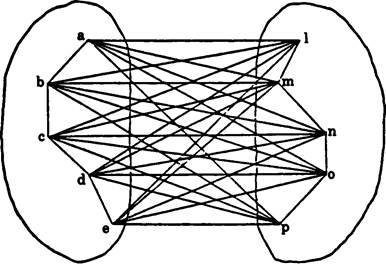
Figure 39.1
concrete reminiscences from which no detail could be omitted. Suppose, for example, we begin by thinking of a certain dinner-party. The only thing which all the components of the dinner-party could combine to recall would be the first concrete occurrence which ensued upon it. AU the details of this occurrence could in him only combine to awaken the next foUowing occurrence, and so on. If a, b, c, d, e, for instance, be the elementary nerve-tracts excited by the last act of the dinner-party, caU this act A, and I, m, n, o, p be those of walking home through the frosty night, which we may caU B, then the thought of A must awaken that of B, because a, b, c, d, e, will each and aU discharge into I through the paths by which their original discharge took place. Similarly they wiU discharge into m, n, o, and p; and these latter tracts wiU also each reinforce the other's action because, in the experience B, they have already vibrated in unison. The lines in figure 39.1 symbolize the summation of discharges into each of the components of B, and the consequent strength of the combination of influences by which B in its totality is awakened.
Hamilton first used the word 'redintegration' to designate aU association. Such processes as we have just described might in an emphatic sense be termed redintegrations, for they would necessarily lead, if unobstructed, to the reinstatement in thought of the entire content of large trains of past experience. From this complete redintegration there could be no escape save through the irruption of some new and strong present impression of the senses, or through the excessive tendency of some one of the elementary brain-tracts to discharge independently into an aberrant quarter of the brain.
Such was the tendency of the word 'heir' in the verse from Tocksley Hall,' which was our first example. How such tendencies are constituted we shall have soon to inquire with some care. Unless they are present, the panorama of the past, once opened, must unroll itself with fatal Iiterality to the end, unless some outward sound, sight, or touch divert the current of thought.Let us call this process impartial redintegration. Whether it ever occurs in an absolutely complete form is doubtful. We all immediately recognize, however, that in some minds there is a much greater tendency than in others for the flow of thought to take this form. Those insufferably garrulous old women, those dry and fanciless beings who spare you no detail, however petty, of the facts they are recounting, and upon the thread of whose narrative all the irrelevant items cluster as pertinaciously as the essential ones, the slaves of literal fact, the stumbiers over the smallest abrupt step in thought, are figures known to all of us. Comic literature has made her profit out of them. Juliet's nurse is a classical example. George Eliot's village characters and some of Dickens's minor personages supply excellent instances.
Perhaps as successful a rendering as any of this mental type is the character of Miss Bates in Miss Austen's Tmma.' Hear how she redintegrates:
Tut where could you hear it7, cried Miss Bates. Where could you possibly hear it, Mr. Knightley? For it is not five minutes since I received Mrs. Cole's note—no, it cannot be more than five—or at least ten—for I had got my bonnet and spencer on, just ready to come out—I was only gone down to speak to Patty again about the pork—Jane was standing in the passage—were not you, Jane?—for my mother was so afraid that we had not any salting-pan large enough. So I said I would go down and see, and Jane said: "Shall I go down instead? for I think you have a little cold, and Patty has been washing the kitchen." "Oh, my dear," said I—well, and just then came the note.
A Miss Hawkins—that's all I know—a Miss Hawkins, of Bath. But, Mr. Knightley, how could you possibly have heard it? for the very moment Mr. Cole told Mrs. Cole of it, she sat down and wrote to me. A Miss Hawkins—'But in every one of us there are moments when this complete reproduction of all the items of a past experience occurs. What are those moments? They are moments of emotional recall of the past as something which once was, but is gone forever— moments, the interest of which consists in the feeling that our self was once other than it now is. When this is the case, any detail, however minute, which will make the past picture more complete, will also have its effect in swelling that total contrast between now and then which forms the central interest of our contemplation.
Ordinary or Mixed Association
This case helps us to understand why it is that the ordinary spontaneous flow of our ideas does not follow the law of impartial redintegration. In no revival of a past experience are all the items of our thought equally operative in determining what the next thought shall be. Always some ingredient is prepotent over the rest. Its special suggestions or associations in this case will often be different from those which it has in common with the whole group of items; and its tendency to awaken these outlying associates will deflect the path of our revery. Jlist as in the original sensible experience our attention focalized itself upon a few of the impressions of the scene before us, so here in the reproduction of those impressions an equal partiality is shown, and some items are emphasized above the rest. What these items shall be is, in most cases of spontaneous revery, hard to determine beforehand. In subjective terms we say that the prepotent items are those which appeal most to our interest.
Expressed in brain-terms, the law of interest will be: some one brain-process is always prepotent above its concomitants in arousing action elsewhere.
Two processes,' says Mr. Hodgson,1 'are constantly going on in redintegration. The one a process of corrosion, melting, decay; the other a process of renewing, arising, becoming.... No object of representation remains long before consciousness in the same state, but fades, decays, and becomes indistinct. Those parts of the object, however, which possess an interest resist this tendency to gradual decay of the whole object.... This inequality in the object—some parts, the uninteresting, submitting to decay; others, the interesting parts, resisting it— when it has continued for a certain time, ends in becoming a new object.'
Only where the interest is diffused equally over all the parts (as in the emotional memory just referred to, where, as all past, they all interest us alike) is this law departed from. It will be least obeyed by those minds which have the smallest variety and intensity of interests—those who, by the general flatness and poverty of their aesthetic nature, are kept forever rotating among the literal sequences of their local and personal history.
Most of us, however, are better organized than this, and our musings pursue an erratic course, swerving continually into some new direction traced by the shifting play of interest as it ever falls on some partial item in each complex representation that is evoked. Thus it so often comes about that we find ourselves thinking at two nearly adjacent moments of things separated by the whole diameter of space and time. Npt till we carefully recall each step of our cogitation do we see how naturally we came by Hodgson's law to pass from one to the other. Thus, for instance, after looking at my clock just now (1879), I found myself thinking of a recent resolution in the Senate about our legal-tender notes. The clock called up the image of the man who had repaired its gong. He suggested the jeweller's shop where I had last seen him; that shop, some shirt-studs which I had bought there; they, the value of gold and its recent decline; the latter, the equal value of greenbacks, and this, naturally, the question of how long they were to last, and of the Bayard proposition. Each of these images offered various points of interest. Those which formed the turning-points of my thought are easily assigned. The gong was momentarily the most interesting part of the clock, because, from having begun with a beautiful tone, it had become discordant and aroused disappointment. But for this the clock might have suggested the friend who gave it to me, or any one of a thousand circumstances connected with clocks. The jeweUer,s shop suggested the studs, because they alone of all its contents were tinged with the egoistic interest of possession. This interest in the studs, their value, made me single out the material as its chief source, etc., to the end. Every reader who will arrest himself at any moment and say, "How came I to be thinking of just this?" will be sure to trace a train of representations linked together by lines of contiguity and points of interest inextricably combined. This is the ordinary process of the association of ideas as it spontaneously goes on in average minds. VVe may call it ordinary, or mixed, association.
Another example of it is given by Hobbes in a passage which has been quoted so often as to be classical:
In a discourse of our present civil war, what could seem more impertinent than to ask (as one did) what was the value of a Roman penny? Yet the coherence to me was manifest enough. For the thought of the war introduced the thought of the delivering up the King to his enemies; the thought of that brought in the thought of the delivering up of CHrist; and that again the thought of the thirty pence, which was the price of that treason: and thence easily followed that malicious question; and all this in a moment of time; for thought is quick.2
Can we determine, now, when a certain portion of the going thought has, by dint of its interest, become so prepotent as to make its own exclusive associates the dominant features of the coming thought—can we, I say, determine which of its own associates shall be evoked? For they are many. As Hodgson says:
The interesting parts of the decaying object are free to combine again with any objects or parts of objects with which at any time they have been combined before. All the former combinations of these parts may come back into consciousness; one must; but which will?
Mr. Hodgson replies:
There can be but one answer: that which has been most habitually combined with them before. This new object begins at once to form itself in consciousness, and to group its parts round the part still remaining from the former object; part after part comes out and arranges itself in its old position; but scarcely has the process begun, when the original law of interest begins to operate on this new formation, seizes on the interesting parts and impresses them on the attention to the exclusion of the rest, and the whole process is repeated again with endless variety. I venture to propose this as a complete and tπιe account of the whole process of redintegration.
In restricting the discharge from the interesting item into that channel which is simply most habitual in the sense of most frequent, Hodgson's account is assuredly imperfect. An image by no means always revives its most frequent associate, although frequency is certainly one of the most potent determinants of revival. If I abruptly utter the word swallow, the reader, if by habit an ornithologist, will think of a bird; if a physiologist or a medical specialist in throat diseases, he will think of deglutition. If I say date, he will, if a fruit-merchant or an Arabian traveller, think of the produce of the palm; if an habitual student of history, figures with A.D. or B.c. before them will rise in his mind. If I say bed, bath, morning, his own daily toilet will be invincibly suggested by the combined names of three of its habitual associates. But frequent lines of transition are often set at naught. The sight of C. Goring's ‘System der Icritischen Philosophie' has most frequently awakened in me thoughts of the opinions therein propounded. The idea of suicide has never been connected with the volumes. But a moment since, as my eye fell upon them, suicide was the thought that flashed into my mind. Why? Because but yesterday I received a letter from Leipzig informing me that this philosopher's recent death by drowning was an act of self-destruction. Thoughts tend, then, to awaken their most recent as well as their most habitual associates. This is a matter of notorious experience, too notorious, in fact, to need illustration. If we have seen our friend this morning, the mention of his name now recalls the circumstances of that interview, rather than any more remote details concerning him. If Shakespeare's plays are mentioned, and we were last night reading Kichard II,' vestiges of that play rather than of 'Hamlet' or 'Othello' float through our mind. Excitement of peculiar tracts, or peculiar modes of general excitement in the brain, leave a sort of tenderness or exalted sensibility behind them which takes days to die away. As long as it lasts, those tracts or those modes are liable to have their activities awakened by causes which at other times might leave them in repose. Hence, recency in experience is a prime factor in determining revival in thought.
Vividness in an original experience may also have the same effect as habit or recency in bringing about likelihood of revival. If we have once witnessed an execution, any subsequent conversation or reading about capital punishment will almost certainly suggest images of that particular scene. Thus it is that events lived through only once, and in youth, may come in after-years, by reason of their exciting quality or emotional intensity, to serve as types or instances used by our mind to illustrate any and every occurring topic whose interest is most remotely pertinent to theirs. If a man in his boyhood once talked with Napoleon, any mention of great men or historical events, battles or thrones, or the whirligig of fortune, or islands in the ocean, will be apt to draw to his lips the incidents of that one memorable interview. If the word tooth now suddenly appears on the page before the reader's eye, there are fifty chances out of a hundred that, if he gives it time to awaken any image, it will be an image of some operation of dentistry in which he has been the sufferer. Daily he has touched his teeth and masticated with them; this very morning he brushed them, chewed his breakfast and picked them; but the rarer and remoter associations arise more promptly because they were so much more intense.
A fourth factor in tracing the course of reproduction is congruity in emotional tone between the reproduced idea and our mood. The same objects do not recall the same associates when we are cheerful as when we are melancholy. Nothing, in fact, is more striking than our utter inability to keep up trains of joyous imagery when we are depressed in spirits. Storm, darkness, war, images of disease, poverty, and perishing afflict unremittingly the imaginations of melancholiacs. And those of sanguine temperament, when their spirits are high, find it impossible to give any permanence to evil forebodings or to gloomy thoughts. In an instant the train of association dances off to flowers and sunshine, and images of spring and hope. The records of Arctic or African travel perused in one mood awaken no thoughts but those of horror at the malignity of Nature; read at another time they suggest only enthusiastic reflections on the indomitable power and pluck of man. Few novels so overflow with joyous animal spirits as The Three Guardsmen' of Dumas. Yet it may awaken in the mind of a reader depressed with sea-sickness (as the writer can personally testify) a most dismal and woeful consciousness of the cruelty and carnage of which heroes like Athos, Porthos, and Aramis make themselves guilty.
Habit, recency, vividness, and emotional congruity are, then, all reasons why one representation rather than another should be awakened by the interesting portion of a departing thought. We may say with truth that in the majority of cases the coming representation will have been either habitual, recent, or vivid, and will be congruous. If all these qualities unite in any one absent associate, we may predict almost infallibly that that associate of the going thought will form an important ingredient in the coming thought. In spite of the fact, however, that the succession of representations is thus redeemed from perfect indeterminism and limited to a few classes whose characteristic quality is fixed by the nature of our past experience, it must still be confessed that an immense number of terms in the linked chain of our representations fall outside of all assignable rule. Take the instance of the clock. Why did the jeweller's shop suggest the shirt-studs rather than a chain which I had bought there more recently, which had cost more, and whose sentimental associations were much more interesting? Both chain and studs had excited brain-tracts simultaneously with the shop. The only reason why the nerve-stream from the shop-tract switched off into the stud-tract rather than into the chain-tract must be that the stud-tract happened at that moment to lie more open, either because of some accidental alteration in its nutrition or because the incipient sub-consdous tensions of the brain as a whole had so distributed their equilibrium that it was more unstable here than in the chain-tract. Any reader's introspection will easily furnish similar instances. It thus remains true that to a certain extent, even in those forms of ordinary mixed assodation which lie nearest to impartial redintegration, which assodate of the interesting item shall emerge must be called largely a matter of acd- dent—acddent, that is, for our intelligence. No doubt it is determined by cerebral causes, but they are too subtle and shifting for our analysis.
Notes
1. Time and Space, p. 266. Compare Coleridge: "The true practical general law of association is this: that whatever makes certain parts of a total impression more vivid or distinct than the rest will determine the mind to recall these, in preference to others equally linked together by the common condition of Contemporaeity or of contiguity. But the will itself, by confining and intensifying the attention, may arbitrarily give vividness or distinctness to any object whatsoever." (Biographia Litteraria, Chap. V.) 2. Leoiathm, pt. I. chap. ΠL, [chap. 35 in this volume].