Agents of change vary in their intensity, frequency, and extent
As you might guess, the tempo of succession is largely determined by how often, at what magnitude, and to what areal extent agents of change act. For example, when the avalanche produced by Mount St.
Helens ripped through the alpine community back in 1980, it produced a disturbance that was larger and more severe than any others that had occurred that year, that decade, or that century. The intensity, or severity, of that disturbance—the amount of damage and death it caused—was huge, both because of the massive physical force involved and because of the area covered. In contrast, the frequency of that kind of disturbance is low because such eruptive episodes are so rare (occurring once every few centuries). Extremely intense and infrequent events, such as the eruption of Mount St. Helens, are at the far end of the spectrum of disturbances organisms experience in communities (FIGURE 17.4). In this case, the entire community is affected, and recovery involves the complete reassembly of the community over time.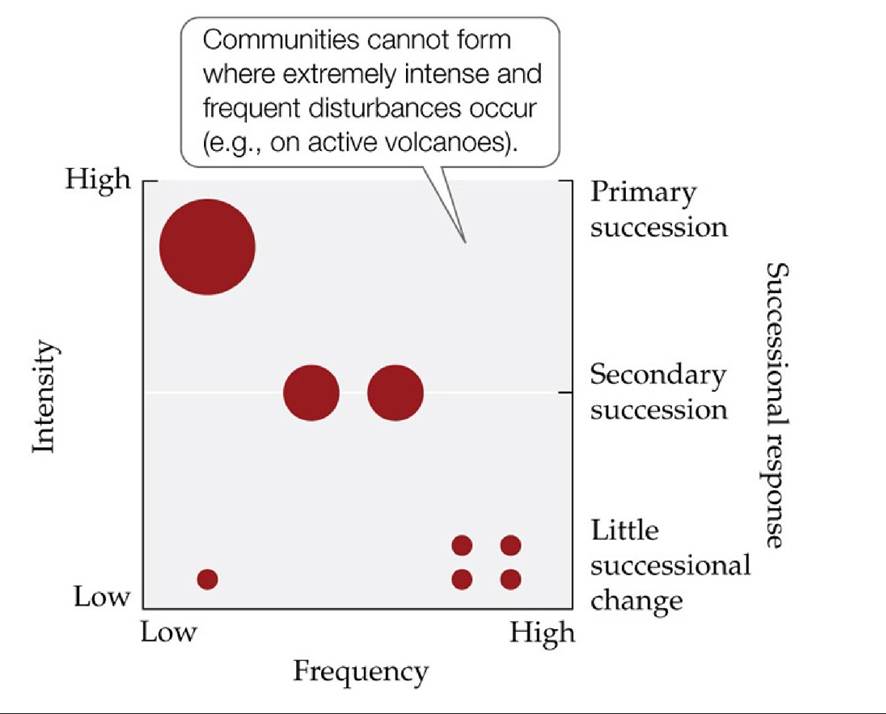
FIGURE 17.4 ThespectrumofDisturbance How much biomass is removed (the intensity, or severity, of disturbance) and how often it is removed (the frequency of disturbance) can influence the amount of change (represented by the size of the red circles) that occurs and the type of succession that is possible afterward (right side of the graph).
Describe how the type of organism being studied might influence whether we classify a disturbance as being intense or frequent.
View larger image
At the other end of the spectrum are weak and frequent disturbances that may have more subtle effects or affect a smaller area (see Figure 17.4). Prior to the eruption of Mount St. Helens, such disturbances might have included wind blowing down old trees living in the Douglas fir forests surrounding the mountain.
These more frequent disturbances open up patches of resources that can be used by individuals of the same or different species. A mosaic of disturbed patches can promote species diversity in communities over time but may not lead to much successional change.Climate Change Connection
Volcanoes and Climate as an Agent of Change
The eruption of Mount St. Helens not only created a massive disturbance to land, it also affected the atmosphere. An ash cloud roiled as high as 18 km (11 miles) and began to drift eastward in the atmospheric winds (see Figure 17.1). After the eruption, climate scientists Clifford Mass and Alan Robock (1982) were interested in whether the ash and gases propelled into the atmosphere affected local climate and, if so, for how long. Volcanic eruptions are known to have local to global effects on climate. For example, the 1883 eruption on the island of Krakatoa in Indonesia (see Figure 18.22), one of the most deadly and destructive volcanic events, injected a huge amount of sulfur dioxide (SO2) gas into the stratosphere (80 km [50 miles] high), which was then carried by winds around the globe. The sulfur dioxide gas interacted with water vapor, producing sulfuric acid, which can partially reflect solar radiation. In the year following the eruption, the average temperature in North America dropped by 0.4°C (0.72°F). A similar decrease in global temperatures (0.5°C [1°F]) from the eruption of Mount Pinatubo occurred in the Philippines in 1992.
What did Mass and Robock (1982) find out about the eruption of Mount St. Helens on climate? The blanket of ash cooled Eastern Washington and Idaho by 8°C (15°F) during the day and warmed it by the same amount at night. But the local temperature effects lasted only one day as the volcanic dust cloud dissipated and moved east. In addition, because the volcano did not produce a high- elevation plume of sulfur dioxide gas, there was no long-term or global influence on climate. Thus, the consequences of volcanic explosions on the atmosphere, and the potential ensuing changes to local or global climate, vary considerably depending on the intensity, frequency, and extent of the eruption.
Let's turn our attention from the intensity, frequency, and extent of agents of change to their consequences for community succession.