All waters contain dissolved salts
Salinity refers to the concentration of dissolved salts in water. Salts are ionic compounds, composed of cations (positively charged ions) and anions (negatively charged ions) that disassociate when placed in water.
Dissolved salts are important from a biological perspective because they influence properties of water that affect the ability of organisms to absorb it, as we will see in Concept 4.3. Salts also have direct influences on organisms as nutrients (as we will see in Concept 22.1) and can inhibit metabolic activity if their concentrations are too high or too low.Although all waters contain dissolved salts, we often think about salinity in the context of oceans, which account for 97% of the water on Earth; 70% of Earth's surface is under salty ocean waters. The salinity of the oceans varies between 33 and 37 parts per thousand; this variation is a result of evaporation, precipitation, and the freezing and melting of sea ice (FIGURE 2.24). The salinity of ocean surface waters is highest near the equator and lowest at high latitudes.
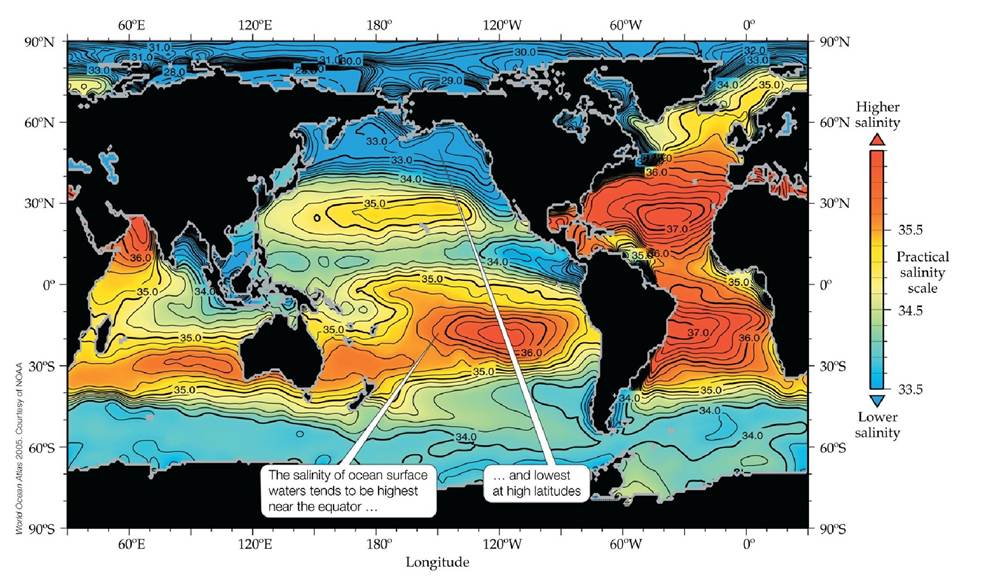
FIGURE 2.24 Global Variation in Salinity at the Ocean Surface Variations in the salinity of ocean surface waters reflect the concentrating effect of evaporation, dilution by melting sea ice, and precipitation. View larger image
What are the salts that make water saline, and where do they come from? Ocean salts consist mainly of sodium, chloride, magnesium, calcium, sulfate, bicarbonate, and potassium. These salts come from gases that were emitted by volcanic eruptions early in Earth's history, when its crust was cooling, and from the gradual breakdown of minerals in the rocks that make up Earth's crust.
The salinity of water bodies is determined by the balance of inputs and losses of salts and water. Most landlocked bodies of water become more saline over time, reflecting a balance between water inputs from precipitation, water losses due to evaporation, and inputs of salts.
When these inland “seas” occur in arid areas (e.g., the Great Salt Lake and the Dead Sea), their salinities usually exceed that of ocean water because of high rates of evaporation and its concentrating effect. The types of salts that contribute to their salinity vary, reflecting the chemistry of the minerals in the rocks that make up their basins. Despite the high salinity levels in these inland lakes, some organisms have managed to thrive in their waters, including algae and cyanobacteria.High levels of salinity occur naturally in waterlogged soils adjacent to oceans, such as those in salt marshes. Soils may also become more saline in arid regions as water from deeper soil layers is brought to the surface by plant roots or through pumping of groundwater for irrigation. As this transported water evaporates, it leaves its salts behind. If there is little precipitation to leach the salts to deeper soil layers, or if drainage of the water is impeded by impervious layers beneath the soil, high rates of evapotranspiration will result in a progressive buildup of salts at the soil surface. This process, known as salinization, occurs naturally in some desert soils and is a common occurrence in irrigated agricultural soils of arid regions (FIGURE 2.25). Salinization contributed to agricultural decline in ancient Mesopotamia (now Iraq) and is a problem today in California's Central Valley, Australia, and other regions.
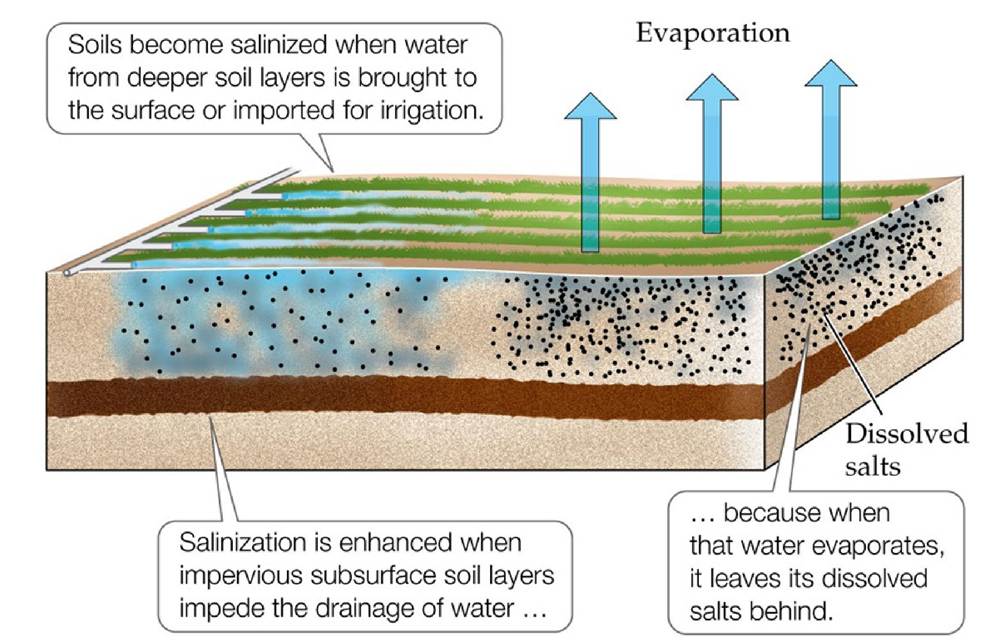
FIGURE 2.25 Salinization Salinization of soils is disrupting agricultural production in many areas, especially in arid regions. View larger image