Answers to Analyzing Data 13.1 Questions
1. This experiment tests the hypothesis that the symbiont Spiroplasma is more common in fruit flies harboring the nematode parasite Howardula. The “Howardula absent” treatment serves as the control.
The frequency of Spiroplasma fluctuated in the control but did not rise or fall consistently over time. In contrast, the frequency of Spiroplasma in the “Howardula present” treatment rose from its initial value of 50% to more than 95% by generation 5, supporting the hypothesis.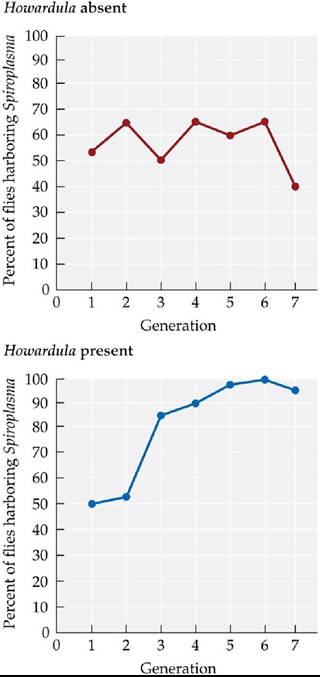
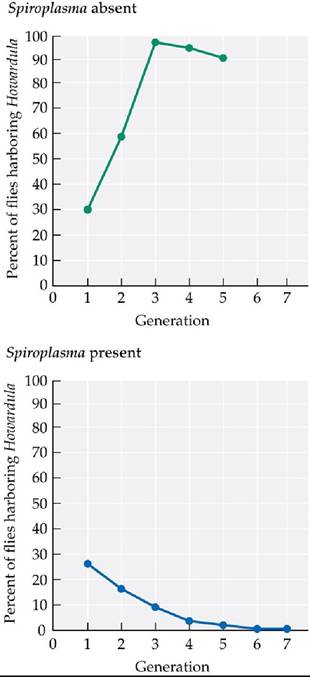
2. This experiment tests the hypothesis that the presence of the symbiont Spiroplasma protects fruit flies from the nematode parasite, Howardula. The “Spiroplasma absent” treatment serves as the control. In control populations, by generation 3, 95% of fruit flies were infected by the nematode parasite; all control populations declined to extinction by generation 6 (because, without the symbiont, the parasite sterilizes flies that it infects). In contrast, the frequency of Howardula dropped steadily in the “Spiroplasma present” treatment, reaching 0% by generation 6. These results support the hypothesis that the symbiont can protect fruit flies from attack by Howardula.
3. We would predict that if there was a large cost for harboring the symbiont, the frequency of flies harboring the symbiont would decline in the absence of the parasite. This did not occur (see the graph in Question 1 for the “Howardula absent” treatment), suggesting that the flies experience few costs for harboring the symbiont.