Answers to Hone Your Problem-Solving Skills Questions
1. For A. carolinensis lizards that were either caught in the wild or reared in a common garden, the average toepad area of lizards from uninvaded islands was lower than the average toepad area of lizards from invaded islands.
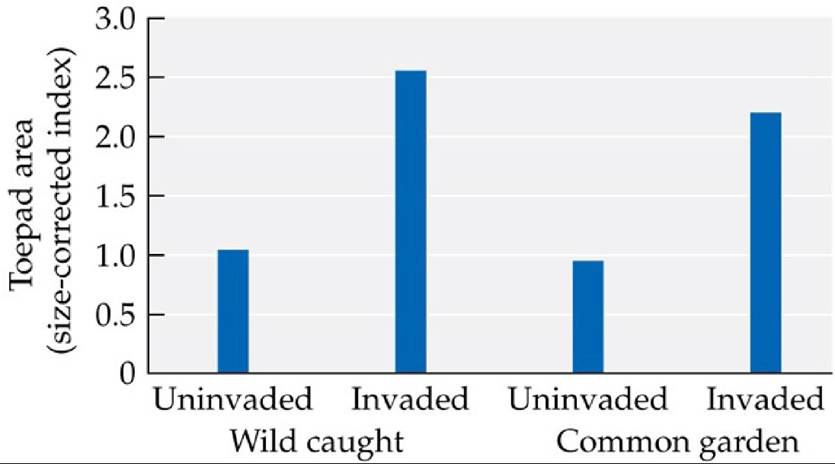
2.
If toepad area differences resulted from evolution, individuals caught in the wild on uninvaded islands would differ genetically from individuals caught on invaded islands—and the same would be true for individuals reared from eggs collected on uninvaded versus invaded islands. Hence, if changes in A. carolinensis toepad area were caused by evolution, wild-caught results and common garden results should be similar.3. If phenotypic plasticity was the primary cause of differences in toepad area, genes that affect toepad area would not differ between individuals living on uninvaded islands versus invaded islands. Thus, individuals reared from eggs collected on uninvaded versus invaded islands would also be similar genetically. In a common garden in which those (genetically similar) eggs were reared under identical conditions, toepad area should not change depending on whether the eggs were collected on uninvaded versus invaded islands. Hence, if changes in A. carolinensis toepad area were caused by phenotypic plasticity, wild- caught results and common garden results should differ from one another.
4. Since wild-caught results and common garden results were similar, this suggests that changes in toepad area resulted primarily from evolution, not phenotypic plasticity. Because an ecological event (invasion by a competitor species, A. sagrei) drove these evolutionary changes, this indicates that the invasion did lead to eco-evolutionary effects.