Answers to Hone Your Problem-Solving Skills Questions
1. The model best describes the intermediate disturbance hypothesis, which shows a unimodal relationship between species richness and disturbance, stress, or predation. At low levels of disturbance, species diversity is low because dominant species are free to exclude competitively inferior species.
At high levels of disturbance, species diversity declines because many species may become locally extinct as mortality increases. At intermediate levels of disturbance, species diversity is maximized simply by the balance between competition and mortality.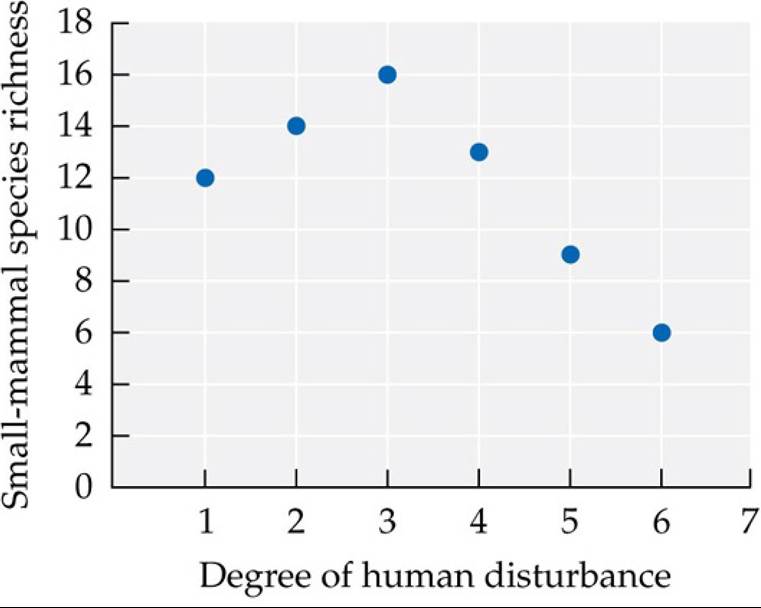
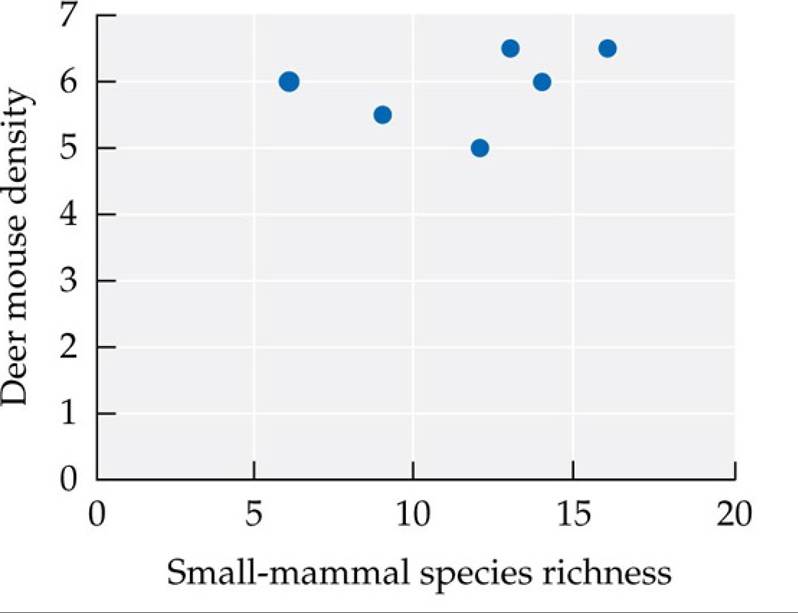
2. The graph shows that deer mouse density does not change with species richness. The data suggest that resource partitioning is not an important factor in the community. If the small-mammal species were partitioning resources, you would expect that where there is high species richness, there would also be lower densities of all species, including the deer mouse.
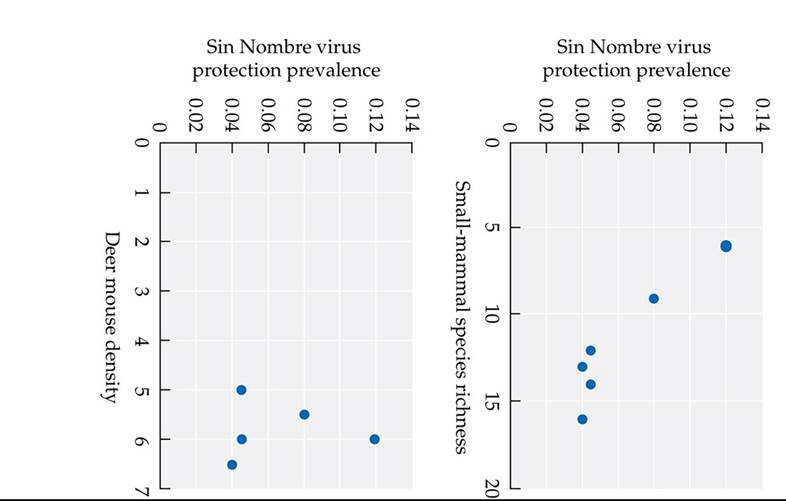
3. The graphs below show that Sin Nombre virus infection prevalence in the deer mouse is positively related to small-mammal species richness loss. There is no clear relationship with deer mouse density. The results suggest that when deer mouse hosts live in more species diverse communities, they are more likely to come into contact with individuals of other species than their own species (conspecifics), thus reducing the probability of transmission.