Answers to Review Questions
1. There are many built-in time lags in the responses of populations to changes in density. For example, the amount of available food may increase or decrease between the time the parent generation feeds and the time its offspring are born.
In such a situation, the number of offspring produced may be more closely related to the previous conditions than to the conditions at the time of their birth. As a result of such time lags, the population may experience delayed density dependence, which may cause it to fluctuate in abundance over time.2. Small populations can be threatened by chance events associated with genetic factors, demographic stochasticity, environmental stochasticity, and natural catastrophes. Genetic factors that increase the risk of extinction in small populations include genetic drift and inbreeding, both of which can increase the frequencies of harmful alleles. Demographic stochasticity results from chance events related to the reproduction and survival of individuals; such events can cause population growth rates to drop, as might occur if considerably more females than males happened to die in a small population, leaving few females to produce the next generation of offspring. Environmental stochasticity refers to unpredictable variation in environmental conditions; such variation can cause population growth rates to vary dramatically from year to year, increasing the chance of extinction in small populations. Finally, natural catastrophes can cause sudden reductions in population size, subjecting a population to increased risks from genetic factors, demographic stochasticity, and environmental stochasticity.
3.
a. Yes, as illustrated by the two generations of parents and offspring in the diagram. KEY: FC = female child; MC = male child; FG = female grandchild, MG = male grandchild
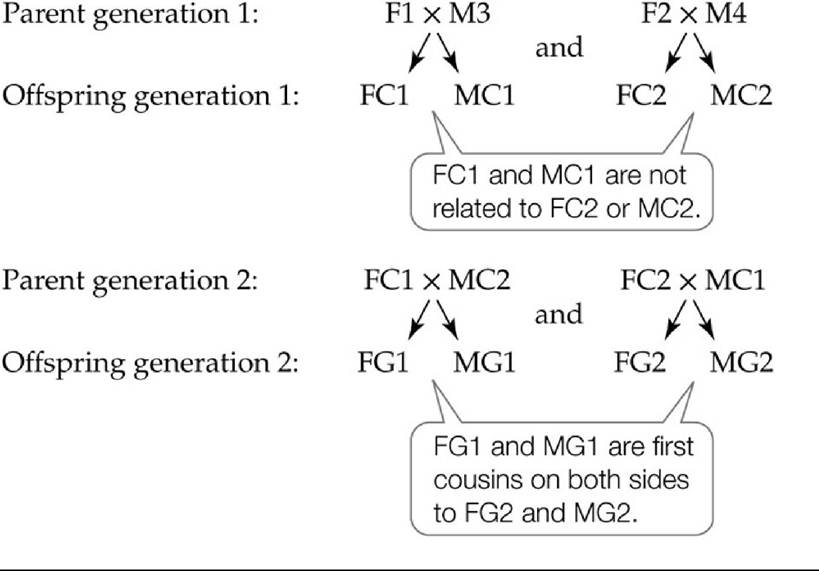
b. No, all of the individuals in the second generation of offspring are related to one another. As illustrated by this example, inbreeding is likely to be common in small populations.
More on the topic Answers to Review Questions:
- Answers to Review Questions
- Answers to Review Questions
- Answers to Review Questions
- Answers to Review Questions
- REVIEW QUESTIONS
- REVIEW QUESTIONS
- Answers to Review Questions
- REVIEW QUESTIONS
- REVIEW QUESTIONS
- REVIEW QUESTIONS