Basic Principles of Green Chemistry
Green chemistry as has already been stated (sec. 16.1) is defined as the environmentally benign chemical synthesis. Any synthesis performed in small scale or industrial scale should create none or minimum by products which pollute the environment.
According to Paul T. Anastas and John C. Wamer (Green chemistry, Theory and Practice, Oxford University Press, New York, 1998), the following basic principles of green chemistry have been formulated:• Prevention of waste/by-products
• Maximum incorporation of the reactants (starting materials and reagents) into the final product
• Prevention or minimization of hazardous products
• Designing safer chemicals
• Energy requirement for any synthesis should be minimum.
• Selecting appropriate solvent
• Selecting appropriate starting materials
• Use of protecting groups should be avoided when ever possible
• Use of catalyst should be preferred when ever possible
• Products obtained should be biodegradable
• The manufacturing process should be so designed so as to eliminate the possibility of accidents during operations
• Reuse of waste byproducts
16.3.1 Prevention of Waste / By-products
The synthesis should be carried out in such a way so that formation of waste (by- products) is minimum. It is very important, since in most cases, the cost involved in the treatment and disposal of waste adds to the overall cost of production. Even the unreacted starting materials form part of waste (see sec. 16.3.2). The waste or by-products, if discharged in the atmosphere, water bodies or land, not only cause pollution but also require expenditure for cleaning up.
16.3.2 Maximum incorporation of the reactants (starting materials and reagents) into the final product
It is believed that if the yield of a reaction is more than 90%, the reaction is considered to be good.
The percentage yield is calculated by the expression.o/ ■ и _ Actual yield of the product x ι∩∩
/o yield = Theoretical yield of the product
A perfectly efficient synthesis in which one mole of a starting material gives one mole of the final product (making the yield of 100%) is considered to be extremely efficient by the above calculations. However, the above procedure may generate significant amount of waste or by-products, which is not visible in the above calculation. Such a synthesis is by no means a Green synthesis. Typical reactions like Wittig reaction and the Grignard reaction illustrate above contention. Both these reactions may proceed with 100% yield but do not take into account the considerable amounts of by-products obtained.
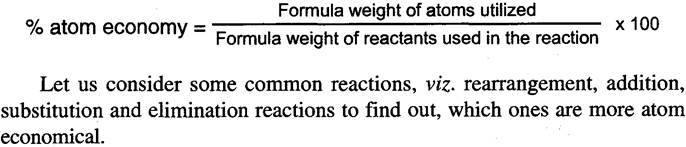
A synthesis or a reaction is considered to be green if there is maximum incorporation of the starting materials and the reagents in the final product. One should take into account the percentage atom utilization, which is calculated or determined by the following equation.

The concept of atom economy developed by B.M. Trost (Science, 1991, 254, 1471-1477) is a consideration of how much of the reactants end up in the final product. The same concept was determined by R.A. Sheldon (Chem. Ind. (London). 1992,903-906) and is given as
16.3.2.1 Rearrangement Reactions
In these reactions, there is rearrangement of atoms. The most well known example is Claisen rearrangement.
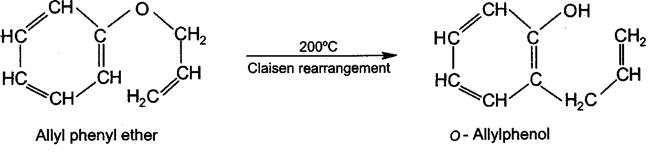
This is a 100% atom economical reaction, since all the reactants are incorporated into the product.
16.3.2.2 Addition Reactions
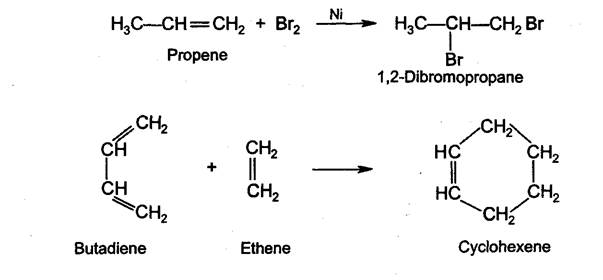
The addition of H2 to an olefin is an addition reaction.

In this example also, all elements of reactants (propene and hydrogen) are incorporated in the final product (propane).
This reaction is a 100% atom economical reaction.Similarly, addition of bromine to olefins and cycloaddition reactions of olefins are 100% atom economical reactions.
16.3.2.3 Substitution Reactions
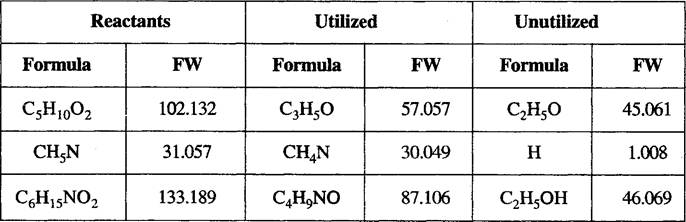
In these reactions, one atom or group of atoms is replaced by another atom or group of atoms. The atom or group that is replaced is not utilized in the formation of the final product. Thus, substitution reactions are not 100% atom economical; these are less atom economical than rearrangement or addition reactions. Consider the reaction of ethyl propionate and methyl amine.

In the above reaction, the leaving group (- OC2H5) of the ester and one hydrogen atom of methyl amine are not incorporated in the final product. The total of atomic weights of the atoms in the reactants that are utilized is 87.106g moΓ1 while the total molecular weight including the reagent used is 133.189g moΓ1 (see Table 16.1). Thus, a molecular weight of 46.069g moΓ1 remains unutilized in the reaction.
Table 16.1

16.3.2.4 Elimination Reactions
In an elimination reaction, two atoms or group of atoms are lost from the reactant. Consider the following Hofmann elimination reaction.
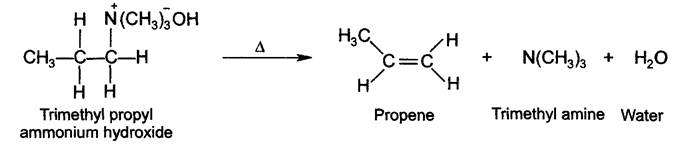
The above elimination reaction is not very atom- economical. The percentage atom economy is 35.30%. In fact, this is the least atom economical of all the above reactions.
Let us consider another elimination reaction involving dehydrohalogenation of 2- bromo-2-methylpropane with sodium ethoxide to give 2- methylpropene.

The above elimination reaction is also not very atom- economical. The percentage atom economy is 27% which is even less than Hofmann elimination reaction.
16.3.3 Prevention or Minimization of Hazardous Products
An important basic principle of Green chemistry is to prevent or at least minimize the formation of hazardous products, which may be toxic and environmentally harmful. These hazardous products may affect the workers. The minimum that should be done is to protect the workers by protective clothing, respirators etc. This, of course, will add to the cost of production. Also, the controls may fail putting the workers at greater risks. Green chemistry offers a scientific option to deal with such situations.
16.3.4 Designing Safer Chemicals
It is extremely important that the chemicals synthesized or developed (e.g. dyes, adhesives, paints, pharmaceuticals etc.) should be safe to use. An example of an unsafe drug is thalidomide (introduced in 1961) for reducing the effects of nausea and vomiting during pregnancy (morning sickness). The off spring bom to women taking this drug suffered from the birth defects including missing or deformed limbs. The use of thalidomide was banned and strict laws were formulated for testing new drugs.
With the advancement of better technology, it has now become possible to design and produce safer chemicals. Chemists can manipulate the molecular structure to achieve this objective.
16.3.5 Energy Requirements for Synthesis
For any synthetic procedure, the energy requirements should be kept to a minimum. For example, if the starting materials and the reagents have to be dissolved to bring them into solution and reaction mixture has to be heated to complete the reaction, in such case the time required for completion of the reaction should be minimum so that the energy requirement is least. Use of a catalyst has the added advantage of reducing the energy requirement for a reaction.
In case the final product is impure, it has to be purified by distillation, recrystallisation etc. for which energy is required. The process should be designed, as far as possible, in such a way that there is no need for separation or purification, so that the energy requirements are minimum.
Energy can also be supplied to a reaction by photochemical means, microwaves or sonication. These procedures take much less time with minimum energy.
16.3.6 Selection of Appropriate Solvent
The solvent selected should not cause any health hazard or any environmental pollution. Use of super- critical CO2 should be explored. If possible, the reaction should be carried out in aqueous phase or in the solid state without the use of the solvent.
In case of solvents, the volatility is one of the problems which may affect human health and the environment. A novel class of solvents, generally referred to as green solvents, is that of versatile ionic liquids. These are non-volatile and have excellent solvent properties. ∖
16.3.7 Selection of Starting Materials ξ
As far as possible, the starting materials should be obtainable from renewable sources. Thus, petrochemicals are considered to be obtained from non- renewable sources in the sense that it takes million of years for the formation of petroleum oil from vegetable and animal remains. The starting materials which can be obtained from agricultural or biological products, are referred to as renewable starting materials. The main problem with these materials is that such products cannot be obtained in a continuous supply due to factors like crop failure etc.
Gases like carbon dioxide (generated from natural sources or synthetic routes) and methane (obtained from natural sources like natural gas or marsh gas) are available in abundance. These are considered as renewable starting materials.
16.3.8 Use of Protecting Groups
In organic synthesis, if there are two reactive groups and we want to use only one of the groups, the other group has to be protected.
After the reaction is completed, the protecting group is finally removed. One such example is given below.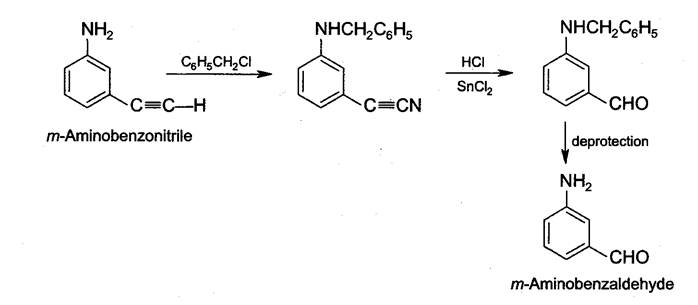
We see that the protecting groups are needed to solve a chemo-selectivity problem. The protecting reagent should be added in stoichiometric amounts only and removed after the reaction is complete. These protecting groups are not
incorporated into the final product and hence, their use make a reaction less atom-economical. As far as possible, the use of protecting groups should be avoided.
16.3.9 Use of Catalyst
If possible, a catalyst should be used to facilitate transformations at comparatively low temperatures. The catalyst is not incorporated in the final product and can be reused. Some advantages of the use of catalyst are as follows:
(i) BetterYield
Hydrogenation or reduction of olefins in presence of nickel catalyst

Preparation of cyanides
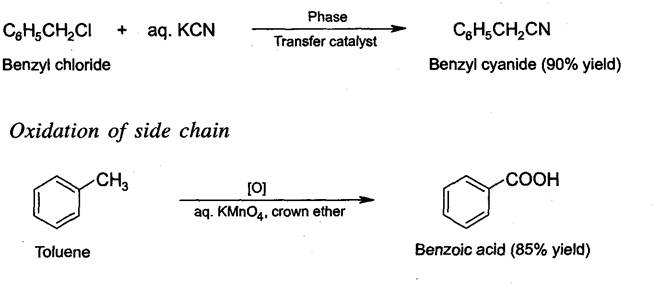
(ii) The reaction proceeds even in those cases where no reaction is normally possible without the use of catalyst.
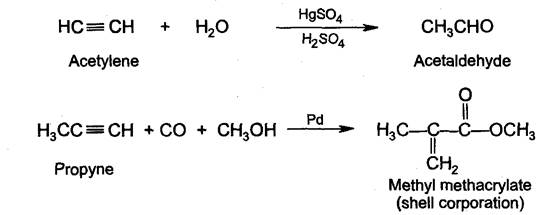
Towards Cleaner Future
327
(iii) Enhancement of selectivity

16.3.10 Products Designed Should be Biodegradable
In case, the products obtained are not biodegradable, these keep on accumulating in the land or water bodies and are responsible for the environmental problems besides having other effects. Such a problem was encountered in insecticides and polymers. It is now well known that some of the insecticides (like DDT and organophosphates) are not biodegradable. These accumulate in many plants and get incorporated into food chain and finally into humans and animals causing extremely harmful effects. Also some of the insecticides are responsible for the decline of population of beneficial insects. In view of the above, it is very important that any product (e.g. insecticide) synthesized must be biodegradable. It is equally important that during biodegradation, the products obtained should not have any toxic effects or should not be harmful to human health. It is possible to have a molecule which may possess functional groups that facilitates its biodegradation. The functional groups should be susceptible to hydrolysis, photolysis or other cleavage.
Rohm and Hass Company have developed some diacylhydrazines which are useful as insecticides and are biodegradable.
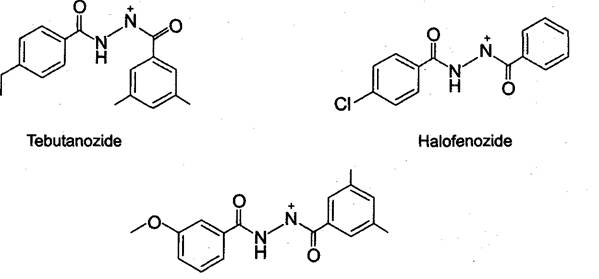
Methoxyfenozide
16.3.11 Designing Manufacturing Plants
It is extremely important to design manufacturing units in such a way that the possibility of accidents is minimum. A large number of accidents have occurred
in industrial units. The gas tragedy in Bhopal (Dec. 1984) and several other places has resulted not only in loss of thousands of human lives but have also rendered numerous other people disabled for the rest of their lives. The manufacturing plants should be so designed that it eliminates the possibility of accidents during operation.
16.3.7 Re -use of Waste or By- products
The waste or by- products generated in any industrial unit should be such that they can be recycled or put to some other use.
As on date, numerous examples are reported using basic principles of green chemistry.