16.4 Rain Water Harvesting
Water is one of the most essential components for existence of life. Although it is abundant in plenty on the earth, there is acute water shortage in large areas of the world.
Since ancient times, water had been of immense importance to the human beings.
Various civilizations flourished in river valleys. A large population of the world still lives near riverbanks, coastal areas and at places where water is available easily. Water is considered as the gift of God and worshiped even today because of its utmost importance right from the birth to the death.A large part of the surface of earth is covered with water. But only about 3% of the total amount is fresh water and it is this water, which sustains life on the earth. Again, out of this, 80% is frozen in the form of ice caps, snow, glaciers etc. and rest 20% occurs as liquid in the form of lakes, rivers, ponds and other water bodies. Water also occurs in soil, ground, living beings, atmosphere etc.
Water finds various uses such as irrigation, domestic, industrial, navigation, generation Ofhydroelectricity etc. The population explosion, rapid urbanization and increasing industrial and developmental activities demand more and more water and have lead to the scarcity of water or water crisis. Although some areas in the world are lucky to have sufficient water, some others are deserts, have very scanty rainfall and have very small water resources. Today, more than 1 billion people do not get safe drinking water.
In India, although, we are fortunate in terms of the water received by annual rainfall, the area such as Cherapunji which receives a large amount of rainfall (~1100 mm per year), also suffers from acute shortage of drinking water. India receives an average rainfall of400 m ham (million hectare metre) out of which 185 m ham is available as surface water, 50 m ham can be stored as ground water and 165 m ham can be stored in soil.
Many factors are responsible for the scarcity of water. The surface water sources have been over exploited leading to a decrease in the water level. The process of urbanization involving construction of houses, markets, roads, pavements and storm water drains, takes a lot of surface area and drains out the rain water as early as possible. Hence, there is no time for the rainwater to percolate to the natural ground to replenish the water sub-surface aquifer. This results in the lowering of the water table.
Since human activities have caused global warming and changes in climatic conditions, rains have also become irregular. The rainfall has reduced and has become erratic. Thus, the need for water conservations is being felt more and more. Also, the scarcity of water affects different sectors of the society to different extents. Rich can still afford to buy mineral water for drinking but they also need water for other activities. The poor, who cannot afford such luxury, have to depend upon whatever type of water is available to them. The poor quality of water leads to the spread of many diseases and epidemics. Also, unsafe water quality leads to poor health and such water is a slow poison.
The clean safe water is the requirement of all. Hence, it is our collective responsibility to make judicious use of available water without wasting even its single drop. Not only this, we have to conserve whatever water is available to us.
Generally, rainwater which reaches us in large quantities, is allowed to drain off and is not utilized. We can save this water and store it for future use. Rainwater harvesting is the process of augmenting the natural infiltration of rainwater or surface runoff into the ground by artificial methods. Broadly, the rainwater harvesting involves the following two processes:
(1) Storage of rainwater above or below ground using containers.
(2) Recharging the stored water into the ground for future use.
Any typical rainwater harvesting arrangement has the following four elements:
(1) Catchment area
(2) Conduits
(3) Settlement tank
(4) Recharge facility or storage facility.
Figure 16.1 illustrates this.
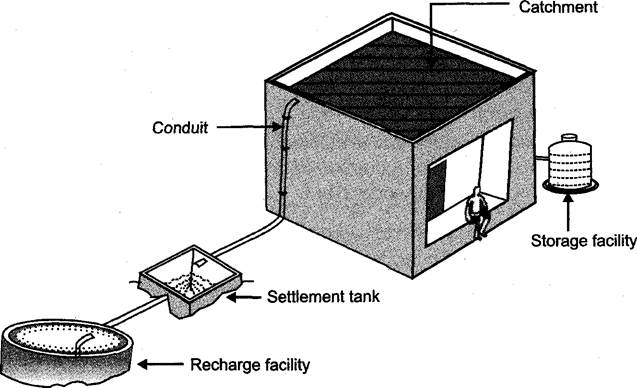
Fig. 16.1: Rainwater Harvesting
The catchment area receives the rainfall directly. It can be any surface such as a terrace or courtyard of a building or any unpaved area like a lawn or an open ground. Conduits are pipes which carry the rainwater from the catchments to the harvesting/storage facility. They can be made of PVC, asbestos, galvanized material or earthen pipes, or bamboos which are used in North- Eastern States.
Traditionally, pits, underground tanks, ponds, check dams, weirs, trenches, dug wells etc. are used for the collection and storage of rainwater.
Several methods are used in different regions of the country for the conservation of water.Some of these are discussed below:
(i) In Thar Desert
In the sandier tracts of the Thar Desert, villagers use an ingenious system of rainwater harvesting known as kunds and kundis. A kund is a covered Undergroimd tank, see Fig 16.2.
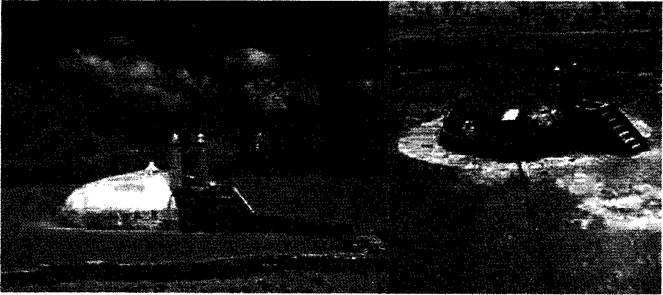
Fig. 16.2: A kund
The kunds are popular in the Western arid regions of Rajasthan and in areas having moderate to saline water. They provide convenient, clean and sweet drinking water in these places. Kunds are constructed both by the individuals and by the community and their use is known since the early seventeenth century. There are about 300 kunds in an area called Jalwali in Rajasthan.
Kunds and their catchments areas are kept clean by taking a lot of care. Kunds are circular in shape and have 3 - 4.5 m diameter. Studies have shown that in the 11 desert districts of Rajasthan, kunds provided sufficient water for use.
(ii) Bamboo Drip Irrigation in Meghalaya
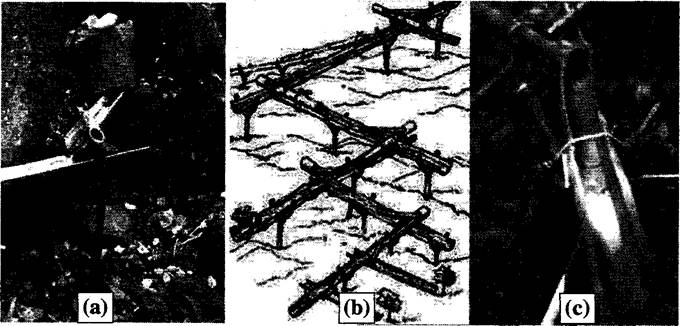
Fig. 16.3: (a), (b) and (c) Bamboo Drip Irrigation
In Meghalaya, bamboo pipes are used for tapping stream and spring water.
The system is very perfect and the rate of flow of water can be controlled,see Fig. 16.3. It is used by the farmers of Khasi and Jaintia tribes since more than last two centuries. Bamboos of different diameters are used for making channels. It is possible to divert water from the main channel and distribute it according to the requirement. This system is used for the irrigation of betel leaf or black pepper crops planted in areca nut orchards or in mixed orchards.(iii) In Trans Himalaya
The Spiti area OfHimachal Pradesh is a cold desert area but has managed to get water from distant glaciers by using kuls, see Fig. 16.4.
Spiti is a rain shadow area and is snowbound for six months in a year. It receives very less rainfall.
Kuls are basically diversion channels which run along mountain slopes and can be even 10 km long. They have a head at the glacier from which water is to be tapped. The kul is lined with stones to prevent clogging and seepage. Kul finally ends up in a circular tank in the village from which water is drawn. People using these kuls have developed socially acceptable system for sharing of water. They have been using this system since very long times without entering into any altercations or enmities.
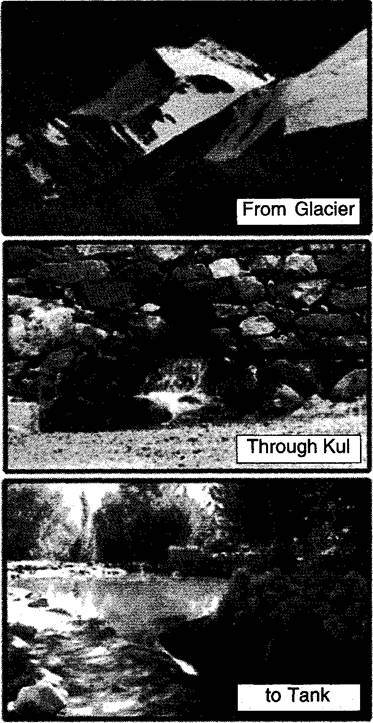
Fig. 16.4: From Glacier to Kul to Tank Source: (www.rainwaterharvesting.org).
Ward No 2
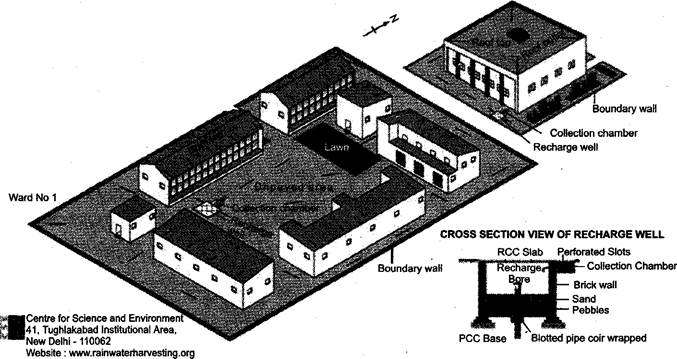
Fig. 16.5: Rainwater Harvesting
Water harvesting is being encouraged in urban areas in these days and a lot of people and institutions have started practicing it. Fig. 16.5 shows layout for rain harvesting in Tihar Jail. Many buildings in cities are proud to use it. Even the Rashtrapati Bhavan has rainwater harvesting facilities Fig. 16.6 (a) and (b). The Presidential Estate has an area of 133 hectare. It has large water requirements both for about 7000 people residing in it and about 3000 people visiting it.
The Mughal Gardens also require a lot of water. The total requirement is about 730 million Htres per year. About one-third of this requirement is met by groundwater resources which have gone down by 2 to 7 m in last few years. Therefore, rainwater harvesting has been taken up actively in the Rashtrapati Bhavan.
Fig.16.6: (a) Presidental Estate
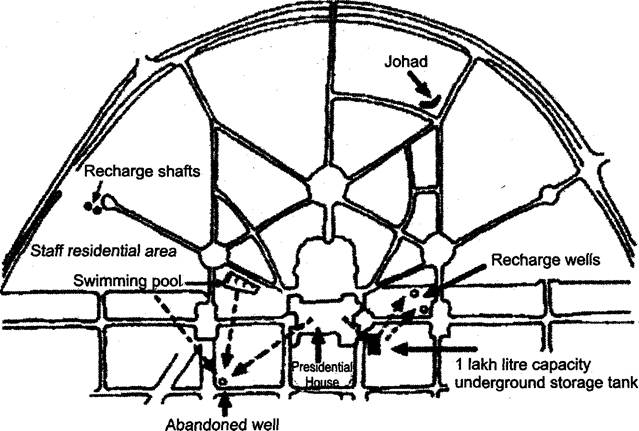
Fig.16.6: (b) Rainwater Harvesting Plan
Rainwater from the northern side of the roof and paved area is diverted to the underground storage tank of 1 lakh litre capacity for low quality use. The overflow from it is diverted to two dug wells for recharging. Rainwater from the southern side of the roof is also diverted to a dry open well for recharging. Runoff from the staff residential area is also diverted to a dry well. The swimming pool having 9 lakh litre capacity is also planned to be connected to the dry dug well. A Johad is planned to be constructed near the Mughal Gardens. Water accumulated in the johad percolates in the soil to augment the groundwater.
(Source: http://www.rainwaterharvesting.org/methods/modem/rbhavan.html)
16.5
More on the topic 16.4 Rain Water Harvesting:
- 16.4 Rain Water Harvesting
- Characteristics of Water
- Water is essential for life. Water is the medium in which all biochemical reactions necessary for physiological functioning occur.
- RAIN, FOREST
- Types of Water Pollutants
- CONTENTS
- Sources of Water Pollution