Characteristics of Water
Water is a unique liquid, without which no life can survive. This is attributed to the following characteristics.
(i) Water is regarded as a universal solvent. No other liquid can be compared to water as solvent.
Since natural water is slightly acidic (due to dissolved carbon dioxide which gives carbonic acid, H2CO3 (for more details see sec. 4.5.1; pH of natural water is 5.6). It can dissolve a variety of compounds from simple salts to minerals including sodium chloride (common table salt) and calcium carbonate (calcite) in limestone rock. Water also reacts with complex organic compounds including many amino acids found in the human body.(ii) Water possesses the highest heat of fusion and heat of evaporation, collectively known as the latent heat, of all known liquid substances at ordinary temperature. The latent heat of water is responsible for moderating the temperature of the biosphere. It also plays a vital role in the evaporation of water and its condensation as rain and as dew (see hydrological cycle, sec. 2.8.1.1)
(iii) Compared with other common liquids water has a high surface tension, a characteristic that is very important in many physical and biological processes involving movement of water through and into organisms.
(iv) Water is a poor thermal conductor as compared to metals.
(v) Water has a high viscosity which allows organisms to swim using simple movements.
(vi) Water protects the aquatic animals and plants from the mechanical disturbances.
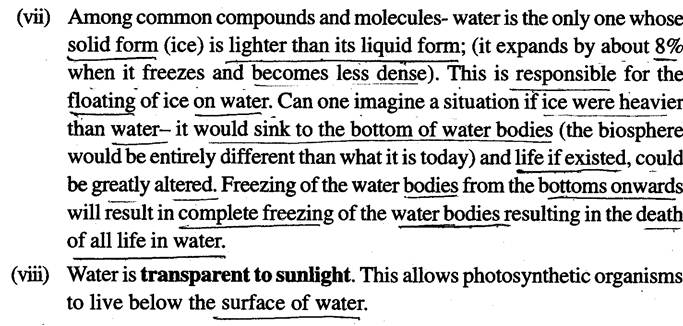
(ix) Water exerts pressure. Organisms living at sea level experience a pressure of about 15 psi (~1 atmosphere, which is equal to 760 mm mercury). With depth, the pressure increases at the ratio of about one atmosphere for every 10 meters of descent. The physical characteristics like solubility, ionic dissociation and surface tension - all are influenced by the pressure.
5.4
More on the topic Characteristics of Water:
- Water is essential for life. Water is the medium in which all biochemical reactions necessary for physiological functioning occur.
- CONCEPT 4.3 The water balance of an organism is determined by exchanges of water and solutes with the external environment.
- Characteristics of Soil
- DESCRIPTIVE CHARACTERISTICS
- WATER TRADING
- Ecologists often delineate communities by their physical or biological characteristics
- Types of Water Pollution
- Water Quality Parameters
- 16.4 Rain Water Harvesting
- DRINKING WATER
- Water flows along energy gradients
- WATER ALLOWANCE TRADING
- THE EQUITY PRINCIPLE AND WATER TRADING
- Characteristics of Roman Law in Antiquity Essential for its Survival
- § 1. General Characteristics.
- Characteristics of Mutualism
- Fundamental Characteristics
- SOIL AND WATER AS RESERVOIRS
- WATER HOMEOSTASIS
- 3 Water quality standards and environmental permits