Fundamental Characteristics
By any standards the Soviet Union was an unusual empire. It was created in 19171922 in a massive sociopolitical revolution and civil war which swept away most of the institutions of its predecessor, the Russian Empire.
From the outset it had a definite and proclaimed purpose, which concerned not just its own territory but the entire world: the creation of an international proletarian socialist state, which was to bring a harmonious social and economic life to all humanity. The Soviet leaders proposed to create socialism by abolishing the capitalist market which governed the international economy and creating in its place an economy of egalitarian plenty by means of state planning. The Communist ideology, which was minutely elaborated in learned institutes, became compulsory for everyone; it was imposed by a rigid censorship, as well as by state control of education, culture, and the media.To reflect its ultimate ambition, the empire's name had no ethnic or geographical connotation, but derived from a form of democratically elected workers' organization which was supposed to be at its heart. The aim of immediate world revolution was abandoned as impracticable by the mid-1920s, but its first stage, the consolidation of socialism in its provisional homeland and bastion, Russia, still went ahead under the name of “socialism in one country.” Inevitably this meant that the interests of international socialism came to be identified with the interests of the Soviet Union.
Another distinctive feature of the Soviet Union, connected with its international ambitions, was the systematic advancement of the non-dominant, that is to say the non-Russian, ethnicities. More than any other empire, the Soviet Union renounced the idea of a dominant people, and in principle offered all ethnicities equal opportunities to develop their own forms of citizenship and culture within the overarching state.1 Prime Minister Aleksei Rykov claimed that “Britain's colonial policy consists in developing the metropolis at the expense of the colonies, but we are developing the colonies at the expense of the metropolis.”2
The Soviet Union's ideological impetus determined its place in global politics.
From the time its empire reached its greatest extent, in the late 1940s, the Soviet1 Slezkine 1994; Martin 2001.
2 Solovei 2011, 210.
Geoffrey Hosking, The Soviet Union In: The Oxford World History of Empire. Edited by: Peter Fibiger Bang, C.A. Bayly,
Walter Scheidel, Oxford University Press (2021). © Oxford University Press. DOI: 10.1093/oso/9780197532768.003.0043.
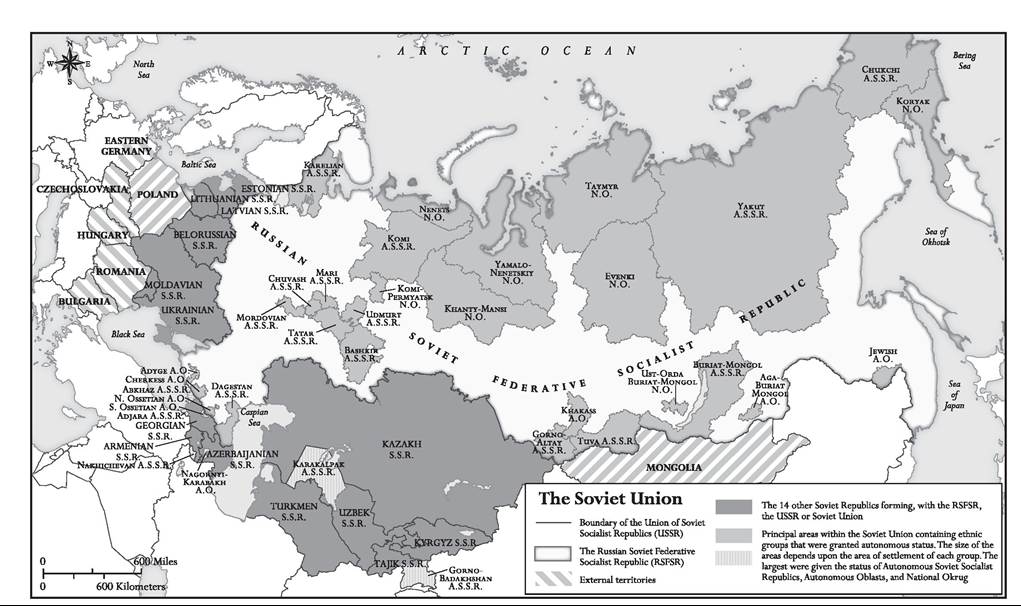
Map 43.1. The Soviet Union.
Copyright: Oxford University Press.
1188 GEOFFREY HOSKING
Union had an explicit rival: the United States. The two powers had no territorial disputes, but their ideological conflict was total; each became the other's “Other.”[2709] The Cold War was the defining context for the Soviet Union's evolution as a great power. Ensuring its absolute security against the United States was an overriding priority for its leaders. This meant creating nuclear weapons and missile systems, as well as conventional armaments, along with a world-standard army, navy, and air force. When the Western powers set up NATO as an anti-Soviet armed alliance, the Soviet Union responded with the creation of the Warsaw Pact. Relations between them rested on an uneasy balance between “peaceful coexistence” (a policy enunciated by Khrushchev in the mid- 1950s to avoid a horrifically destructive war) and ideological struggle. The long-term Soviet ambassador to the United States, Anatolii Dobrynin, commented in his memoirs that “the East-West confrontation was a practical result of the Soviet leadership's attempts to reconcile these two ideological principles and somehow strike a balance between them. But it also resulted in our unnecessary involvement in a superpower rivalry with the United States in the Third World.”[2710]
The military priorities necessarily inflicted costs on the Soviet population's living standards. In 1988 the historian Paul Kennedy diagnosed the problem of “imperial overstretch”: devoting so may resources to military and imperial expenditure enfeebled the metropolitan economy and with it the social will to continue shouldering the burden of empire.[2711]
The Soviet Union failed in each of its ideological aims.
Instead of an international polity, it ultimately created a cluster of nation-states, most of which had never existed previously. Instead of an egalitarian economy of abundance, it created a hierarchical economy of scarcity, and its ultimate fruit was an anarchical and rapacious capitalism. In its geopolitical rivalry with the United States, it was the loser. Its total life span of 74 years was quite brief by historical standards: roughly, say, the interval between two successive Chinese dynasties.Yet, in its own way, the Soviet Union achieved a great deal, notably the defeat of Nazi Germany in World War II. Soviet conduct of that war demonstrated dramatically both the strengths and the weaknesses of the system. The first year and a half saw disastrous defeats and the loss of extensive territory and millions of soldiers and civilians, largely because Stalin had failed to prepare for the early outbreak of war. He had become a prisoner of his own dictatorial powers: the outlawing of alternative opinions had become so total that advisors of greater foresight did not dare to present their views publicly, and in any case lacked the institutions through which to do so.[2712] The German invasion thus achieved total surprise. Many Red Army units more or less melted away, as both officers and soldiers surrendered without fighting, deserted, or simply fled. Many of them, peasants in particular, hated Stalin and the Communist Party, and saw no reason to fight for a cause which in any case seemed doomed.[2713]
Once it became clear, however, that this really was a “war of extermination,” as Hitler called it, and that the Red Army was capable of resistance, the popular mood changed, and then the Soviet military-political structure proved well adapted to conducting total war. Soviet propaganda had always used martial rhetoric, and now that rhetoric had turned out to be absolutely accurate. The tightly centralized political structure was ideal for defining priorities and concentrating on what was most urgently needed, as was demonstrated by the remarkable speed with which industry was evacuated from threatened territory, reassembled, and set working again far in the rear.
Once Soviet mobilization was in full swing, the country's resources were far greater than those of Germany, and they were eventually brought to bear. By 1945 no fewer than 35 million men had served in the Red Army. They were motivated to fight partly by the army's brutal discipline: “blocking detachments” moved up just behind the front to intercept panickers and deserters, and shot a good many of them. But the regime's propaganda was also effective: Stalin gave it a more Russian national resonance. In his speech on the anniversary of the October Revolution in 1941, he evoked not only the Red Army's feats during the Civil War, but also the victories of Alexander Nevskii, Dmitrii Donskoi, and Mikhail Kutuzov from the pre-revolutionary past. Red Army soldiers were encouraged to see their own small unit's solidarity as part of a great Russian national war effort. This was the message of Alexander Tvardovsky's narrative poem Vasilii Terkin, which many men carried in their knapsacks. A new Soviet-Russian patriotism was born, which accepted Stalin as its leader and the Communist Party as its guide. The link was fortified by the party's recruitment drive, which accepted many soldiers into party membership without the usual probationary period. Even soldiers who hated Stalin were impelled to defend their own homeland.[2714]
The Soviet Union also achieved the rapid—if lopsided—modernization of a country which by European standards was relatively backward. Building on a Tsarist base which was far from negligible, it created a strong heavy industrial sector, carried through its own form of urbanization, brought primary and secondary education to most of the population, and established a social welfare system which in its later decades provided a lifeline for most of the weak and unfortunate. When priorities were urgent and unambiguous, the Communist Party functioned effectively, though far from humanely.
What were the sources of the Soviet Union's remarkable strengths and weaknesses? Never has any empire depended so much on ideological power, as conceptualized by Michael Mann.
The ideology was conveyed to the population by every possible means: through the mass media, culture, and the education system.Every school pupil and college student studied history and the social sciences through a Marxist-Leninist prism, and had to take examinations in subjects such as the history of the Communist Party of the Soviet Union (CPSU), dialectical materialism, and scientific atheism.
There was, though, a mismatch between the content of the ideology and the way it was disseminated. The medium contradicted the message. In the words of Alexei Yurchak, it aimed at “total liberation by means of total control.”9 Writing in Sovietized Czechoslovakia, Vaclav Havel articulated the contradiction pithily in his parable of the greengrocer who displayed in his shop window a poster exhorting “Workers of the World, Unite!” He did so not because he believed in the sentiment, but because he had received the poster from the ministry along with the turnips and potatoes. “It has been that way for years,... everyone does it, and that is the way it has to be. If he were to refuse, there could be trouble.”10
Some people did of course believe in the ideology. Much depended on an individual’s situation. Young people, especially young men, making their way in the world, could appropriate the parts of the ideology they found both attractive and useful—innovation, boldness, struggle against the old world—assimilate them into their personalities and deploy them in advancing their careers. We should not interpret this as mere instrumentalism: people often believe sincerely and even to the point of self-sacrifice in ideas which are either widely accepted in their milieu or are beneficial to them personally. Even literary figures as staunch, independent, and courageous as the poets Boris Pasternak and Osip Mandelstam made one or two sincere attempts to engage in the idealism of the Five Year Plans and to praise Stalin as a great leader.11
For several decades, that ideological power was successfully combined with Mann’s other constituents of social power: political, military, and economic.
The Communist Party was not just the bearer of an ideology; it created a power structure which penetrated the whole of society. Its grip on political power was exercised through the nomenklatura appointments system. Party secretaries in every constituent republic or region would maintain two personnel lists, one of senior posts which they were responsible for filling, and one of persons qualified to fill them. Many of those posts were ostensibly elective, but in practice the party secretary’s choice was decisive. The party’s influence also determined all senior appointments in the armed forces, where it was reinforced by political commissars.12 Party secretaries tended to appoint individuals they knew well and could trust. In this way the nomenklatura system generated patronage networks which extended throughout society, doing much to determine the way power was exercised and resources distributed everywhere. Over time, though, those networks became calcified and were no longer capable of responding effectively to changing demands.139 Yurchak 2006, 284.
10 Havel 1985, 27.
11 Beyrau 1998; Fitzpatrick 2009.
12 Who were known by different names in different periods.
13 Voslensky 1984.
Economic power was mediated through the state planning authority, Gosplan. Planning was intended to create abundance, and proved good at enforcing the relatively unambiguous priorities of early industrial development and of assimilating millions of rural dwellers swarming into the towns. It was very effective in producing the arms and equipment necessary for waging war, and for other high-priority initiatives such as the space exploration program. It was also effective in extracting resources from the population. This was done by means of a turnover tax which was levied mostly on food and consumer goods by the device of charging much more for them in state shops than the wholesale price paid to producers. By comparison, heavy industry made only a small contribution toward total taxation.[2715] In this way the population was exploited without usually being aware of it.
As the economy became more complex and sophisticated, however, Gosplan proved ever more inept at responding to the demands of consumers (other than the military, who had political channels for enforcing their requirements). Gosplans rigid targets impeded the assimilation of new technology: producers were mainly concerned with fulfilling targets, not with meeting the needs of customers. Most of its enterprises continued to turn out old-fashioned and poorly designed products. Already in 1956 its head, Nikolai Baibakov, complained that production figures were “unreal” and “abstract,” and that “capital investments are going down the drain.”[2716] Planning generated an economy of bottlenecks and scarcity, exacerbated by the high priority given to military spending. The way the nomenklatura elite distributed scarce resources determined the life-chances of most of the population. In order to get by, most people needed to find employment under a skillful dispenser of patronage, and to forge unofficial personal links to obtain scarce consumer goods and services.[2717]
The party itself became increasingly a conveyor belt for the distribution of those resources. Its own full-time officials were the most privileged sector of society, and those they favored were at the head of the queue for material benefits. The natural result was that members of the nomenklatura elite clung to their posts as the best guarantee of well-being, while their clients in turn clung to their benefactors. From the 1960s the party's policy of “stability of cadres” exacerbated this tendency and engendered a profoundly conservative society, poor at coping with changes and challenges.
A key reason for ultimate failure was the breakdown of the social trust which was necessary to tie the ideology to the power structure and the economy. The roots of that breakdown lay in the nature of the revolution and civil war which had established the Soviet state. They destroyed or fatally weakened some of the normal components of social cohesion, the institutions which underpin routine, unreflec- tive, and generalized social trust: the monarchy, the civil service, the church, the media, institutions of learning, law courts, police, and local government. Some of them were replaced by Soviet-style simulacra, usually surrounded by a firewall of censorship and institutional monopoly which blocked the investigation of mistakes or abuses and the airing of alternative ideas. Historical memory was challenged, disrupted, and then supplanted by new narratives, now immune from serious questioning.[2718] Even the family, the primary unit of social trust, was seriously endangered, both by revolutionary violence and by the Communists' conscious attempts to replace it through collective provision of social facilities.[2719]
The way in which the Communist leaders configured political power radicalized this distrust and further weakened social sinews. They were profoundly marked by the experiences which had brought them to power. They had fought a desperate civil war, which it often seemed they would lose. Through these abrupt changes of fortune, they forged a strong sense of embattled interdependence and mutual trust, without which they could scarcely have persisted in their endeavor. Absolute trust in the party became a hallmark of Communists. When transferred from one post to another, each leader, using the nomenklatura system, would take with him his own trusted colleagues and subordinates. During the 1920s Stalin strengthened his own position by aiding and abetting these joint moves.[2720]
Yet the same factors also gave rise to intense distrust. The messianic and apocalyptic narrative which underlay the spiritual life of Communists divided the world into “comrades” and “enemies.” “He who is not with us is against us” became a common saying. When in the 1920s the party faced serious and unavoidable problems about how to carry out their policies, their debates over strategy polarized opinion, for they were dealing with questions of life and death, total success and total failure. Since there was no opposition party, and since the Communists claimed uniquely valid insight into social evolution, they automatically assumed that there was only one solution to all problems and that alternative opinions could only be held by enemies. Internal party rhetoric escalated to the point where political rivals were characterized as “deviationists,” then as “terrorists” and “enemies of the people.”[2721]
From 1929 dekulakization, the forcible collectivization of agriculture, and the highly ambitious Five Year Plans for industrial development generated further social upheavals, and also encountered a large number of unexpected setbacks and disasters, culminating in the famine of 1932-1933, in which some five million people died prematurely. The party leadership could only ascribe these impediments to “enemies”—enemies, moreover, within the upper levels of the nomenklatura hierarchy. Suspicion and distrust were intensified by genuine and growing external threats, from the capitalist powers in general, and from Japan and Nazi Germany in particular. Stalin could and did portray internal “enemies” as agents of those foreign powers. His attempts to uncover and eradicate these imagined figures led to the Great Terror. In the worst years, 1937-1938, nearly 700,000 people were executed, and many more died prematurely in labor camps and penal settlements.[2722]
Soviet society never fully recovered from the fear and widespread distrust generated by these operations. The security police not only did the job of secret services everywhere: it also protected the CPSU power network from any form of rivalry, and shielded the population from the import of “subversive” ideas—crucial for an ideological state which wished to insulate itself against contact with a feared and powerful rival. It operated through an all-pervasive network of employees and informers whose activities compelled every citizen to ask him- or herself constantly: Whom can I trust? Whom should I distrust?
Yet no society can operate on the basis of total distrust, and the Soviet Union did create new social bonds, mostly of a type which its ideologists had not foreseen. The ideology developed its own “shadow message,” spread partly through what Michael Mann calls “interstitial networks,” and partly by the official bearers of power themselves. Ultimately that message proved fatal to the Soviet Union itself.
More on the topic Fundamental Characteristics:
- Fundamental causes of income differences
- DESCRIPTIVE CHARACTERISTICS
- Ecologists often delineate communities by their physical or biological characteristics
- Characteristics of Water
- Characteristics of Soil
- The fundamental challenges
- The fundamental Marxian theorem
- Conditional probability as fundamental
- Section 1 Fundamental Concepts and Theories
- Negative dialectics and fundamental ontology
- Issue of Fundamental Rights and View of the Court
- The Case of Ludin and its Consequences: Some Fundamental Questions
- Characteristics of Roman Law in Antiquity Essential for its Survival
- § 1. General Characteristics.