The fundamental challenges
The establishment of a unified theory of economic growth that can account for the intricate process of development over the course of the last thousands of years has been one of the most significant research challenges faced by researchers in the field of growth and development.
A unified theory unveils the underlying micro-foundations that are consistent with the entire process of economic development, enhancing the confidence in the viability of growth theory, its predictions and policy implications, while improving the understanding of the driving forces that led to the recent transition from stagnation to growth and the Great Divergence. Moreover, a comprehensive understanding of the hurdles faced by less developed economies in reaching a state of sustained economic growth would be futile, unless the forces that initiated the transition of the currently developed economies into a state of sustained economic growth would be identified, and modified, to account for the differences in the evolutionary structure of less developed economies in an interdependent world.The evidence presented in Section 2 suggests that the preoccupation of growth theory with the empirical regularities that have characterized the growth process of developed economies in the past century and of less developed economies in the last few decades, has become harder to justify from a scientific viewpoint. Could we justify the use of selective observations about the recent course of the growth process and its principal causes in the formulation of exogenous and endogenous growth models? Could we be confident about the predictions of a theory that is not based on micro-foundations that match the major characteristics of the entire growth process? The evolution of theories in older scientific disciplines suggests that theories that are founded on the basis of a subset of the existing observations are fragile and non-durable, and are often generating increasingly distorted predictions.
3.1. Mysteries of the growth process
The underlying determinants of the stunning recent escape from the Malthusian trap have been shrouded in mystery and their significance for the understanding of the contemporary growth process has been explored only very recently. What are the major economic forces that led to the epoch of Malthusian stagnation that characterized most of human history? What is the origin of the sudden spurt in growth rates of output per capita and population that occurred in the course of the take-off from stagnation to growth? Why had episodes of technological progress in the pre-industrialization era failed to generate sustained economic growth? What was the source of the dramatic reversal in the positive relationship between income per capita and population that existed throughout most human history? What are the main forces that prompted the demographic transition? Would the transition to a state of sustained economic growth be feasible without the demographic transition? Are there underlying unified behavioral and technological structures that can account for these distinct phases of development simultaneously and what are their implications for the contemporary growth process?
The mind-boggling phenomenon of the Great Divergence in income per capita across regions of the world in the past two centuries, that accompanied the take-off from an epoch of stagnation to a state of sustained economic growth, presents additional unresolved mysteries about the growth process. What accounts for the sudden take-off from stagnation to growth in some countries in the world and the persistent stagnation in others? Why has the positive link between income per capita and population growth reversed its course in some economies but not in others? Why have the differences in income per capita across countries increased so markedly in the last two centuries? Did the pace of transition to sustained economic growth in advanced economies adversely affect the process of development in less-developed economies?
The transitions from a Malthusian epoch to a state of sustained economic growth and the emergence of the Great Divergence have shaped the current growth process in the world economy.
Nevertheless, non-unified growth models overlooked these significant underlying forces of the process of development.3.2. The incompatibility of non-unified growth theories
Existing (non-unified) growth models are unable to capture the growth process over the entire course of human history. Malthusian models capture the growth process during the Malthusian epoch, but are incompatible with the transition to the Modern Growth Regime. Neoclassical growth models (with endogenous or exogenous technological change), in contrast, are compatible with the growth process of the developed economies during the Modern Growth Regime, but fail to capture the evolution of economies during the Malthusian epoch, the origin of the take-off from the Malthusian epoch into the Post-Malthusian Regime, and the sources of the demographic transition and the emergence of the Modern Growth Regime. Moreover, the failure of non-unified growth models in identifying the underlying factors that led to the transition from stagnation to growth, limits their applicability for the contemporary growth process of the less developed economies, and thereby for the current evolution of the world income distribution.
3.2.1. Malthusian and Post-Malthusian theories
The Malthusian theories The Malthusian theory, as was outlined initially by Malthus (1798), captures the main attributes of the epoch of Malthusian stagnation that had characterized most of human existence, but is utterly inconsistent with the prime characteristics of the Modern Growth Regime.[117]
The theory suggests that the stagnation in the evolution of income per capita over this epoch reflected the counterbalancing effect of population growth on the expansion of resources, in an environment characterized by diminishing returns to labor. The expansion of resources, according to Malthus, led to an increase in population growth, reflecting the natural result of the “passion between the sexes”.[118] In contrast, when population size grew beyond the capacity of the available resources, it was reduced by the “preventive check” (i.e., intentional reduction of fertility) as well as by the “positive check” (i.e., the tool of nature due to malnutrition, disease, and famine).
According to the theory, periods marked by the absence of changes in the level of technology or in the availability of land, were characterized by a stable population size as well as a constant income per capita. In contrast, episodes of technological progress, land expansion, and favorable climatic conditions, brought about temporary gains in income per capita, triggering an increase in the size of the population which led eventually to a decline in income per capita to its long-run level. The theory proposes, therefore, that variation in population density across countries during the Malthusian epoch reflected primarily cross-country differences in technologies and land productivity. Due to the positive adjustment of population to an increase in income per capita, differences in technologies or in land productivity across countries resulted in variations in population density rather than in the standard of living.
The Malthusian theory generates predictions that are largely consistent with the characteristics of economies during the Malthusian epoch, as described in Section 2.1. It suggests that: (a) technological progress or resource expansion would lead to a larger population, without altering the level of income in the long run, (b) income per capita would fluctuate during the Malthusian epoch around a constant level, and (c) technologically superior countries would have eventually denser populations but their standard of living in the long run would not reflect the degree of their technological advancement. These predictions, however, are irremediably inconsistent with the relationship between income per capita and population that has existed in the post-demographic transition era as well as with the state of sustained economic growth that had characterized the Modern Growth Regime.
Unified theories of economic growth, in contrast, incorporate the main ingredients of the Malthusian economy into a broader context, focusing on the interaction between technology, the size of the population, and the distribution of its characteristics, generating the main ingredients of the Malthusian epoch as well as an inevitable take-off to the Post Malthusian Regime and the Modern Growth Regime.
The Post-Malthusian theories The Post-Malthusian theories capture the acceleration of the growth rate of income per capita and population growth that occurred during the Post-Malthusian Regime in association with the process of industrialization. They do not capture, however, the stagnation during the Malthusian epoch and the economic forces that gradually emerged in this era and brought about the take-off from the Malthusian trap. Moreover, these theories do not account for the factors that ultimately triggered the demographic transition and the shift to a state of sustained economic growth.[119]
These theories suggest that during the Post-Malthusian Regime the acceleration in technological progress and the associated rise in income per capita was only channeled partly towards an increase in the size of the population. Although, the Malthusian mechanism, linking higher income to higher population growth, continued to function, the effect of higher population on the dilution of resources per capita, and thus on the reduction of income per capita, was counteracted by the acceleration in technological progress and capital accumulation, allowing income per capita to rise despite the offsetting effects of population growth.
Kremer (1993), in an attempt to defend the role of the scale effect in endogenous growth models, examines a reduced-form of the co-evolution of population and technology in a Malthusian and Post Malthusian environment, providing evidence for the presence of a scale effect in the pre-demographic transition era.50 Kremer’s Post-Malthusian theory, however, does not identify the factors that brought about the take-off from the Malthusian trap, as well as the driving forces behind the demographic transition and the transition to a state of sustained economic growth.
Unified theories capture the main characteristics of the Post-Malthusian Regime, and generate in contrast, the endogenous driving forces that brought about the take-off from the Malthusian epoch into this regime and ultimately enabled the economy to experience a demographic transition and to reside in a state of sustained economic growth.
3.2.2. Theories of modern economic growth
Exogenous growth models [e.g., Solow (1956)] that have focused primarily on the role of factor accumulation in the growth process, as well as endogenous growth models [e.g., Romer (1990), Grossman and Helpman (1991) and Aghion and Howitt (1992)] that have devoted their attention to the role of endogenous technological progress in the process of development, were designed to capture the main characteristics of the Modern Growth Regime. These models, however, are inconsistent with the pattern of development that had characterized economies over most of human history, and they do not posses the research methodology that could shed light on the process of development in its entirety.
Non-unified growth models do not unveil the underlying micro-foundations of the intricate patterns of the growth process over human history, and thus they could not capture the epoch of Malthusian stagnation that characterized most of human history, the underlying driving forces that triggered the transition from stagnation to growth, the hurdles faced by less developed economies in reaching a state of sustained economic the demographic transition and ultimately sustained economic growth. In the long-run the economy remains in the Post-Malthuisan Regime in which the growth of population and output are positively related. Other non-Malthusian models that abstract from population growth and generate an acceleration of output growth along the process of industrialization include Acemoglu and Zilibotti (1997).
50 Komlos and Artzrouni (1990) simulate an escape from a Malthusian trap based on the Malthusian and Boserupian interaction between population and technology. growth, and the associated phenomenon of the Great Divergence in income per capita across countries.[120]
Moreover, although the evolution of the demographic regime in the course of human history appears essential for the understanding of the evolution of income per capita over the process of development, most endogenous and exogenous growth models abstract from the determination of population growth over the growth process, and their predictions are inconsistent with the demographic structure over the course of human history.[121]
Non-unified growth models with endogenous population have been largely oriented toward the modern regime, capturing some aspects of the recent negative relationship between population growth and income per capita, but failing to capture the significance of the positive effect of income per capita on population growth that had characterized most of human existence, as well as the economic factors that triggered the demographic transition and the take-off to a state of sustained economic growth.[122]
3.3. Theories of the demographic transition and their empirical assessment
This section examines various mechanisms that have been proposed as possible triggers for the demographic transition, assessing their empirical validity, and their potential role in the transition from stagnation to growth.[123]
The demographic transition that swept the world in the course of the last century has been identified as one of the prime forces in the movement from an epoch of stagnation to a state of sustained economic growth, enabling economies to convert a larger share of the fruits of factor accumulation and technological progress into growth of income per capita. Theories of the demographic transition attempt to capture the determinants of this significant reduction in fertility rates and population growth in various regions of the world in the past century, in the aftermath of an unprecedented increase in population growth during the Post-Malthusian Regime.
The simultaneity of the demographic transition across Western European countries provides a fertile ground for the examination of the validity of the various theories in the context of countries that appear in similar stages of development, and are not overly diverse in their sociocultural heritage. The simultaneous reversal in the significant upward trend in fertility rates among Western European countries suggests that a common economic force may have triggered the demographic transition in this region and is likely to be the driving force behind the onset of the fertility decline in other regions of the world as well.
Was the onset of the demographic transition across Western European countries an outcome of a simultaneous decline in mortality rates? Was it associated with the higher levels of income enjoyed by Western European countries in the process of industrialization? Was it an outcome of the rise in the relative wages of women in the second phase of the Industrial Revolution? Or, an outcome of the regional acceleration in technological progress and its impact on the universal rise in the industrial demand for human capital in the second phase of the Industrial Revolution?
Historical evidence suggests that demographers’ preferred explanation for the demographic transition - the decline in mortality rates - does not account for the reversal of the positive historical trend between income and fertility. Moreover, the role attributed to higher income levels in the demographic transition appears implausible. The evidence suggests that the rise in the demand for human capital is the most significant force behind the demographic transition, and it is therefore a central building block in unified growth theory.
3.3.1. The decline in infant and child mortality
The decline in infant and child mortality rates that preceded the decline in fertility rates in many countries in the world, with the notable exceptions of France and the US, has been demographers’ favorite explanation for the onset of the decline in fertility in the course of the demographic transition.[124] Nevertheless, it appears that this viewpoint is based on weak theoretical reasoning and is inconsistent with historical evidence. While it is highly plausible that mortality rates were among the factors that affected the level of total fertility rates along human history, historical evidence does not lend credence to the argument that the decline in mortality rates accounts for the reversal of the positive historical trend between income and fertility.
The decline in mortality rates does not appear to be the trigger for the decline in fertility in Western Europe. As demonstrated in Figures 22 and 24, the mortality decline in Western Europe started nearly a century prior to the decline in fertility and it was
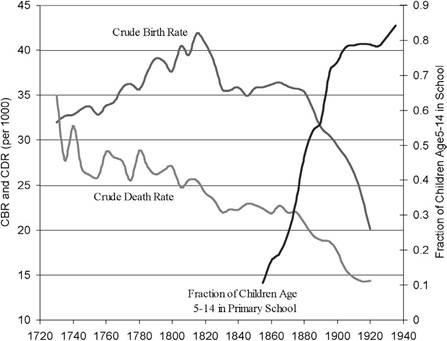
Figure 34. Investment in human capital andthe demographic transition, England, 1730-1935. Sources: Flora et al. (1983) and Wrigley and Schofield (1981).
associated initially with increasing fertility rates in some countries and non-decreasing fertility rates in other countries. In particular, as demonstrated in Figure 34, the decline in mortality started in England in the 1730s and was accompanied by a steady increase in fertility rates until 1820.[125] The rise in income per capita in the Post-Malthusian Regime increased the desirable number of surviving offspring and thus, despite the decline in mortality rates, fertility did not fall so as to reach this higher desirable level of surviving offspring.[126] As depicted in Figure 34, the decline in fertility during the demographic transition occurred in a period in which the pattern of declining mortality (and its adverse effect on fertility) maintained the trend that existed in the 140 years that preceded the demographic transition.[127] The reversal in the fertility patterns in England as well as other Western European countries in the 1870s suggests, therefore, that the demographic transition was prompted by a different universal force than the decline in infant and child mortality - a force that reflects a significant change in course prior to the demographic transition.
Furthermore, most relevant from an economic point of view is the cause of the reduction in net fertility (i.e. the number of children reaching adulthood). The decline in the number of surviving offspring that was observed during the demographic transition (e.g., Figure 22) is unlikely to follow from mortality decline. Mortality decline would lead to a reduction in the number of surviving offspring if the following conditions would be satisfied:[128] (i) there exists a precautionary demand for children, i.e., individuals are significantly risk averse with respect to the number of their surviving offspring and thus they hold a buffer stock of children in a high mortality environment - highly improbable from an evolutionary perspective, (ii) risk aversion with respect to consumption is not larger than risk aversion with respect to fertility - evolutionary theory would suggest the opposite), (iii) sequential fertility (i.e., replacement of non-surviving children) is modest,[129] and (iv) parental resources saved from the reduction in the number of children that do not survive to adulthood are not channeled towards childbearing.[130]
The quantitative analysis of Doepke (2005) supports the viewpoint that a decline in infant mortality rates was not the trigger for the decline in net fertility during the demographic transition. Utilizing the mortality and fertility data from England in the time period 1861-1951, he shows that in the absence of changes in other factors, the decline in child mortality in this time period should have resulted in a rise in net fertility rates, in contrast to the evidence. Similar conclusions about the insignificance of the mortality decline for the decline in fertility during the demographic transition is reached in the quantitative analysis of Fernandez-Villaverde (2005).
3.3.2. The rise in the level of income per capita
The rise in income per capita prior to the demographic transition has led some researchers to argue that the demographic transition was triggered by the rise in income per capita and its asymmetric effects on the income of households on the one hand and the opportunity cost of raising children on the other hand.
Becker (1981) advanced the argument that the decline in fertility in the course of the demographic transition is a by-product of the rise in income per capita that preceded the demographic transition. He argues that the rise in income induced a fertility decline because the positive income effect on fertility that was generated by the rise in wages was dominated by the negative substitution effect that was brought about by the rising opportunity cost of children. Similarly, Becker and Lewis (1973) argue that the income elasticity with respect to child quality is greater than that with respect to child quantity, and hence a rise in income led to a decline in fertility along with a rise in the investment in each child.
This theory appears counter-factual. It suggests that the timing of the demographic transition across countries would reflect differences in income per capita. However, remarkably, as depicted in Figure 22, the decline in fertility occurred in the same decade across Western European countries that differed significantly in their income per capita. In 1870, on the eve of the demographic transition, England was the richest country in the world, with a GDP per capita of $3191.[131] In contrast, Germany that experienced the decline in fertility in the same years as England, had in 1870 a GDP per capita of only $1821 (i.e., 57% of that of England). Sweden’s GDP per capita of $1664 in 1870 was 48% of that of England, and Finland’s GDP per capita of $1140 in 1870 was only 36% of that of England, and nevertheless, their demographic transitions occurred in the same decade as well.[132]
The simultaneity of the demographic transition across Western European countries that differed significantly in their income per capita suggests that the high level of income that was reached by these countries in the Post-Malthusian Regime had a limited role in the demographic transition. Furthermore, cross-section evidence within countries suggests that the elasticity of the number of surviving offspring with respect to income was positive prior to the demographic transition [e.g., Clark and Hamilton (2003)], in contrast to Becker’s argument that would require, at least at high income levels, a negative relationship. Moreover, a quantitative analysis of the demographic transition in England, conducted by Fernandez-Villaverde (2005), demonstrates that Becker’s theory is counter-factual. In contrast to Becker’s theory, the calibration suggests that a rise in income would have resulted in an increase in fertility rates, rather than in the observed decline in fertility.
Interestingly, despite the large differences in the levels of income per capita across European countries that experienced the demographic transition in the same time period, the growth rates of income per capita of these countries were rather similar, ranging from 1.9% per year in the UK, 2.12% in Norway, 2.17% in Sweden, and 2.87% in Germany, over the period 1870-1913. This observation is consistent with theories that underlined the critical role of the acceleration in technological progress, via its effect on the industrial demand for human capital, on the onset of the demographic transition [e.g., Galor and Weil (2000) and Galor and Moav (2002)].
3.3.3. The rise in the demand for human capital
The rise in the demand for human capital in the second phase of industrialization of less developed economies, as documented in Section 2.3.3, and its close association with the timing of the demographic transitions, has led researchers to argue that the increasing role of human capital in the production process induced households to increase their investment in the human capital of their offspring, leading to the onset of the demographic transition.
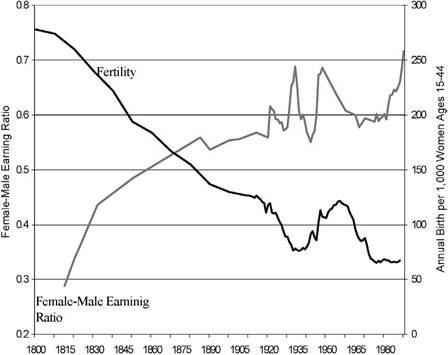
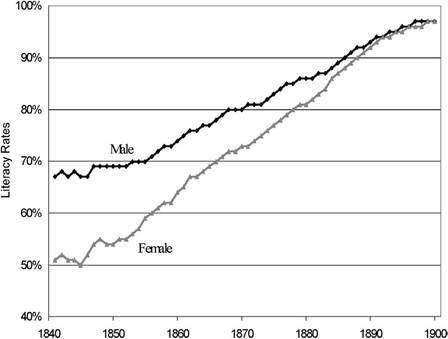
Galor and Weil (1999, 2000) argue that the acceleration in the rate of technological progress gradually increased the demand for human capital in the second phase of the Industrial Revolution, inducing parents to invest in the human capital of their off- spring.64 The increase in the rate of technological progress and the associated increase in the demand for human capital brought about two effects on population growth. On the one hand, improved technology eased households’ budget constraints and provided more resources for quality as well as quantity of children. On the other hand, it induced a reallocation of these increased resources toward child quality. Inthe early stages of the transition from the Malthusian Regime, the effect of technological progress on parental income dominated, and population growth as well as the average population quality increased. Ultimately, further increases in the rate of technological progress, that were stimulated by human capital accumulation, induced a reduction in fertility rates, generating a demographic transition in which the rate of population growth declined along with an increase in the average level of education. Thus, consistent with historical evidence, the theory suggests that prior to the demographic transition, population growth increased along with investment in human capital, whereas the demographic transition brought about a decline in population growth along with a further increase in human capital formation.[133] [134] Galor and Weil’s theory suggests that a universal rise in the demand for human capital in the second phase of the Industrial Revolution and the simultaneous increase in educational attainment across Western European countries generated the observed simultaneous onset of the demographic transition across Western European countries that differed significantly in their levels of income per capita. The rise in the demand for human capital in the second phase of the Industrial Revolution (as documented in Section 2.3.3) led to a significant increase in the investment in children’s education and therefore to a decline in fertility. In particular, as depicted in Figure 34, the demographic transition in England was associated with a significant increase in the investment in child quality as reflected by years of schooling. Quantitative evidence provided by Doepke (2004) suggests that indeed educational policy that promoted human capital formation played an important role in the demographic transition in England. Reinforcing mechanisms The decline in child labor The effect of the rise in the industrial demand for human capital on the reduction in the desirable number of surviving offspring was magnified via its adverse effect on child labor. It gradually increased the wage differential between parental labor and child labor, inducing parents to reduce the number of their children and to enhance the investment in their quality [Hazan and Berdugo (2002)].66 Moreover, the rise in the importance of human capital in the production process induced industrialists to support education reforms [Galor and Moav (2006)] and thus laws that abolish child labor [Doepke and Zilibotti (2005)], inducing a reduction in the prevalence of child labor and thus in fertility. Doepke (2004) provides quantitative evidence that suggests that indeed child labor law, and to a lesser extent educational policy, played an important role in the demographic transition in England. The rise in life expectancy The impact of the increase in the demand for human capital on the decline in the desirable number of surviving offspring may have been reinforced by the rise in life expectancy. The decline in mortality rates in developed countries since the 18th century, as depicted in Figure 24, and the recent decline in mortality rates in less developed countries, as depicted in Figure 25, corresponded to a gradual increase in life expectancy. As depicted in Figure 27, life expectancy increased in Western Europe during the 19th century from 36 in 1820 to 46 in 1900, 67 in 1950, and 78 in 1999. In particular, as depicted in Figure 26, life expectancy in England increased at a stable pace from 32 years in the 1720s to about 41 years in the 1870. This pace subsequently increased and life expectancy reached 50 years in 1900, 69 years in 1950, and 77 years in 1999. In less developed economies, in contrast, life expectancy increased markedly in the 20th century. Despite the gradual rise in life expectancy prior to the demographic transition, investment in human capital was rather insignificant as long as a technological demand for human capital did not emerge. In particular, the increase in life expectancy in England occurred 150 years prior to the demographic transition and may have resulted in a gradual increase in literacy rates, but not at a sufficient level to induce a reduction in fertility. Similarly, the rise in life expectancy in less developed regions in the first half of 66 The hypothesis of Hazan and Berdugo (2002) is consistent with existing historical evidence. For instance, Horrell and Humphries (1995) suggest, based on data from the United Kingdom, that earnings of children age 10-14 as a percentage of father’s earning, declined from the period 1817-1839 to the period 1840-1872 by nearly 50% if the father was employed in a factory. Interestingly, the effect is significantly more pronounced if the father was employed in skilled occupations, reflecting the rise in the relative demand for skilled workers and its effect on the decline in the relative wages of children. the 20th century has not generated a significant increase in education and a demographic transition. In light of the technologically-based rise in the demand for human capital in the second phase of the Industrial Revolution, however, the rise in the expected length of productive life has increased the potential rate of return to investments in children’s human capital, and thus re-enforced and complemented the inducement for investment in education and the associated reduction in fertility rates.[135] Changes in marriage institutions The effect of the rise in the demand for human capital on the desirable quality of children, and thus on the decline in fertility was reinforced by changes in marriage institutions. Gould, Moav and Simhon (2003) suggest that the rise in the demand for human capital increased the demand for educated women who have a comparative advantage in raising quality children, increasing the cost of marriage. Polygamy therefore became less affordable, inducing the transition from polygamy to monogamy, and reinforcing the decline in fertility. Edlund and Lagerlof (2002) suggest that love marriage, as opposed to arranged marriage, redirected the payment for the bride from the parent to the couple, inducing investment and human capital accumulation and thus reinforcing the decline in fertility. Natural selection and the evolution ofpreferences for offspring’s quality The impact of the increase in the demand for human capital on the decline in the desirable number of surviving offspring may have been magnified by cultural or genetic evolution in the attitude of individuals toward child quality. An evolutionary change in the attitude of individuals towards human capital could have generated a swift response to the increase in demand for human capital, generating a rapid decline in fertility along with an increase in human capital formation. Human beings, like other species, confront the basic trade-off between offspring’s quality and quantity in their implicit Darwinian survival strategies. Preferences for child quantity as well as for child quality reflect the well-known variety in the quantity-quality survival strategies (the K and r strategies) that exists in nature [e.g., MacArthur and Wilson (1967)]. Moreover, the allocation of resources between offspring quantity and quality is subjected to evolutionary changes [Lack (1954)]. Galor and Moav (2002) propose that during the epoch of Malthusian stagnation that characterized most of human existence, individuals with a higher valuation for offspring quality gained an evolutionary advantage and their representation in the population gradually increased. The agricultural revolution facilitated the division of labor and fostered trade relationships across individuals and communities, enhancing the complexity of human interaction and raising the return to human capital. Moreover, the evolution of the human brain in the transition to Homo sapiens and the complementarity between brain capacity and the reward for human capital increased the evolutionary optimal investment in the quality of offspring. The distribution of valuation for quality lagged behind the evolutionary optimal level and offspring of individuals with traits of higher valuation for their offspring’s quality generated higher income and, in the Malthusian epoch when income was positively associated with aggregate resources allocated to child rearing, a larger number of offspring. Thus, the trait of higher valuation for quality gained the evolutionary advantage, and the Malthusian pressure gradually increased the representation of individuals whose preferences were biased towards child quality.[136] This evolutionary process was reinforced by its interaction with economic forces. As the fraction of individuals with high valuation for quality increased, technological progress intensified, raising the rate of return to human capital. The increase in the rate of return to human capital along with the increase in the bias towards quality in the population reinforced the substitution towards child quality, setting the stage for a more rapid decline in fertility along with a significant increase in investment in human capital. 3.3.4. The decline in the gender gap The rise in women’s relative wages in the process of development, and its potential impact on the rise in female labor force participation and the associated decline in fertility rates, have been the center of another theory of the demographic transition that generates the observed hump-shaped relationship between income per capita and population growth, as depicted in Figure 11. The rise in women’s relative wages along with declining fertility rates have been observed in a large number of developed and less developed economies. In particular, as depicted in Figure 35, this pattern is observed in the US during the period 1800-1940. Galor and Weil (1996) argue that technological progress and capital accumulation increased the relative wages of women in the process of industrialization, triggering the onset of the demographic transition. They maintain that technological progress along with physical capital accumulation complemented mental-intensive tasks rather than Figure 35. Female relative wages and fertility rates, United States 1800-1990. Sources: U.S. Bureau of the Census (1975) and Hernandez (2000). physical-intensive tasks (i.e., brain rather than brawn) and thus, in light of the comparative advantage of women in mental-intensive tasks, the demand for women’s labor input gradually increased in the industrial sector, increasing the absolute wages of men and women but decreasing the gender wage gap.[137] As long as the rise in women’s wages was insufficient to induce a significant increase in women’s labor force participation, fertility increased due to the rise in men’s wages.[138] Ultimately, however, the rise in women’s relative wages was sufficient to induce a significant increase in labor force participation, generating a demographic transition. Unlike the single-parent model in which an increase in income generates conflicting income and substitution effects that cancel one another, if preferences are homothetic, in the two-parent household model, if most of the burden of child rearing is placed on women, a rise in women’s relative wages increases the opportunity cost of raising children more than household’s income, generating a pressure towards a reduction in fertility. Figure 36. The decline in the human capital gap between male and female: England 1840-1900. Source: Cipolla(1969). The process of development was associated, in addition, with a gradual decline in the human capital gap between male and female. As depicted in Figure 36, literacy rates among women which were only 76% of those among men in 1840, grew faster in the 19th century reaching men’s level in 1900. The rise in the demand for human capital in the process of development induced a gradual improvement in the level of female education, raising the opportunity cost of children more than household’s income, and triggering a fertility decline [Lagerlof (2003b)]. 3.3.5. Othertheories The old-age security hypothesis The old-age security hypothesis has been proposed as an additional mechanism for the onset of the demographic transition. It suggests that, in the absence of capital markets that permit intertemporal lending and borrowing, children are assets that permit parents to smooth consumption over their lifetime.[139] Hence, the process of development and the establishment of capital markets reduced this motivation for rearing children, contributing to the demographic transition. Although old-age support is a plausible element that may affect the level of fertility, it appears as a minor force in the context of the demographic transition. First, since there are rare examples in nature of offspring that support their parents in old age, it appears that old-age support could not be the prime motivation for child rearing, and thus its decline is unlikely to be a major force behind a significant reduction in fertility. Second, the rise in fertility rates prior to the demographic transition, in a period of improvements in credit markets, raises doubts about the significance of this mechanism. In particular, cross-section evidence does not indicate that wealthier individuals that presumably had a better access to credit markets had a smaller number of surviving offspring. On the contrary, fertility rates in the pre-demographic transition era were positively related to levels of skills, income, and wealth [e.g., Clark and Hamilton (2003)]. Exogenous shocks - Luck Becker, Murphy and Tamura (1990) advance a theory that emphasizes the role of a major exogenous shock in triggering the demographic transition, underlying the role of luck in the determination of the relative timing of the demographic transition and thus the wealth of nations.[140] This theory generates predictions that are inconsistent with the observed demographic patterns in the process of development[141] Existing evidence shows that the process of industrialization and the associated increase in income per capita was accompanied by sharp increase in population growth, prior to their decline in the course of the demographic transition. In their theory, in contrast, a major shock shifts the economy from the basin of attraction of a high-fertility to a low-fertility steady-state equilibrium, generating counter-factually, a monotonic decline in fertility rates along with a monotonic rise in income per capita. 4.