Unified growth theory
The inconsistency of exogenous and endogenous growth models with the process of development over most of human history, induced growth theorists to develop a unified theory of economic growth that would capture in a single framework the epoch of Malthusian stagnation, the contemporary era of modern economic growth, and the underlying driving forces that triggered the recent transition between these regimes and the associated phenomenon of the Great Divergence in income per capita across countries.[142]
The advancement of unified growth theory was fueled by the conviction that the understanding of the contemporary growth process would be limited and distorted unless growth theory would be based on micro-foundations that would reflect the qualitative aspects of the growth process in its entirety.
In particular, the hurdles faced by less developed economies in reaching a state of sustained economic growth would remain obscure unless the origin of the transition of the currently developed economies into a state of sustained economic growth would be identified and its implications would be modified to account for the additional economic forces faced by less developed economies in an interdependent world.75The establishment of a unified growth theory has been a great intellectual challenge, requiring major methodological innovations in the construction of dynamical systems that would capture the complexity that has characterized the evolution of economies from a Malthusian epoch to a state of sustained economic growth. In light of historical evidence that suggests that the take-off from the Malthusian epoch to a state of sustained economic growth, rapid as it may appear, was a gradual process, a unified growth theory in which economies take off gradually but swiftly from an epoch of a stable Malthusian stagnation would necessitate a gradual escape from an absorbing (stable) equilibrium, in contradiction to the concept of a stable equilibrium.
Thus, it has become apparent that the observed rapid, continuous phase transition would be captured by a single dynamical system, if the set of steady-state equilibria and their stability would be altered qualitatively in the process of development. As proposed by Galor and Weil (2000), during the Malthusian epoch the dynamical system would have to be characterized by a stable Malthusian equilibrium, but ultimately due to the evolution of latent state variables [i.e., the rise in a latent demand for human capital in Galor and Weil (2000) and the evolution of the distribution of genetic characteristics in Galor and Moav (2002)], the Malthusian steady-state equilibrium would vanish endogenously leaving the arena for the gravitational forces of the emerging Modern Growth Regime, and permitting the economy to take off and to converge to a modern-growth steady-state equilibrium.The observed role of the demographic transition in the shift from the Post-Malthusian Regime to the Sustained Growth Regime, and the associated non-monotonic evolution of the relationship between income per capita and population growth, added to the complexity of the desirable dynamical system. Capturing this additional transition required an endogenous reversal in the positive Malthusian effect of income on population in the second phase of industrialization, providing the reduction in fertility the observed role in the transition to a state of sustained economic growth.
(2002), Hansen and Prescott (2002), Jones (2001), Kogel and Prskawetz (2001), Hazan and Berdugo (2002), Tamura (2002), Lagerlof (2003a, 2003b, 2006), Doepke (2004), Fernandez-Villaverde (2005), as well as others. The Great Divergence and its association with the transition from stagnation to growth was explored in a unified setting by Galor and Mountford (2003).
75 Although the structure of unified growth theories is based on the experience of Europe and its offshoots, since these were the areas that completed the transition from the Malthusian regime to modern growth, these theories could be modified to account for the incomplete transition of the less developed countries, integrating the significant influence of the import of pre-existing production and health technologies on their process of development.
4.1. From stagnation to growth
The first unified growth theory in which the endogenous evolution of population, technology, and income per capita is consistent with the process of development in the last thousands of years was advanced by Galor and Weil (2000). The theory captures the three regimes that have characterized the process of development as well as the fundamental driving forces that generated the transition from an epoch of Malthusian stagnation to a state of sustained economic growth.
The theory proposes that in early stages of development economies were in the proximity of a stable Malthusian equilibrium. Technology advanced rather slowly, and generated proportional increases in output and population. The inherent positive interaction between population and technology in this epoch, however, gradually increased the pace of technological progress, and due to the delayed adjustment of population, output per capita advanced at a miniscule rate. The slow pace of technological progress in the Malthusian epoch provided a limited scope for human capital in the production process and parents, therefore, had no incentive to reallocate resources towards human capital formation of their offspring.
The Malthusian interaction between technology and population accelerated the pace of technological progress and permitted a take-off to the Post-Malthusian Regime. The expansion of resources was partially counterbalanced by the enlargement of population and the economy was characterized by rapid growth rates of income per capita and population. The acceleration in technological progress ultimately increased the demand for human capital, generating two opposing effects on population growth. On the one hand, it eased households’ budget constraints, allowing the allocation of more resources for raising children. On the other hand, it induced a reallocation of resources toward child quality. In the Post-Malthusian Regime, due to the modest demand for human capital, the first effect dominated and the rise in real income permitted households to increase the number as well the quality of their children.
As investment in human capital took place, the Malthusian steady-state equilibrium vanished and the economy started to be attracted by the gravitational forces of the Modern Growth Regime. The interaction between investment in human capital and technological progress generated a virtuous circle: human capital generated faster technological progress, which in turn further raised the demand for human capital, inducing further investment in child quality, and triggering the onset of the demographic transition and the emergence of a state of sustained economic growth.[143]
The theory suggests that the transition from stagnation to growth is an inevitable outcome of the process of development. The inherent Malthusian interaction between the level of technology and the size of the population accelerated the pace of technological progress, and eventually raised the importance of human capital in the production process. The rise in the demand for human capital in the second phase of the industrial revolution and its impact on the formation of human capital as well as on the onset of the demographic transition brought about significant technological advancements along with a reduction in fertility rates and population growth, enabling economies to convert a larger share of the fruits of factor accumulation and technological progress into growth of income per capita, and paving the way for the emergence of sustained economic growth.
Variations in the timing of the transition from stagnation to growth and thus in economic performance across countries (e.g., England’s earlier industrialization in comparison to China) reflect initial differences in geographical factors and historical accidents and their manifestation in variations in institutional, demographic, and cultural factors, trade patterns, colonial status, and public policy. In particular, once a technologically- driven demand for human capital emerged in the second phase of industrialization, the prevalence of human capital promoting institutions determined the extensiveness of human capital formation, the timing of the demographic transition, and the pace of the transition from stagnation to growth.
Thus, unified growth theory provides the natural framework of analysis in Whichvariations in the economic performance across countries and regions could be examined based on the effect of variations in educational, institutional, geographical, and cultural factors on the pace of the transition from stagnation to growth.The unified theory of Galor and Weil is calibrated by Lagerlof (2006). His analysis demonstrates that the theory quantitatively replicates the observed time paths of population, income per capita, and human capital, generating (a) the Malthusian oscillations in population and output per capita during the Malthusian epoch, (b) an endogenous take-off from Malthusian stagnation that is associated with an acceleration in technological progress and is accompanied initially by a rapid increase in population growth, and (c) a rise in the demand for human capital, followed by a demographic transition and sustained economic growth.
4.1.1. Central building blocks
The theory is based upon the interaction between several building blocks: the Malthusian elements, the engines of technological progress, the origin of human capital formation, and the determinants of parental choice regarding the quantity and quality of offspring.
The Malthusian elements. Individuals are subjected to subsistence consumption constraint. As long as the constraint is binding, an increase in income results in an increase in population growth. Technological progress, which brings about temporary gains in income per capita, triggers therefore in early stages of development an increase in the size of the population that offsets the gain in income per capita due to the existence of diminishing returns to labor. Growth in income per capita is ultimately generated, despite diminishing returns to labor, since technological progress outpaces the rate of population growth.
The forces behind technological progress in the process of development. The size of the population stimulates technological progress in early stages of development [Boserup (1965)], whereas investment in human capital is the prime engine of technological progress in more advanced stages of development.
In the Malthusian era, the technological frontier was not distant from the working environment of most individuals, and the scale of the population affected the rate of technological progress due to its effect on: (a) the supply of innovative ideas, (b) the demand for new technologies, (c) the rate of technological diffusion, (d) the division of labor, and (e) the scope for trade.[144] As the distance between the knowledge of an uneducated individual and the technological frontier gets larger, however, the role of human capital becomes more significant in technological advancement [e.g., Nelson and Phelps (1966)] and individuals with high levels of human capital are more likely to advance the technological frontier.The origin of human capital formation. The introduction of new technologies is mostly skill-biased although in the long run, these technologies may be either “skill biased” or “skill saving”. The “disequilibrium” brought about by technological change raises the demand for human capital.[145] Technological progress reduces the adaptability of existing human capital to the new technological environment and educated individuals have a comparative advantage in adapting to the new technological environment.[146]
The determination of paternal decisions regarding the quantity and quality of their offspring. Individuals choose the number of children and their quality in the face of a constraint on the total amount of time that can be devoted to child-raising and labor market activities. The rise in the demand for human capital induces parents to substitute quality for quantity of children.[147]
4.1.2. The basic structure of the model
Consider an overlapping-generations economy in which activity extends over infinite discrete time. In every period the economy produces a single homogeneous good using land and efficiency units of labor as inputs. The supply of land is exogenous and fixed over time whereas the number of efficiency units of labor is determined by households’ decisions in the preceding period regarding the number and level of human capital of their children.
Production of final output Production occurs according to a constant returns to scale technology that is subject to endogenous technological progress. The output produced at time t, Yt,is

where Ht is the aggregate quantity of efficiency units of labor employed in period t, X is land employed in production in every period t, At represents the endogenously determined technological level in period t, and AtX are therefore the “effective resources” employed in production in period t,and α ∈ (0, 1).
Output per worker produced at time t, yt,is
Suppose that there are no property rights over land.[148] The return to land is therefore zero, and the wage per efficiency unit of labor is equal to the output per efficiency unit of labor:

Preferences and budget constraints In each period t, a generation that consists of Lt identical individuals joins the labor force. Each individual has a single parent. Members of generation t (those who join the labor force in period t) live for two periods. In the first period of life (childhood), t — 1, individuals consume a fraction of their parental unit time endowment. The required time increases with children’s quality. In the second period of life (parenthood), t, individuals are endowed with one unit of time, which they allocate between child rearing and labor force participation. They choose the optimal mixture of quantity and quality of (surviving) children and supply their remaining time in the labor market, consuming their wages.
Individuals’ preferences are represented by a utility function defined over consumption above a subsistence level c > 0, as well as over the quantity and quality (measured
by human capital) of their (surviving) children:82  where ct is the consumption of individual of generation t, nt is the number of children of individual t, and ht+1 is the level of human capital of each child.83 The utility function is strictly monotonically increasing and strictly quasi-concave, satisfying the conventional boundary conditions that assure, for a sufficiently high income, the existence of an interior solution for the utility maximization problem. However, for a sufficiently low level of income the subsistence consumption constraint is binding and there is a corner solution with respect to the consumption level.84
Individuals choose the number of children and their quality in the face of a constraint on the total amount of time that can be devoted to child-raising and labor market activities. For simplicity, only time is required in order to produce child quantity and quality.85 Let τ + et+1 be the time cost for a member i of generation t of raising a child with a level of education (quality) et+1. That is, τ is the fraction of the individual’s unit time endowment that is required in order to raise a child, regardless of quality, and et+1 is the fraction of the individual’s unit time endowment that is devoted for the education of each child.86
Consider members of generation t who are endowed with ht efficiency units of labor at time t. Define potential income, zt, as the earning if the entire time endowment is devoted to labor force participation, earning the competitive market wage, wt, per efficiency unit. The potential income, zt ? wtht, is divided between consumption, ct, and expenditure on child rearing (quantity as well as quality), evaluated according to the value of the time cost, i.e., wtht [τ + et+1], per child. Hence, in the second period of life (parenthood), the individual faces the budget constraint 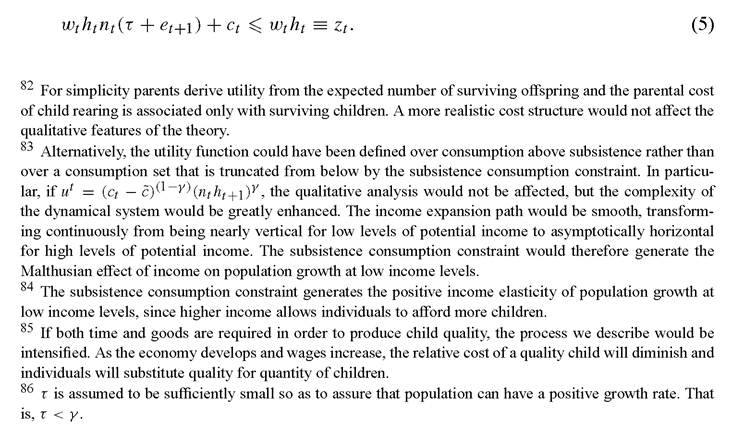
The production of human capital Individuals’ level of human capital is determined by their quality (education) as well as by the technological environment. Technological progress reduces the adaptability of existing human capital for the new technological environment (the ‘erosion effect’). Education, however, lessens the adverse effects of technological progress. That is, skilled individuals have a comparative advantage in adapting to the new technological environment. In particular, the time required for learning the new technology diminishes with the level of education and increases with the rate of technological change.
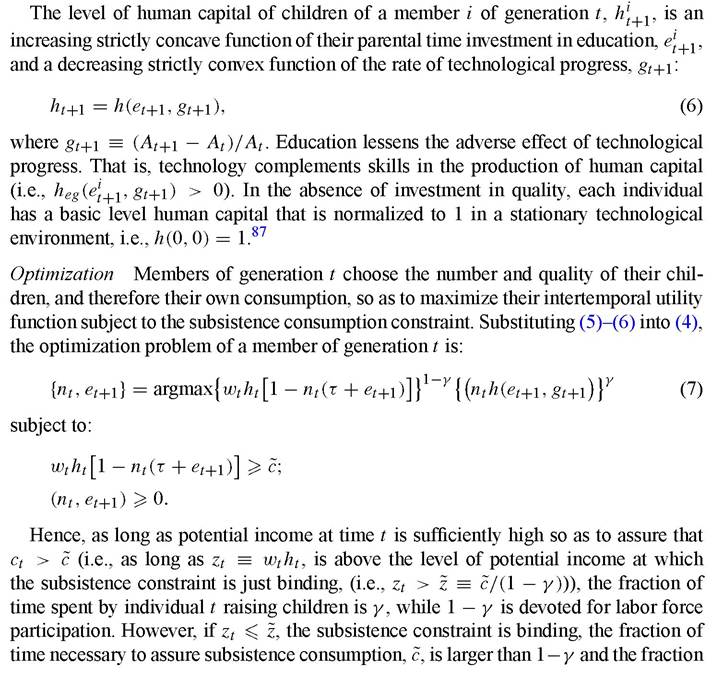
87 For simplicity, investment in quality is not beneficial in a stationary technological environment, i.e., he(0, 0) = 0, and in the absence of investment in education, there exists a sufficiently rapid technological progress, thatduetothe erosion effectrendersthe existinghuman capital obsolete (i.e., limg→∞ h(0,gt+ι) = 0). Furthermore, although the potential number of efficiency units of labor is diminished due to the transition from the existing technological state to a superior one (due to the erosion effect), each individual operates with a superior level of technology and the productivity effect is assumed to dominate. That is, ∂yt∕∂gt > 0.
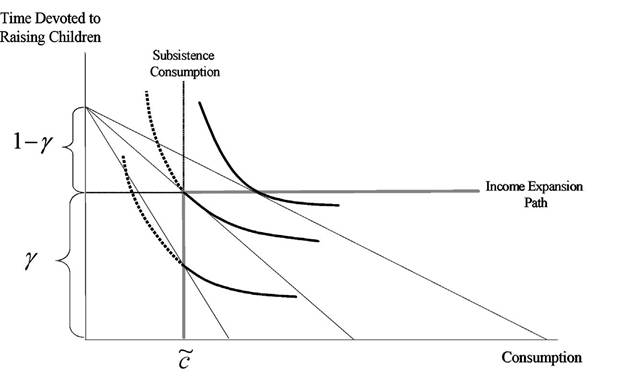
Figure 37. Preferences, constraints, and income expansion path.
of time devoted for child rearing is therefore below γ. That is,

Figure 37 shows the effect of an increase in potential income zt on the individual’s allocation of time between child rearing and consumption. The income expansion path is vertical as long as the subsistence consumption constraint is binding. As the wage per efficiency unit of labor increases in this income range, the individual can generate the subsistence consumption with a smaller labor force participation and the fraction of time devoted to child rearing increases. Once the level of income is sufficiently high such that the subsistence consumption constraint is not binding, the income expansion path becomes horizontal at a level γ in terms of time devoted to child rearing.
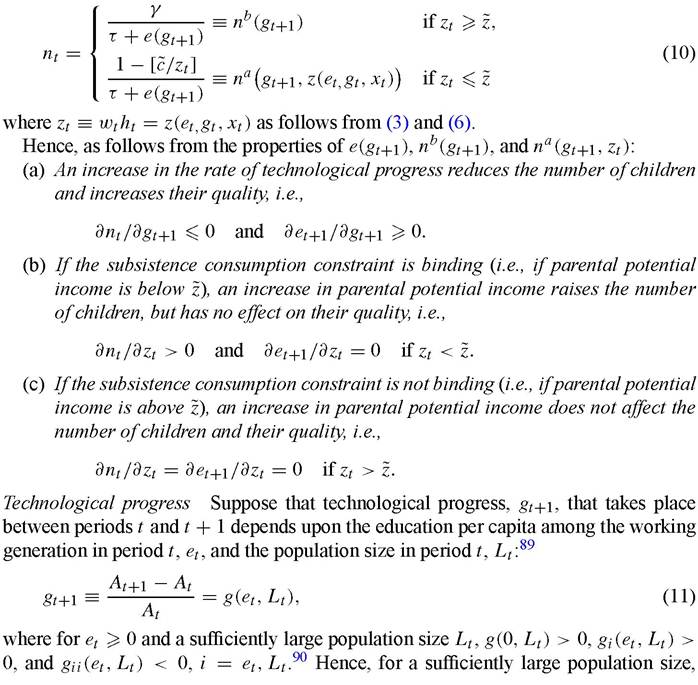
Furthermore, the optimization with respect to et+1 implies that the level of education chosen by members of generation t for their children, et+1, is an increasing function of gt+1.

[1] e" (gt+1) depends upon the third derivatives of the production function of human capital. e"(gt+1) is assumed to be concave, which appears plausible.
spent on quality and time spent on quantity is affected by the rate of technological progress, which changes the return to education.
Furthermore, substituting (9) into (8), it follows that nt is:
[1] While the role of the scale effect in the Malthusian epoch is essential, none of the existing results depend on the presence or the absence of the scale effect in the modern era. The functional form of technological progress given in (11) can capture both the presence and the absence of the scale effect in the modern era. In particular, the scale effect can be removed, once investment in education is positive, assuming for instance that limL→∞ gL (et, L) = 0 for et > 0.
[1] For a sufficiently small population the rate of technological progress is strictly positive only every several periods. Furthermore, the number of periods that pass between two episodes of technological improvement declines with the size of population. These assumptions assure that in early stages of development the economy is in a Malthusian steady state with zero growth rate of output per capita, but ultimately the growth rates is positive and slow. If technological progress would occur in every time period at a pace that increases with the size of population, the growth rate of output per capita would always be positive, despite the adjustment in the size of population.
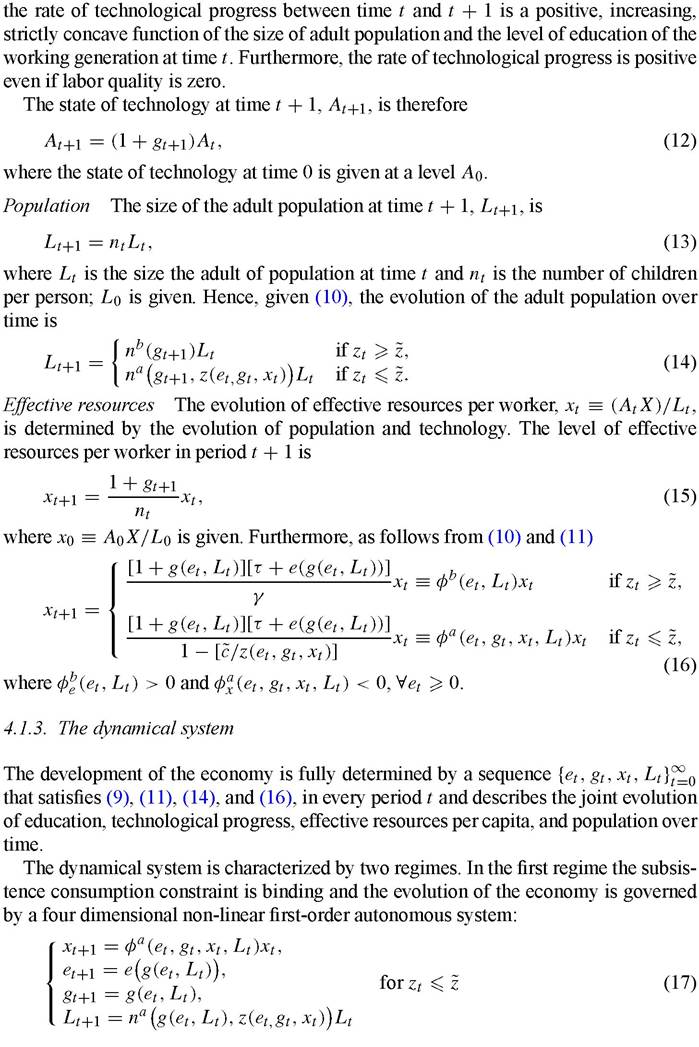
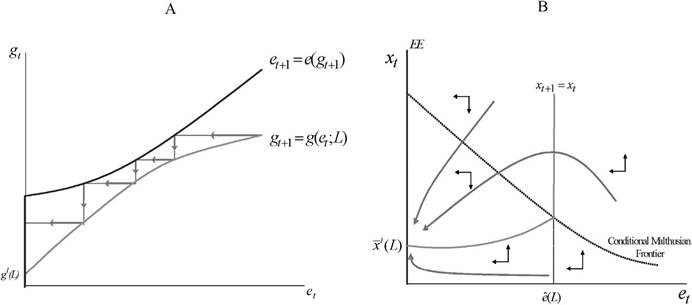
Figure 38. The evolution of technology, gt, education, et, and effective resources, xt: small population.
where the initial conditions e0, g0, x0, and L0 are historically given.
In the second regime the subsistence consumption constraint is not binding and the evolution of the economy is governed by a three-dimensional system:
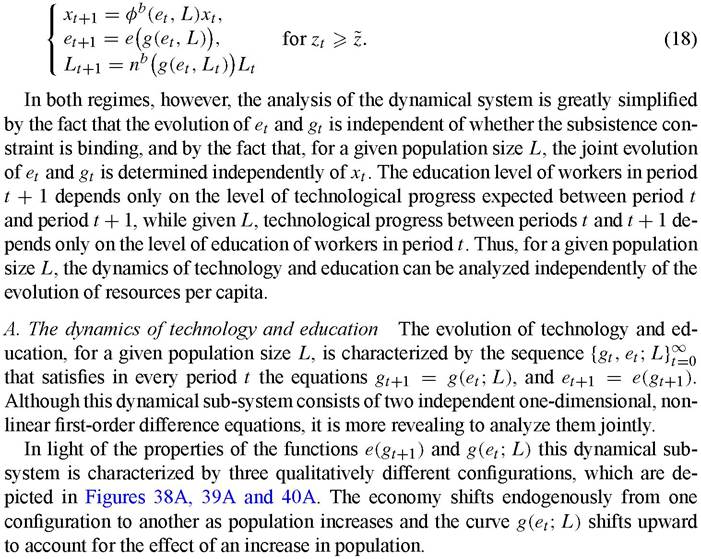
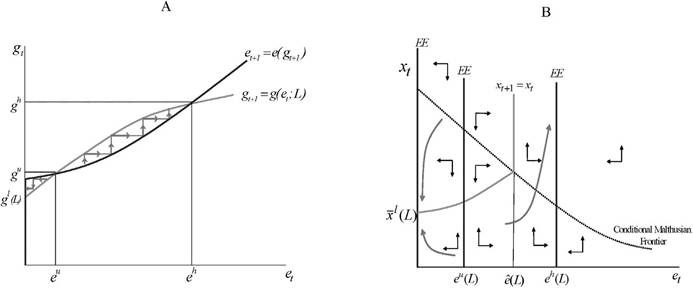
Figure 39. The evolution of technology, gt, education, et, and effective resources, xt: moderate population.
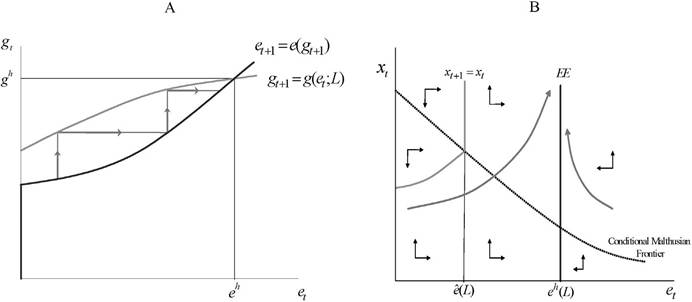
Figure 40. The evolution of technology, gt, education, et, and effective resources, xt: large population.
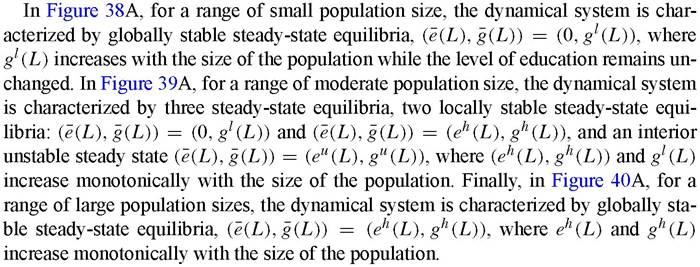
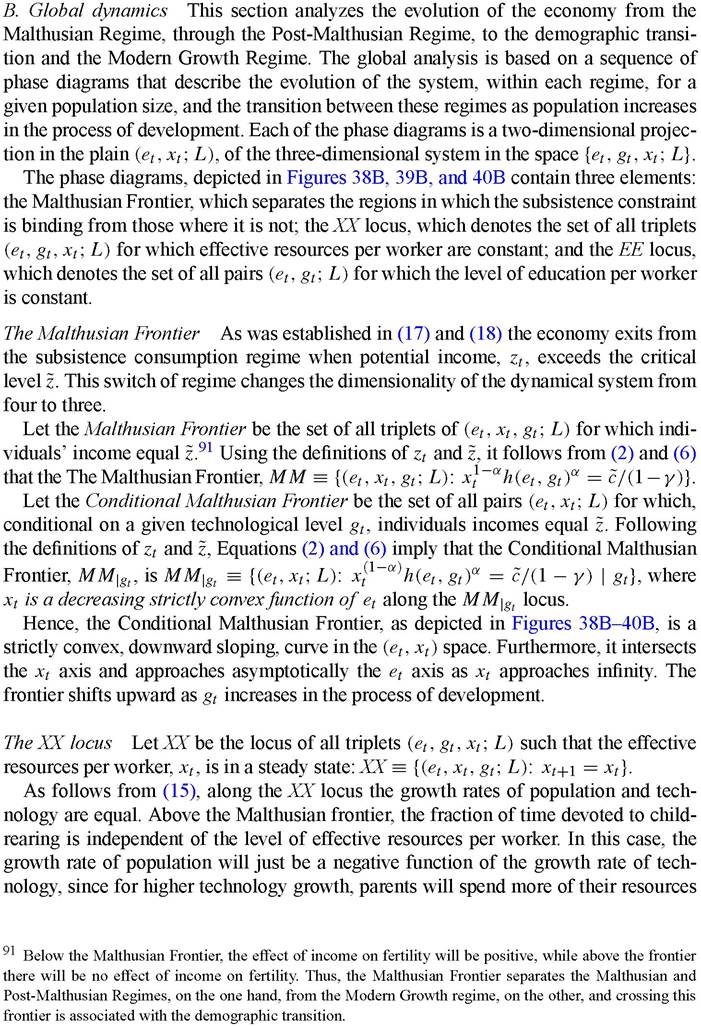
on child quality and thus less on child quantity. Thus there will be a particular level of technological progress which induces an equal rate of population growth. Since the growth rate of technology is, in turn, a positive function of the level of education, this rate of technology growth will correspond to a particular level of education, denoted e. Below the Malthusian Frontier, the growth rate of population depends on the level of effective resources per capita, x, as well as on the growth rate of technology. The lower is x, the smaller the fraction of the time endowment devoted to child-rearing, and so the lower is population growth. Thus, below the Malthusian frontier, a lower value of effective resources per capita would imply that lower values of technology growth (and thus education) would be consistent with population growth being equal to technology growth. Thus, as drawn in Figures 38B, 39B, and 40B, lower values of x are associated with lower values of e on the part of the XX locus that is below the Malthusian frontier.
If the subsistence consumption constraint is not binding, it follows from (16) that for

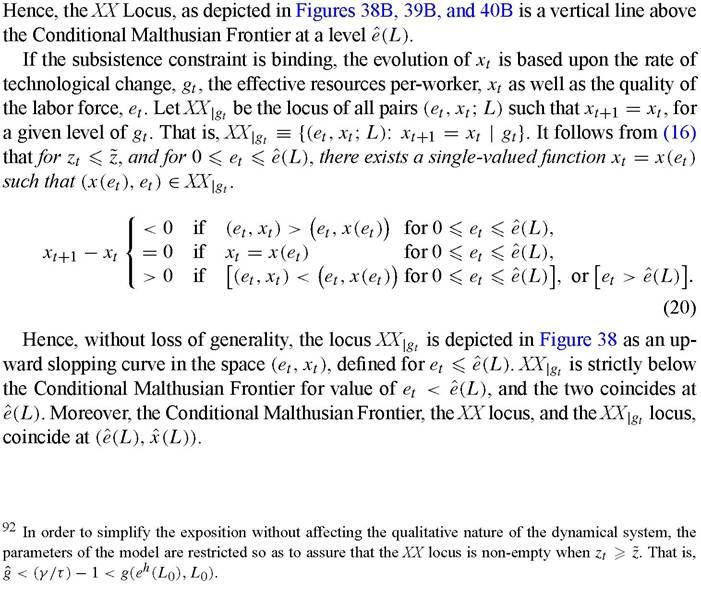
Conditional steady-state equilibria In early stages of development, when population size is sufficiently small, the dynamical system, as depicted in Figure 38B, is characterized by a unique and globally stable conditional steady-state equilibrium.[149] It is given by a point of intersection between the EE locus and the xt+1 = xt locus. That is, conditional on a given technological level, gt, the Malthusian steady state (0, x(L)) is globally stable.94 In later stages of development as population size increases sufficiently, the dynamical system as depicted in Figure 39B is characterized by two conditional steady-state equilibria. The Malthusian conditional steady-state equilibrium is locally stable, whereas the steady-state equilibrium (eu (L), xu (L)) is a saddle point.95 For education levels above eu (L) the system converges to a stationary level of education eh (L) and possibly to a steady-state growth rate of xt. In mature stages of development when population size is sufficiently large, the system convergences globally to an educational level eh(L) and possibly to a steady-state growth rate of xt.
4.1.4. From Malthusian stagnation to sustained growth
The economy evolves from an epoch of Malthusian stagnation through the Post- Malthusian Regime to the demographic transition and a Modern Growth Regime. This pattern and the prime driving forces in this transition emerge from the phase diagrams depicted in Figures 38-40.
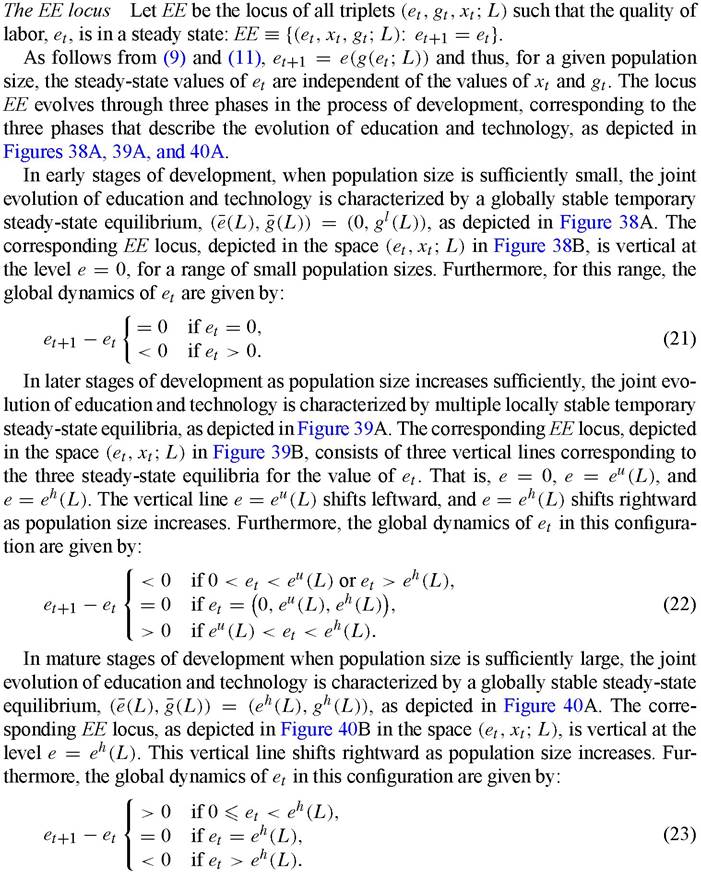
Consider an economy in early stages of development. Population size is relatively small and the implied slow rate of technological progress does not provide an incentive to invest in the education of children. As depicted in Figure 38A, the interaction between education, et, and the rate of technological change, gt, for a constant small population, L, is characterized by a globally stable steady-state equilibrium (0, gl(L)), where education is zero and the rate of technological progress is slow. This steady-state equilibrium corresponds to a globally stable conditional Malthusian steady-state equilibrium, depicted in Figure 38B. For a constant small population, L, and for a given rate of technological progress, effective resources per capita, as well as the level of education are constant, and output per capita is therefore constant as well. Moreover, shocks to population or resources will be resolved in a Malthusian fashion.
As population grows slowly in reaction to technological progress, the g(et+1, L) locus, depicted in Figure 38A, gradually shifts upward. The steady-state equilibrium shifts vertically upward reflecting small increments in the rate of technological progress, while the level of education remains constant at a zero level. Similarly, the conditional Malthusian steady-state equilibrium drawn in Figure 38B shifts vertically upward, as the XX the evolution of et is monotonic, whereas the evolution and convergence of xt may be oscillatory. Nonmonotonicity inthe evolution of xt may arise only if e < e and it does not affect the qualitative description of the system. Furthermore, if gt, xt)xt > — 1 the conditional dynamical system is locally non-oscillatory.
The phase diagrams in Figures 38A-40A are drawn under the assumptions that assure that there are no oscillations.
94 The local stability of the steady-state equilibrium (0,x(gt)) can be derived formally. The eigenvalues of the Jacobian matrix of the conditional dynamical system evaluated at the conditional steady-state equilibrium are both smaller than one (in absolute value).
95 Convergence to the saddle point takes place only if the level of education is eu. That is, the saddle path is the entire vertical line that corresponds to et = eu. locus shifts upward. However, output per capita remains initially constant at the subsistence level and eventually creeps forward at a miniscule rate.
Over time, the slow growth in population that takes place in the Malthusian Regime raises the rate of technological progress and shifts the g(et+1, L) locus in Figure 38A sufficiently upward, generating a qualitative change in the dynamical system depicted in Figure 39A.
The dynamical system of education and technology, for a moderate population, is characterized by multiple, history-dependent, stable steady-state equilibria: the steady-state equilibria (0,gl(L)) and (eh(L), gh(L)) are locally stable, whereas (eli(L), gu(L)) is unstable. Giventhe initial conditions, in the absence of large shocks, the economy remains in the vicinity of the low steady-state equilibrium (0, gl(L)), where education is still zero but the rate of technological progress is moderate. These steady-state equilibria correspond to a multiple locally stable conditional Malthusian steady-state equilibrium, depicted in Figure 39B: Malthusian steady state, characterized by constant resources per capita, slow technological progress, and no education, and a modern-growth steady state, characterized by a high level of education, rapid technological progress, growing income per capita, and moderate population growth. However, since the economy starts in the vicinity of Malthusian steady state, it remains there.[150]
As the rate of technological progress continues to rise in reaction to the increasing population size, the g(et+1, Lt) locus shifts upward further and ultimately, as depicted in Figure 40, the dynamical system experiences another qualitative change. The Malthusian steady-state equilibrium vanishes, and the economy is characterized by a unique globally stable modern steady-state equilibrium (eh(L), gh(L)) characterized by high levels of education and technological progress.
Increases in the rate of technological progress and the level of education feed back on each other until the economy converges rapidly to the stable modern steady-state equilibrium. The increase in the pace of technological progress has two opposing effects on the evolution of population. On the one hand, it eases households’ budget constraints, allowing the allocation of more resources for raising children. On the other hand, it induces a reallocation of these additional resources toward child quality. In the Post-Malthusian Regime, due to the limited demand for human capital, the first effect dominates and the rise in real income permits households to increase their family size as well the quality of each child. The interaction between investment in human capital and technological progress generates a virtuous circle: human capital formation prompts faster technological progress, further raising the demand for human capital, inducing further investment in child quality, and eventually, as the economy crosses the Malthusian frontier, triggering a demographic transition. The offsetting effect of population growth on the growth rate of income per capita is eliminated and the interaction between human capital accumulation and technological progress permits a transition to a state of sustained economic growth.
In the Modern Growth Regime, resources per capita rise as technological progress outstrips population growth. Provided that population size is constant (i.e., population growth is zero), the levels of education and technological progress and the growth rates of resources per capita and thus output per capita are constant in the modern-growth steady-state equilibrium.[151]
4.1.5. Major hypotheses and their empirical assessment
The theory generates several hypotheses about the evolution of population, human capital and income per capita in the process of development, underlying the roles of the inherent interaction between population and technology in the Malthusian epoch, as well as the formation of human capital in the second phase of industrialization and the associated demographic transition, in the emergence of a state of sustained economic growth.
Main hypotheses:
(H1) During the initial phases of the Malthusian epoch the growth rate of output per capita is nearly zero and the growth rate of population is miniscule, reflecting the sluggish pace of technological progress and the full adjustment of population to the expansion of resources. In the later phases of the Malthusian epoch, the increasing rate of technological progress, along with the inherent delay in the adjustment of population to the rise in income per capita, generated positive but very small growth rates of output per capita and population.
The hypothesis is consistent with the evidence, provided in Section 2.1, about the evolution of the world economy in the Malthusian epoch. In particular, the infinitesimal pace of resource expansion in the first millennium was reflected in a miniscule increase of the WesternEuropeanpopulation (from 24.7 million people in 1 AD to 25.4 million in 1000 AD), along with a zero average growth rate of output per capita. The more rapid, but still very slow expansion of resources in the period 1000-1500, permitted the Western European population to grow at a slow average rate of 0.16% per year (from 25 million in 1000 to 57 million in 1500), along with a slow average growth rate of income per Capitaatarate of about 0.13% per year. Resource expansion over the period 1500-1820 had a more significant impact on the Western European population that grew at an average pace of 0.26% per year (from 57 million in 1500 to 133 million in 1820), along with a slightly faster average growth rate of income per capita at a rate of about 0.15% per year.
(H2) The reinforcing interaction between population and technology during the Malthusian epoch increased the size of the population sufficiently so as to support a faster pace of technological progress, generating the transition to the Post-Malthusian Regime. The growth rates of output per capita increased significantly, but the positive Malthusian effect of income per capita on population growth was still maintained, generating a sizable increase in population growth, and offsetting some of the potential gains in income per capita. Moreover, human capital accumulation did not play a significant role in the transition to the Post-Malthusian Regime and thus in the early take-off in the first phase of the Industrial Revolution.
The hypothesis is consistent with the evidence, provided in Section 2.2, about the evolution of the world economy in the Post-Malthusian Regime. In particular, the acceleration in the pace of resource expansion in the period 1820-1870, increased the Western European population from 133 million people in 1820 to 188 million in 1870, while the average growth rate of output per capita over this period increased significantly to 0.95% per year. Furthermore, historical evidence suggests that the industrial demand for human capital increased only in the second phase of the Industrial Revolution. As shown by Clark (2003), human capital formation prior to the Industrial Revolution, as well as in its first phase, occurred in an era in which the market rewards for skill acquisition were at historically low levels.[152]
(H3) The acceleration in the rate of technological progress increased the industrial demand for human capital in the later part of Post-Malthusian Regime (i.e., the second phase of industrialization), inducing significant investment in human capital, and triggering the demographic transition and a rapid pace of economic growth.
This hypothesis is consistent with the evidence, provided in Section 2.3, and partly depicted in Figure 41, about the significant rise in the industrial demand for human capital in the second phase of the Industrial Revolution, the marked increase in educational attainment, and the decline in fertility rates, that occurred in association with the acceleration in the growth rate of output per capita. In particular, the predicted timing of the acceleration in the growth rate of output per capita, is consistent with the revisionist
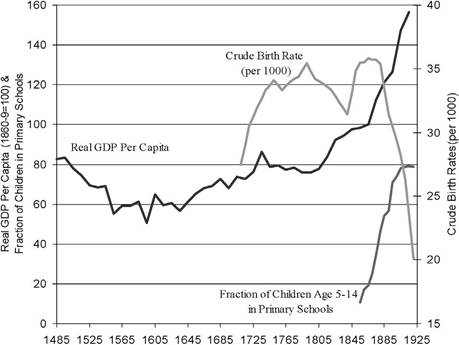
Figure 41. The sharp rise in the growth rate of real GDP per capita and its association with investment in education and fertility decline: England 1485-1920. Sources: Clark (2001), Feinstein (1972), Flora, Kraus and Pfenning (1983), Wrigley and Schofield (1981).
view on the British Industrial Revolution [e.g., Crafts and Harley (1992), Clark (2001), and Voth (2003)] that suggests that the first phase of the Industrial Revolution in England was characterized by a moderate increase in the growth rate of output per capita, whereas the “take-off”, as depicted in Figure 41, occurred only in the 1860s.
Furthermore, quantitative analysis of unified growth theories by Doepke (2004), Fernandez-Villaverde (2005), Lagerlof (2006), and Pereira (2003) indeed suggest that the rise in the demand for human capital was a significant force behind the demographic transition and the emergence of a state of sustained economic growth.[153]
Moreover, the theory is consistent with the observed simultaneous onset of the demographic transition across Western European countries that differed significantly in their income per capita. It suggests that a technologically-driven universal rise in the demand for human capital in Western Europe (as documented in Section 2.3.3) generated this simultaneous transition. It should be noted that the lack of clear evidence about the increase in the return to human capital in the second phase of the Industrial Revolution does not indicate the absence of a significant increase in the demand for human capital over this period. The sizable increase in schooling that took place in the 19th century and in particular the introduction of public education that lowered the cost of education (e.g., The Education Act of 1870), generated significant increase in the supply of educated workers that may have prevented a rise in the return to education.[154]
(H4) The growth process is characterized by stages of development and it evolves non-linearly. Technological leaders experienced a monotonic increase in the growth rates of their income per capita. Their growth was rather slow in early stages of development, it increased rapidly during the take-off from the Malthusian epoch, and it continued to rise, often stabilizing at higher levels. In contrast, technological followers that made the transition to sustained economic growth, experienced a non-monotonic increase in the growth rates of their income per capita. Their growth rates was rather slow in early stages of development, it increased rapidly in the early stages of the take-off from the Malthusian epoch, boosted by the adoption of technologies from the existing technological frontier. However, once these economies reached the technological frontier, their growth rates dropped to the level of the technological leaders.
(H5) The differential timing of the take-off from stagnation to growth across economies generated convergence clubs characterized by a group of poor countries in the vicinity of the Malthusian equilibrium, a group of rich countries in the vicinity of the sustained growth equilibrium, and a third group in the transition from one club to another.[155]
These hypotheses are consistent with Maddison’s (2001) evidence about the growth process in the last 250 years, as well as with contemporary cross section evidence. These studies suggest that the growth process is characterized by multiple growth regimes [e.g., Durlauf and Johnson (1995)] and thus with non-linearities in the evolution of growth rates [e.g., Durlauf and Quah (1999), Bloom, Canning and Sevilla (2003), and Graham and Temple (2004)]. Moreover, this research demonstrates that the evolution of income per-capita across countries is characterized by divergence in the past two centuries along with a tendency towards the emergence of a twin peak distribution [Quah (1996, 1997), Jones (1997), and Pritchett (1997)].[156]
4.2. Complementarytheories
Subsequent theories of economic growth in the very long run demonstrate that the unified theory of economic growth can be augmented and fortified by additional characteristics of the transition from stagnation to growth without altering the fundamental hypothesis regarding the central roles played by the emergence of human capital formation and the demographic transition in this process.
Various qualitative and quantitative unified theories explore plausible mechanisms for the emergence of human capital in the second stage of industrialization and the onset of the demographic transition. These theories focus on the rise in the demand for human capital (due to: technological acceleration, capital-skill complementarity, skilled biased technological change, and reallocation of resources towards skilled-intensive sectors), the decline in child and infant mortality, the rise in life expectancy, the emergence of public education, the decline in child labor, as well as cultural and genetic evolution in the valuation of human capital. The theories suggest that indeed the emergence of human capital formation, and the onset of the demographic transition played a central role in the shift from stagnation to growth.
4.2.1. Alternative mechanisms for the emergence of human capital formation
The emergence of human capital formation and its impact on the demographic transition and the technological frontier is a central element in the transition from the Post-Malthusian Regime to the state of sustained economic growth in all unified theories of economic growth in which population, technology and income per capita are endogenously determined.[157] Various complementary mechanisms that generate or reinforce the rise in human capital formation have been proposed and examined quantitatively, demonstrating the robustness and the empirical plausibility of this central hypothesis.
The rise in the industrial demand for human capital The rise in industrial demand for human capital in advanced stages of industrialization, as documented in Section 2.3.3, and its impact on human capital formation led researchers to incorporate it as a central feature in unified theories of economic growth.
The link between industrial development and the demand for human capital have been modeled in various complementary ways. Galor and Weil (2000) modeled the rise in the demand for human capital as an outcome of the acceleration in technological progress, underlying the role of educated individuals in coping with a rapidly changing technological environment. Their mechanism is founded on the premise that the introduction of new technologies increases the demand for skilled labor in the short-run, although in some periods the characteristics of new technologies may be complementarity to unskilled labor, as was the case in the first phase of the Industrial Revolution.[158]
Subsequent unified theories of economic growth have demonstrated that the rise in the demand for human capital in association with advanced stages of industrialization could emerge from alternative mechanisms, without altering the fundamental insights of the theory. Doepke (2004) constructs his unified theory on the basis of a rising level of skilled-intensive industrial technology, Fernandez-Villaverde (2005) bases his quantitative unified theory on capital-skill complementarity, and Galor and Mountford (2003) generate the rise in the demand for human capital via an increased specialization in the production of skilled-intensive goods, due to international trade.
The rise in the demand for human capital stimulated public policy designed to enhance investment in human capital [Galor and Moav (2006)]. In particular, as established in the quantitative unified theory of Doepke (2004), educational policy and child labor laws in England played an important role in human capital formation and the demographic transition.
Mortality decline, the rise in life expectancy, and human capital formation Several unified theories of economic growth demonstrate that the basic mechanism for the emergence of human capital proposed by Galor and Weil (2000) can be augmented and reinforced by the incorporation of the effect of the decline in mortality rates and the rise in life expectancy (as documented in Section 2.3.2) on the rise in human capital formation, the decline in the desirable number of surviving offspring, and thus on the transition from stagnation to growth.[159]
The significant decline in mortality rates in developed countries since the 18th century, as depicted in Figure 24, and the recent decline in mortality rates in less developed countries, as depicted in Figure 25, corresponded to an acceleration in the rise in life expectancy and a significant rise in human capital formation, towards the end of the 19th century in developed countries (Figures 26 and 28), and towards the middle of the 20th century in less developed countries (Figures 27 and 31). The rise in the expected length of the productive life may have increased the potential rate of return to investments in children’s human capital, and thus could have induced an increase in human capital formation along with a decline in fertility. However, despite the gradual rise in life expectancy in developed and less developed countries, investment in human capital has been insignificant as long as the industrial demand for human capital has not emerged. Thus, it appears that the industrial demand for human capital, as documented in Section 2.3.3, provided the inducement for investment in education and the associated reduction in fertility rates, whereas the prolongation of life may have re-enforced and complemented this process.
Galor and Weil (1999) argue that the Malthusian interaction between technology and population accelerated the pace of technological progress, improving industrial technology as well as medical and health technologies. Consistent with the historical evidence provided in Section 2.3.3, the improvements in the industrial technology increased the demand for human capital, whereas the development of medical technology and health infrastructure generated a significant rise in life expectancy. The expected rate of return to human capital investment increased therefore due to the prolongation of life, as well as the rise in industrial demand for human capital, enhancing the positive interaction between schooling and technological progress, bringing about a demographic transition and the state of sustained economic growth.
Various theories formally examined mechanisms that capture the interaction between human capital formation, the decline in mortality rate, and the rise in life expectancy, in the process of development.[160] Cervellati and Sunde (2005) and Boucekkine, de la Croix and Licandro (2003) focus on the plausible role of the reinforcing interaction between life expectancy and human capital formation in the transition from stagnation to growth, abstracting from its effect on fertility decisions. Others suggest that a decline in mortality rates increased the return to investment in human capital via: (a) prolongation of life [Soares (2005)], (b) increased population density and thus the efficiency of the transmission of human capital [Lagerlof (2003a)], (c) increased population growth and the advancement of skill-biased technologies [Weisdorf (2004)], and (d) improved healthiness and thus the capacity to absorb human capital [Hazan and Zoabi (2004)], generating a substitution of quality for quantity, a demographic transition and a transition to a state of sustained economic growth.[161]
Capital-skill complementarity and the emerging incentives for capitalists to support education reforms The accumulation of physical capital in the early stages of industrialization enhanced the importance of human capital in the production process and generated an incentive for the capitalists to support the provision of public education for the masses.[162] Consistent with the evidence provided in Section 2.3.3, Galor and Moav (2006) argue that due to capital-skill complementarity, the accumulation of physical capital by the capitalists in the first phase of the Industrial Revolution increased the importance of human capital in sustaining their rate of return to physical capital, inducing capitalists to support the provision of public education for the masses.[163] The decline in child labor Other theories that focused on the transition from stagnation to growth suggest that the central role of human capital formation and the demographic transition can be augmented and reinforced by the incorporation of the adverse effect of the rise in the demand for human capital on child labor. Hazan and Berdugo (2002) suggest that technological change increased the wage differential between parental labor and child labor inducing parents to reduce the number of their children and to further invest in their quality, stimulating human capital formation, a demographic transition, and a shift to a state of sustained economic growth.[164] Alternatively, the rise in the importance of human capital in the production process, as documented in Section 2.3.3, induced industrialists to support laws that abolish child labor [Doepke and Zilibotti (2005)], inducing a reduction in child labor, and stimulating human capital formation and a demographic transition.
Cultural and genetic evolution of the valuation of human capital Human capital formation and its impact on the decline in the desirable number of surviving offspring may have been reinforced by cultural or genetic evolution in the attitude of individuals towards human capital formation. Consistent with the gradual rise in literacy rates prior to the Industrial Revolution, Galor and Moav (2002) argue that during the epoch of Malthusian stagnation that had characterized most of human existence, individuals with a higher valuation for offspring quality generated an evolutionary advantage and their representation in the population gradually increased. The increase in the rate of return to human capital along with the increase in the bias towards quality in the population reinforced the substitution towards child quality, setting the stage for a significant increase in human capital formation along with a rapid decline in fertility.
4.2.2. Alternative triggers for the demographic transition
The demographic transition that separated the Post-Malthusian Regime and the Sustained Growth Regime is a central element in quantitative and qualitative unified theories of economic growth in which population, technology, and income per capita are endogenously determined. As discussed in Section 2.3.2, the demographic transition brought about a reversal in the unprecedented increase in population growth that occurred during the Post-Malthusian Regime, leading to a significant reduction in fertility rates and population growth in various regions of the world, and enabling economies to convert a larger share of the fruits of factor accumulation and technological progress into growth of output per capita.[165] The demographic transition enhanced the growth process reducing the dilution of the stock of capital and land, enhancing the investment in the human capital of the population, and altering the age distribution of the population, increasing temporarily the size of the labor force relative to the population as a whole.[166]
Various complementary mechanisms for the demographic transition have been proposed in the context of unified growth theories, establishing, theoretically and quantitatively the importance of this central hypothesis in the understanding of the transition from stagnation to growth.[167]
The emergence of human capital formation The gradual rise in the demand for human capital in the process of industrialization, as documented in Section 2.3.3, and its close association with the timing of the demographic transition, has led researchers to argue that the increasing role of human capital in the production process induced households to increase their investment in the human capital of their offspring, eventually leading to the onset of the demographic transition.
The link between the rise in the demand for human capital and the demographic transition has been modeled in various complementary ways. Galor and Weil (2000) argue that the gradual rise in the demand for human capital induced parents to invest in the human capital of their offspring. In the early stages of the transition from the Malthusian Regime, the effect of technological progress on parental income permitted the rise in population growth as well as the average population quality. Further increases in the rate of technological progress ultimately induced a reduction in fertility rates, generating a demographic transition in which the rate of population growth declined along with an increase in the average level of education. Thus, consistent with historical evidence, the theory suggests that prior to the demographic transition, population growth increased along with investment in human capital, whereas the demographic transition brought about a decline in population growth along with a further increase in human capital formation.
Other theories examine mechanisms that could have reinforced the effect of the rise in the demand for human capital on the demographic transition and the emergence of sustained economic growth, via the decline in benefits from child labor [Hazan and Berdugo (2002), Doepke (2004), and Doepke and Zilibotti (2005)], the decline in mortality rates and the rise in life expectancy [Jones (2001), Lagerlof (2003a), Weisdorf (2004), and Tamura (2004)], and the evolution of preferences for offspring quality [Galor and Moav (2002)], as discussed in Section 3.3. The quantitative examination of Doepke (2004), Fernandez-Villaverde (2005), and Lagerlof (2006) confirm the significance of these channels in originating the demographic transition and the shift from stagnation to growth.
The decline in the gender gap The observed decline in the gender gap in the process of development, as discussed in Section 3.3.4, is an alternative mechanism that could have triggered a demographic transition and human capital formation, as elaborated in other unified theories.
A unified theory based upon the decline in the gender wage gap, the associated increase in female labor force participation, and fertility decline was explored by Galor and Weil (1996, 1999), as elaborated in Section 3.3.4. They argue that technological progress and capital accumulation complemented mental intensive tasks and substituted for physical-intensive tasks in the industrial production process. In light of the comparative physiological advantage of men in physical-intensive tasks and women in mental-intensive tasks, the demand for women’s labor input gradually increased in the industrial sector, decreasing monotonically the wage deferential between men and women. In early stages of industrialization, wages of men and women increased, but the rise in female’s relative wages was insufficient to induce a significant increase in women’s labor force participation. Fertility, therefore increased due to the income effect that was generated by the rise in men’s absolute wages. Ultimately, however, the rise in women’s relative wages was sufficient to induce a significant increase in labor force participation, increasing the cost of child rearing proportionally more than households’ income and triggering a demographic transition and a shift from stagnation to growth.
Similarly, a transition from stagnation to growth based upon a declining gender gap in human capital formation was proposed by Lagerlof (2003b). He argues that the process of development permitted a gradual improvement in the relative level of female education, raising the opportunity cost of children and initiating a fertility decline and a transition from stagnation to growth.[168]
4.2.3. Alternative modeling of the transition from agricultural to industrial economy
The shift from agriculture to industry that accompanied the transition from stagnation to growth, as described in Section 2.2.3, influenced the specifications of the production structure of most unified theories of economic growth. In some unified theories [e.g., Galor and Weil (2000)] the structure of the aggregate production function and its interaction with technological progress, reflects implicitly a transition from an agricultural to an industrial economy in the process of development. In other theories [e.g., Hansen and Prescott (2002), Kogel and Prskawetz (2001), Hazan and Berdugo (2002), Tamura (2002), Doepke (2004), Galor and Mountford (2003), Bertocchi (2003), and Galor, Moav and Vollrath (2003)] the process of development generates explicitly a transition from an agricultural sector to an industrial sector.
In Galor and Weil (2000) production occurs according to a constant returns to scale technology that is subject to endogenous technological progress. The output produced at time t, is Yt = H[α (AtX)1~α, where Ht is the aggregate quantity of efficiency units of labor employed in period t, X is land employed in production in every period t, and At represents the endogenously determined technological level in period t. Hence AtX are the “effective resources” employed in production in period t. In early stages of development, the economy is agricultural (i.e., the fixed amount of land is a binding constraint on the expansion of the economy). Population growth reduces labor productivity since the rate of technological progress is not sufficiently high to compensate for the land constraint. However, as the rate of technological progress intensifies in the process of development, the economy becomes industrial. Technological progress counterbalances the land constraint, the role of land gradually diminishes, and “effective resources” are expanding at a rate that permit sustained economic growth.
Hansen and Prescott (2002) develop a model that captures explicitly the shift from an agricultural sector to an industrial sector in the transition from stagnation to growth. In early stages of development, the industrial technology is not sufficiently productive and production takes place solely in an agricultural sector, where population growth (that is assumed to increase with income) offsets increases in productivity. An exogenous technological progress in the latent constant returns to scale industrial technology ultimately makes the industrial sector economically viable and the economy gradually shifts resources from the agricultural sector to the industrial one. Assuming that the positive effect of income on population is reversed in this transition, the rise in productivity in the industrial sector is not counterbalanced by population growth, permitting the transition to a state of sustained economic growth.
Unlike most unified theories in which the time paths of technological progress, population growth, and human capital formation are endogenously determined on the basis on explicit micro-foundations, in Hansen and Prescott (2002) technological progress is exogenous, population growth is assumed to follow the hump-shaped pattern that is observed over human history, and human capital formation (that appears central for the transition) is absent. Based upon this reduced-form approach, they demonstrate that there exists a rate of technological progress in the latent industrial sector, and a well specified reduced-form relationship between population and output, under which the economy will shift from Malthusian stagnation to sustained economic growth. This reduced-form analysis, however, does not advance us in identifying the underlying micro-foundations that led to the transition from stagnation to growth - the ultimate goal of unified growth theory.
In accordance with the main hypothesis of Galor and Weil (2000), the transition from stagnation to growth in Hansen and Prescott (2002) is associated with an increase in productivity growth in the economy as a whole. Although productivity growth within each sector is constant, a shift towards the higher productivity growth sector, that is
associated with the transition, increases the productivity in the economy, permitting the take-off to a state of sustained economic growth. Moreover, although formally the transition from stagnation to growth in Hansen and Prescott (2002) does not rely on the forces of human capital, if micro-foundations for the critical factors behind the transition would have been properly established, human capital would have played a central role in sustaining the rate of technological progress in the industrial sector and in generating the demographic transition. The lack of an explicit role for human capital in their structure is an artifact of the reduced-form analysis that does not identify the economic factors behind the process of technological change in the latent industrial technology, as well as the forces behind the assumed hump-shaped pattern of population dynamics.[169] Thus, Hansen-Prescott’s explicit modeling of the transition from agriculture to industry does not alter the basic insights from the framework of Galor and Weil - a rise in productivity as well as a rise in the demand for human capital is critical for the transition from stagnation to growth.
A two-sector framework is instrumental in the exploration of the effect of international trade on the differential timing of the transition from stagnation to growth and the associate phenomenon of the great divergence [Galor and Mountford (2003)], as discussed in Section 6.1. Moreover, a two-sector setting would be necessary in order to examine the incentives of land owners to block education reforms and the process of industrialization [Galor, Moav and Vollrath (2003)], as well as the evolution of property rights and their impact on political reforms [Bertocchi (2003)].
5.
More on the topic Unified growth theory:
- Unified Growth Theory and the Transition from Stagnation to Growth
- The modern approach to growth, often called “new growth theory,"really consists of two quite distinct theories.
- Conclusion
- Appendix B: Variables in cross-country growth regressions
- Alogoskoufis George. Dynamic Macroeconomics. The MIT Press,2019. — 800 p., 2019
- Conclusion
- Index
- Bibliography
- Theory
- Conclusion