Unified evolutionary growth theory
5.1. Human evolution and economic development
This section explores the dynamic interaction between human evolution and the process of economic development. It focuses on a recent development of a unified evolutionary growth theory that, based on historical evidence, generates innovative hypotheses about the interplay between the process of development and human evolution, shedding new light on the origin of modern economic growth and the observed intricate evolution of health, life expectancy, human capital, and population growth since the Neolithic Revolution.
Unified evolutionary growth theory advances an analytical methodology that is designed to capture the complexity of the dynamic interaction between the economic, social, and behavioral aspects of the process of development and evolutionary processes in the human population. The proposed hybrid between Darwinian methodology and the methodology of unified theories of economic growth permits the exploration of the dynamic reciprocal interaction between the evolution of the distribution of genetic traits and the process of economic development. It captures potential non-monotonic evolutionary processes that were triggered by major socioeconomic transitions, and may have played a significant role in the observed time path of health, life expectancy, human capital, and population growth.[170]
Humans were subjected to persistent struggle for existence for most of their history. The Malthusian pressure affected the size of the population (as established in Section 2.1.2), and conceivably via natural selection, the composition of the population as well. Lineages of individuals whose traits were complementary to the economic environment generated higher income, and thus a larger number of surviving offspring, and the representation of their traits in the population gradually increased, contributing significantly to the process of development and the take-off from an epoch of Malthusian stagnation to a state of sustained economic growth.
Evidence suggests that evolutionary processes in the composition of existing genetic traits may be rather rapid and the time period between the Neolithic Revolution and the Industrial Revolution that lasted about 10,000 years is sufficient for significant evolutionary changes. There are numerous examples of rapid evolutionary changes among various species.[171] In particular, evidence establishes that evolutionary changes occurred in the Homo sapiens within the time period that is the focus of the analysis. For instance, lactose tolerance was developed among European and Near Easterners since the domestication of dairy animals in the course of the Neolithic revolution, whereas in regions that were exposed to dairy animals in later stages, a larger proportion of the adult population suffers from lactose intolerance. Furthermore, genetic immunity to malaria provided by the sickle cell trait is prevalent among descendants of Africans whose engagement in agriculture improved the breeding ground for mosquitoes and thereby raised the incidence of malaria, whereas this trait is absent among descendants of nearby populations that have not made the transition to agriculture.[172]
Despite the existence of compelling evidence about the interaction between human evolution and the process of economic development, only few attempts have been made to explore the reciprocal interaction between the process of development and human evolution - an exploration that is likely to revolutionize our understanding of the process of economic development as well as the process of human evolution.[173] Galor and Moav (2002) explore the effect of the Malthusian epoch on the evolution of valuation for offspring quality and its role in the transition from stagnation to growth. Ofek (2001) and Saint-Paul (2003) examine the effect of the emergence of markets on the evolution of heterogeneity in the human population. Clark and Hamilton (2003) analyze the relationship between the evolution of time preference and the process of development.
Borghans, Borghans and ter-Weel (2004) explore the effect of human cooperation on the evolution of Major Histocompatibility Complex (MHC), and Galor and Moav (2004b) examine the effect of the process of development on the evolution of life expectancy.5.2. Natural selection and the origin of economic growth
The first evolutionary growth theory that captures the interplay between human evolution and the process of economic development in various phases of development, was developed by Galor and Moav (2002). The theory suggests that during the epoch of Malthusian stagnation that had characterized most of human existence, traits of higher valuation for offspring quality generated an evolutionary advantage and their representation in the population gradually increased. This selection process and its effect on investment in human capital stimulated technological progress and initiated a reinforcing interaction between investment in human capital and technological progress that brought about the demographic transition and the state of sustained economic growth.[174]
The theory suggests that during the Malthusian epoch, the distribution of valuation for quality lagged behind the evolutionary optimal level. The evolution of the human brain in the transition to Homo sapiens and the complementarity between brain capacity and the reward for human capital has increased the evolutionary optimal investment in the quality of offspring (i.e., the level that maximizes reproduction success).[175] Moreover, the increase in the return to human capital in the aftermath of the Neolithic Revolution increased the evolutionary optimal level of investment in child quality. The agricultural revolution facilitated the division of labor and fostered trade relationships across individuals and communities, enhancing the complexity of human interaction and raising the return to human capital. Thus, individuals with traits of higher valuation for offspring’s quality generated higher income and, in the Malthusian epoch when child rearing was positively affected by aggregate resources, a larger number of offspring.
Traits of higher valuation for quality gained the evolutionary advantage and their representation in the population increased over time.The Malthusian pressure increased the representation of individuals whose preferences are biased towards child quality, positively affecting investment in human capital and ultimately the rate of technological progress. In early stages of development, the proportion of individuals with higher valuation for quality was relatively low, investment in human capital was minimal, resources above subsistence were devoted primarily to child rearing, and the rate of technological progress was rather slow. Technological progress therefore generated proportional increases in output and population and the economy was in the vicinity of a Malthusian equilibrium, where income per capita is constant, but the proportion of individuals with high valuation for quality was growing over time.[176]
As the fraction of individuals with high valuation for quality continued to increase, technological progress intensified, raising the rate of return to human capital. The increase in the rate of technological progress generated two effects on the size and the quality of the population. On the one hand, improved technology eased households’ budget constraints and provided more resources for quality as well as quantity of children. On the other hand, it induced a reallocation of these increased resources toward child quality. In the early stages of the transition from the Malthusian Regime, the effect of technological progress on parental income dominated, and the rate of population growth as well as the average quality increased, further accelerating technological progress. Ultimately, the rate of technological progress induced a universal investment in human capital along with a reduction in fertility rates, generating a demographic transition in which the rate of population growth declined along with an increase in the average level of education.
The positive feedback between technological progress and the level of education reinforced the growth process, setting the stage for the transition to a state of sustained economic growth.[177]During the transition from the Malthusian epoch to the sustained growth regime, once the economic environment improved sufficiently, the significance of quality for survival declined, and traits of higher valuation for quantity gained the evolutionary advantage. Namely, as technological progress brought about an increase in income, the Malthusian pressure relaxed and the domination of wealth in fertility decisions diminished. The inherent advantage of higher valuation for quantity in reproduction has started to dominate, and individuals whose preferences are biased towards child quantity gained the evolutionary advantage. Nevertheless, the growth rate of output per worker has remained positive since the high rate of technological progress sustained an attractive return to investment in human capital even from the viewpoint of individuals whose valuation for quality is relatively low.
The transition from stagnation to growth is an inevitable by-product of the interaction between the composition of the population and the rate of technological progress in the Malthusian epoch. However, for a given composition of population, the timing of the transition may differ significantly across countries and regions due to historical accidents, as well as variation in geographical, cultural, social and institutional factors, trade patterns, colonial status, and public policy.
5.2.1. Primary ingredients
The theory is based upon the interaction between several building blocks: the Darwinian elements, the Malthusian elements, the nature of technological progress, the determinants of human capital formation, and the factors that affect parental choice regarding the quantity and quality of offspring.
The Darwinian elements. The theory incorporates the main ingredients of Darwinian evolution (i.e., variety, intergenerational transmission of traits, and natural selection) into the economic environment.
Inspired by fundamental components of the Darwinian theory [Darwin (1859, 1871)], individuals do not operate consciously so as to assure their evolutionary advantage. Nevertheless, their preferences (or strategies) assure that those individuals whose operations are most complementary to the environment would eventually dominate the population.Individuals’ preferences are defined over consumption above subsistence as well as over the quality and the quantity of their children.[178] These preferences capture the Darwinian survival strategy as well as the most fundamental trade-offs that exist in nature - the trade-off between the resources allocated to the parent and the offspring, and the trade-off between the number of offspring and resources allocated to each offspring.[179] The economy consists of a variety of types of individuals distinguished by the weight given to child quality in their preferences.[180] This trait is assumed to be transmitted intergenerationally. The economic environment determines the type with the evolutionary advantage (i.e., the type characterized by higher fertility rates), and the distribution of preferences in the population evolves over time due to differences in fertility rates across types.[181]
The significance that individuals attribute to child quantity as well as to child quality reflects the well-known variety in the quality-quantity survival strategies (or in the K and r strategies) that exists in nature [e.g., MacArthur and Wilson (1967)]. Human beings, like other species, confront the basic trade-off between offspring’s quality and quantity in their implicit Darwinian survival strategies. Although a quantity-biased preference has a positive effect on fertility rates and may therefore generate a direct evolutionary advantage, it adversely affects the quality of offspring, their income, and their fitness and may therefore generate an evolutionary disadvantage. “Increased bearing is bound to be paid for by less efficient caring” [Dawkins (1989, p. 116)]. As was established in the evolutionary biology literature since the seminal work of Lack (1954), the allocation of resources between offspring “caring” and “bearing” is subjected to evolutionary changes.[182]
The Malthusian elements. Individuals are Subjectedto subsistence consumption constraint and as long as the constraint is binding, an increase in income results in an increase in population growth along with an increase in the average quality of a minor segment of the population. Technological progress, which brings about temporary gains in income per capita, triggers therefore an increase in the size of the population that offsets the gain in income per capita due to the existence of diminishing returns to labor. Growth in income per capita is generated ultimately, despite decreasing returns to labor, since technological progress induces investment in human capital among a growing minority.
The determinants of technological progress. The average level of human capital as reflected by the composition of the population is the prime engine of technological 129
progress.129
The origin of human capital formation. Technological change raises the demand for human capital. Technological progress reduces the adaptability of existing human capital for the new technological environment and educated individuals (and thus offspring of parent with high valuation for quality) have a comparative advantage in adapting to the new technological environment.130
The determination of paternal decision regarding offspring quantity and quality. Individuals choose the number of children and their quality based upon their preferences for quality as well as their time constraint.131 The rise in the (genetic or cultural) bias selected such that under any feeding conditions fertility rates ensure the maximal reproductive success. Furthermore, Cody (1966) documents the existence of significant differences between clutch sizes of the same bird species on islands and nearby mainland localities of the same latitude. In temperate regions where food is more abundant in the mainland than on islands, the average clutch size is smaller on the islands. For instance, for Cyanoramphus novaezelandeae, the average mainland clutch is 6.5 whereas the average in the island is 4.
129 This link between education and technological change was proposed by Nelson and Phelps (1966) and is supported empirically by Easterlin (1981), Doms et al. (1997), as well as others. In order to focus on the role of the evolutionary process, the model abstracts from the potential positive effect of the size of the population on the rate of technological progress. Adding this scale effect would simply accelerate the transition process [e.g., Galor and Weil (2000)]. Consistently with Mokyr (2002) who argues that the effect of human capital accumulation on technological progress becomes significant only in the course of the Scientific Revolution that preceded the Industrial Revolution, the effect of human capital accumulation on the rate of technological progress need not be significant prior to the scientific revolution, as long as it becomes significant prior to the Industrial Revolution.
130 See Schultz (1964) and Nelson and Phelps (1966). If the return to education rises with the level of technology rather than with the rate of technological progress, the qualitative analysis would not be affected. However, this alternative would imply that changes in technology were skill-biased throughout human history in contrast to those periods in which technological change was skilled-saving, notably, in the first phase of the Industrial Revolution.
131 Anthropological evidence suggests that fertility control was indeed exercised even prior to the Neolithic Revolution. Reproductive control in hunter-gatherer societies is exemplified by “pacing birth” (e.g., birth every four years) conducted by tribes who live in small, semi nomadic bands in Africa, Southeast Asia, and New Guinea in order to prevent the burden of carrying several children while wandering. Similarly, Nomadic women of the Kung use no contraceptives but nurse their babies frequently, suppressing ovulation and menstruation for two to three years after birth, and reaching a mean interval between births of 44 months. towards quality, as well as the rise in the demand for human capital, induce parents to substitute quality for quantity of children.
5.2.2. Main hypotheses and their empirical assessment
The theory generates several hypotheses about human evolution and the process of development, underlying the role of natural selection in: (i) the gradual process of human capital formation and thus technological progress prior to the Industrial Revolution, and (ii) the acceleration of the interaction between human capital and technological progress in the second phase of the Industrial Revolution, the associated demographic transition, and the emergence of a state of sustained economic growth.
The main hypotheses
(H1) During the initial phases of the Malthusian epoch, the growth rate of output per capita is nearly zero and the growth rate of population and literacy rates is minuscule, reflecting the sluggish pace of technological progress, the low representation of individuals with high valuation for child quality, and the slow pace of the evolutionary process.
This hypothesis is consistent with the characteristics of the Malthusian epoch, as described in Section 2.1.
(H2) In the pre-demographic transition era, traits for higher valuation for offspring quality generated an evolutionary advantage. Namely, individuals with higher valuation for the quality of children had a larger number of surviving offspring and their representation in the population increased over time. In contrast, in the post-demographic transition era, when income per capita has no longer been the binding constraint on fertility decisions, individuals with higher valuation for offspring quantity have an evolutionary advantage, bearing a lager number of surviving offspring. Thus, in the pre-demographic transition era, the number of surviving offspring was affected positively by parental education and parental income whereas in the post-demographic transition era this pattern is reversed and more educated, higher income individuals have a smaller number of surviving offspring.
Clark and Hamilton (2003) examine empirically this hypothesis on the basis of data from wills written in England in the time period 1620-1636. The wills were written in a closed proximity to the death of a person, in urban and rural areas, and across a large variety of occupations and wealth. They contain information about the number of surviving offspring, literacy of testator (measured by whether the will was signed), occupation of testator (if male), the amount of money bequeathed and to whom (spouse, children, the poor, unrelated persons), and houses and land that were bequeathed. Based on this data, Clark and Hamilton find a positive and statistically significant effect of literacy (and wealth) on the number of surviving offspring.[183] They confirm the hypothesis that literate people (born, according to the theory, to parents with quality-bias) had an evolutionary advantage in this (pre-demographic transition) period.[184] The negative relationship between education and fertility within a country in the post-demographic transition era was documented extensively.[185]
(H3) The increased the representation of individuals with higher valuation for quality, gradually increased the average level of investment in human capital,[186] permitting a slow growth of output per capita.
The prediction about the rise in human capital prior to the Industrial Revolution is consistent with historical evidence. Various measures of literacy rates demonstrate a significant rise in literacy rates during the two centuries that preceded the Industrial Revolution in England.[187] As depicted in Figure 42, male literacy rates increased gradually in the time period 1600-1760. Literacy rates for men doubled over this period, rising from about 30% in 1600 to over 60% in 1760. Similarly, as reported by Cipolla (1969), literacy rates of women more than tripled from less than 10% in 1640 to over 30% in 1760.[188]
Moreover, as argued by Clark (2003), human capital accumulation in England began in an era when the market rewards for skill acquisition were at historically low levels, consistent with the argument that the rise in human capital reflected a rise in the preference for quality offspring.
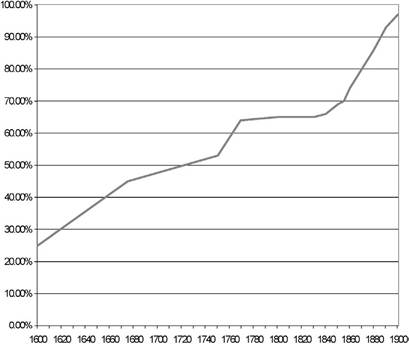
Figure 42. The rise in male literacy rates prior and during the industrial revolution: England: 1600-1900.
Sources: Cipolla (1969), Stone (1969), and Schofield (1973).
(H4) The acceleration in the rate of technological progress that was reinforced by the investment in human capital of individuals with high valuation for offspring quality, increased the demand for human capital in the later part of the Post-Malthusian Regime, generating a universal investment in human capital, a demographic transition and a rapid pace of economic growth.
The hypothesis is consistent with the evidence, provided in Section 2.3 and depicted partly in Figure 41, about the significant rise in the industrial demand for human capital in the second phase of the Industrial Revolution, the marked increased in educational attainment, the emergence of universal education towards the end of the 19th century in association with a decline in fertility rates, and a transition to a state of sustained economic growth.
5.3. Complementarymechanisms
The theory suggests that during the Malthusian epoch hereditary human traits, physical or mental, that generate higher earning capacity, and thereby potentially larger number of offspring, would generate an evolutionary advantage and would dominate the population. Hereditary traits that stimulate technological progress or raise the incentive to invest in offspring’s human capital (e.g., ability, longevity, and a preference for quality), may trigger a positive feedback loop between investment in human capital and technological progress that would bring about a take-off from an epoch of Malthusian stagnation, a demographic transition, and a shift to a state of sustained economic growth. Hence, the struggle for existence that had characterized most of human history stimulated natural selection and generated an evolutionary advantage to individuals whose characteristics are complementary to the growth process, eventually triggering a takeoff from an epoch of stagnation to sustained economic growth. Galor and Moav (2002) focus on the evolution of the trade-off between resources allocated to the quantity and the quality of offspring. Their framework of analysis can be modified to account for the interaction between economic growth and the evolution of other hereditary traits.
5.3.1. The evolution of ability and economic growth
Suppose that individual’s preferences are defined over consumption above a subsistent level and over child quality and quantity. Individuals are identical in their preferences, but differ in their hereditary innate ability. Suppose further that offspring’s level of human capital is an increasing function of two complementary factors: innate ability and investment in quality. Thus, since the marginal return to investment in child quality increases with ability, higher-ability individuals and hence dynasties would allocate a higher fraction of their resources to child quality.
In the Malthusian era, individuals with a higher ability generate more income and hence are able to allocate more resources for child quality and quantity. High ability individuals, therefore, generate higher income due to fact that their innate ability as well as their quality are higher. In the Malthusian era fertility rates are positively affected by the level of income and (under plausible configurations) the high ability individuals have therefore an evolutionary advantage over individuals of lower ability. As the fraction of individuals of the high ability type increases, investment in quality rises, and technological progress intensifies. Ultimately the dynamical system changes qualitatively, the Malthusian temporary steady state vanishes endogenously and the economy takes off from the Malthusian trap. Once the evolutionary process generates a positive feedback between the rate of technological progress and the level of education, technological progress is reinforced, the return to human capital increases further, setting the stage for the demographic transition and the shift to a state of sustained economic growth.
5.3.2. The evolution of life expectancy and economic growth
Suppose that individuals differ in their level of health due to hereditary factors. Suppose further that there exists a positive interaction between the level of health and economic well-being. Higher income generates a higher level of health, whereas higher level of health increases labor productivity and life expectancy. Parents that are characterized by high life expectancy, and thereby expect their offspring to have a longer productive life, would allocate more resources toward child quality. In the Malthusian era, fertility rates are positively affected by the level of income and individuals with higher life expectancy, and therefore higher quality and higher income, would have (under plausible configurations) an evolutionary advantage. Natural selection therefore, increases the level of health as well as the quality of the population. Eventually, this process generates a positive feedback loop between investment in child quality, technological progress and health, bringing about a transition to a sustained economic growth with low fertility rates and high longevity.
Alternatively, Galor and Moav (2004b) develop an evolutionary growth theory that captures the intricate time path of life expectancy in the process of development, shedding new light on the origin of the remarkable rise in life expectancy since the Agricultural Revolution. The theory argues that social, economic and environmental changes that were associated with the transition from hunter-gatherer tribes to sedentary agricultural communities, and ultimately to urban societies, affected the nature of the environmental hazards confronted by the human population, triggering an evolutionary process that had a significant impact on the time path of human longevity. The theory suggests that the deterioration in the health environment enhanced the genetic potential for longer life expectancy thereby playing a significant role in the dramatic impact of recent improvements in health infrastructure on the prolongation of human life.
The rise in population density, the domestication of animals, and the increase in work effort in the course of the Agricultural Revolution, increased the exposure and the vulnerability of humans to environmental hazards such as infectious diseases and parasites, increasing the extrinsic mortality risk and leading to the observed temporary decline in life expectancy during the Neolithic period.[189] The theory suggests, however, that the evolutionary optimal allocation of parental resources towards somatic investment, repairs, and maintenance (e.g., enhanced immune system, DNA repairs, accurate gene regulation, tumor suppression, and antioxidants) was altered in the face of the fundamental trade-off between current and future reproduction. The rise in the extrinsic morality risk generated an evolutionary advantage to individuals who were genetically pre-disposed towards higher somatic investment leading to the observed increase in life expectancy in the post-Neolithic period.
Galor and Moav (2004b) suggest, therefore, that the increase in the extrinsic morality risk (i.e., risk associated with environmental factors) in the course of the Agricultural Revolution triggered an evolutionary process that gradually altered the distribution of genes in the human population that are associated with the intrinsic mortality risk (i.e., physiological and biochemical decay over lifetime). Individuals that were characterized by a higher genetic predisposition towards somatic investment, repairs, and maintenance gained the evolutionary advantage during this transition, and their representation in the population increased over time.[190] Despite the increase in the extrinsic mortality risk that brought about a temporary decline in life expectancy, longevity eventually increased beyond the peak that existed in the hunter-gatherer society, due to the changes in the distribution of genes in the human population. This evolutionary process in life expectancy reinforced the interaction between investment in human capital, life expectancy, and technological progress thereby expediting the demographic transition and enhancing the economic transition from stagnation to growth.[191] Moreover, the biological upper bound of longevity gradually increased, generating the biological infrastructure that contributed significantly to the impact of recent improvements in medical technology on the dramatic prolongation of life expectancy.
6.
More on the topic Unified evolutionary growth theory:
- Unified growth theory
- Chapter 4 FROM STAGNATION TO GROWTH: UNIFIED GROWTH THEORY
- A unified theory of the evolution of international incomes
- The modern approach to growth, often called “new growth theory,"really consists of two quite distinct theories.
- Chapter 21 A UNIFIED THEORY OF THE EVOLUTION OF INTERNATIONAL INCOME LEVELS
- REFLECTIONS ON GROWTH THEORY
- 6. Towards a non-aggregative growth theory
- Introduction: neo-classical growth theory
- 3. Cross-country growth regressions: from theory to empirics
- Size, openness and growth: Theory
- Chapter 12 FINANCE AND GROWTH: THEORY AND EVIDENCE
- Financial development and economic growth: Theory
- Chapter 3 HORIZONTAL INNOVATION IN THE THEORY OF GROWTH AND DEVELOPMENT
- Chapter 7 GROWTH THEORY THROUGH THE LENS OF DEVELOPMENT ECONOMICS
- Chapter 28 ECONOMIC GROWTH AND THE ENVIRONMENT: A REVIEW OF THEORY AND EMPIRICS
- The theory of vague propositions outlined in chapter 6 appealed freely to the orthodox Bayesian theory of credences and learning, which assumes, among other things, that the correct theory of rational credence is one governed by the classical axioms of probability theory.
- AN OVERVIEW OF A UNIFIED ANALYTICS PLATFORM
- Unified Location Tax (ULT)
- Fragmentation alters evolutionary processes