Conditional probability as fundamental
The working econometrician takes the concept of a probability space as a formalization of the concept of a random experiment. This is fine if the adopted interpretation of probability is that of relative frequency.
Nevertheless, it is more natural in economics to adopt the propensity interpretation, and so it should be adopted as basic the notion of (qualitative) conditional probability. I will introduce in what follows a rather natural axiomatization of this concept, due originally to Luce (1968).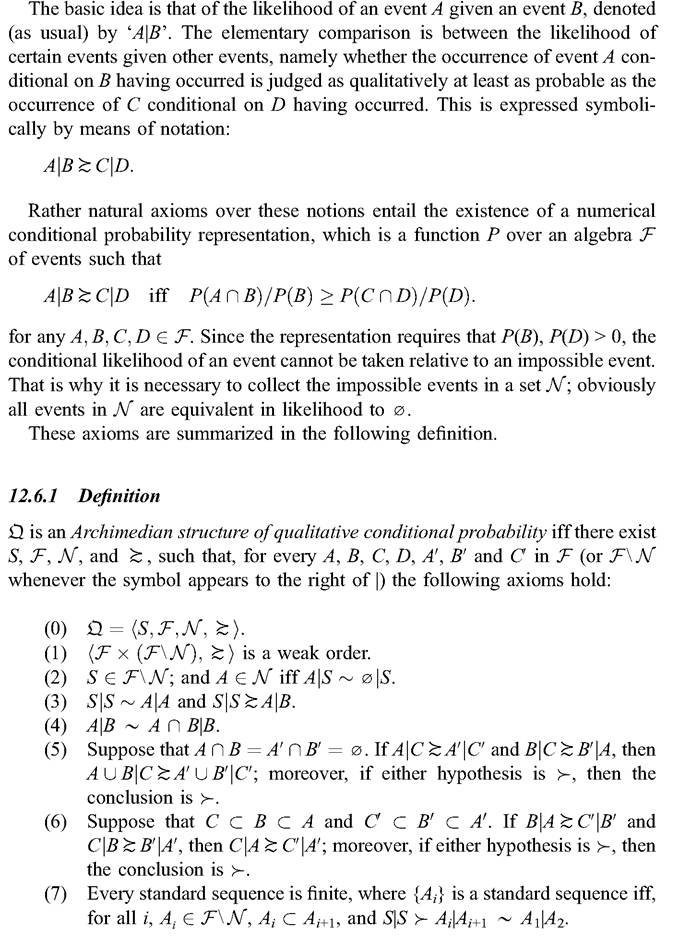
Conditions (1)-(7) are necessary but not sufficient for the existence of a representation. KLST (1971) introduce an axiom that completes the axioms and yields
The logical structure of econometrics 193 the representation. The axiom is a sort of solvability axiom asserting that the structure is sufficiently rich so that, whenever A∣B > C∣D, it is possible to add enough to C in order to make C'∖D equivalent to A∣B. In more precise terms,

An initial analysis of the DGP may reveal intuitively some of the dependences among the events, but, as it is usual in the application of any scientific theory, the methods of determination of the terms of a theory may be rather indirect (they are called, in econometrics, ‘statistical inference’). Starting from structures of qualitative conditional probability, I will show how the apparatus of econometrics is built. Roughly, the steps are the following: 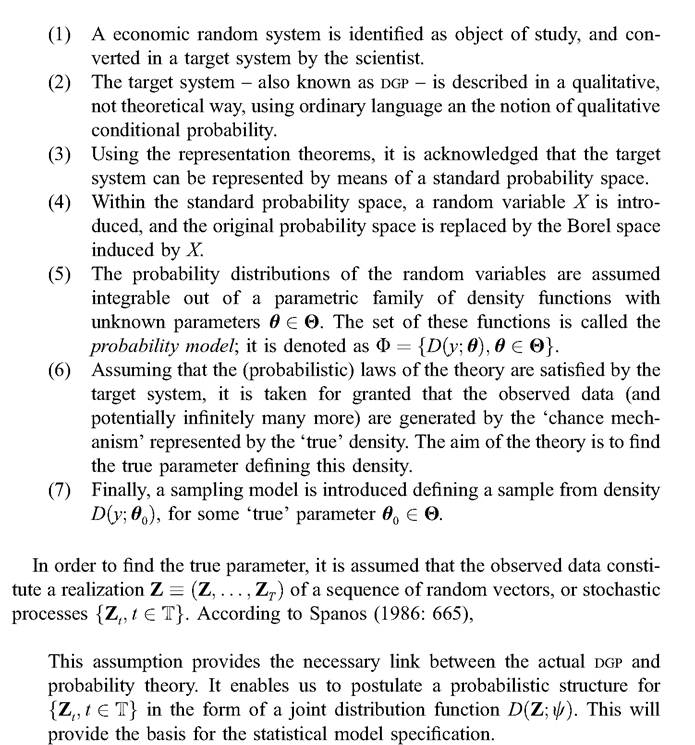
12.7