The fundamental Marxian theorem
10.2.1 Definition
If a is any activation of the production system,
(1) The variable capital v is the monetary value of the labor force operated with intensity a: v = wYa.
(2) The constant capital c is the monetary value of the inputs operated with intensity a : c = pYa.
(3) The monetary value of the net product is p = pYa.
(4) The total profit or benefit b is the difference between the monetary value of the net product and that of the variable capital: b = p - v
(5) the average rate of profit π is the ratio between total profit b and the costs of capital: c + v: π = b/(c + v).
(6) The maximum rate of profit π* is π* = p/c.
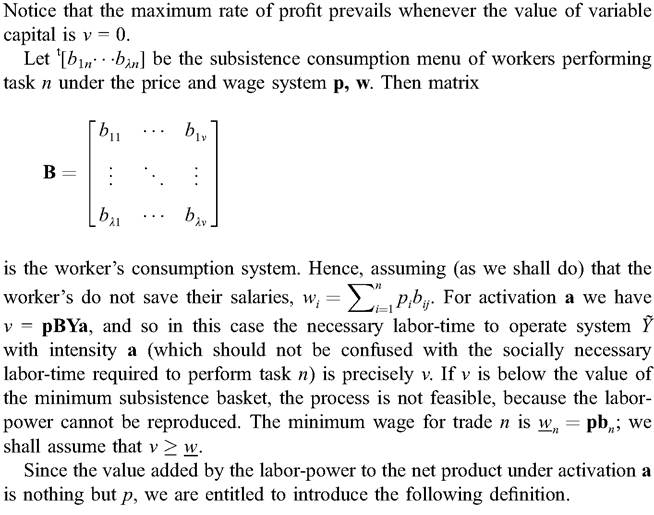
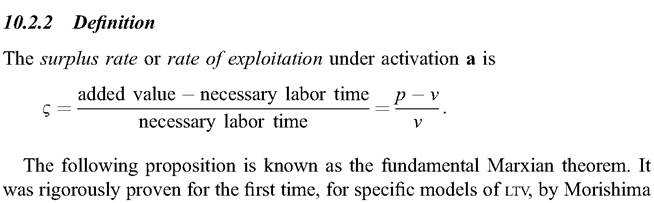
and Seton (1961), and later by Okishio (1963). The following one is the most general version thus far.
10.2.3 Theorem (fundamental marxian theorem)
If the value v of the wages paid by the firm operating nonnull process y is less than or equal to the value created by the firm, p = py > 0, then the profit rate π is positive iff the surplus rate ς is positive. Moreover, the surplus rate is an increasing function of the average profit rate.
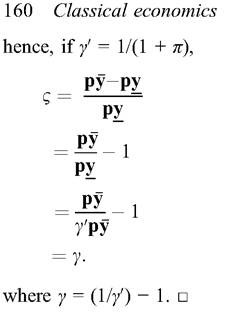
PROOF: Sincep > 0, the minimum value that ς can adopt is 0, namely, when the value v of the salaries v equals the value p added by the workers. On the other hand, the relationship between the average rate of profit π and the surplus rate ς, is determined in the following way: 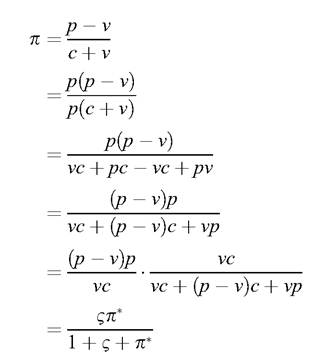
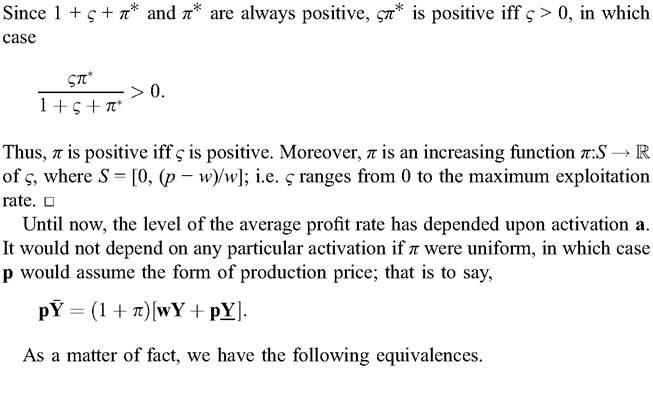
10.2.4 Theorem
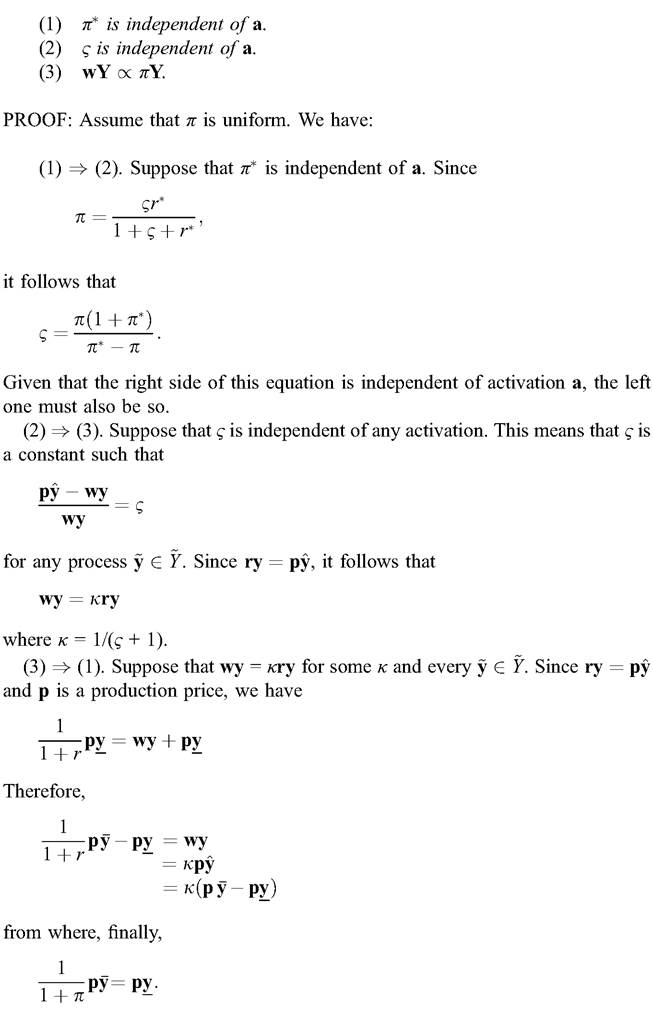
If π is uniform, then the following assertions are equivalent for every activation a:
10.3