General equilibrium
The capitalist economy is a complex mechanism that has to fulfill several conditions in order to operate well and reproduce itself. In this section I will propose a formulation of a set of conditions sufficient to guarantee the existence of what I shall call a classical equilibrium.
Roughly speaking, a classical equilibrium is a state of the economy in which a production price prevails that allows the reproduction of the economy while the agents maximize their utility. Other conditions are: (1) the optimal consumption menus of the working class are enough to guarantee the subsistence of the workers, and they are also feasible, in the sense that they are affordable with their salaries; (2) the production processes chosen by the firms are feasible, in the sense that they do not demand more labor-power and material inputs than they are available in the economy, and also reproduce the economy, guaranteeing at least a return to the previous levels of social wealth (simple reproduction), or even creating more wealth than the original one at the the beginning of the cycle (augmented reproduction).
A classical economy is similar to what Debreu (1959: 78) called ‘private ownership economy’, but it includes the apparatus of the labor theory of value. Actually, a classical economy integrates this theory with the concepts of what Debreu calls ‘theory of value’. The main novelties reside in that there is a financial capital market in which the firms can borrow or give away credits in order to operate a process, and the concept of an equilibrium price includes also a uniform rate of profit whose level depends upon the rate of surplus value.
Regarding the description of any consumer i, I will adopt the usual attribution of a regular, continuous, locally nonsatiated and strictly convex preference relation ≥i over the set Xi of possible consumption menus. This set is assumed to be a closed convex cone in the nonnegative orthant of Rλ; notice that this implies that 0 ∈ xi.
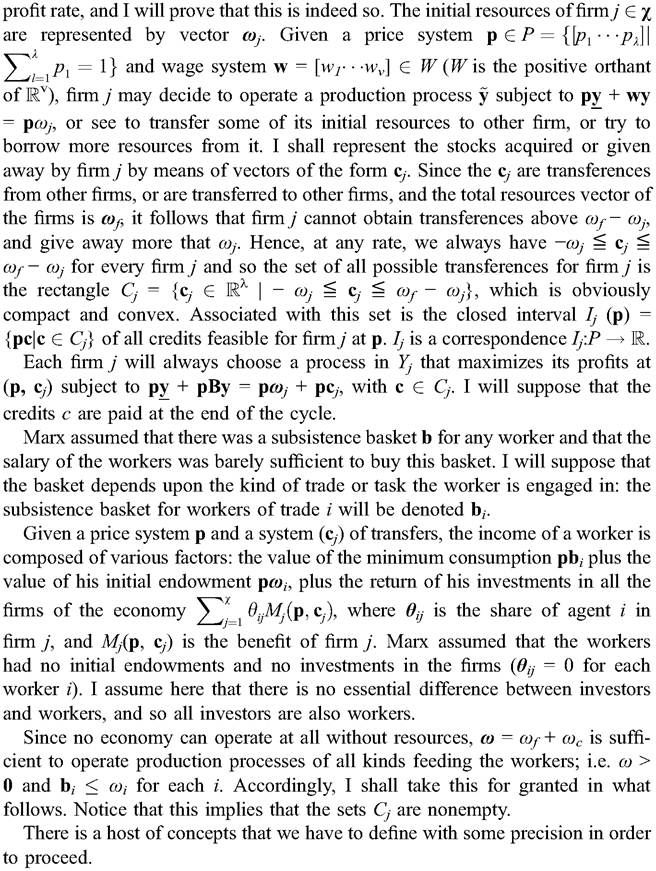
The financial market allows the firms to get more resources in order to produce more, or give away resources in order to produce less but gaining money at a certain interest rate. Clearly, in equilibrium, this rate has to be equal to the
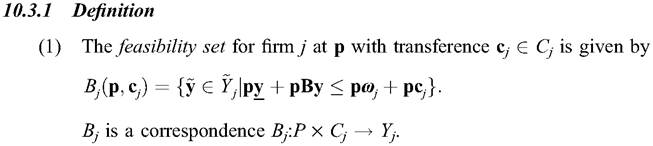
id="Picutre 190" class="lazyload" data-src="/files/uch_group77/uch_pgroup302/uch_uch7196/image/image189.jpg">
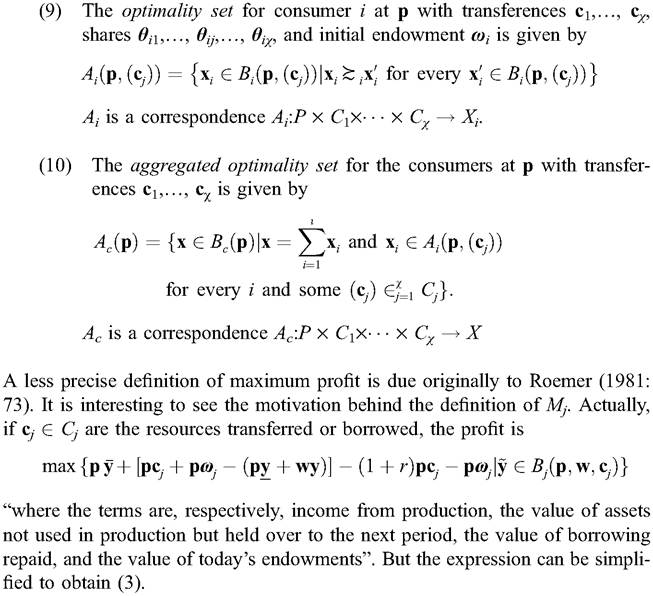
10.3