Equilibrium
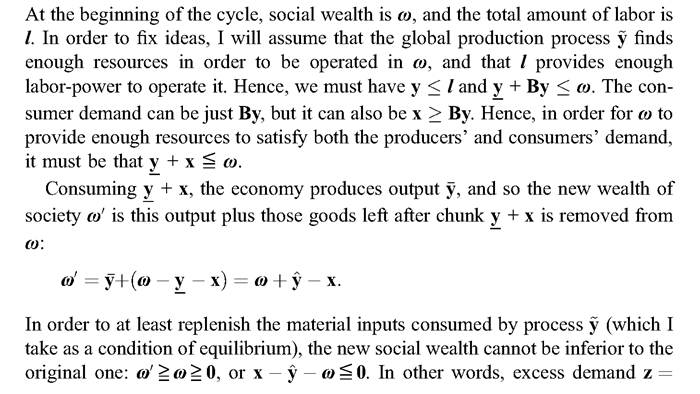
x — y — ω must be zero or semi-negative. Taking this reflection into account, we may proceed to define the crucial notion of equilibrium.
10.4.1 Definition
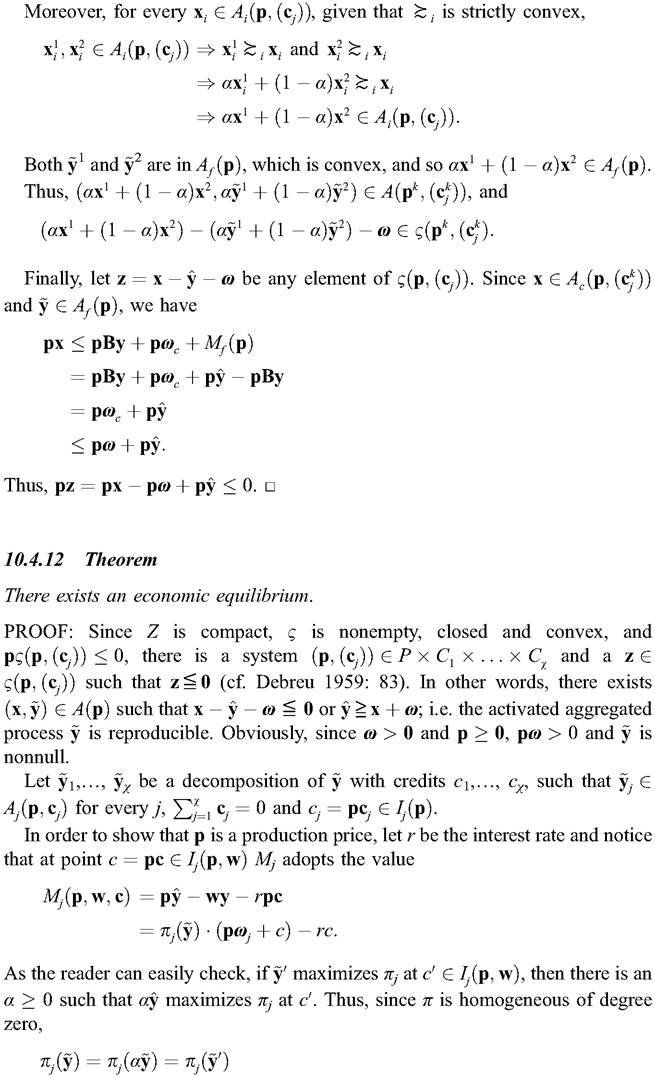
An economic equilibrium is a tuple ((xi∙), (yj∙), p, (c,∙)) such that
(1) x 2 4(p, (cy));
(2) y 2 Aj(p, c7.);
(3) the economy is reproducible; i.e. the net product, after the maintenance of the working class and its additional consumption x has been discounted, is at least equal to the original amount of total resources ω; i.e. excess demand z = x — y — ω is zero or semi-negative;
(4) p is a production price; i.e. the profit rate π is uniform with 0 ≤ p ≤ (pyj - pByzVpByz;
(5) the financial capital market clears: 1 cj∙ = 0;
(6) there exist a reduction w with pB = wy.
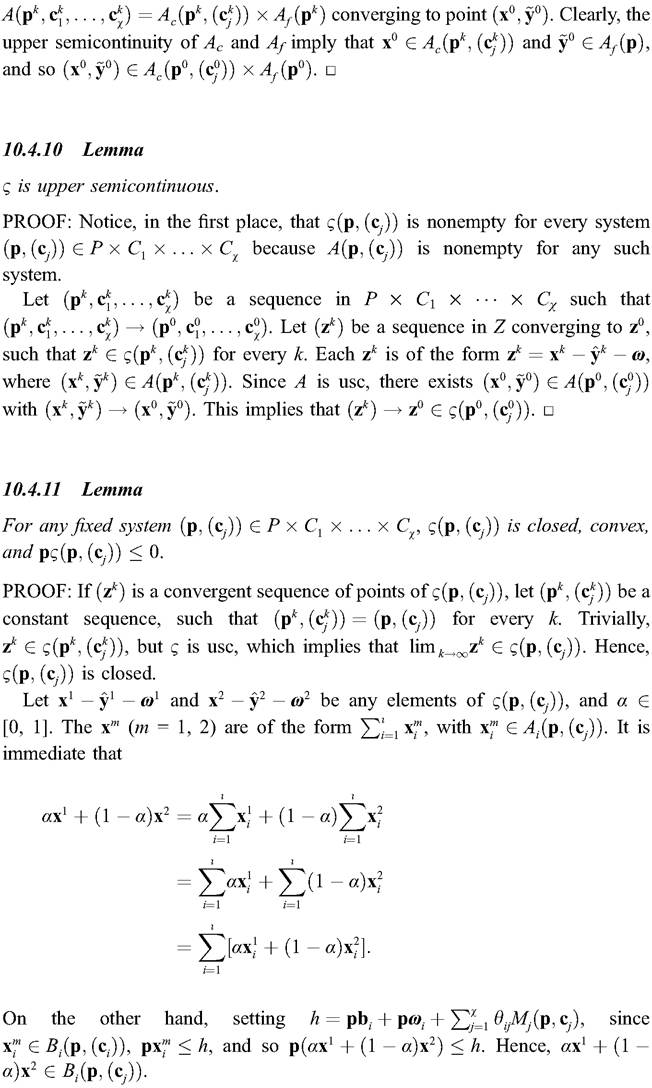
In order to prove the existence of an equilibrium, let us introduce some auxiliary concepts and lemmas. Notice that none of the sets introduced in the definition are empty.
Let Y' be the set {[y, y, y] 2 Y ∣y ≤ l and y ≤ ωg of all production processes that satisfy the labor and material resources restriction.
Let X' be the set {x 2 X∣x ≤ y + ω for some y 2 Y'g of consumptions feasible given the labor and material resources restriction.
Let Y be the set {y — By∣y 2 Y'g of all net products, after basic consumptions are discounted, of processes feasible given the labor and material resources restriction.
Let Z be the set X — Y — {ωg.
Let A:P ? ? C1 ? ■■ ■ ? Cχ → X ? Y be defined by condition A(p; (cj)) = Ac (p; (cj)) ? Af (p).
Let ς be the correspondence ς: P x C1 x... x Cw → Z such that
B(p; (cj)) = {x - y - ω'-x∙y) 2 A(p; (cj))}-
In order to prove the existence of an equilibrium, several previous lemmas are needed.
10.4.2 Lemma
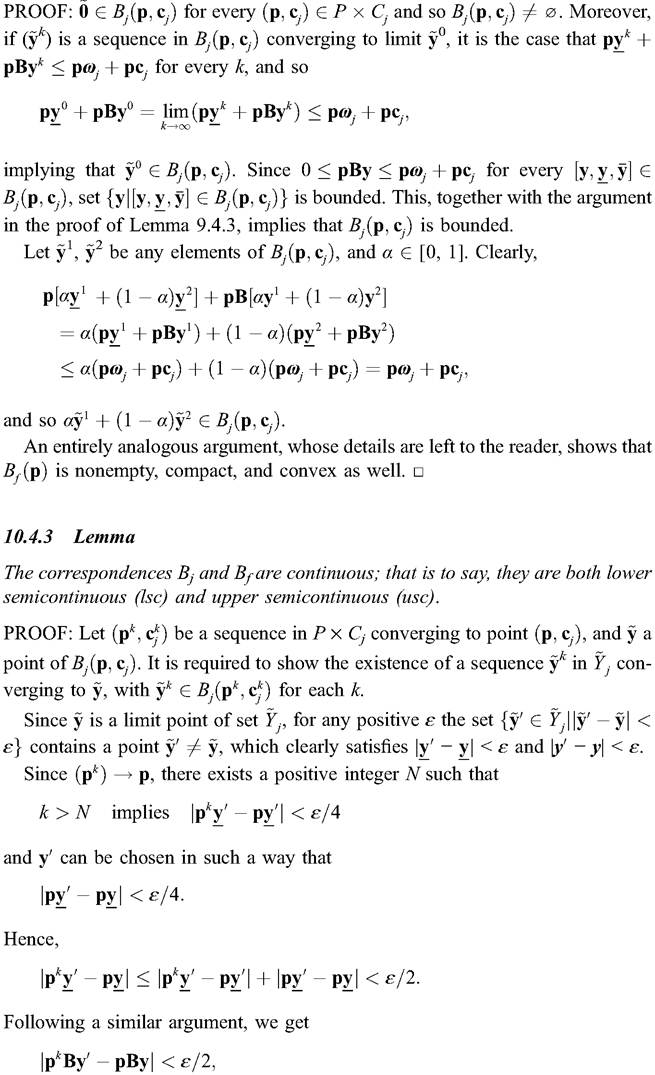
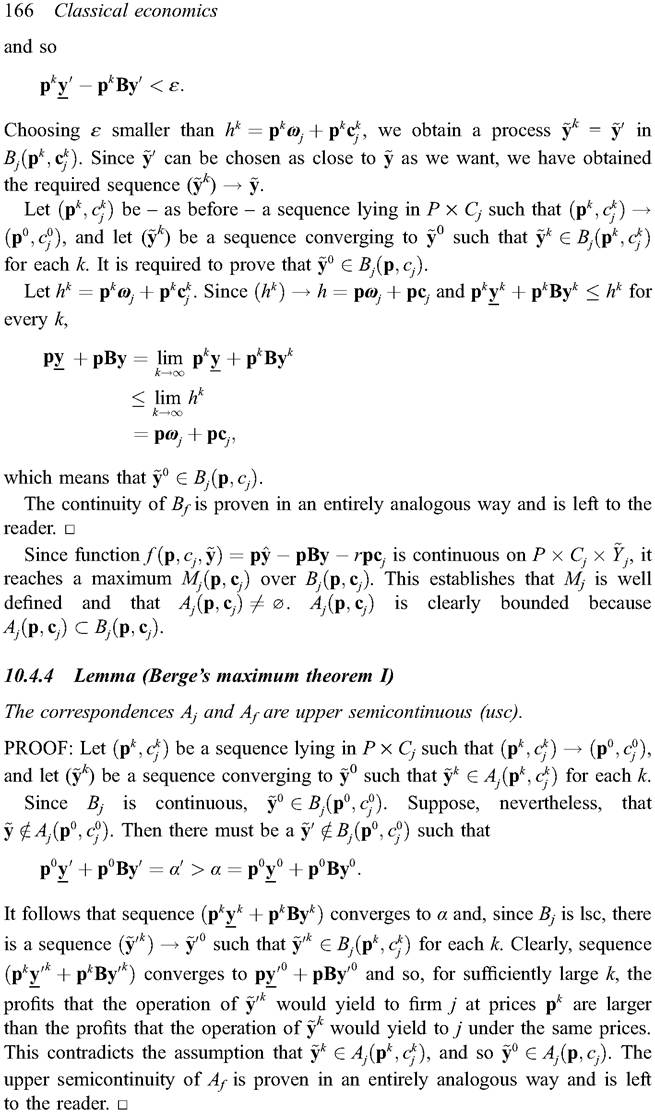
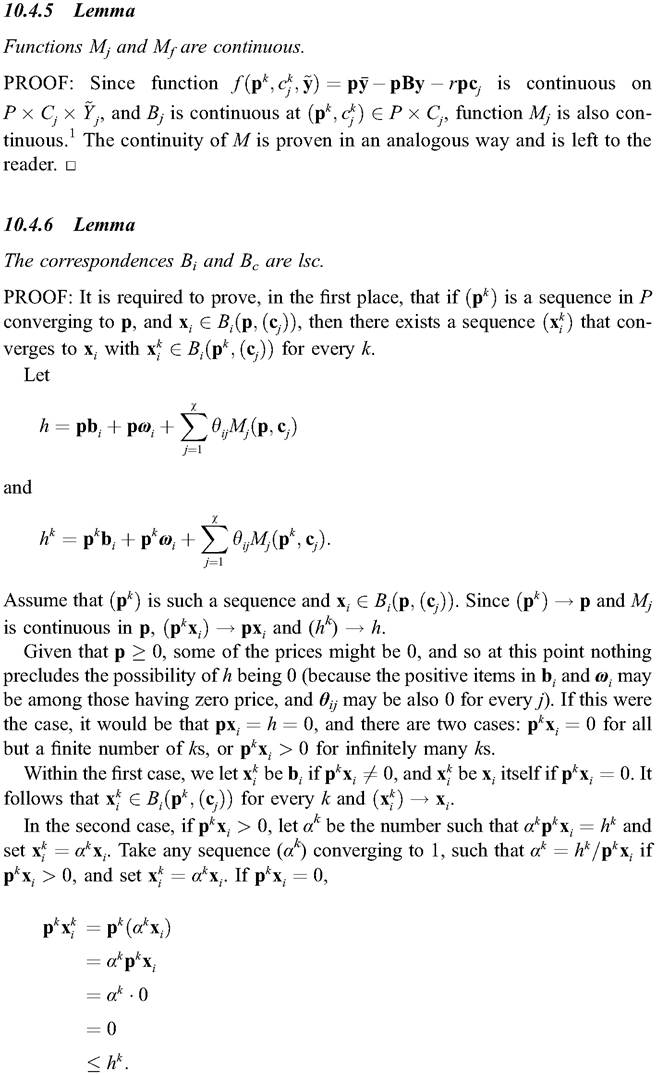
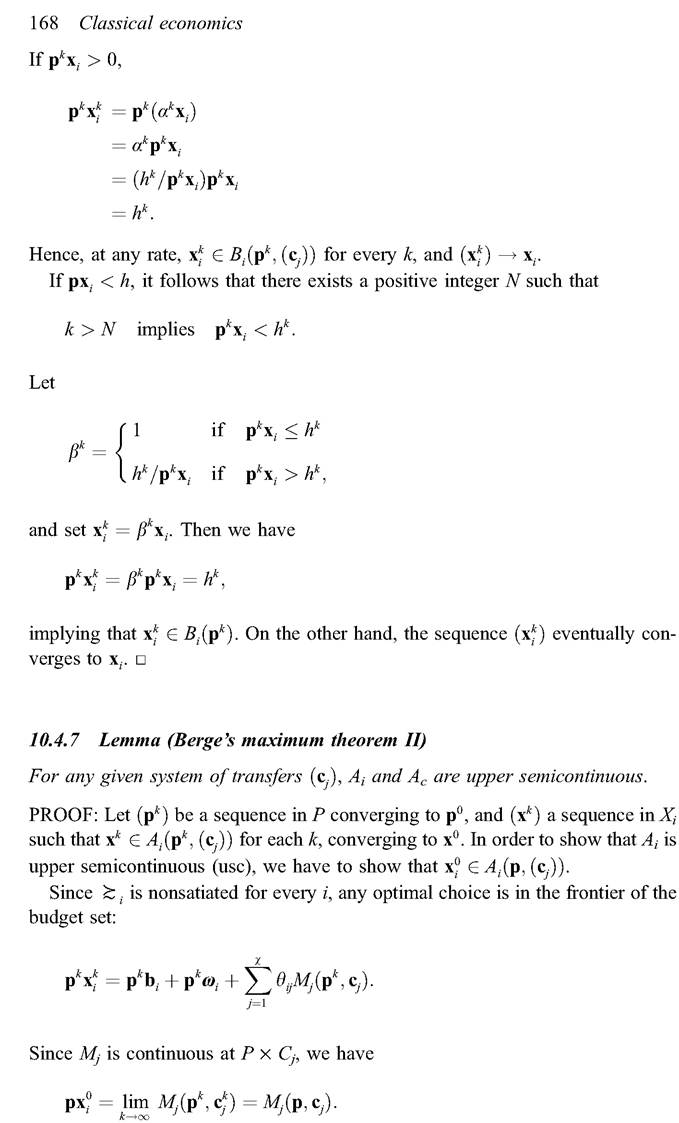
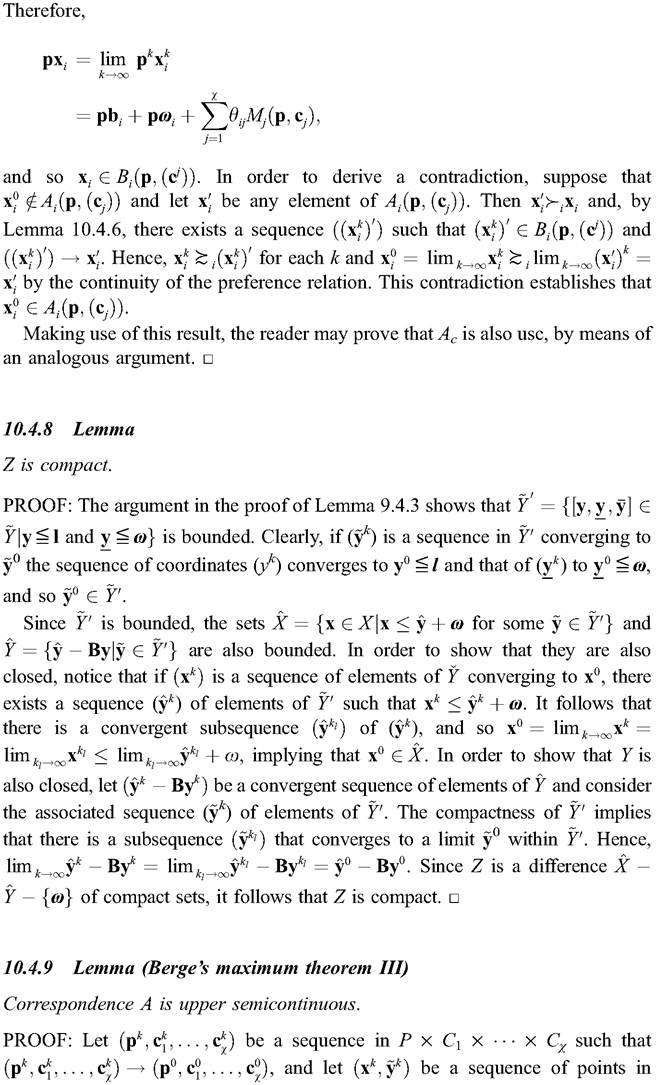
For every price vector p and every transfer c, sets Bj(p, cj∙) and Bw (p) are nonempty, compact, and convex.
172 Classical economics
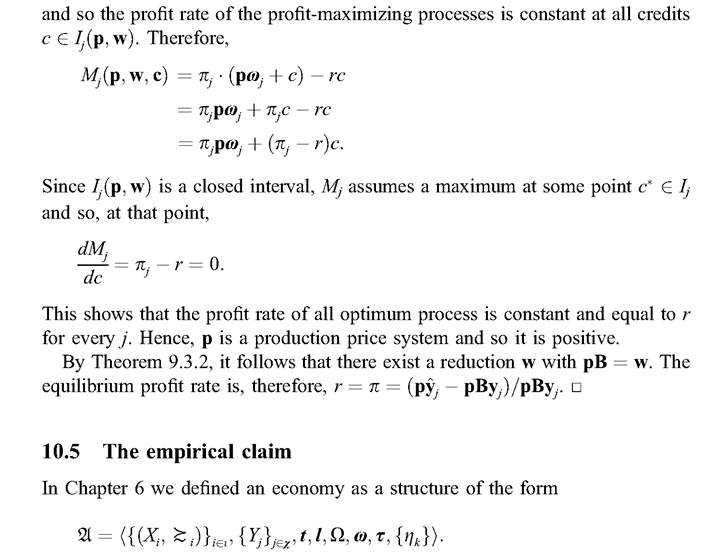
We have specified these concepts to some extent (with the exception of τ) in order to characterize classical economies. Functions ηk describe the actually observed behavior of the agents, which is supposed to be based on a limited, imperfect knowledge of the actual prevailing equilibrium of the system, or its tendencies of change. The empirical claim is that the agents’ actions, including the occasional fixation of local prices, takes place within a band determined by the equilibrium price, which in turn is determined by the social ponderation of the different trades and the structure of the industry.
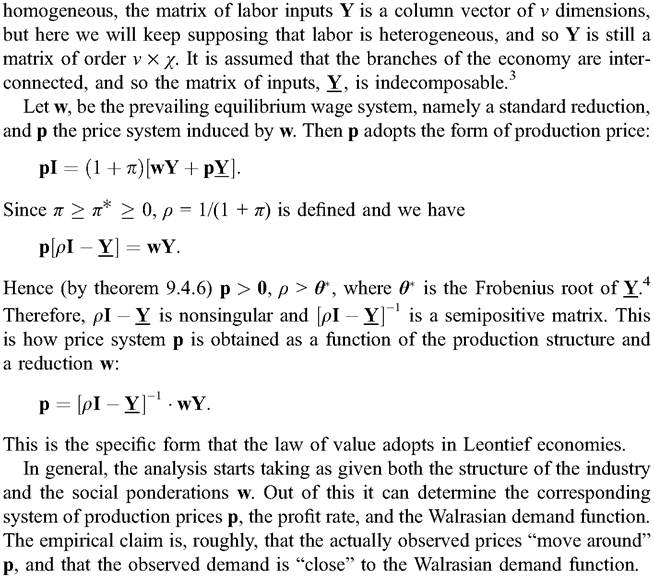
One of the most suggestive formulations given by Marx is that the system of prices is something like a nomic transformation of abstract labor; that it arises out of abstract labor durch allge- meine Gesetze bestimmte Modifikationen.2 But it is perhaps more exact to say that the ‘observed’ system of prices approaches a production price system which is a nomic modification of the state of the production system together with some standard reduction determined by the social ponderation of the different tasks (a ponderation which is the result of a rather long catalactic process).The Leontief model (in the Tarskian sense of ‘model’) is quite illustrative of the former ideas. It represents a technology in which every kind of good is produced by only one production process (there are no alternative techniques), there is no joint production, and the only primary factor is labor, which is supposed to be homogeneous. The matrix Y of inputs is square of order λ, while the matrix of outputs Y = I is the identity matrix of order λ. If labor is assumed to be
Notes
1 Cf. Debreu (1959: 19), Proposition 4. φ is our Bj and g is our Mj.
2 Quoted by Hamminga (1990: 92).
3 For a precise definition of this concept, cf. Takayama (1985: 370).
4 By theorem 4.D.2 in Takayama (1985: 392).
11
More on the topic Equilibrium:
- NASH EQUILIBRIUM
- The equilibrium concept
- General equilibrium
- In logistic growth, the population approaches an equilibrium
- Reflective equilibrium
- Phase 4: Unstable Equilibrium, 1914-39
- The equilibrium theory of island biogeography holds true for mainland areas
- Appendix 2A Literature on Transient and Dynamic Stochastic General Equilibrium (DSGE) Estimates
- Finding an International Equilibrium in Times of Globalisation and Redesign of International Institutions
- In the previous chapter we argued that the interplay between credit constraints and the equilibrium interest rate acts as a propagation mechanism for exogenous shocks and in certain cases has the potential to generate persistent fluctuations
- Analysis of models of competition
- Answers to Analyzing Data 14.1 Questions
- Evolution of competitors in a food web context
- The Many Reasons Why the Theory of Economic Policy Has an Impact on Institutions
- Technological change in frictional labor markets
- Conditions for Controllability in a Static Strategic Setting with Two or Multiple Players
- Methods of measuring and describing competition
- A theory of economic development