Conditions for Controllability in a Static Strategic Setting with Two or Multiple Players
The theoretical tools devised by the classical theory of economic policy are relevant for finding the outcome of a conflict. In fact, when a player has a number of instruments at least equal to that of his or her targets, his or her actions will determine the outcome of the game and reach the desired target values, notwithstanding actions by opponent(s).
This can also control the system, unless another player with target values different from those of the first player has a number of instruments at least equal to that of his or her targets. In this case, no equilibrium would arise. If the target values do not differ, in principle, there are multiple solutions in the target space, but - because of this - the equilibrium in the space of instruments cannot be defined.In the case of more than two players, as mentioned earlier, implicit coalitions can arise. The properties of equilibrium will be similar to those indicated for two players, but now the concepts of conflict, controllability and existence or multiplicity are referred to coalitions and no longer to single players. In addition, the concept of implicit coalitions can be generalised. In fact, an implicit coordination can also emerge if some players only partially share the same target values and the concept of controllability can be substituted by the more powerful one of ‘decisiveness’. The latter implies a degree of control of some variables by a group of players, but not necessarily the achievement of any desired targets. Let us deal with these issues in a more analytical form in the following subsections.
4.4.1 Neutrality and Existence of an Equilibrium in a Two-Player Static Game
We consider two players: the public sector (‘government’), indexed by 1, and the private sector (‘agent’), indexed by 2. The government has q(1) targets. The number of the agent’s targets is q(2).
Since the players may share some target variables, we also have q(1) + q(2) ≥ K. Each player minimises a quadratic loss functions depending on the deviations of each target from its target value.The loss functions can be expressed as
(4-1) Li = 2 (y« - yi)0i (h - λ) i = {1>2g
whereyi∈Rq^ is a vector of target variables, yi∈Rq^ is a vector of target values, and Q is an appropriate positive-definite diagonal matrix. Note that Q is a square matrix of full rank by assumption. Player i’s first best (or the optimum opti- morum) corresponds to his or her target values.
In this setup, all the vectors of target variable are subvectors of y∈Rκ. The K target variables are linked together by the following linear equation system:
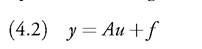
where is the vector of the controls set by the two players, and vector f ∈Rk is a vector of given constants that are outside the players' control.[53] Each row of (4.2) corresponds to a linear relationship between one target and the full instrument vector u. To keep things simple, we will assume that the basis of A is the identity matrix.[54] All the players' control vectors, i.e., ui∈Rm^t'1, are sub-vectors of u∈Rm. We also assume that m(1) + m(2) = M because a policy control, by definition, cannot be set by more than one player at a time. For the sake of simplicity, we also assume that each player cannot control more instruments than the number of targets under that player's supervision: i.e. m(i) ≤ q(i).
We consider three kinds of interactions (solution concepts), which are based on different information sets.
In the non-cooperative ‘Nash equilibrium', both decision makers play simultaneously, and each of them has to form expectations of the opponent's policy choices. In the case of a ‘commitment equilibrium', the government is a Stackelberg game leader who forms expectations of the opponent's behaviour. The government can commit itself to a policy rule, optimal or otherwise, and hence to a policy that is not contingent on that formulated by the other player. The follower (agent) can then choose, given whatever the government has chosen. The decisions are sequential across players. Finally, in a ‘discretionary equilibrium', the government is a Stackelberg follower and cannot pre-commit to a particular policy, although the agent forms expectations for the government's policy.By rearranging the matrix equation representing the economic system, we can reduce a decision problem in a two-player strategic context to two separate optimisation problems, one for each player. Player i's problem consists in minimising his or her loss function subject to the constraint of a system derived from the model of the entire economy, indicating the value of that player's targets as a function of his or her instruments.
The relevant subsystem for player i is  matrices and vectors. Each problem can be studied and solved individually with the tools used in the traditional approach to economic policy. In our decoupled representation of the policy game, a straightforward condition for neutrality can be stated as follows.
Theorem 4.1 (policy neutrality). If equilibrium exists, the government's (agent's) policy is neutral with respect to the targets shared with the agent (government) if the subsystem relevant for his or her targets is controllable by the agent (government). It is worth noticing here that controllability by one player (e.g. the agent) implies that that player will always achieve his or her target values because his or her decisions correspond to his optimum optimorum.
Although intuitive, the above-mentioned condition may appear to contain a contradiction, since controllability by the agent does not exclude the possibility that the government can also Tinbergen-Theil control their own subsystem. However, this contradiction is in fact only apparent. Indeed, were it more than just apparent, a policy equilibrium would
not exist. The issue of equilibrium existence is therefore crucially related to that of controllability and neutrality.
Formally, the following theorem can be stated and proved:
Theorem 4.2 (existence of an equilibrium and the govern
ment’s policy neutrality). (i) The equilibrium of the game in target space exists if the intersection of the players' controllable sets is empty or if the players share the same target values for the variables contained therein. (ii) The government's policy is neutral for all the government's target variables contained in the agent's controllable target set. (iii) Symmetrically, the agent's decisions are neutral for all the agent's target variables in the government's controllable target set. These results apply not only to Nash but also to Stackelberg equilibria.
In the case where there are costs for the use of an instrument (or more instruments), these must be included in the players' loss functions by adding for each costly instrument an auxiliary target variable and an equality constraint between it and the instrument in question, in a way that indicates the need for minimising the costs of deviations from the target value of the instrument itself. This will affect the results of the game and the existence of a policy equilibrium as the number of targets is now higher. Controllability by a player then would require the availability of a correspondingly higher number of his or her instruments. Other generalisations are possible for linear quadratic loss functions.
One advantage of this approach is that conditions for model building and solving, i.e. policy effectiveness or neutrality and equilibrium existence, can be detected without solving the model but simply by looking at the number of targets and independent instruments of each player or - more precisely - by checking the order of matrix Ci.
In particular, player i controls his or her sub-system if m(i) ≥ q(i); however, if this condition is satisfied for both players, no equilibrium exists.4.4.2 Equilibria in an n-Player Static Game from the Point of View of Each Player
From this point of view, Theorems 4.1 and 4.2 can easily be extended to problems with any number of players, as indicated by the following theorem.
Theorem 4.3 (equilibrium existence and neutrality gen
eralised). (i) The equilibrium of a policy game between any n players exists (in target space) if the intersection of their controllable target sets is empty or if the variables contained in the set are associated with the same quantitative target value for all the players that control them. (ii) Player i's policy is neutral for all his or her targets contained in the union of the other players' controllable target sets.
Analysis so far has been performed with reference to the outcomes relevant for each player (i.e. in outcome space only), and issues of multiplicity of equilibria either in this space or in instrument space were not investigated from the point of view of the whole system. By contrast, now we focus on the entire system to derive general conditions for equilibrium existence and multiplicity, in terms of the controllability of the whole system.
4.4.3 Policy Neutrality and Equilibrium Existence with Respect to the System As a Whole
Let us refer to games where players aim to maximise preferences defined on the same target variables (but with potentially different target values) as ‘fully shared preferences games'. If all players share the same bliss point, we have a ‘common-interest game'.
The possibility of interactions between policymakers has raised problems of coordination and comparisons between
Conditions for Controllability in a Static Strategic Setting 141 the outcomes of decentralised and centralised solutions.11 Only occasionally have these issues been dealt with in terms of controllability of the system and the existence of an equilibrium.
However, the essence of this problem is already well known in the economic literature, at least since Mundell (1968) raised the ‘nth country problem'. In a world of n countries, there are n - 1 independent external balances, trade balances or exchange rates as possible targets but n possible independent policy instruments, such as interest rates, which could, in theory, be set by the n policymakers. As a result, if each policymaker made independent use of his or her instrument, a conflict would arise among the n countries, and no equilibrium would exist because of the adding-up constraint that must hold between the n external balances or n exchange rates.[55] [56]The conditions for existence derived in the above-cited theorems by first decoupling the policy game in a set of single-player problems and then applying the Tinbergen and Theil tools to each of them refer to the point of view of single players. By contrast, now we focus on the entire system to derive general conditions for equilibrium existence and multiplicity in terms of the controllability of the whole system.
Specifically, a decentralised equilibrium is characterised by multiple equilibria in the instrument space whenever the total number of independent instruments, summing across players, is greater than the total number of their (independent) targets when taken together. Surprisingly perhaps, the availability of instruments more numerous than the targets, which is a virtue of a centralised or ‘social planner' solution as it confers some degrees of freedom, is problematic in a decentralised environment because coordination on an equilibrium is difficult.
The equilibrium existence is shown to be unlikely in games with conflicts about the target values. Instead, in common-interest games, at least one equilibrium exists that is also Pareto optimal. However, the excess of instruments may cause a problem of coordination on how to set instruments to achieve it. It can be shown that the players can be given an incentive to choose exactly the values of the instruments leading to that Pareto-optimal equilibrium.
Let us assume that the total number of independent instruments available to the players is not smaller than the number of independent targets ∑2i2Nw(z) ≥ K; i.e. we have a Tinbergen system. Then the following theorem can be stated (Acocella, Di Bartolomeo and Hughes Hallett 2013).
Theorem 4.4 (instruments, targets and multiple equilibria). If the total number of instruments exceeds the total number of independent targets, Nash equilibria are multiple in the instrument space, if they exist.
This does not necessarily imply that there are multiple equilibria in the target space. In a common-interest game with a Tinbergen system, at least one Nash equilibrium exists in the space of outcomes. But counterintuitively, this is not sufficient to guarantee that this equilibrium is unique. Although the outcome of the equilibrium where all target values are reached is ‘privileged' by being the unanimous best choice for all players, there might be cases in which other vectors of targets satisfy the system as well. A possible example arises when the quasi-reaction functions of all players are coincident: at each of these infinite points, no player has any incentive to deviate as each of all the multiple equilibria in the outcome space is supported by multiple equilibria in the instrument space, given the assumption of a total number of instruments larger than the number of targets.
As a way of partial conclusion, we can say that in n-person games in general, if at least one player satisfies controllability, Nash equilibria (if they exist) are multiple in the instrument space and unique in the outcome space. By contrast, in a common-interest game, if at least one player satisfies controllability, there exist multiple equilibria in the instrument space and a unique one in the outcome space.
At a practical level, if there are too many instruments available in the game, it might become impossible for each player to make conjectures about the policies of the opponents.[57] The inability to forecast the strategy selected by the other players may then lead to a series of randomised policy interventions, which would destroy the policymakers’ ability to coordinate on a Nash equilibrium, and even in the case of common-interest games, a unique equilibrium in the instrument space will not exist and instrument values remain somehow ‘indeterminate’. By contrast, the over-determination of an economic system has no consequences for the centralised solution. In fact, a social planner can always select one of the infinite solutions arising when the economic system is overdetermined. They are obtained simply by fixing the values of the instruments in excess of the targets.
A way to solve the problem of multiple equilibria in decentralised solutions is to introduce instrument costs. This would add to the number of targets and make the number of instruments always less than that of the targets. The introduction of extra costs for the players in excess of the number of instruments really acts as an equilibrium-selection device by selecting one of the multiple equilibria existing in the instrument space. If the equilibrium is unique in the outcome space, instrument costs clearly coordinate players towards the desired target. Moreover, if there are multiple equilibria in that space, introducing costs can coordinate players on the Pareto-efficient one. Usually, they should be introduced only when operating instruments really imply costs. However, from a practical point of view - and not only at an analytical level - the imposition of a cost is fictitious in commoninterest games. In fact, in this case, any arbitrary deviation of cost imposed implies that the players will not actually bear that cost, since they would prefer to do nothing. In that way, they would obtain their first best solution.
13
4.4.4 Conflicts and Coordination among Groups:
Implicit Coalitions
A situation of no conflict can arise when there is a convergence of interests between different players. In this case, ‘implicit’ coalitions can arise among the players that share the same target values of the common target variables. This results in a move from a situation of conflict among all players, such as that assumed in the preceding subsections, to a situation where there is absence of a conflict among some players but a residual opposition or rivalry among certain groups of them. In a nutshell, similarly to the preceding cases, the existence of a conflict implies an opposition among the (implicit) coalitions that will lead to the nonexistence of an equilibrium if more than one coalition controls conflicting targets. By contrast, if only one coalition controls (in the same sense) the economic system, we end up with policy invariance. In addition, the concept of implicit coalitions can be generalised to the case where some players only partially share the same target values, and the tool of decisiveness can be introduced to solve the game.
In the two-player case, implicit coordination may emerge as the result of a decentralised setting without conflict between the two players. In a multiple-agent context, more
general situations can be considered, e.g. implicit coordination among a subset of players or among a subset of target variables. This subsection explores the former; for the latter, the reader can refer to Acocella, Di Bartolomeo and Piacquadio (2009).
Let us consider an economy where n agents interact strategically. We assume - without loss of generality - that each agent aims at minimising a quadratic criterion defined in terms of deviations from a desired target value vector y14:

and is endowed with only one instrument; implying there are n instruments in total. Targets and instruments are both linearly independent. Agent i’s first best solution is obtained for y = yi and, as a consequence, Li = 0.
The economy is described by the following linear system:

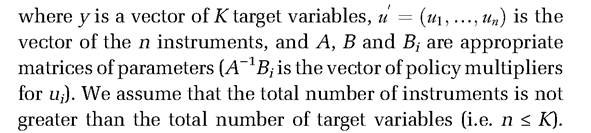
An (implicit) coalition is the set of agents for whom a certain target set Y contains their first best. We say that two coalitions have a conflict of interests if there exists at least one desired target value different for the same variable that is of interest to both of them. A coalition is said to possess coalition controllability if the strategies of coalition members always imply that they reach their first best outcomes for any given strategy of the other players.
14
Qi is not required to be of full rank as one agent may not be interested in one or more of the target variables.
Coalition controllability implies that a combination of instruments of the coalition members (coalition policy) exists such that for any given set of values for the instruments chosen by non-coalition members, the coalition members always achieve their first best outcomes. Conditions ensuring coalition controllability have been stated.
The concept of coalition also can be generalised to situations where not all target values - but only some of them - are shared. In this situation, differences in some target values can be settled within this group of players, where a Nash equilibrium can be reached. Even with partially differing target values, consideration of this case is important because the group can neutralise other external groups' policies. It is then relevant for policy effectiveness and institutional discussions.
These results are essential to fully understand policy games and, thus, for model building, as they state the conditions for the consistency of the optimal strategies of all the players (and thus the existence of an equilibrium to the game) as well as the effectiveness of policy instruments. In addition, they are relevant for institution building, as they can help us to show the conditions under which a decentralised equilibrium may hold or fail to exist or to be Pareto efficient.
4.4.5 Announcement Games
We have seen that cases of multiple equilibria can emerge in policy games and have derived the formal conditions under which this occurs. In such a case, the Nash equilibrium concept is too broad to tell us how policymakers interact and what the outcome of the game will be. Consequently, the issue of how to select one equilibrium arises. Nonbinding announcements (‘cheap talk') can be used as a device for coordinating the policymakers onto a solution. Along the way, we consider the ‘credibility' of those announcements and their consistency across players and reaction functions.
The problem of multiple Nash equilibria has often been discussed in the literature. For instance, David Kreps considers multiple equilibria, and how to choose between them, to be one of the paramount problems in game theory. Many sorts of games have, in fact, multiple equilibria, ‘and the theory is often of no help in sorting out whether any one is the solution and, if one is, which one is' (Kreps 1990: 97).
In some games with multiple equilibria, players know what to do. This knowledge comes from directly relevant past experience and from a sense of how individuals act generally. However, formal mathematical game theory still has much to say about where these expectations come from, how and why they persist or when and why we might expect them to arise (Kreps 1990). The problem of equilibrium selection in particular is closely related to various kinds of coordination failures (see e.g. Cooper and John 1988).
The natural solution to coordination failures is based on the idea of focal points (Schelling 1960), which is, however, not always appealing - in particular, when there is a conflict of interest among the agents. More interesting are the solutions that prevent the emergence of coordination problems by considering small two-stage variations of the standard coordination game that are based on pre-play communication or the introduction of outside options. Adding the option for one player to make an announcement does not alter the set of possible Nash equilibria.
We consider a general linear-quadratic (LQ) coordination game and introduce a pre-play stage that takes account of both cheap talk and outside options. In particular, we assume that an agent can make an announcement in the first stage of the game that other agents can take into account or not as they wish. If they do not coordinate on the announcement equilibrium, they expect the payoff given by the outside option. Therefore, the sender has to take account of this possibility in determining his or her selfcommitting announcements.15
Finally, we investigate the traditional time-inconsistency issue by clarifying the relationship between credible and non-credible promises. Costless announcements and the traditional commitment solution are briefly compared as alternative techniques for creating credible policy commitments. For a more exhaustive comparison, see Acocella et al. (2014). The LQstructure of the game allows us to derive closed-form solutions and to describe the entire taxonomy of it, including necessary and sufficient conditions to observe and solve coordination failures.
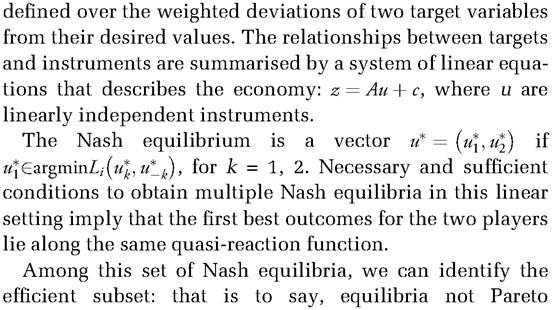
We consider a static LQ game between two players with complete information.[58] Each player k sets an instrument uk to minimise the following loss functions:

[1] The possibility of announcement wars can also be considered, which we do not investigate here for simplicity.
dominated by any other Nash equilibrium. This is given by all the (linear) convex combinations of the first best outcomes of the players. By contrast, Nash equilibria outside the subset of these equilibria represent coordination failures in the sense of Cooper and John (1988). Of course, if the target values of all players coincide, then all Nash equilibria that lead to different outcomes are Pareto inefficient (when the β are finite and different from zero, and players are interested in both targets).
All these cases of multiple equilibria, however, need some kind of ‘story’ of how a particular equilibrium may finally be selected. This can be provided by showing that sequences of announcements can lead players to coordinate their actions around one set of outcomes.
Here we consider only one-sided announcements for simplicity. For a more developed analysis, see Acocella et al. (2014). We allow players to make an announcement in the underlying game described earlier. At the beginning of the period, a player makes a public announcement about his or her policy. Thereafter, without any binding commitment, the two players simultaneously set their instruments. Since the announcement is not binding, the players can take it into account or not as they prefer. If they do not take account of that announcement, the outside option, which is naturally defined as the expected outcome of the underlying Nash game, is obtained.
Following Farrell (1988), we assume that credible nonbinding announcements exist.[59] If a credible announcement is made, it will not be ignored by the receiver and will be used to coordinate the agents’ actions. This means that agents will act according to that announcement. Credibility of nonbinding announcements is based on ‘self-committing’ messages and on an additional constraint, induced by the introduction of the outside option, which ensures that the coordination phase is implemented.
We assume that agents can communicate by a common language. Since an announcement can be seen as a nonbinding commitment about the agent's own supporting strategy, we assume that the agent receiving the announcement interprets it correctly. He also correctly links the announced outcome to the supporting strategies.
If an agent decides to ignore the announcement, the outcome of the underlying game is driven by an exogenously given probability distribution defining both the sender's and the receiver's outside option. Without entering into a discussion about its possible derivation, we just point out that this outcome distribution could have had its origin in a mixed- strategy equilibrium as well as in the players' beliefs, which may ultimately be derived from institutional or historical experiences. However, a detailed analysis of the form of the probability distribution is beyond the scope of this chapter.
We define the set of credible announcements as the set of announcements for which a series of axioms on selfcommitment and acceptability holds. Clearly, given our assumptions, if an announcement equilibrium exists at all, it will completely describe the outcome and actions of the two agents in the game. Then the outcome of the game is the one first announced by one of the players, which corresponds to his or her most favourable outcome from among all the credible announcements. If there is at least one outcome on the quasi-reaction functions that Pareto dominates the random solution, then the one-sided announcement game has a unique announcement equilibrium.
As the announcement equilibrium is always unique and always a Nash equilibrium, it acts as an equilibriumselection device. The idea is simply that the player making the announcement can use his or her ‘announcement power' to eliminate the random outcomes to obtain his or her most favoured of the credible outcomes. However, if there is no outcome on the quasi-reaction functions that Pareto dominates the random solution, no credible announcement can be made, and the random solution is to be expected. The announcement therefore succeeds in solving the equilibrium-selection dilemma because it is a way to signal a common strategy that will lead to an outcome that is better than the random outcomes for both players.[60]
A one-sided announcement is a ‘weak’ promise in comparison to commitment. It is less favourable for the agent that makes the promise but crucially does not need any external credibility support in order to be implemented. Announcements therefore allow the players to convert a desirable outcome into a focal point upon which to coordinate, and thereby reduce (but not in general eliminate), inefficiencies even if the players are in conflict. In this way, they solve two very annoying problems of games with multiple equilibria: (1) how to arrange convergence to a Nash equilibrium and (2) how to solve coordination problems.
The introduction of an outside option strongly affects the results: this is a common-knowledge expectation about the payoff of the game when communication is not possible or unsuccessful. Specifically, the existence of an outside option restricts the set of credible announcements and forces the sender to announce a second-best outcome. Multiple announcements strengthen this result further because the sender has to take account of the possibility that the receiver can dismiss the proposal and announce a new one.
Finally, notice that announcements as an equilibriumselection device are more likely to be observed when there is a large degree of uncertainty, little disagreement between agents about the targets and higher expected losses if players do not coordinate their actions. By allowing for cheap-talk announcements by both agents, additional insights into the outcomes can be derived without affecting the properties of the game. Indeed, in contrast to the case of commitment - where having two committing agents would bring no equilibrium (e.g. when there are two Stackelberg leaders) - using sequential announcements from both sides will always lead to a unique equilibrium. In the limiting case of a frictionless bargaining process (no transaction costs), this corresponds to implementing the Nash bargaining solution with appropriate weights representing bargaining powers.
4.5