Technological change in frictional labor markets
Most of the models presented so far feature an aggregate production technology, i.e., the production structure is centralized, and competitive labor markets. Constructing a frictional model of the labor market requires departing from both attributes and moving toward a decentralized production structure and a labor market with imperfect coordination between workers and firms in the matching process.
This class of models gives rise to frictional equilibrium unemployment and “frictional equilibrium inequality”. By frictional inequality, we mean wage dispersion that is purely an artifact of frictions and that, without frictions, would disappear. A useful way to think about this phenomenon is to introduce the concept of “return to labor market luck”.Throughout this chapter, we have discussed several models where technological progress produces a rise in the return to observable and unobservable permanent components of individual skills, such as educational attainment, age, and innate ability. These permanent factors greatly determine inequality of earnings among the population, but they are not by any means exhaustive. Earnings display a large stochastic component (e.g., events related to the luck of individuals, firms, or industries) that is responsible for their fluctuations around the permanent component.[215]
Gottschalk and Moffitt (1994) were the first to ask how much of the observed increase in inequality is attributable to a rise in earnings volatility and instability around its permanent component. They used a simple statistical model where log wages, wit, for an individual i at time t - net of their predictable age profile - are assumed to be the sum of two orthogonal components, a fixed individual effect αi and a stochastic (i.i.d.) component εit. Using the covariance structure of wages within a panel of U.S.
males (constructed from PSID data), they reached the conclusion that the fraction of the total increase in cross-sectional inequality attributable to a surge in earnings volatility is between one third and one half.[216] One can interpret this fact as a rise in frictional inequality, or in the “return to labor market luck”. The argument set forth is that the rapid diffusion of a new technology leverages the importance of these stochastic factors, raising the premium to workers with no observable distinguishing characteristics other than their good fortune.Most of the work we review uses the random matching model of the labor market [see, e.g., Mortensen and Pissarides (1998) or Pissarides (2000)]. In this framework the existence of frictions creates a bilateral monopoly as a result of a meeting between a vacant firm and a worker. Wages are determined by bargaining over total output, so more productive firms tend to pay more, creating wage dispersion among ex-ante equal workers. We start by studying how technological change affects unemployment in this class of models. Next, we move to wage inequality. Random matching is a somewhat extreme characterization of frictions. In the last part of the section we contrast random search models to directed search models.
7.1. Technological progress and frictional unemployment
There is a sizeable literature trying to characterize how equilibrium unemployment reacts qualitatively to variations of the rate of technological change within a matching model a la Diamond-Mortensen-Pissarides (DMP) with vintage capital a la Solow (1960). Two distinct approaches emerge from the literature.
The first, that can be attributed to Aghion and Howitt (1994), argues that when new and more productive equipment enters the economy exclusively through the creation of new matches - because existing matches cannot be “upgraded” - it has a Schumpeterian “creative-destruction” effect: new capital competes with old capital by making it more obsolete and tends to destroy existing matches, because workers are better off separating from their old matches to search for the new firms endowed with the most productive technology.
Thus, unemployment tends to go up as growth accelerates, due to a higher job-separation rate.The second approach, due to Mortensen and Pissarides (1998), proposes an alternative view whereby the new technologies enter into existing firms through a costly “upgrading” process of old capital. In the extreme case where upgrading is free, we have the Solowian model of disembodied technological change, even though the carrier of technology is equipment. The separation rate is unaffected by faster growth and all the effects work through job creation. For small values of the upgrading cost, unemployment falls with faster growth, thanks to the familiar “capitalization effect”: investors are encouraged to create more vacancies, knowing that they will be able to incorporate (and hence benefit from) future technological advances at low cost.[217]
Hornstein, Krusell and Violante (2003b) try to resolve the issue quantitatively. When they parameterize the model to match some salient features of the U.S. economy, they find that, in the vintage-matching model, the link between capital-embodied growth and unemployment does not importantly depend on to what parties - new matches or old ones - the benefits of the technological advancement accrue. The intuition for this “equivalence result” is that upgrading can be much better than creative destruction only if it is very costly for vacant firms to meet workers, but the data on the low average unemployment and vacancy durations imply that, in the model, this meeting friction is minor. That paper also shows that the same data on average unemployment duration impose severe restrictions on how much frictional wage inequality the model can generate. In the standard search model, high dispersion of wage opportunities makes workers very demanding and increases unemployment spells. Thus, a high wage dispersion could only coexist, in equilibrium, with long unemployment durations.
We now turn to the analysis of how technological progress impinges on frictional inequality in random matching models.
In these models, however, the limits on the extent of wage inequality due to luck emphasized in Hornstein, Krusell and Violante (2003b) apply as well.7.2. Technological heterogeneity and the returns to luck
In a frictional labor market populated by ex-ante equal workers, an increase in technological heterogeneity can increase the return to luck. We explain this mechanism within a simple framework based on Aghion, Howitt and Violante (2002).69 Consider an economy populated by a measure one of infinitely lived, ex-ante equal, and riskneutral workers as well as by the same measure of jobs. Jobs are machines embodying a given technology. The technological frontier advances every period at rate γ > 0. The machines have a productive life of two periods. An age j ∈ {0, 1} machine that is matched with a worker produces output yj = (1 + γ)~jh (normalized relative to the age 0 machine), where h represents the skill level of the workers.
The labor market is frictional, i.e., workers separated from their jobs are randomly rematched with a vacant machine. To simplify, we assume that they always make contact with a machine. We postulate that, upon contact, the bilateral monopoly problem is solved by a rent sharing mechanism setting wages to be a constant fraction, ξ, of current output yj, where ξ is a measure of the bargaining power of workers.
It is easy to see that in an equilibrium where all job offers are accepted, the lucky half of the workers will be employed on new machines and the unlucky half on old machines. The variance of log wages is simply given by var(log w) = γ2/4, which is increasing in the rate of embodied technological change. Intuitively, in this economy all the heterogeneity is generated by technological differentials across machines. A technological acceleration (rise in γ) amplifies the productivity gaps between jobs. Since in this non-competitive labor market individual wages are linked to individual output, this acceleration then also raises wage dispersion even among ex-ante equal workers, i.e., it raises the return to luck.[218] [219] As in Jovanovic (1998), however, if the scrapping age of capital is endogenous, the model would display an offsetting force.
This force is due to the fact that, when the growth rate is higher, machines becomes obsolete faster, and firms scrap machines earlier. Therefore the equilibrium age range of machines in operation shrinks, compressing technological heterogeneity.7.3. Vintage human capital with frictions
A technological acceleration not only affects transitory residual wage inequality through its impact on the underlying distribution of job productivity differences. The technological acceleration may also affect the distribution of worker productivity differences if it interacts with the accumulation of job/technology-specific knowledge.[220] Violante (2002) extends the above model to include vintage human capital. Employed workers accumulate, through learning-by-doing, knowledge about the technology they are matched with. We normalize the amount of specific skills cumulated after every employment period to 1, so that the learning curve of the workers is concave, i.e., learning is faster for workers with lower initial skills. To keep the model tractable, we also assume that skills fully depreciate after two periods.
A worker on a machine of age i who moves on to a machine of age j next period can transfer hij units of the accumulated skills to the new job

with τ > 0 and i, j ∈ {0, 1}. The fraction of skills that can be transferred from an old to a newer machine is proportional to the technological distance between the two machines through a factor τ f 0. The presence of the term γ in the transferability technology is crucial: the rate of quality improvement of capital-embodied technologies determines the degree by which new technology is different, more complex, and richer than the previous generation of machines. A higher γ reduces skill transferability in the economy.[221] Equation (24) and the depreciation assumption implies that we have three skill levels in the economy

and the corresponding wage rates (normalized relative to the wage on an age 0 machine) are Note that, given this simple expression for wages, the variance of log wages can be written as

which is the sum of technological heterogeneity (the force discussed earlier), ex-post skill heterogeneity among workers, and the degree of assortative matching between skills and technologies measured by their covariance.[222]
One can prove that, for large enough γ, workers separate from firms every period.[223] Under this optimal separation rule, the equilibrium level of wage dispersion is given by

so it is increasing in γ whenever the variance is well defined (positive).
In particular, the equilibrium displays var(h) = γ2τ2/2, and cov(h, j) = γτ/4. The variance of skills is increasing in γ since a higher γ reduces the skill transferability of the bottomend workers (h10), while not affecting the skill level of the top end workers (h01). The covariance between skills and age of technology is also increasing in γ, a force that restrains inequality because it worsens equilibrium sorting in the economy. The reason is that a larger γ reduces the skills of workers moving to the new technology relatively more than the skills of workers moving to old technologies.A common criticism of this class of models is that the degree of churning in the labor market (i.e., labor mobility or job reallocation) has to rise in order to generate more volatile earnings, whereas the empirical literature documents no significant rise in labor mobility [Neumark (2000)].[224] This is a misconception. One way to unravel this issue exploits the equivalence between cross-sectional wage dispersion and individual wage instability in a model with ex-ante equal and infinitely lived agents. A technological acceleration has two effects. First, it curtails skill transferability, thereby increasing wage losses upon separation. Second, it reduces the average skill level of workers who find themselves, on average, on the steeper portion of a concave learning curve, which in turn implies higher wage growth on the job. Both these forces tend to raise individual earnings volatility, for any given level of labor mobility. Violante (2002) offers some evidence of wage losses upon separation and wage growth on the job being larger in the 1980s than in the 1970s and shows that a calibrated full-scale version of this model can account up to 90 percent of the rise in wage instability in the U.S. economy, while at the same time implying only a very modest rise in equilibrium labor turnover.
7.2.1. Occupation-specific human capital
Occupation-specific experience may be one of the least transferable components of human capital, and a change in occupational mobility can have a big impact on the wage structure. Kambourov and Manovskii (2004) document an increase in occupational mobility in the United States from 16 percent in the early 1970s to 19 percent in the early 1990s[225] Based on a calibration exercise Kambourov and Manovskii argue that 90 percent of the rise in residual inequality (i.e., in both the permanent and the stochastic component) is due to increased occupational mobility.
The authors build a model of occupation-specific human-capital accumulation based on the equilibrium search framework of Lucas and Prescott (1974). At any one time workers can work in one occupation only. Workers choose their occupation based on their occupation-specific experience. When working in an occupation, workers increase their specific experience, and they lose some of this experience when moving between occupations. A worker’s wage in a given occupation depends on the specific experience and the occupation’s productivity.
The productivity of occupations is subject to shocks, and increased variability of these shocks directly increases wage variability. However, the total impact of occupational productivity shocks on wage inequality depends on the occupational choice response of workers. Workers in an occupation whose productivity declines choose to move in search of better occupations and, by so doing, they dampen the effect of the shock on inequality. When the increased variance of productivity shocks is accompanied by decreased persistence - as conjectured by the authors - workers in occupations hit by moderately negative shocks may choose not to switch occupation because occupations which look profitable today may turn quickly into unproductive ones. This latter effect amplifies the direct effect of the initial shocks.[226]
7.2.2. A precautionary demand for general skills
Gottschalk and Moffitt (1994) found that the transitory component of inequality is larger (and increased more) for low-education workers. Gould, Moav and Weinberg (2001) model this phenomenon using a vintage human capital model where risk-averse workers choose their level of education. They study an economy where workers are ex-ante heterogeneous with respect to permanent innate ability, and the return to college education is increasing in ability. High-ability workers obtain a college education that provides them with general skills which do not depreciate as technology advances. Low-ability workers do not acquire general skills in college; rather, they acquire technology-specific experience through on-the-job learning. Here, we refer to workers with a college education as skilled and to workers without a college education as unskilled.
Gould, Moav and Weinberg (2001) consider a shock to the economy that simultaneously increases the rate of embodied technological change and the ex-ante variance of technological progress across jobs.[227] This shock increases the “precautionary” demand for college education, since holding technology-specific skills becomes more risky. The lowest ability threshold for college graduates falls, and thus permanent inequality increases within skilled workers and falls within the group of unskilled workers. At the same time, the rise in the variance of embodied technological change means that “skill erosion” has a bigger impact on the relative wages of unlucky and lucky unskilled workers, so the increase in their wage variance is mostly determined by transitory components.
This mechanism relies on the assumption that the variance of technical progress is heteroskedastic in the sense that it rises with its mean. We know very little about this property: Cummins and Violante (2002) analyze the whole cross-industry distribution of equipment-embodied technical change for 62 industries in the United States from 1947 to 2000 and find little evidence of changing variance, although the mean grows substantially over the period. However, they document a rise in the cross-sectoral variance of the “technological gap” between average capital and leading-edge machines.[228] According to the transferability technology (24), the technological gap closely measures the degree of skill erosion of an average worker displaced in a given industry.
7.2.3. Explaining the fall in real wages
Interestingly, in a set of model economies with vintage human capital [Helpman and Rangel (1999), Gould, Moav and Weinberg (2001), Violante (2002) or Kambourov and Manovskii (2004)], during the transition to the new steady state, and notwithstanding the technological acceleration, the fall in the average skill level of the workforce can generate a temporary slowdown in average wage growth and a fall in the real value of wages at the bottom of the distribution - two facts that have been documented extensively for the period of interest.
To illustrate this point, let us return to the model from Section 7.3. Note that in an equilibrium where workers separate every period - as assumed - each skill type represents one fourth of all workers. The four skills types are reported in expression (25). It is immediate to see that the normalized average log level of skills is -τγ, and thus it falls unambiguously when γ increases. This opens the interesting possibility that, in the model, the average wage could decrease along the transition following a technological acceleration.
Suppose that at time t the economy is in steady state with γ = yL (and with the productivity of the new machine normalized to 1). The average log wage is then Wjt =  Suppose now that γ rises to yH. Then, some simple algebra shows that in the next period, the average log wage is

Thus, despite the technological acceleration, the average wage decreases along the transition if τ > (yl + yh)∣(yh - yl), that is, if τ or the increase in γ are large.
An alternative explanation for the fall in real wages - which does not depend on vintage human capital - is advanced by Manuelli (2000) within a frictional labor market model where workers have bargaining power and can seize a fraction of the firm’s future stream of profits, through wage negotiations. Consider what happens when it is announced that: (1) a new technology will be available in the future; but (2) the incumbent firms will be able to adopt it only with some probability [as in Greenwood and Jovanovic (1999)]. Existing firms will anticipate a future increase in wages, driven by the new, more productive entrants. Hence, there will be a transitional phase before the arrival of the new technology, where the market value of the incumbent firms will fall and, with them, the wages they currently pay.
7.4. Random matching vs. directed search as source of luck
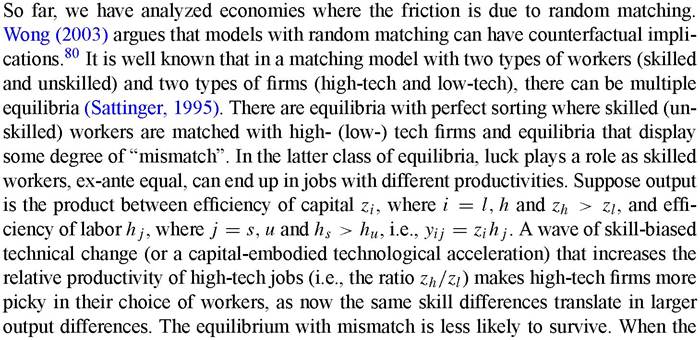
[1] See also Albrecht and Vroman (2002) for a similar environment.
economy switches to the equilibrium with perfect sorting, luck-driven inequality among ex-ante equal workers falls to zero.[229]
One of the key reasons why the model has this counterfactual prediction is that, due to random matching, prices (wages) have no signaling value. Shi (2002) analyzes exactly the same framework (a two-worker, two-firm economy) but he replaces Nash bargaining and random matching with wage posting and directed search, following the alternative approach of “competitive search” [Moen (1997)]. His conclusion is that random matching is not essential for technical progress to leverage the effect of luck in the labor market: directed search works equally well.
In this environment, skilled workers only apply to high-tech jobs, while unskilled workers apply to both types of jobs. Ex ante, every unskilled worker is indifferent between jobs, but inequality is generated ex post. Since high-tech firms give always priority to skilled applicants, unskilled workers applying for high-tech jobs are less likely to become employed than are unskilled workers applying for low-tech jobs. Therefore unskilled workers applying for high-tech jobs have to be offered higher wages than in low-tech jobs.
With free entry, a rise in the relative productivity of high-tech jobs (skill-biased technical change) induces the creation of more high-tech vacancies. More unskilled workers become attracted to the high-tech sector and in equilibrium their job finding probability in the high-tech sector falls, so wages rise. In the meantime, fewer unskilled workers stay in the low-tech sector, so their wages fall. In sum, wage inequality among ex-ante equal workers rises with the degree of skill bias in technology.
Can one conclude that directed search models are more suitable than random search models for studying problems where heterogeneity is crucial, such as wage inequality? The answer depends on the dimension of inequality studied. Directed search seems a more reasonable assumption when the trait determining heterogeneity is observable (e.g., education, general experience), whereas random matching fits better in the analysis of wage inequality when the source of heterogeneity is not directly observable (e.g., ability or vintage-specific skills).
8.