Technology-policy complementarity: United States vs. Europe
A large portion of this chapter has been dedicated to the analysis of a number of different economic models designed to decipher the dynamics of the U.S. wage distribution over the past three decades, in light of changes in technology.
In this section we expand our viewpoint to include other dimensions of labor market inequality, which allows us to contrast the U.S. experience with the European experience. In Section 2 we documented that while wage inequality soared in the United States, both the labor share of income and the unemployment rate remained remarkably stable there. In sharp contrast, in most of the large continental European economies, the wage structure did not change much at all, while the labor share fell substantially and unemployment increased steadily. Inparticular, the increase in European unemployment largely reflects longer durations rather than higher unemployment incidence.
8.1. The Krugman hypothesis
Why have we observed such different outcomes for two regions of the world standing at a similar level of development and, therefore, being subject to very similar aggregate shocks? Are we witnessing a sort of devil's bargain, i.e., a trade-off between inequalities: low unemployment can only be achieved by paying the price of soaring wage inequality? And, if so, what determines the position of each country along this tradeoff?
In Table 2 we report, for the set of countries from Table 1, some indexes of the rigidity of various labor market institutions reproduced from Nickell and Layard (1999). The conclusion is unambiguous: compared to the United States, continental Europe has stricter employment protection legislation, more generous and longer unemployment benefits, less decentralized wage bargaining, and more binding minimum wage law.
The large majority of papers in the literature have taken the data exhibited in Table 2 as uncontroversial evidence that the reason for the observed differences can be found in the differences in labor market institutions between United States and continental Europe.
Krugman (1994) was probably the first to provide a simple formalized model of this hypothesis. Simply put, the interaction between a severe technological shock and rigid European institutions have induced an adjustment through equilibrium quantities of labor (i.e., the employment distribution), whereas in the flexible U.S. labor market, the adjustment occurred through prices (i.e., the wage distribution).Several authors have tried to test the Krugman hypothesis econometrically. The typical analysis is based on a cross-country panel of institutions and shocks, i.e., it allows for changing institutions over time, beyond aggregate shocks. A statistical model linking shocks and institutions to the dynamics of unemployment and wage inequality is estimated to evaluate the role of shocks and institutions, first separately and then interacted. The shocks considered are usually of technological nature and are measured through changes in measured TFP and changes in the labor share of income, possibly capturing a form of capital-biased technical change. In all cases the shock is assumed to be common across countries.
Blanchard and Wolfers (2000) argue that changing institutions alone have little explanatory power. The performance of the statistical model in explaining cross-country patterns of unemployment rates improves once shocks and institutions are interacted: an equal-size technological shock has differential effects on unemployment when labor market institutions differ. Bertola, Blau and Kahn (2001) provide further evidence for this view. Bentolila and Saint-Paul (1999) also study the evolution of the labor share across OECD countries since 1970. Using panel data techniques, they find that in the
Table 2
Data on various labor market institutions across OECD countries. Averages for the period 1985-1995.
Cross-country institutions data (1984-1995)
| Country | Labor standards | Employment protection | Union density | Bargaining centralization | Ratio of min. to avg. wage | Benefit repl. rate | Benefit duration |
| Austria | 5 | 16 | 46.2 | 17 | 0.62 | 0.50 | 2.0 |
| Belgium | 4 | 17 | 51.2 | 10 | 0.60 | 0.60 | 4.0 |
| Denmark | 2 | 5 | 71.4 | 14 | 0.54 | 0.90 | 2.5 |
| Finland | 5 | 10 | 72.0 | 13 | 0.52 | 0.63 | 2.0 |
| France | 6 | 14 | 9.8 | 7 | 0.50 | 0.57 | 3.0 |
| Germany | 6 | 15 | 32.9 | 12 | 0.55 | 0.63 | 4.0 |
| Ireland | 4 | 12 | 49.7 | 6 | 0.55 | 0.37 | 4.0 |
| Italy | 7 | 20 | 38.8 | 5 | 0.71 | 0.20 | 0.5 |
| Netherlands | 5 | 9 | 25.5 | 11 | 0.55 | 0.70 | 2.0 |
| Norway | 5 | 11 | 56.0 | 16 | 0.64 | 0.65 | 1.5 |
| Portugal | 4 | 18 | 31.8 | 7 | 0.45 | bgcolor=white>0.650.8 | |
| Spain | 7 | 19 | 11.0 | 7 | 0.32 | 0.70 | 3.5 |
| Sweden | 7 | 13 | 82.5 | 15 | 0.52 | 0.80 | 1.2 |
| U.K. | 0 | 7 | 39.1 | 6 | 0.40 | 0.38 | 4.0 |
| Canada | 2 | 3 | 35.8 | 1 | 0.35 | 0.59 | 1.0 |
| USA | 0 | 1 | 15.6 | 2 | 0.39 | 0.50 | 0.5 |
| Europe average | 5.15 | 13.77 | 44.52 | 10.77 | 0.54 | 0.61 | 2.38 |
Note.
Data are taken from Nickell and Layard (1999, Tables 6, 7, 9, 10). Labor standards are summarized in an index whose max value is 10 and refers to labor market standards enforced by legislation. The employment protection index ranges from 1 to 10. Union density is measured as a percentage of all salary earners. Centralization is an index where 17 corresponds to the most centralized regime. Benefit duration is in years. Europe average: unweighted mean of European countries, except U.K.presence of institutions that promote wage rigidity, shocks that reduce employment also significantly reduce the labor share of income. One common problem in this empirical literature is that the results are, in general, not robust to the chosen specification.[230]
Another problem of this methodology is that the economic mechanism behind the interaction between technology and policy is not explicit. Consistently with the approach we took in the chapter so far, we will devote more space to quantitative analyses based on “structural” equilibrium models. In the rest of this section, we present the various frameworks the literature has explored to understand the interactions between technological progress and labor market institutions in shaping the various dimensions of inequality. We have grouped these frameworks into six categories, according to the type of technological shock modeled: (1) a rise in microeconomic turbulence, linked to some fundamental change in technology, (2) a slowdown in total factor productivity, (3) an acceleration in the rate of capital-embodied productivity improvements, (4) skill- biased technical change, (5) a technological innovation whose adoption is endogenous, and (6) the structural transformation from manufacturing to services.
8.2. Rise in microeconomic turbulence
In Section 2 we have documented that roughly one-half of the rise in cross-sectional wage differentials in the United States is not associated to a higher return to permanent skills.
Rather, it is due to increased wage “instability” over the workers’ life time. In other words, transitory idiosyncratic shocks to labor productivity and wages have become more important over time [Gottschalk and Moffitt (1994)]. These larger temporary wage movements constitute important evidence that there has been a rise in the degree of microeconomic turbulence in the U.S. economy.More evidence comes from the firm side. Campbell et al. (2001) show that the crosssectional variability of individual stock returns has trended upward from 1962 to 1997. Chaney, Gabaix and Philippon (2003) and Comin and Mulani (2003) use Compustat firm-level data to demonstrate that the firm-level volatility of real variables, such as investment and sales, has gone up from 1970-1975 to 1990-1995. Overall, these papers provide snapshots, from very different angles, of an economy where idiosyncratic turbulence and volatility have risen to a high level.
Bertola and Ichino (1995) and Ljungqvist and Sargent (1998, 2003) argue that a rise in microeconomic turbulence that interacted with more or less rigid institutions can explain the U.S.-Europe dichotomy. Interestingly, the former authors identify wage rigidity and strict employment protection laws as the culprits, while the latter emphasize the generosity of unemployment benefits. Note, though, that one key premise behind these theories is that the surge in turbulence is common to the United States and Europe. We are not aware of any empirical work documenting trends in microeconomic instability in continental Europe. Currently, this represents a limit for this class of explanations.
8.2.1. The role of wage rigidity
The framework proposed by Bertola and Ichino (1995) is inspired by the Lucas and Prescott (1974) island-model of equilibrium unemployment. The economy is populated with a measure, L, of risk-neutral workers and a measure one of firms, indexed by i ∈ [0, 1]. Each firm is subject to idiosyncratic productivity shocks that follow a two-state Markov chain taking values (Ag, Ab), with Ag > Ab, and with transition probability p, that the state (good G and bad B) changes.
When labor mobility is perfect, employment adjusts across good and bad firms to equalize wage differentials, and a unique market-clearing wage rate arises in equilibrium, i.e., there is no wage inequality.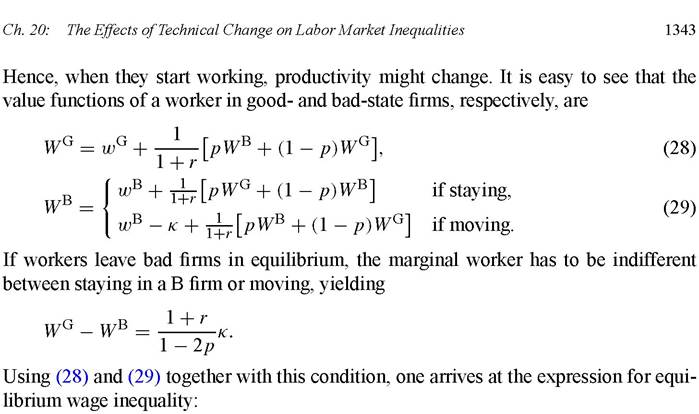
r + 2p
1 — 2p
к.
(30)
Consider now the case where wages are flexible, but where workers have to pay a fixed moving cost, κ > 0, to change firms (this is the U.S.-like economy). In any period, workers observe the productivity level in all firms, but moving takes one period. Onthe one hand, the closer p is to 0, the more permanent are productivity changes. This justifies a large amount of wage-equalizing mobility, and hence there is smaller ex-post wage inequality across firms. On the other hand, the larger is the degree of volatility in the economy (the closer p is to 1 /2), the riskier it is to move for a worker, as the new firm can quickly turn into the B state, and the cost к is wasted. In this case, mobility will be low and the ex-post wage differential will increase.
Now consider the same experiment in a Europe-like economy where wages are rigid, i.e., where wb = wg = w, and where firing costs are prohibitively high, so that employment at every firm is constant at Ї. To analyze this situation, Bertola and Ichino assume that firm i has a linear marginal revenue product π(ll) = zl — all, so that the marginal values for a firm in the G and B state of a unit of labor, respectively, are in the face of a negative shock, they will be very cautious in hiring new workers even in the high-productivity state. Note, in fact, that the larger is the productivity differential Ag - AB across states, the higher will average unemployment in the economy be.
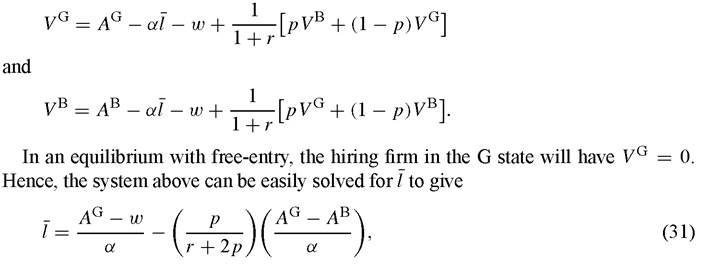
which shows that a rise inp that increases the degree of turbulence in the rigid economy will reduce average employment, i.e., it will increase the unemployment rate, L — l. The reason is straightforward: when firms are constrained in their ability to shed labor
In conclusion, a similar increase in economic uncertainty induces more caution in workers’ mobility and larger wage differentials in an economy with flexible wages whereas it leads to more caution in firms’ hiring and lower average employment in an economy with rigid wages and costly layoffs. This result remains qualitative, as the authors did not try an exploration of the quantitative importance of their mechanism. In particular, it would be of interest to study by how much labor turnover needs to decline in order to generate a rise in wage inequality of the magnitude observed in the U.S. economy. Interestingly, as mentioned earlier, Jovanovic and Rousseau (2004) document a substantial downward trend in labor mobility in the United States, from 50 percent in 1970 to 35 percent in 2000.
8.2.2. The role of welfare benefits
Ljungqvist and Sargent (1998, 2003) propose an alternative mechanism based on the standard search model of unemployment [McCall (1970)]. Here, we present a strippeddown version of their argument. Consider an unemployed worker with skill level h, who searches for a job, sampling wage offers every period from the stationary distribution F(w), with finite support [w, w]. Her skill level, when unemployed, decays at the geometric rate δ, whereas, when employed, skills remain unchanged. Employment is an absorbing state (no exogenous breakup of jobs), and workers discount the future at rate r. Unemployment benefits are equal to b. The values of employment and unemployment for a worker of skills h are
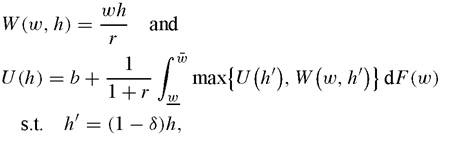
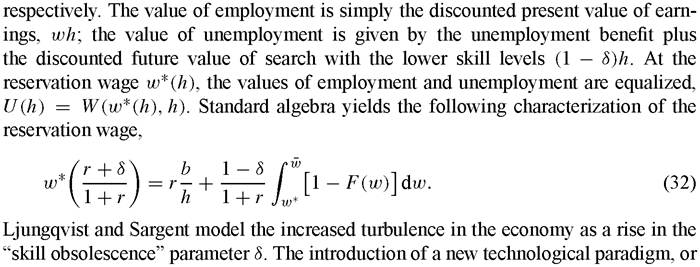
an acceleration in the rate of technological change, can lead to a higher rate of obsolescence, insofar as skills are at least partly technology-specific (recall our discussion in Section 7).
It is straightforward to show, through simple comparative statics, that w* falls with δ: a worker aware that her skills will become obsolete faster during unemployment chooses optimally to reduce her time spent searching and decreases her reservation wage. As a result, the unemployment duration falls.
However, an increase in δ has an equilibrium effect on the distribution of workers across skills: the average skill level in the population falls, and one can show that the reservation wage declines in the skill level, i.e., dw*∕dh < 0. The key behind this result is that the unemployment benefits, b, do not depend on the current skill level, h, of the unemployed workers, whereas wage offers are naturally linked to h. A fall in h worsens the value of the average wage offer relative to the value of remaining unemployed with benefits b. Thus, both the reservation wage and unemployment duration increase.[231] The net effect of these two forces is qualitatively ambiguous, and only a quantitative analysis can determine which force is paramount. Note that it is easy to show that the derivative, dw*∕dh, is increasing (in absolute value) in b. Thus, in Europe-like economies with more generous benefits, the second effect tends to be stronger.
Ljungqvist and Sargent embed this simple mechanism in a much richer and detailed model. They calibrate the increase in turbulence to reproduce average earnings losses upon separation of the size estimated in the labor economics literature and show that in economies with generous welfare state (high b), the rise in microeconomic uncertainty brings about a surge in unemployment comparable to the one observed in continental Europe, with all the increase explained by longer durations, as the data suggest. In a “laissez-faire” economy with low b, the faster rate of skill obsolescence barely has any effect.
A related explanation is set forth by Marimon and Zilibotti (1999). In their model, unemployment insurance has the standard result of reducing employment, but it also helps workers find a suitable job. They construct two artificial economies which only differ by the degree of unemployment insurance and assume that they are hit by a common technological shock which enhances the importance of “mismatch”. This shock reduces the proportion of jobs which workers regard as acceptable in the economy with unemployment insurance, and unemployment doubles in the Europe-like economy.
In the Ljungqvist-Sargent and Marimon-Zilibotti frameworks, the shock-policy interaction operates entirely through the labor supply side. These authors essentially argue that unemployment in Europe went up because, for the jobless, it was more beneficial to collect unemployment insurance than to work at a low wage, given that technological change made their skills obsolete (or made it difficult to use them on the current jobs).
8.3. Slowdown in total factor productivity
A decline of TFP growth rates, such as measured for the United States and Europe after the mid-1970s (see Section 2) can reduce employment in a matching framework through the standard “capitalization effect”. Consider the decision of a firm to create a job: the firm will compare the set-up cost with the discounted present value of profits. In a growing economy, where technical change is disembodied and benefits all firms equally, a productivity slowdown increases the “effective rate” at which profits are discounted and discourages the creation of new jobs [Pissarides (2000)].
den Haan, Haefke and Ramey (2001) evaluate this explanation quantitatively within the context of a standard matching model, a la Mortensen and Pissarides (1998). They find that for this channel to have a significant effect on unemployment, one needs to put restrictions on the shape of the cross-sectional distribution of firms’ productivities. Since useful data to test these restrictions are scant, the mechanism remains largely unexplored.
Interestingly, in the same paper the authors argue that once the Ljungqvist and Sargent mechanism is embedded into a model with endogenous job destruction, the comparative statics for increased turbulence are reversed, i.e., unemployment falls. The reason is that as the speed of skill obsolescence rises, workers become more reluctant to separate, and job destruction falls.[232] This force dominates the effect described in the previous section. Ljungqvist and Sargent (2003) counter-argue that such an economic mechanism would be relevant only if every worker who separates (including those who quit voluntarily) were hit by faster skill obsolescence. In their view, a more reasonable assumption is that only the workers who suffer an exogenous layoff see their skills decreasing, in which case the original result in Ljungqvist and Sargent (1998) remains intact.
8.4. Acceleration in capital-embodied technical change
Several measures of embodied technical change suggest that the rate of technical change accelerated around the mid-1970s in the U.S. economy (see Section 2, especially Figure 2). A recent OECD study [Colecchia and Schreyer (2002)] measures the decline in relative price for several high-tech equipment items across various countries in Europe from 1980 to 2000 and concludes that European countries experienced an acceleration quantitatively comparable to the United States. Jorgenson (2005, Table 3.5) measures the growth in the quality of the aggregate stock of capital across some OECD countries and finds that, even though the United States had the fastest average annual growth (1.5 percent from 1980 to 2001), Germany and Italy were quite close, with 1.3 percent and 1.1 percent annual growth rates, respectively.
Hornstein, Krusell and Violante (2003a) study precisely whether the interaction between an acceleration in capital-embodied growth, common between the United States and Europe, and certain labor market institutions whose strength differs between the United States and Europe, can explain the simultaneous evolution of the three dimensions of labor market inequalities quantitatively: the unemployment rate, the labor share, and wage inequality.
Their environment builds on the matching model with vintage capital developed by Aghion and Howitt (1994).85 Consider a continuous-time economy populated by a stationary measure one of ex-ante equal, infinitely lived workers who supply one unit of labor inelastically. Workers are risk-neutral and discount the future at rate r. Production requires one machine and one worker. Machines are characterized by their age, a, translating into match productivity e-γa, where γ is the rate of technological progress embodied in capital.85 [233] [234]
At any time firms can freely enter the market and post a vacancy at a cost κ. Then they proceed to search for a worker in a frictional labor market governed by a standard constant-returns-to-scale matching function. Once matched, they produce and share output with the worker in a Nash fashion, with ξ denoting the bargaining power of the worker. At age a (determined endogenously), capital is scrapped and the job is destroyed.[235] Two key labor market policies are modeled explicitly: unemployment benefits b, and an employment protection system that combines a hiring subsidy T and an equal-size firing tax upon separation.
As is standard in this framework, it is possible to reduce the equilibrium of the model to two key equations - the job creation condition and the job destruction condition - in two unknowns, θ and a. These equations, respectively, read

Here, q(θ) and p(θ) are the meeting probabilities for firms and workers, respectively, expressed as a function of the vacancy-unemployment ratio θ. We denote by S(0, a) the “surplus” of a match of age 0, conditional on destruction taking place at age H: the surplus is the value of the relationship for the parties (the discounted present value of the output stream), net of their outside options. Clearly the surplus is increasing in a,as a longer match yields a bigger surplus.
The job-creation curve states that vacancies are created (and q(θ) falls) until the expected return of the marginal vacancy equals its cost, κ. The job-destruction curve states that, at age a, the pair is indifferent between continuing operating the machine, which gives output e-γa, and separating, which yields the respective outside options for worker and firm (zero in equilibrium for the firm, because of free entry), net of the firing tax.
Figure 6 depicts the comparative statics of a rise in γ in a rigid economy (high b, high T) and in a flexible economy (b = T = 0) in the (θ, a) space.[236] Note that a low value for H corresponds to high separation rate and unemployment incidence, whereas a low value for θ corresponds to long unemployment durations. Thus, the two axes depict the two dimensions of equilibrium unemployment. To illustrate the result more sharply, we have chosen values for b and T in the rigid economy such that the initial equilibrium in the two economies is the same. This is possible since generous benefits and strict employment protection have offsetting effects on job destruction, while they are neutral on job creation, as evident from Equations (33). The model is therefore consistent with an initial situation where, originally, the labor markets of the United States and Europe looked alike, as the data for the 1960s show. Figure 6 illustrates that a rise in γ has a dramatically different impact across the two economies, especially regarding the amplitude of the shift in the job destruction curve.
To understand intuitively the economic forces at work, it is useful to think of the acceleration in equipment-embodied technology as an “obsolescence shock”. As the rate of productivity growth of new capital accelerates, existing capital-worker matches - which have old vintages of capital - become obsolete faster. In the United States, this loss of economic value is to a higher extent borne by workers, whose wages fall in order to keep firms from scrapping capital and breaking up earlier to invest in better machines.
In Europe, however, labor payments are kept artificially high by generous unemployment benefits and by rents on firing costs, which make wages downwardly rigid. As a result, firms must bear the initial adjustment by destroying matches earlier and creating fewer jobs. The corresponding sharp increase in unemployment greatly improves the relative bargaining position of firms, which can now push workers closer to their outside option, thus reducing the labor share of output. Since the outside option is constant across all workers, this force also limits the rise in wage inequality that comes about with faster technical change because of larger productivity differentials across machines.[237] Thus, in response to a technological acceleration, an economy with rigid, European-like institutions would experience a higher unemployment rate, a more pronounced decline in the labor share, and a slower rise in wage inequality than would be observed in a more flexible economy.
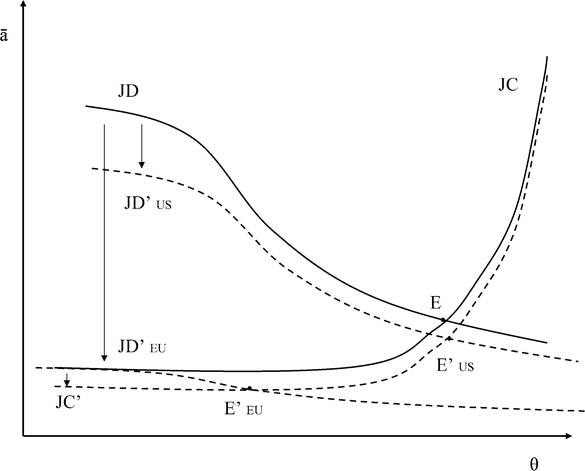
Figure 6. The equilibrium comparative statics of the model by Hornstein, Krusell and Violante (2003a). Following an acceleration in the rate of capital-embodied technical change, both the job-creation (JC) and the job-destruction (JD) curves shift. The amplitude of the shift is regulated by institutions, and hence it differs between the flexible economy (U.S.) and the rigid economy (EU).
Quantitatively, a permanent rise in the rate of capital-embodied productivity growth of the magnitude observed in the data can replicate a large fraction of the differential increase in the unemployment rate and of the capital share between the flexible U.S. economy and the rigid Europe-like economy (with the increase in unemployment taking place along the duration margin, as in the data). Wage inequality increases in the U.S.-like economy and declines in the rigid economy, but the changes generated by the model are rather small (recall our discussion of Section 7.1).
8.5. Skill-biased technical change
A number of explanations for the rise in wage inequality in the United States - many of which we have reviewed in Section 3 - build on the idea of skill-biased technical change. Could this type of technological advancement, interacted with more rigid institutions, also be at the origin of the rise in European unemployment?
Mortensen and Pissarides (1999) explore this question in a model where the economy is populated by a finite number of types of workers, ex-ante different in their skill (productivity level). Skill is observable (e.g., education), and all workers endowed with the same skill level are segmented in their own labor market, which is modeled as frictional with a standard matching function governing the meeting process.
In this model, unemployed workers receive welfare benefits which are partly proportional to their wage (and skill level), and partly lump-sum. The equilibrium unemployment is decreasing and convex in the skill level: low-skill markets have higher unemployment, as benefits represent a form of wage rigidity that is more binding at low levels of skills. As benefits become more generous, the convexity becomes more pronounced.
The skill-biased shock is introduced as a mean-preserving spread in the skill distribution, calibrated to match the rise in wage inequality in the economy with low benefits, like the United States. The model predicts a sharp surge in unemployment in the economy with generous benefits, due to the convex equilibrium relationship between unemployment and the skill level. A crucial ingredient of the Mortensen-Pissarides mechanism, which is present also in the Hornstein, Krusell and Violante (2003a) setup, is that welfare benefits are not fully proportional to wages and productivity; rather, they have a “flat”, lump-sum component. If they were fully proportional, every skill market would just be a rescaled version of the highest-skill market, with the same unemployment rate. Hansen (1998) studies the institutional details of the welfare state in several European countries and argues that flat “social assistance” benefits are an important component of these welfare systems.[238]
Finally, the Mortensen and Pissarides model has the counterfactual implication that the rise in unemployment is concentrated among the low-skilled workers, whereas Nickell and Bell (1996) and Gottschalk and Smeeding (1997), among others, conclude that data from many European countries support the conclusion that unemployment rose proportionately across the entire skill spectrum.
8.6. Endogenous technology adoption
A careful look at Table 1 shows a non-monotonic evolution of the labor share in many European countries: the labor share rose between 1965 and 1980, only to decline sharply afterwards. In some countries this pattern is striking. In Portugal, for example, the labor share skyrocketed from 56 percent to 75 percent in the period 1965-1980, and then plunged to 68 percent by 1995. Blanchard (1997) and Caballero and Hammour (1998) proposed an explanation for these dynamics based on the idea that technological advancement responds to the relative cost of factor inputs.
The late 1960s and early 1970s witnessed a rapid evolution of capital-labor relationships in favor of labor in many European countries: “pro-labor” measures were introduced with the objective of consolidating unions’ power, increasing the generosity and coverage of unemployment benefits, making economically motivated dismissals harder to justify.[239] The result was, in the language of Caballero and Hammour, an “appropriability shock” that shifted bargaining power away from capital.
In a model where the technological menu for capital-labor substitutability is fixed in the short run, but endogenous in the long run, one will observe an initial rise in the labor share as a result of such a shock. However, as time goes by, more and more firms respond to this institutional “pro-labof’ push by introducing new technologies that substitute capital for labor. Therefore, in the long run the capital-labor ratio rises, and both the labor share and employment decline, as observed in the last two decades in Europe.
Why do the U.S. data not display the same pattern? According to Blanchard (1997), since the initial appropriability shock was much smaller, so was the response of capital. A natural question arises, if one follows this logic through: is it only a coincidence that the technological change away from unskilled labor was biased toward capital in Europe and toward skilled labor in the United States?
According to Acemoglu (2003a) the direction of the bias in technological innovations is endogenous (see also our discussion in Section 3) and institutional differences can be key in explaining different biases between the United States and Europe. Consider a flexible economy, like the United States, where firms can either produce with one unit of skilled labor with productivity hs, or one unit of unskilled labor with productivity hu, where hu < hs. Output is yi = hi, with i = u,s, and the wage paid to the worker is simply a fraction, ξ, of output. Firms can also choose to pay a fixed cost κ, and adopt a new technology that increases output by a factor 1 + A < hs∕hu. Consider first an equilibrium where
κ>(, 1 - ξ)Ahs>(. 1 - ξ)Ahu,
so that it is not profitable for firms to implement the new innovation, and wage inequality is simply given by ws∕wu = hs∕hu. Suppose now that, due to technological progress, the cost of capital decreases to a new value, κ' < к, such that it is always profitable to adopt it for skilled workers, but not for unskilled workers, i.e.,
(1 - ξ)Ahs>κ' > (1 - ξ)Ahu.
As a result of this adoption decision, wage inequality jumps to the higher level (1 + A)hs∕hu in the U.S. economy.
Consider now an alternative economy, like Europe, where, because of some institutional constraint, wages cannot fall below a fixed level Ub, where ξhs > w > ξ(1 + A)hu, so that the constraint is binding for the unskilled workers, even in the case of adoption, but never for the skilled workers.
Whenever the new cost level, κ', satisfies
Ahu > κ' > (1 - ξ')Ahu
in Europe, the new technology will be adopted also with unskilled workers; this is an effect of the minimum wage constraint. The intuition for this result is that, since firms in Europe pay a fixed wage Wj to the unskilled workers, whether or not they adopt the new technology, the institutional constraint makes the firm the residual claimant on output, once Wj is paid. The new technology increases output without changing the wage payment, and thus it may be optimal to adopt in an economy with wage rigidity and not to adopt in an economy with wage flexibility, with the obvious implication that inequality will not increase in Europe.[240]
Formalized models, where the direction of technical change is endogenous, are still in their infancy: in the case of this application to the U.S.-Europe comparison, one important extension would be verifying if this result survives when the “institutional wage rigidity” is endogenized so that it can respond to changes in the technological environment.
8.7. Sectoral transformation
The standard approach to the U.S.-Europe differentials is built on comparing the diverging dynamics in the unemployment rate. Rogerson (2004) argues that the analysis of relative unemployment rates is misleading, and if one focuses instead on employmentpopulation ratios, new insights surface.
In particular, Rogerson shows two new features of the data: (1) the relative deterioration of European employment starts as early as in the 1950s, whereas unemployment rates start diverging in the mid-1970s; (2) the deterioration of European unemployment is largely explained by the differential in manufacturing employment growth.[241]
These facts lead Rogerson to focus on the importance of the structural transformation occurring in the economy, i.e., the secular pattern of reallocation of resources across broad sectors of the economy: first from agriculture to manufacturing, and then from manufacturing to services. Expressed in terms of the shocks-institutions paradigm that we have highlighted in this section, the relevant shock is the transformation of modern economies into service-driven economies, and the relevant institutions are those which hampered the full development of a service sector in Europe.
Although this new approach is still in its infancy, and as such it lacks a quantitative assessment within a rigorous equilibrium model, it appears to be quite promising.
8.8. Discussion
Nickell and Layard (1999), in a widely cited piece in the most recent edition of the Handbook of Labor Economics, carefully review the empirical literature and conclude that time spent worrying about the effects of several labor market institutions on crosscountry unemployment differentials is largely wasted, given these effects seem small and are often even ambiguous in sign. From the perspective of the research surveyed in this section, however, it seems that when institutional differences are studied in conjunction with technological change, the results are more encouraging.
Of course, much is still far from being well understood. First, once we recognize that the interaction of shocks and institutions is important, what are the key common shocks and the crucial institutional differences that can account for the facts? One would, for example, like to see a unified structural equilibrium framework where several shocks and institutions are jointly analyzed in order to investigate which shock-policy interaction is quantitatively important and which is not.
Second, in answering this question, more “discipline” is needed in the quantitative analysis. Often, the approach in the literature is to calibrate the shock by matching either the rise in wage inequality or the fall in the labor share. We maintain the view that changes in employment/unemployment, wage inequality, and income shares are intimately related and must be explained jointly: they are dimensions along which the model should be evaluated rather than calibrated. Thus, the shock should be calibrated, as much as possible, using independent observations. The use of data on technological change such as that for the relative price of equipment goods is such an example.
Third, it is important to note that we are not aware of any quantitative model of a rigid Europe-like economy that can generate a rise in equilibrium unemployment which is similar across all skill levels, which is what the data suggest.
Fourth, the literature is split between labor-supply models (Ljungqvist and Sargent, Marimon and Zilibotti) and labor-demand models (Bertola and Ichino, Caballero and Hammour, Hornstein et al.). Obviously, interpreting the European and U.S. labor market outcomes in terms of “labor demand” or “labor supply” is not mutually exclusive. In a theoretical framework with elements of vintage human capital and vintage physical capital, an embodied technological acceleration will also worsen the rate of skill obsolescence - exactly as in Ljungqvist and Sargent’s paper. The next generation of investigations of the European (un)employment puzzle should bring together supply and demand forces and allow a joint evaluation of their respective strength.
9.
More on the topic Technology-policy complementarity: United States vs. Europe:
- United States Government Accountability Office
- Reform Movements in Europe and the United States
- The United States, containment and Western Europe
- SOME CONCLUSIONS ON OPPORTUNITIES AND CHALLENGES WITH A POLICY VIEW