Technical progress as a source of change in labor market institutions
Throughout the chapter, up to this point, we have maintained a “competitive” view of the labor market and argued that skills are priced at their marginal product, potentially explaining large parts of the observed dynamics of inequality.
However, the labor market displays very peculiar features compared to many other markets in the economy: a sizeable fraction of labor may be considered as under-employed in any given period (unemployment), individual workers often organize themselves into coalitions (unions), and wages frequently seem to be set through some explicit negotiation between firms and workers (individual and collective bargaining). These attributes of the labor market are, arguably, better captured by non-competitive models. We begin our departure from the purely competitive framework by introducing unions and collective bargaining.Historically, unions and centralized bargaining have been key institutions in the determination of wages and other important labor market outcomes. Over the past 30 years, the economies of the United States and the United Kingdom experienced rapid deunionization. In the United States, in the late 1970s, 30 percent of male non- agricultural private-sector workers were unionized. By 2000, only 14 percent were unionized [Farber and Western (2000)]. In the United Kingdom, union density among male workers was around 58 percent in the late 1970s and it has fallen uninterruptedly since to 30 percent today [Machin (2000, 2003)]. There is a variety of evidence that unions compress the structure of wages, even after controlling for workers’ characteristics, and thus many economists suspect that their decline may have been an important factor in the increase in inequality in the Anglo-Saxon economies [see, e.g., Gosling and Machin (1995) and DiNardo, Fortin and Lemieux (1996)].
The existing literature has explored mainly two explanations for the decline in unions.
The first generation of papers argued that an important force in the fall of unionization is the change in the composition of the economy away from industries, demographic groups, and occupations where union organization was comparatively cheaper and unions have been traditionally strong [Dickens and Leonard (1985)]. However, Farber and Krueger (1992) estimate that compositional shifts can account for at most 25 percent of the decline in the United States and have played virtually no role since the 1980s. Machin (2003) reports that only around 20 percent of the U.K. union decline of the last two decades can be attributed to compositional change.The second hypothesis is that the legal and political framework supporting union membership deteriorated in the 1970s and 1980s.[210] To date, this explanation seems to have gained rather broad acceptance, even though this view has limits as well. For example, the fall in union organizing activity precedes two key political events: the air-traffic controller strike of 1981 and Reagan’s Labor Board appointments in 1983 [Farber and Western (2002)]. U.K. data also show that the fall in union membership pre-dates the first Thatcher government. Overall, we think that the forces behind rapid deunionization are not yet well understood.
In most of continental Europe, unions are still strong, and there are no clear signs of decline in union coverage, but a marked change in union behavior has occurred over the past 30 years. Several indexes of coordination and centralization in unions’ bargaining for Europe show a distinct trend toward more decentralized wage negotiations, especially in the Scandinavian countries, whose unionization rates are the highest [Iversen (1998)].
The standard explanation for the shift toward decentralized bargaining is based on the interaction between monetary policy and wage setting arrangements. With an independent national central bank, coordination in bargaining among unions is useful because it allows unions to internalize the implications of their wage claims on inflation.
With the advent of the European monetary union and the institution of the European Central Bank within-country coordination proves less useful. However, the evidence in favor of this hypothesis is scant. First, monetary policy does not seem to Granger-cause centralization empirically [Bleaney (1996)]. Second, we did not observe a substantial trend toward cross-border coordination in unions’ bargaining.Recently, a new hypothesis for deunionization and decentralization in unions’ wage setting, based on skill-biased technological change, has been advanced by Acemoglu, Aghion and Violante (2001) and Ortigueira (2002). Their arguments rest on the view that unions are coalitions of heterogeneous workers which extract rents from employers and only exist insofar as members have an incentive to stay in the coalition and continue bargaining in a centralized fashion. The conjecture of these authors is that skill-biased technical change can dramatically alter such incentives.
6.1. Skill-biased technology and the fall in union density
Here, we outline a reduced form model that conveys the basic trade-offs highlighted by Acemoglu, Aghion and Violante (2001). Suppose there are two kinds of workers ls of which are skilled and lu = 1 - ls of which are unskilled. If employed in the competitive sector, these workers will receive wages equal to their productivity, hs and hu < hs, respectively. We will think of skill-biased technological change as a rise in hs relative to hu.
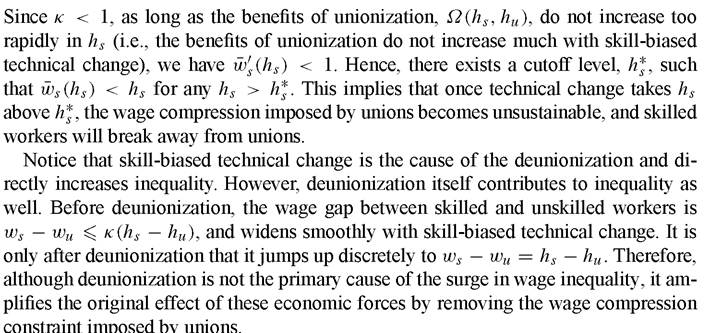
Workers can also be employed in unionized firms and receive wages, ws and wu. A main characteristic of unions is that they compress wages. In our setup, this means that the wage gap between the unionized skilled and unskilled workers is smaller than the productivity gap, or

where к < 1 is the degree of wage compression.
This equation may arise for a variety of reasons. Collective decision-making within a union may reflect the preferences of its median voter, and if this median voter is an unskilled worker, he will try to increase unskilled wages at the expense of skilled wages. It is also possible that union members choose to compress wages because of ideological reasons or for social cohesion purposes. Or, in presence of idiosyncratic uncertainty, unions could offer insurance to their members by setting a flatter income profile. The empirical literature is broadly consistent with the notion that unions compress wages, though it does not distinguish among the various possible reasons for it [see Booth (1995)].Union wages (ws, wu) must also satisfy some participation constraint for firms (who would otherwise either shut down or open a non-unionized plant). Suppose that this takes the form of non-negative profits:

where Ω(hs,hu) > 0 is the additional contribution of unions to output, as a function ofbothtypes of labor.[211] This could be because unions, ceteris paribus, increase productivity [for example, Freeman and Medoff (1984) and Freeman and Lazear (1995) argue this]. Or unions may encourage training [as in Acemoglu and Pischke (1999)].
Solving the wage compression and participation constraint Equations (21) and (22) as equalities, we obtain the maximum wage that a skilled worker can be paid as a union member:

Intuitively, as ws rises, wu must increase too in order to satisfy the wage compression constraint (21) but since profits fall with labor costs there is an upper bound to the wage of a skilled union member. Skilled workers will remain union members as long as what they are paid as union members exceeds their competitive salary,

From the no-quit condition (23) and the wage compression constraint (21), it follows that Wju f hu, so unskilled workers will always remain unionized.
Observe that the slope of the maximum union skilled wage, Wjs, as a function of the productivity of skilled workers, hs, is
6.2. Skill-biased technology and the fall in centralized bargaining
In many European countries - in particular among the Scandinavian countries - the so-called “Ghent system” creates a fiscal-policy link among unions. Under this system,
unemployment benefits are administered by the individual unions, but they are funded by the government through aggregate labor income taxation. Hence, not only does the net income of unions’ members depend on their negotiated wage, but, through the equilibrium tax rate, also on the wage claims of other unions. Ortigueira (2002) outlines a model economy with this institutional feature, where there are two types of workers, skilled and unskilled, and two unions that can choose to coordinate their wage determination. Unemployment is generated through a frictional labor market with a standard matching function.
Under decentralized bargaining, unions take the tax as given. Ortigueira (2002) shows that there are two possible steady states: in one, unions expect a low tax, thus making moderate wage claims which, in turn, keep equilibrium unemployment and tax rate low, fulfilling the initial expectation; in the other steady state, unions expect a high tax rate, thus making strong wage claims that produce high unemployment and a high tax rate. This second equilibrium yields lower income and lower welfare for union members. Centralized bargaining avoids the coordination failure and the associated welfare losses that can arise in this “bad equilibrium”, and hence it can be preferred by unions. Note, however, that the “good equilibrium” under decentralized bargaining is still the best outcome. It is the ex-ante uncertainty that the bad equilibrium could arise that makes coordination attractive.
However, consider what happens with the advent of a skill-biased technology that increases the demand for skilled workers sharply, reducing their unemployment incidence. When unemployment benefits are proportional to wages, the fact that skilled workers are much less likely to be unemployed decreases the social expenditures of the government. As a result, under decentralized bargaining, the equilibrium with high taxes and low welfare does not survive the advent of a skill-biased technology. This justifies the shift in unions’ wage setting policies toward decentralization.[212]
6.3. Discussion
The testable implications that can be identified above are that (1) among the experienced workers, the most skilled leave the unions in response to technological improvements and that (2) among the new entrant cohorts, the most educated workers opt for nonunionized jobs. However, these implications are derived from theories of technology- induced deunionization that are rather exploratory; more sophisticated and rigorous models of unions (with endogenous membership and endogenous wage-compression mechanisms) are yet to be developed.
The recent empirical studies by Card (2001), for the United States, and Addison, Bailey and Siebert (2004), for the United Kingdom, compare the unionization rate across several skill groups before and after the collapse in union density in these two countries (1973 and 1993 for the United States, and 1983 and 1995 for the United Kingdom). The common finding of these two papers, is that unionization declined most for the low- and middle-skill groups.[213] Taken at face value, this preliminary evidence is not favorable to the hypothesis discussed in this section. However, one has to be cautious in interpreting these results because this work does not control for unobserved hetero- geneity.[214] Suppose that - as documented by Card (1996) - unobserved ability is higher among unionized workers with low observable skills. Given that unionized firms offer a compressed wage schedule, such a contract would attract the highest ability workers with low education and the lowest ability workers with high education. Moreover, assume that technological change induces a rise in the market return for innate ability, as discussed in Section 3.2. Then, the theory suggests that one should observe exactly the cross-skill deunionization pattern documented from U.S. and U.K. data.
It should be mentioned that a technology-based theory of deunionization must also explain why union density did not fall (in fact, it expanded somewhat) in the public sector. Since the public sector is, by definition, sheltered from the international competition, it is reasonable to conjecture that the leap in competitive pressure faced by many manufacturing industries over the past 30 years eroded those rents that are, according to some researchers, at the heart of the existence of unions. A quantitative evaluation of the importance of this channel is yet to be performed.
Another avenue that so far has not been pursued is the analysis of deunionization in conjunction with the structural changes in workplace organization that occurred in the past 30 years. In Section 5, we argued that a distinct feature of the recent change in the production process, especially in manufacturing, is the switch from Tayloristic organizations, where workers repeatedly performed similar tasks around the conveyer belt, toward “flatter” organization built on teams where workers engage in multiple tasks and where the individual division of labor is much fuzzier. Union’s wage setting arrangements, based on “equal pay for equal work”, can be effective within a Tayloristic plant, but then become very inefficient in plants where production is organized through teams. There is no reason to assume that workers performing the same task will be equally productive, since they perform many other complementary operations simultaneously [see, e.g., Lindbeck and Snower (1996)].
7.