Inside the firm: The organization of work
Hayek (1945) argued that a fundamental problem of societies is how to use optimally the knowledge that is available, but is dispersed across individuals. In frictionless markets, prices can solve this problem: they transmit knowledge about relative scarcity and relative productivity of resources.
Since Coase (1937), it is well understood that frictions limit the efficiency of markets, and they divert certain transactions to occur within the boundaries of firms. Within the firm, the organization of work and production plays the role of the market as “information processor to allow efficient use and transmission of knowledge.It is therefore not surprising that the recent innovations that revolutionized the way in which information and communication takes place have affected the workplace organization within firms and the boundaries of firms. Their impact on the wage structure is perhaps less clear. The maintained hypothesis in the literature is that the recent episodes of reorganization of production, especially in manufacturing, have favored adaptable workers who have general skills and who are more versed at multi-tasking activities. An alternative view, which we will develop later in this section, is that organizational change is not induced by technological change, but that the increased relative supply of skilled labor created the incentives to change the organization of production.
4.3. The Milgrom-Roberts hypothesis: IT-driven organizational change
Milgrom and Roberts (1990) were the first to emphasize the interaction between the diffusion of information technologies in the workplace and the reorganization of production. Their hypothesis builds on the idea that information technologies reduce a set of costs within the firm which triggers the shift toward a new organizational design. First, electronic data transmission through networks of computers reduces the cost of collecting and communicating data, and computer-aided design and manufacturing reduces the costs of product design and development.
Second, there are complementarities among a wide group of strongly integrated activities within the firm (product design, marketing, and production), and pronounced non-convexities and indivisibilities in each activity.As a result, as the marginal cost of IT declines, it is optimal to reorganize all activities to exploit this shock, and, due to non-convexities, organizational change can be sudden and drastic in nature. In particular, because of lower communication costs the layers in the hierarchical structure can be reduced, so that the organization of the firm becomes “flatter”.[204] Workers no longer perform routinized, specialized tasks, but they are now responsible for a wide range of tasks within teams. These teams, in turn, communicate directly with managers. Because of the flexibility of IT capital, the scale of production decreases [recall the evidence in Mitchell (2001) on plant size], allowing greater production flexibility and product customization.
An elegant formalization of this hypothesis is contained in Bolton and Dewatripont (1994). They study the optimal hierarchical structure for an organization whose only objective is that of efficiently processing a continuous flow of information and show using their model that a reduction in communication costs leads to a flatter and smaller organization.
4.3.1. Implications for the wage structure
Although in their original papers neither Milgrom and Roberts nor Bolton and Dewatripont explore the implications of organizational change for the wage structure, a small but growing literature on IT-driven organizational change and inequality has developed since.
Lindbeck and Snower (1996) emphasize the “complementarity” aspect of the Milgrom-Roberts hypothesis. They consider a production function with two tasks and two types of workers. The Tayloristic model would assign one type of workers to each task, according to comparative advantages to exploit specialization. The alternative organization of production is the flexible model, where each type of worker performs both tasks.
This more flexible organization is preferred when there are large informational complementarities across tasks. The introduction of IT capital amplifies these informational complementarities and makes the flexible organization more profitable. Moreover, firms increase the demand for skilled workers who are more adaptable and versed in multi-tasking, and the skill premium rises.Mobius (2000) focuses on the “customization” aspect of organizational change. When products are standardized, demand is certain and production tasks perfectly predictable, inducing a high division of labor (the Tayloristic principle). New flexible capital allows firms to greatly expand the degree of product variety and customization in product markets. Larger variety implies a more uncertain demand mix because producers become subject to unpredictable “fad shocks” and producers therefore favor a flexible organization of production, with less division of labor. Once again, to the extent that the most skilled workers are also the most adaptable and versatile, the skill premium will increase.
The mechanism in Garicano and Rossi-Hansberg (2003) is based, instead, on the fall in the communication cost within the organization. Their paper has the particular merit of taking the literature on the internal organization of firms [e.g., Bolton and Dewatripont (1994)] one step further by recognizing that organizational hierarchies and labor market outcomes are determined simultaneously in equilibrium. Consider an organization where managers perform the most difficult and productive tasks and workers specialize in a set of simpler tasks. Managers also spend a fraction of their time “helping” workers unable to perform their task, and by so doing, they divert resources away from their most productive activities. The fall in the cost of communication allows workers to perform a wider range of tasks, using a smaller amount of the manager’s time. The implications for wage inequality are stark. First of all, since workers are heterogeneous in ability, and ability is complementary to the number of tasks performed, inequality among workers within the firm increases.
Second, the pay of the manager relative to that of the workers rises because the manager can concentrate on the tasks with high return.The previous papers have studied how IT-based advances have affected the organizational structure within firms. Saint-Paul (2001) addresses the spectacular rise in the pay of CEOs and a few other professions (e.g., sportsmen and performers) documented in Section 2 using a model where IT-based advances affect the organization of markets with frictions. Saint-Paul combines a model with “superstar” or “winner-take-all” effects [Rosen (1981)] with the advent of information technology. In his model, human capital has two dimensions: productivity, i.e., the ability to produce units of output, and creativity, i.e., the ability to generate ideas that can spread (and generate return) over a segment of an economy, called a “network”. The diffusion of information technology expands networks increasing the payoff to the most creative workers and widening the income distribution at the top. However, as networks become large enough, the probability that within the same network there will be somebody with another idea at least as good rises: superstars end up competing against each other, mitigating the inegalitarian effects of information technology. Under certain parametric assumptions, inequality first rises and then falls over time.
4.3.2. Empirical evidence on the complementarity between technology, organizational change and human capital
Bresnahan, Brynjolfsson and Hitt (2002) investigate the hypothesis that IT adoption, workplace reorganization, and product variety expansion (customization) are complementary at the firm level. Their view is that simply installing computers or communications equipment is not sufficient for achieving efficiency gains. Instead, firms must go through a process of organizational redesign. The combination of IT investments and reorganization represents a skill-biased force increasing the relative demand for more educated labor.
Their empirical analysis is based on a sample of over 300 large firms in the United States, and their definition of organizational change is a shift toward more decentralized decision making and more frequent teamwork. They find a significant correlation between IT, reorganization, and various measures of human capital.[205]
In a related paper, Caroli and Van Reenen (2001) argue that the existence of complementarities between organizational change and the demand for skilled labor leads to three predictions: (1) organizational change should be followed by a declining demand for less skilled workers; (2) in the vein of the directed technical change hypothesis (see next section), cheaper skilled labor should increase the occurrence of organizational change; and (3) organizational change should have a larger impact in workplaces with higher skill levels.
They test these predictions combining two data sets, one for the United Kingdom and one for France, with information on changes in work organization, working practices, and the skill level of the labor force. Interestingly, they also have information on the introduction of new IT capital, so they can distinguish the effect of organizational change from that of skill-biased technical progress. They find some supporting evidence for all three predictions.
Baker and Hubbard (2003) offer an example where technological change not only affects the organizational design of firms but also the boundary of firms. In particular, they study how IT may have reduced the moral hazard problem in the U.S. trucking industry. Drivers may simply operate the trucks as employees of the dispatching company, or they may actually own the trucks they operate. If the dispatcher owns the truck, there is only limited assurance that the driver will operate in a way that preserves the value of the asset, since the dispatcher cannot perfectly monitor the driving operations. When this moral hazard problem is severe, decentralized ownership will be the outcome, that is, the driver owns the truck.
Using detailed truck-level data, Baker and Hubbard show that with the introduction of a new monitoring technology - on-board computers linked to the company servers - the share of driver-ownership decreased significantly.5.2. Directed organizational change
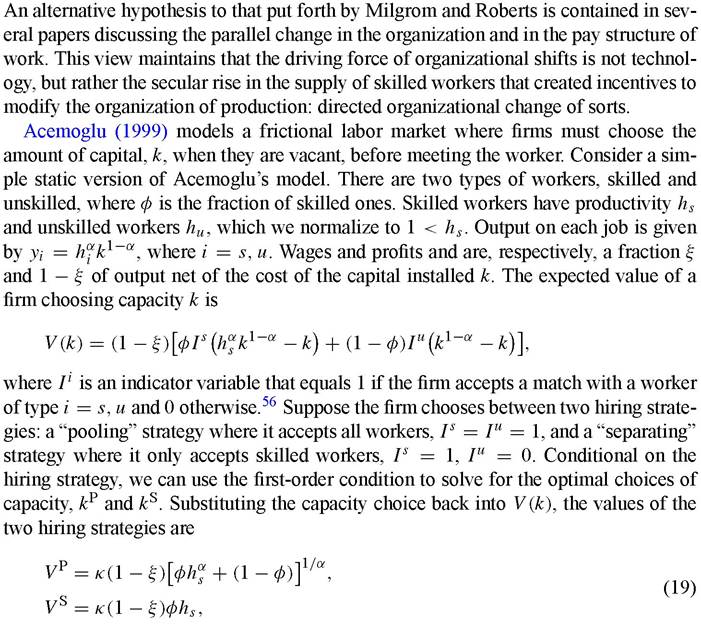
where κ is a constant depending only on α. Comparing these two values, we conclude that the payoff to the “separating” strategy, Vs, dominates the payoff of the “pooling”
56 Here, for simplicity we assume that workers accept passively each job offer. We do not consider equilibria where firms randomize, i.e., where Ii ∈ (0, 1).
strategy, Vp, whenever

Note that the left-hand side of this expression decreases in φ, the fraction of skilled workers. When the size of the skilled group is small, a “pooling” equilibrium arises where all firms invest the same amount of capital and search for both types of workers. As the relative size of the skilled group rises, the economy switches to a “separating” equilibrium where firms find it optimal to install more capital and accept exclusively skilled workers in their search process.[206] One can interpret the pooling and the separating equilibrium as different types of work organizations, displaying different degrees of segregation along the skill dimension within sectors. The switch from the low-segregation to the high-segregation organization stretches the wage structure and generates higher inequality.
In a related paper, Kremer and Maskin (1996) offer an alternative explanation for the rise in the degree of assortative matching in the workplace, using a frictionless assignment model. Their paper contains some suggestive evidence that the degree of sorting (“segregation”) has risen within industries and plants. However, their model is based on an increase in the skill dispersion in the population, for which there is little evidence in the data.[207]
Thesmar and Thoenig (2000) embed a choice of organizational design into a Schumpeterian growth model. Firms can opt for a Tayloristic organization that has large product-specific set-up costs, with the benefit of a high level of productive efficiency. Alternatively, they can choose a new and more flexible organization that can be built with a lower initial fixed cost, but whose productivity level is lower.[208] As is common in this class of Schumpeterian models, there is an R&D sector, where product innovations are generated proportionately to the amount of skilled workers hired. The patent of each new product is then sold to a monopolistic producer who can choose optimally which organization of work to set up (Tayloristic or flexible) according to the volatility of the economic environment.
A rise in the supply of skilled workers will increase the innovation rate in the R&D sector: the higher the innovation rate, the shorter the product’s life expectancy for a monopolistic producer, and the less profitable organizations with large fixed costs prove to be, compared to the more flexible production method. The model also produces a rise in segregation, since skilled workers tend to cluster into the R&D sector, as well as a rise in inequality as unskilled workers lose from the abandonment of the Tayloristic model since the production phase becomes less efficient.[209]
4.4. Discussion
The case examined by Baker and Hubbard (2003) is one where IT improves firms’ monitoring ability of workers’ effort. However, it is plausible that the trend toward a “flatter” organizational design where single-task routinized work is replaced by multitasking team-work induces a rise in the cost of monitoring individual workers’ effort. Firms would then, optimally, introduce incentive schemes (e.g., tournament contracts) with the result of increasing inequality in rewards. In other words, optimal contracts respond to technological and organizational changes that affect the extent of moral hazard within the firm. This line of research is largely unexplored at the moment.
All the models we surveyed in this section are qualitative in nature and, although they establish a logical link between organizational change and inequality, they do not provide any quantitative analysis. One of the main obstacles is that explicit models of organizations contain parameters and variables that are hard to observe, measure, and therefore calibrate (hierarchies, communication costs, number of tasks, etc.). Recently, several papers have started to measure, in various ways, “organizational capital” or “intangible capital” [see, e.g., Hall (2001), McGrattan and Prescott (2003) and Atkeson and Kehoe (2002)]. A promising avenue for research would try to incorporate this measurement into models that link reorganization with changes in the stock of organizational capital and that relate the latter to the wage structure in order to perform a more rigorous quantitative analysis.
5.