Technical change and the returns to experience
According to Card and DiNardo (2002), one of the most important challenges to the hypothesis that the recent changes in the wage structure are linked to technological progress is to explain the combination of the rise in the returns to labor market experience for the low-educated workers in the population and the flat, or declining, pattern of the experience premium for college graduates.
It turns out that the existing theoretical literature does not provide a unified answer to the question of how technological change affects the experience premium. Examples of the literature we review in this section include job-specific or technology-specific experience that, in principle, may be adversely affected by technological change, but that may also benefit from technological change if that change is of a ‘general purpose’ variety, that is, if it makes experience more widely applicable.[199] We also look at general labor-market experience as a vehicle to lower the cost of adapting to technological change.
4.1. Experience with general purpose technologies
An important feature of the recent technological developments that has not received much attention in the literature on inequality is its general purpose nature. Aghion, Howitt and Violante (2002) formalize the idea of “generality” of a technology and build a theoretical framework to understand how it affects various dimensions of wage inequality, such as the experience premium. They model generality in relation to human capital: a more general technology allows a larger degree of transferability of sectorspecific experience across the different sectors of the economy. For example, the ability to use computers for word-processing or programming is useful in numerous sectors and jobs in the economy.[200] Given that actual technological change is uneven across sectors, transferability of experience then increases the value of experience, that is, the experience premium.
Consider a simple overlapping-generations (OLG) model with two-period lived agents, and two production sectors indexed by i = 0, 1. Each cohort of agents has measure one and works in both periods. Technological progress results in capital-embodied innovations that increase productivity by a factor 1 + γ occurring in each of the two sectors in alternation. Let “0” denote the new sector in the current period. Suppose, for simplicity, that production takes place with a fixed amount of capital, normalized to one: the production function in sector i (in the stationary transformation of the model) is yi = A∕h1-a, where Ai measures the efficiency of capital in sector i (A0/A1 = 1 + γ), and hit measures the effective labor input in sector i = 0, 1.
Young agents are always productive on the new technology, whereas old workers can productively move to the new sector only with probability σ. This captures the idea that young workers are more “adaptable” than old workers possibly because of vintage effects in their schooling, or because the ability to learn declines with age. Moreover, assume that this “adaptability constraint” is binding, in the sense that: (1) the equilibrium fraction σ * of old workers who moves equals σ, and (2) there is not enough labor mobility (σ is sufficiently low) to offset the impact on wages of the sectoral productivity differential 1 + γ.
Newborn agents start working in the new sector with initial knowledge normalized to 1.50 Agents accumulate η additional units of experience through learning-by-doing in the first period of work. The generality of the technology determines the degree of skill transferability for the old workers τo, i.e., the fraction of accumulated knowledge η a worker can carry over if she moves to the leading-edge sector at the beginning of her second period of life.
The entire knowledge η can be used if the worker stays in the old sector.Aggregate human capital in the old sector h1 is determined by old, non-adaptable workers, a fraction 1 - σ, who have accumulated 1 + η units of experience. Human capital in the new sector is determined by the new cohorts that have one unit of experience, and old adaptable workers with transferable experience, that is, h0 = 1 + σ(1 + τoη). With competitive labor markets, the ratio between the prices of efficiency units of labor in the old and the new sector therefore is

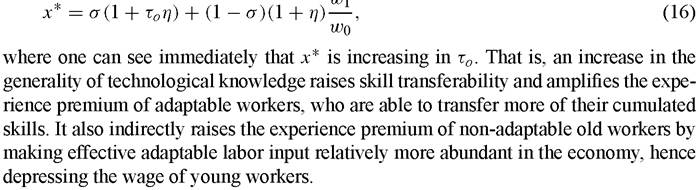
The steady-state experience premium, i.e., the average wage of old workers relative to the average wage of young workers, is therefore given by
50 Aghion, Howitt and Violante (2002) show that this is indeed the optimal choice of young cohorts, for general conditions.
This result is particularly interesting in light of the fact that a version of this model that is based purely on the hypothesis that the rate of embodied technical change, γ, has accelerated would predict a decline in the experience premium. This is evident from the fact that the wage ratio w1∕w0 is decreasing in γ: larger productivity differentials between the young and the old vintages represent a relative advantage to young workers who are more adaptable.
The more general model in Aghion, Howitt and Violante (2002) also features a flexible choice of capital. Another interpretation of generality of the technology offered in their paper is based on the compatibility of physical capital, i.e., the extent to which capital equipment embodying the old technology can be retooled - so as to embody the new leading-edge technology - and moved to the new sector.
Under this interpretation, the arrival of a GPT, which increases the compatibility across vintages of capital, reduces the experience premium since it allows the transfer of more capital to the new sector where it benefits the young, inexperienced, but more adaptable workers.[201]4.2. Vintage-specificity of experience
According to the GPT hypothesis, human capital becomes more transferable across sectors once the new technological platform has fully diffused throughout the economy. However, it is also reasonable to think that, at least in the transition phase, certain skills associated to the old way of producing quickly become obsolete. Or, put differently, human capital is vintage-specific. Thus, although in the final steady state skill transferability will be higher, it can undershoot during the transition.
To study the implications of vintage human capital for the experience premium, we can slightly modify the two-period OLG model in the previous section. To make this point starkly, consider the extreme case where old workers never find it profitable to move across sectors, so σ * = 0, and suppose that when young workers join the new sector they lose a fraction 1 - τy of their initial knowledge (as before, normalized to 1). Modifying appropriately the equilibrium wage ratio (15), Equation (16) for the experience premium becomes

which shows that x* is decreasing in the skill transferability rate for young workers τy. The arrival of a new technology that makes the knowledge of its (young) users obsolete can widen the returns to experience.
In analyzing earlier Equation (16) we argued that a rise in γ would depress the experience premium, which is a problem for the pure “acceleration hypothesis”. Vintage human capital can overturn this result. Suppose, as in Violante (2002), that the degree of skill transferability is decreasing in the speed of technological improvements, i.e., τy = (1 + γ)-τ.
Then, it is easy to see from (17) that as long as τ > α∕(1 - α), the experience premium will rise after a technological acceleration, since the loss of vintage-specific human capital incurred by young workers is larger than the productivity improvement embodied in physical capital.[202] In Section 7.3 we return to the role of vintage human capital and discuss the plausibility of the assumption that the extent to which skills are transferable depends on γ.4.2. Technology-experience complementarity in adoption
According to the standard technology adoption models, the adopters of the new technology are likely to be the young workers because they face a lower learning cost or a longer time horizon to recoup the adoption costs. Weinberg (2003b) challenges this view and argues that there is one other force that gives more experienced workers an advantage: complementarity between new technologies and skills, together with the fact that more experienced workers are more skilled, should lead to the prediction that older workers will adopt the new technology. What force dominates? And what are the implications for the experience premium?
Weinberg looks at the empirical pattern of computer usage (i.e., adoption of one of the new recent technologies) over the life-cycle and shows that it differs dramatically between high-school graduates and college graduates (see Figure 5).
Among uneducated individuals the profile is hump-shaped and peaks around 30 years of experience, while for educated individuals it is downward-sloping. As expected, the adoption rates for college graduates are higher at any given age.
These data suggest that the answer to the first question above depends on the level of schooling: for low-educated workers, experience is a substitute for general education, and the more experienced workers are also more productive in the new technology. Workers with high education levels are all equally adaptable to the new technology, so, for such workers, additional experience has a small marginal return in adoption.
Since the learning cost increases with age, the youngest are more likely to adopt the new technology.Adding to this mechanism the assumption that new technologies are more productive yields that the adopters gain a wage increase, which is consistent with the different pattern of the experience premium for low and high education groups that we described in Section 2.
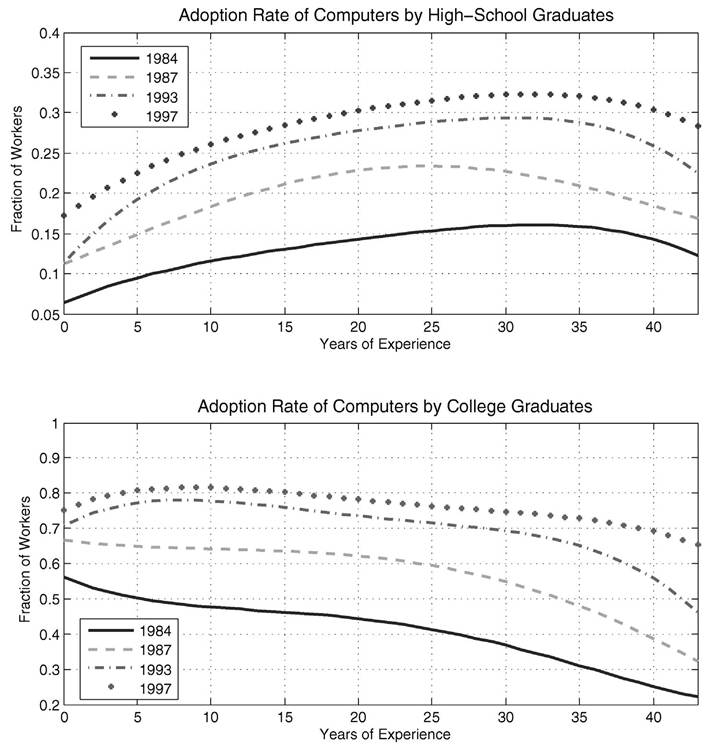
Figure 5. The top panel depicts the experience profile of the adoption rate of computers for U.S. high-school graduates for 1984, 1987, 1993 and 1997. The bottom panel plots similar experience profiles for college graduates. The figure is reproduced from Weinberg (2003b).
4.4. On-the-job training with skill-biased technological change
The models reviewed in this section treat the degree of skill transferability or adaptability of workers as exogenous. If old workers recognize that “new knowledge” is necessary for dealing with the transformed technological environment, then one should expect that they would be willing to forego some resources to acquire such skills through training.
Mincer and Higuchi (1991) advanced this hypothesis and found some supporting evidence from U.S. sectoral data: industries with faster productivity growth were also the ones with steeper experience profiles and lower job-separation rates. They interpreted these facts as reflecting the training channel in light of the findings of Lillard and Tan (1986) showing that the incidence of firm-specific on-the-job training is higher in sectors with high rates of productivity growth. Interestingly, Bartel and Sicherman (1998) document that the marginal impact of a rise in productivity growth on the likelihood of training (thus on the steepness of the wage profile) is stronger for low-educated workers, which is consistent with the pattern of the last 30 years mentioned in Section 2.
The model developed by Heckman, Lochner and Taber (1998) explains the recent dynamics of the experience premium based precisely on this mechanism. To simplify the exposition, consider again a two-period OLG model where risk-neutral workers are endowed with a unit of human capital, work in both periods, and choose how much time to devote to on-the-job training and production in the first period. Training increases human capital in the second and final period. The problem of a worker at time t is
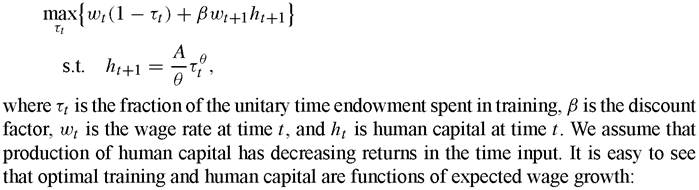
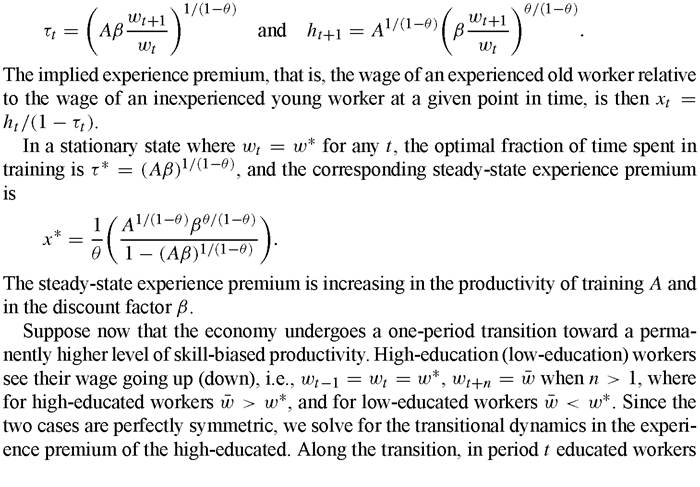
increase their investment in training since the anticipated rise in their wages increases the return to human capital accumulation, whereas in all future periods, i.e., t + 1 and higher, educated workers do not change their human capital investment decision since their anticipated wage change is not affected:

The implied sequence of experience premia for educated workers is given by

The experience premium first rises from x * to xt and then falls gradually toward the steady state. For low-educated workers, the opposite pattern will hold. If one thinks of time t — 1 as 1965, i.e., the moment before the rise in inequality started, time t as 1975, and so on, this stylized model can qualitatively explain the rise in the experience premium for the less educated workers and the decline in the experience premium for the more educated in the 1980s.
The key force is the intertemporal substitution between working and training that the expected changes in wages bring along.[203] Also, as emphasized by Heckman, Lochner and Taber (1998), it is important to recognize that movements in earnings, w( 1 - t), can differ from movements in skill prices w when labor supply is endogenous. The major limit of the theory is probably that the mechanism depends crucially on the ability of agents to perfectly foresee changes in wage rates decades in advance.
5.