Skill-biased technical change: Inside the black box
As we have just observed, the pattern of relative quantities of skills measured by education suggest that the behavior of the skill premium, that is, the increase in the wages of highly educated workers relative to those of less educated workers, should be attributed to a skill-biased labor demand shift, or to “skill-biased technical change”.
In the absence of a factor-bias in technological progress, the upward trend in the supply of skills documented in Figure 1 (top panel) would have reduced the skill premium.Katz and Murphy (1992) were the first to use a production framework with limited substitution between skilled and unskilled labor to recover changes in relative FSP from changes in the skill premium. One should note a substantial drawback of the pure skill- biased technical change hypothesis: it is based on unobservables (relative FSP changes) that are measured residually from Equation (10), so very much like TFP, it is a “black box”. In this section we review the attempts to give some specific economic content to the notion of skill-biased technical change.
We start from the capital-skill complementarity conjecture advanced originally by Krusell et al. (2000). Next, we analyze models based on the Nelson-Phelps hypothesis: the adoption phase of a new technology requires skilled and educated workers. If one allows for an important role of FSP changes, then it is paramount to understand what economic forces induce these changes endogenously. In this context, we review the theory of “directed technical change” associated mainly to the work by Acemoglu (2002b, 2003b): exogenous spurts in the relative supply of skilled labor can induce the introduction of skill-biased technological advancements by affecting the incentives of the innovators.
3.1. Capital-skill complementarity
Krusell et al. (2000; KORV henceforth) argue that the dynamics of SSP that induced the substantial drop in the relative price of equipment capital is the force behind the rise in the skill premium.
The decline in the price of equipment due to productivity improvements, especially that embodied in information and communication technologies, led to an increased use of equipment capital in production. KORV observe that, at least since Griliches (1969), various empirical papers support the idea that skilled labor is relatively more complementary to equipment capital than is unskilled labor. As a result, the higher capital stock increased skilled wages relatively more than unskilled wages. Consequently, the skill premium increased.Thus, the key elements in KORV’s analysis are: (1) separating the effect of equipment capital from that of other capital, mainly structures, (2) allowing equipment to have different degrees of complementarity with skilled and unskilled labor, (3) measuring the efficiency units of capital, especially the new technologies, correctly.[185]
KORV capture the differential complementarity between capital and skilled and unskilled labor using the following nested CES production function of four inputs: structures ks, equipment ke, skilled labor ls, and unskilled labor lu:

with ρ,σ ≤ 1. Profit-maximizing behavior of a price-taking firm implies that the skill premium can be approximately written as

KORV estimate σ = 0.4 and ρ = — 0.5, and thus that the skill premium increases with the stock of equipment capital.27 They find that the relative productivity of skilled labor grows at a modest 3 percent per year, a much more plausible number than the one estimated by Katz and Murphy (1992). Overall, KORV show that with their estimated parameters, the relative wage movements in the data can be quite closely tracked. This includes the decline of the wage premium in the 1970s, attributable to an acceleration in the growth of college enrollment due to the Vietnam war draft and the entry of the baby-boom cohorts.28
From Equation (12) it follows that the skill premium can increase, even if the relative productivity of skilled labor remains constant and the relative supply of skilled labor increases, provided the equipment-skilled labor ratio trends upward fast enough.
From this perspective, the results of KORV complement Katz and Murphy’s (1992) work: when capital and skills are complementary in production, capital accumulation can explain a large fraction of the residual trend in skill-biased productivity growth.2927 With this nested CES in 3 factors (equipment, skilled and unskilled labor) it is unclear how to define capital-skill complementarity. One possible, but slightly unorthodox, definition is that the skill premium rises with the stock of equipment. A more traditional definition involves comparing the Allen elasticities of substitution. The elasticity of substitution between equipment and unskilled labor is 1/(1 — σ), while the elasticity of substitution between equipment and skilled labor is

where ωe and ωs are, respectively, the income shares of equipment and skilled labor. Thus, according to both definitions, the parameter estimates in KORV imply that equipment capital is more complementary with skilled labor compared to unskilled labor. See Ruiz-Arranz (2002) for a discussion of the various definitions of elasticity of substitution in production function with more than 2 inputs. Interestingly, Ruiz-Arranz divides equipment into finer categories and finds that IT capital (defined as computers, communication equipment and software) is the subgroup with the largest degree of capital-skill complementarity.
28 Lee and Wolpin (2004) find evidence of capital-skill complementarity both in the goods-producing industries and services in the U.S. economy, and argue that it is an important ingredient to explain the pattern of relative wages and relative labor inputs across the two sectors, over the past 50 years.
29 Acemoglu (2002a) argues that if the capital-skill complementarity hypothesis is valid, then in Equation (10) the relative price of equipment should proxy the shift in the demand for skills and perform better than
3.1.1.
Further applications of the capital-skill complementarity hypothesisIn KORV, the production structure is “centralized” through an aggregate production function. Jovanovic (1998) models an economy with vintage capital where production is decentralized into machine-worker pairs. Newer machines are more productive than older machines, and workers differ in their innate skill level. The pair’s output is a multiplicative function of these two inputs. Jovanovic assumes perfect information (no coordination frictions), and hence the labor market equilibrium assignment displays “positive sorting” between skills and machines’ productivity [Becker (1973)], i.e., capital-skill complementarity emerges endogenously.30 An acceleration in the growth rate of technology embodied in machines, that is, an increase of the relative productivity differences across vintages, has two effects: (1) for a given age range of machines, it widens the underlying distribution of job productivity differences and, since in equilibrium high-skilled workers are assigned to high-productivity machines, it magnifies the skill premium; (2) the faster rate of obsolescence shortens the optimal life of capital, that is, the range of operative vintages narrows, which tends to weaken inequality since the least productive workers are now matched with better machines. As we will see, these two counteracting forces will survive in the frictional economies of Section 7, in spite of the different nature of the equilibrium assignment of workers to machines.
The capital-skill complementarity hypothesis has proved to be helpful to interpret the dynamics of the skill premium in other countries. Perhaps the most interesting example is Sweden. Lindquist (2002) documents that the facts to be explained in Sweden are qualitatively similar to the U.S. facts: between 1983 and 1999 the college premium rose by over 20% and the supply of skilled workers increased substantially. Sweden represents an especially interesting test case for the KORV model because Swedish labor market institutions are commonly believed to play a crucial role in wage setting, arguably making market forces less critical in determining relative wage movements.
The main result of Lindquist (2002) is that capital-skill complementarity explains close to half of the dynamics of the skill premium.31How can one reconcile the traditional strength of labor market institutions, such as unions and collective bargaining, in the Swedish labor market with the finding that
a linear time trend. However, he finds the trend is always more significant. First, as Equation (12) shows, the right variable to add to the Katz-Murphy equation is not the relative price of equipment, but the equipmentskill labor ratio. Second, even using this latter variable one would be bound to find that the linear time trend is more significant because in an OLS regression the estimated coefficient on the time trend converges to its true value at a faster rate than the coefficient on the equipment-skill ratio. More importantly, the key insight of KORV is to give an economic content to the “skill-biased technical change” view, by replacing an unobservable trend with an observable variable.
30 Holmes and Mitchell (2004) start from a more primitive level where production combines tasks of various complexity and the production factors can perform tasks at a given setup-cost per task. They show that under reasonable primitive assumptions on setup costs for capital, skilled labor and unskilled labor, the former two inputs display a form of complementarity.
31 Lindquist uses the KORV specification for aggregate technology in Equation (11) and estimates ρ = -0.92 and σ = 0.31. market forces account for a large part of relative wage dynamics? One possibility is that institutions set the aggregate share of income going to labor in any given period - possibly extracting rents from firms. The distribution of these rents among workers is then determined by their individual outside options, which differ across skill levels and are affected by technical change. In Section 8 we develop further this conjecture in the context of the decline in union membership in the United States, but the economic linkages between the dynamics of institutions and technological progress are far from being well understood.
More international evidence in favor of the capital-skill complementarity model is offered by Flug and Hercowitz (2000). They estimate a strong effect of equipment investment on relative wages and employment of skilled labor using a panel data set for a wide range of countries around the world.
Recently, the capital-skill complementarity idea has been imported into the study of inequality at the business-cycle frequency. The skill premium is found to be close to acyclical in the United States: its contemporaneous correlation with output is positive, but not statistically different from zero. Lindquist (2004) argues that, since unskilled labor is relatively more pro-cyclical than skilled labor, a Cobb-Douglas production function in three inputs (capital, skilled labor, and unskilled labor) would predict a strongly pro-cyclical skill premium. Inspection of Equation (12) suggests that introducing capital-skill complementarity in production can help matching the data since, at impact, skilled hours respond more than the stock of equipment: the capital-skill complementarity effect is countercyclical and offsets the change in relative supply.[186]
In sum, the studies discussed in this section indicate that capital-skill complementarity is a quantitatively important ingredient in competitive theories of relative wage determination, within centralized as well as decentralized production structures and at high as well as low frequencies.
3.2. Innate skills and the Nelson-Phelps hypothesis
Nelson and Phelps (1966) argued that the wage premium for more skilled workers is not just the result of their having higher “static productivity”. Workers endowed with more skills, they contended, tend to deal better with technological change in the sense that their productivity is less adversely affected by the turmoil created by technological transformations of the workplace, or in that it is less costly for them to acquire the additional skills needed to use a new technology. Greenwood and Yorukoglu (1997) cite sources reporting that the skill premium also rose during the course of the first industrial revolution. In the context of the recent “IT revolution”, Bartel and Lichtenberg (1987) provide evidence that more educated individuals have a comparative advantage at implementing the new technologies and Bartel and Sicherman (1998) argue that high- skilled workers sort themselves into industries with higher rates of technical change.
The theory has been formalized in various formats. Lloyd-Ellis (1999) embeds a race between the innovation rate and the “technological absorption rate” of workers (the maximum numbers of innovations that can be adopted per unit of time) in a general equilibrium model: at times when the innovation rate exceeds the absorption rate, wage inequality increases due to the fierce competition for scarce, adaptable labor. Galor and Moav (2000) formalize this hypothesis differently and assume that technological change depreciates the human capital of the unskilled workers faster than that of skilled workers (the “erosion effect”). Krueger and Kumar (2004) distinguish between workers with general education and workers with vocational skill-specific education and postulate that only the former type remains productive when new technologies are incorporated into production.
It is important to remark that this hypothesis, in all its versions, applies to educational skills as well as dimensions of skills that are not necessarily observable or correlated with education. Hence, it can potentially account for the rise in within-group (or residual) inequality. Ingram and Neumann (1999) offer some evidence on the increase in the return to certain categories of skills not fully captured by education. They match individual data on wages and occupations from the CPS with the skill content of several occupations, obtained from the Dictionary of Occupational Titles (DOT). DOT data contain information on how much each occupation requires of each of a wide range of skills such as verbal aptitude, reasoning development, numerical ability, motor coordination, and so on. Using factor analysis they group over 50 type of skills into four factors (intelligence, clerical skills, motor skills, and physical strength) and estimate that the return to “intelligence” has almost doubled from 1971 to 1998. Moreover, adding the quantity of this factor to a standard Mincerian wage regression weakens the implied increase in the returns to college education significantly.[187]
The idea that the diffusion of IT may have raised the demand for adaptable skilled workers - thus, even within educational groups - has been formalized in various ways by Galor and Tsiddon (1997), Greenwood and Yorukoglu (1997), Caselli (1999), Galor and Moav (2000) and Aghion, Howitt and Violante (2002).
To illustrate the basic mechanism of such a theory, consider an economy where workers differ in their cost of learning the new technology.[188] Suppose that this economy starts in a steady-state equilibrium where production uses the “old” technology, y1 = A1kfl1~α. The labor market is competitive; thus, in steady state, all workers are employed in the old sector and there is no wage inequality.
Suppose a new technology becomes available and the sector using this new technology can produce output with y0 = A0k0l0~α where A0 > A1. Because of the learning
cost, labor is not perfectly mobile, and wages in the two sectors may differ. Capital, however, is free to move toward its more productive use, and factor-price equalization for capital yields
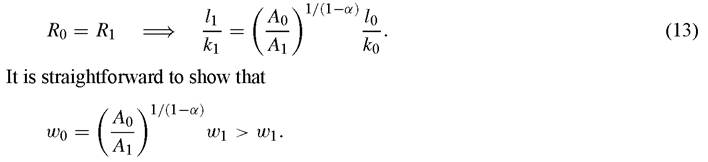
Therefore, in equilibrium, a premium emerges for those workers with low learning cost (i.e., high ability) who can adapt quickly and move to the new sector.
The skill premium increases due to two effects. With full mobility of labor, inequality would disappear. With no labor mobility and no capital mobility, the skill premium would reflect the productivity difference A0∕A1. In this class of models, labor mobility is limited by the distribution of ability in the economy, but capital moves freely. Full mobility of capital induces a general equilibrium feedback that amplifies inequality: factor-price equalization requires capital to flow to the sector operating the new technology to equate marginal productivities of capital.[189] Thus, workers on the new technologies are endowed with more capital, which boosts their relative wages further.
In its typical version, the Nelson-Phelps hypothesis implies that the rise in the skill premium will be transitory: it is only in the early adoption phase of a new technology that those who adapt more quickly can reap some benefits. Over time there will be enough workers who learn how to work with the new technology to offset the wage differential. Note the difference with the KORV hypothesis, where the effect on the skill premium is permanent. Are new technologies and skills complement in the whole production process or just in the adoption phase? Chun (2003) uses industry-level data for the U.S. to disentangle the impact of “adoption” and “use” of IT. He finds that the increase in the relative demand of educated workers from 1970 to 1996 in the U.S. is related significantly to both factors, but quantitatively the impact of use is twice as large.
3.2.1. Further applications of the Nelson-Phelps hypothesis
Aghion (2002) and Borghans and Weel (2003) emphasize that the Nelson-Phelps approach can explain why, in the 1970s, the college premium declined at the same time that the wage dispersion within college graduates increased. The idea is that in the early phase of IT diffusion in the 1970s only educated workers with high ability adopt. Naturally, this higher return to ability increases within-group inequality. The contemporaneous acceleration in the growth of the supply of educated labor, due to exogenous factors, explains the relative fall in the average wage of college graduates.
Beaudry and Green (2003) compare the United States and Germany, highlighting an apparently puzzling feature of the data: the relative supply of skilled labor in the United States grew faster than in Germany, and yet the skill premium rose in the United States, but not in Germany. They outline a model that combines elements of Caselli (1999) and Krusell et al. (2000). Consider an economy where there are two technologies in operation and the “new” technology displays more capital-skill complementarity than the old one. An exogenous rise in the supply of skills increases the relative return to capital in the new sector. Capital then flows from the old to the new sector and, ultimately, this higher capital intensity can raise the relative wage of skilled labor if labor is not perfectly mobile because, as in CasellTs model, only skilled workers can quickly adapt. Thus, in the long-run, the country with the initial spur in the supply of skilled labor (the United States) finds itself with a larger skill premium.
In their original paper, Nelson and Phelps (1966) developed the concept of “technological gap”, defined as the percentage difference between the technology operated by the typical machine in the economy and the one embodied in the leading-edge machine. They conjectured that a rise in the technological gap should be associated with a large skill premium because of the surge in the demand for educated workers needed to adopt the new, more productive technologies. Cummins and Violante (2002) use data on the quality-adjusted relative prices and quantities of equipment investment to construct a measure of the technological gap for the U.S. economy.36 Figure 3 shows that the technological gap and the skill premium have moved largely in tune over the past half century, confirming - at least in the time-series dimension - even the most literal version of the Nelson-Phelps hypothesis.
Put differently, the size of the technological gap can be thought of a proxy for shifts in the relative demand of skilled workers.
3.3. Endogenous skill-biased technical change
In the literature we discussed so far, the sector bias and the factor bias of technical change were assumed to be exogenous. Over the past 20 years a substantial body of work in the field of growth theory has formalized the idea that the efforts of innovators
36 Precisely, if qt is the level of productivity embodied in the new investment at time t, then the average unit of productive capital in the economy at time t embodies a technology with productivity Qt, defined as 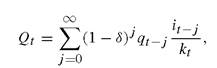
where δ is the depreciation rate, i denotes investments and k the capital stock, both expressed in units of consumption. In other words, Qt is the ratio between capital stock correctly measured in efficiency units (the numerator) and capital stock k not adjusted for quality. Then, the gap is defined as (qt — Qt)∕Qt∙
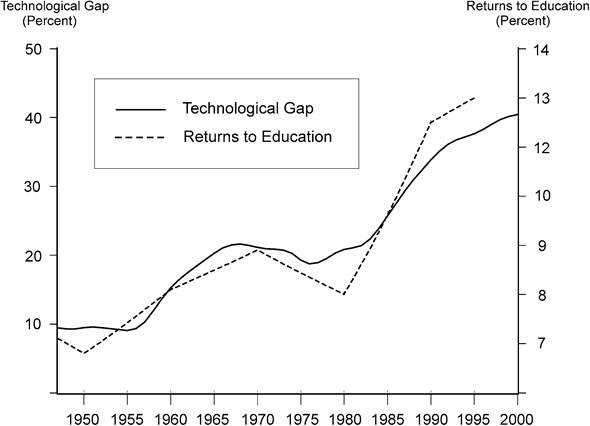
Figure 3. Thejoint dynamics of the returns to education and the technological gap (1947-2000) in the U.S. economy. The figure is reproduced from Cummins and Violante (2002).
are endogenous and respond to market incentives. The models belonging to the so-called “new growth theory” describe the endogenous determination of the level of innovative activity.
Recently, Acemoglu (1998, 2002b, 2003b) and Kiley (1999) have developed the idea that the composition, or direction, of innovations is also endogenous: if R&D activity can be purposefully directed toward productivity improvements of different inputs (capital, skilled labor, and unskilled labor), then it will be biased toward the factor that ensures the largest returns.
An important ingredient of this approach is that the returns to R&D targeted toward a given input are proportional to the total supply of that input, since “productivity” and “quantity” are complements in production. This creates a “market size” effect of R&D: productivity-improving resources are allocated to factor markets with large relative factor supplies.[190]
It is useful to see how this mechanism works within a simple model that represents a reduced form of the richer environments offered by Acemoglu and Kiley. Consider an economy with a given endowment of skilled and unskilled labor, ls and lu, and a production Iirnction (9) as in Section 2.2.4. Conditional on the FSPs, As and Au, wages and
employment are determined competitively, and the competitive equilibrium is Pareto- optimal. Now suppose that the Social Planner wants to maximize production subject to a given frontier of technological possibilities, that is, choices of As and Au,
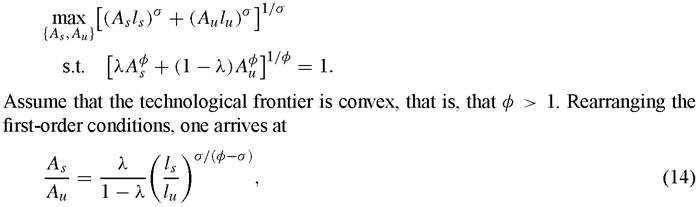
which describes the optimal choice of skill-bias given the relative factor supply. The above equation shows that when skilled and unskilled labor are substitutes, 0 < σ ≤ 1, the skill bias is increasing in the relative supply of skills. This latter parametric condition implies that the marginal product of each innovation is increasing in its corresponding factor.
A surge in the relative endowment of skilled labor, like the one witnessed by the U.S. economy in the postwar period, induces the adoption of more skill-biased technologies in production. This force tends to counteract the direct relative supply effect on wage inequality. Can the endogenous skill bias be so strong in the long run as to overturn the initial supply effect?
To answer this question, we substitute the expression for the skill bias, (14), into the expression for the skill premium, (10), and obtain

We see that the skill premium is increasing in the relative supply of skilled labor as long as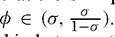 Thus, theoretically, it is possible to explain a positive long-run
relationship between the relative supply of skilled labor and the skill premium as the one depicted in Figure 1 (top panel).
One limitation of existing models of directed technical change, and also of most of the literature surveyed in this section, is that arguments for the skill-premium focus on the response of a relative price to exogenous changes in relative factor supplies. Whereas one can reasonably assume that “ability” is largely pre-determined with respect to the point in the life-cycle when agents start making economic decisions, education is not. One would expect that changes in returns to education as large as the ones we observed in the past 30 years would significantly affect the incentives to acquire education. However, it is an open question to what extent the observed changes in returns were predicted by the cohorts affected by these returns when they made their education decisions.38
38
See Abraham (2003) for a related analysis.
Models of directed technical change, augmented by an endogenous supply of skills, can give rise to multiple steady states. If the innovators expect the supply of educated workers to rise, they will invest in skill-biased R&D which, in turn, will augment the returns to college and induce households to acquire human capital, fulfilling the innovators’ expectations.
3.2.1. Sources of the skill-bias in recent times
Equation (14) shows that the most natural candidate as engine of the recent skill-biased technical change was the rise in the relative supply of educated workers. The latter was, according to Acemoglu (2002a) largely exogenous, at least initially, and a result of the high college enrollment rates of the baby-boom cohort and of the Vietnam war draft. The crucial issue, still unresolved, is whether the necessary parametric restrictions discussed earlier are plausible, and whether the initial shock is large enough.[191] What other changes in the economic environment can be listed as potential sources of skill- biased innovations?
First, there are possible interactions between capital-skill complementarity and the direction of technical change. Hornstein and Krusell (2003) have taken a first step at incorporating the idea of factor-biased innovations into the KORV explanation of the skill premium. Intuitively, an acceleration in capital accumulation due, for example, to an exogenous fall in the price of capital increases the returns to skill-biased innovations if capital is more complementary with skilled labor. Hence, capital-embodied productivity improvements can be the source of factor-biased technical progress. For a calibrated version of their model, Hornstein and Krusell find that a persistent decline of the relative price of capital results in a temporary, but very persistent, increase of the skill premium. In their model the skill premium not only increases because of capital accumulation (as in KORV), but it also increases because of the endogenously induced spur of skill-biased technical change.
Second, the increased openness to trade can play a role. Using a Schumpeterian growth model, Dinopoulos and Segerstrom (1999) argue that if trade liberalization boosts the profitability for monopolistic suppliers by increasing the size of their markets, then resources shift from manufacturing to R&D activities. If, in turn, R&D is a skill-intensive sector, the skill premium rises. This model determines endogenously the level of R&D, but does not display endogenous factor bias in the equilibrium innovation rate. In Acemoglu (2003c), the direction of technical change is related to international trade. A natural assumption about factor endowments is that in the United States the ratio of skilled to unskilled labor is higher than in the rest of the world. After the U.S. economy opens to trade, the world prices are determined by the aggregate relative factor endowment, and thus skill-intensive goods become relatively more expensive. In the class of models with an endogenous factor bias, factors which produce goods with the highest relative price - and the highest expected profits - will be the target of the largest amount of innovative activity (the “relative price” effect). Thus trade opening induces skill-biased technical change. This mechanism can, under some conditions, explain also the increase in the skill premium in less-developed countries documented, for example, by Robbins (1996).
Third, Cozzi and Impullitti (2004) argue that government policy may also have contributed to the bias in technical change. In the 1980s, U.S. technology policy rapidly shifted its priority from security and defense to economic competitiveness in order to counteract the emerging dominance of Japan in the sectors producing high-tech goods.[192] Within a Schumpeterian growth model, they show that when the government reallocates its expenditures toward the (high-tech) manufacturing goods with the highest potential quality improvement, it creates a market-size effect that can lead to a rise in the innovation rate in those sectors and a net increase in the demand for skilled R&D workers and their wages.[193]
Although we have learned from the above analyses about possible channels influencing the skill premium, there is little work that allows us to quantify each of the channels. A careful calibration and evaluation of a model which incorporates these various channels would be an important first step in this direction.
3.3. A historical perspective on the skill premium
In Section 2 we have observed that, over the last 100 years, wage inequality first declined and then increased, with the turning point somewhere around 1950. Can the theoretical models developed to interpret the increasing wage inequality for the second half of the 20th century also account for the declining wage inequality of the first half of the 20th century?
3.3.1. Capital-skill complementarity
Figure 4 plots the relative price of equipment together with the returns to one year of education (both college and high school) since 1929.[194] The pattern is rather striking and is broadly consistent with an explanation based on the capital-skill complementarity
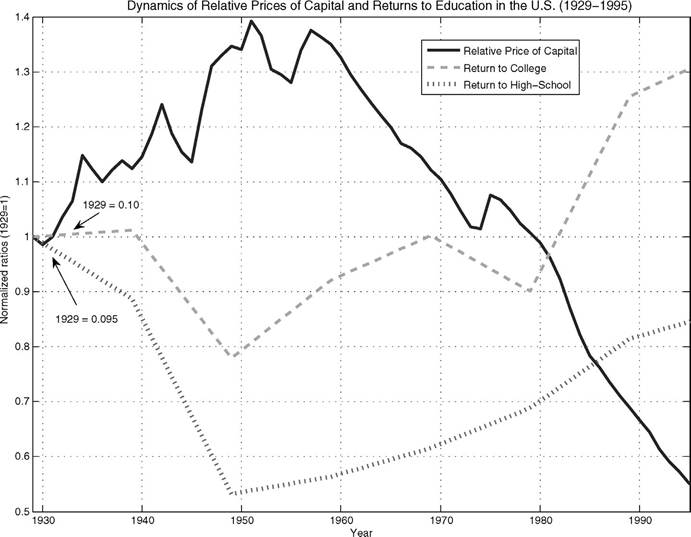
Figure 4. The dynamics of the relative price of capital and the returns to education from 1929-1995 in the U.S. economy. Source: Cummins and Violante (2002) and Goldin and Katz (1999).
hypothesis. During the first half of the century, the price of capital increased which slowed the demand for educated labor and the skill premium. Then around mid-century it started to decline, fostering a strong demand shift in favor of educated labor.
This extension of the KORV analysis to the whole 20th century is yet to be performed formally.43 Thus, before one fully subscribes to this explanation, it is worth discussing the key assumption behind the model. Is it an accurate historical assessment that the introduction of new capital goods has systematically increased the productivity of skilled
occurred since the mid-1970s is less evident here. The series on the return to education for 1939, 1949, 1959, 1969, 1979, 1989 and 1995 are taken from Table 7 in Goldin and Katz (1999) and interpolated linearly for the missing years in between. The first datapoint for 1929 is obtained by linear interpolation from 1914.
43 Admittedly, the evidence in Figure 4 is rather indirect. Looking directly at the stock of equipment (unadjusted for quality improvements), its average annual growth rate in the periods 1930-1950, 1950-1980, 1980-2000 is, respectively, 2.2%, 5.0% and 4.2%. However, when quality-adjusted, the growth rate of equipment from 1980-2000 is close to 8% [Cummins and Violante (2002)]. See also Hornstein (2004) for a discussion of historical trends of U.S. capital-output ratios. labor relative to the productivity of unskilled labor? In other words, when can one date the birth of work organizations displaying capital-skill complementarity?
According to Goldin and Katz (1998), until the early 20th century there was no trace of skill-biased technical change; rather, the opposite bias was at work. The origins of capital-skill complementarity are associated with the introduction of electric motors, and a shift away from assembly lines and toward continuous and batch processes. This development started in the second and third decades of the 20th century. In particular, the declining relative price of electricity, and the consequent electrification of factories, made it possible to run equipment at a higher speed. This, in turn, increased the demand for skilled workers for maintenance purposes. Since then, the introduction of new equipment, such as numerically controlled machines, robotized assembly lines, and finally computers further increased the relative productivity of skilled labor. Thus, we conclude that based on anecdotal evidence, the period portrayed in Figure 4 is one where capital-skill complementarity became more important.
Mitchell (2001), in a related interpretation on the last century of data, emphasizes the technological aspects of optimal plant size. Mitchell documents a striking similarity between the historical path of wage inequality and the pattern of average plant size in manufacturing which rose over the 1900-1950 period and shrunk between 1950 and 2000, thus almost producing the mirror image of inequality at low frequencies. The time-path of plant size can be interpreted as an indicator of the magnitude of the fixed costs of capital and fits well with the evidence of Figure 4.
In Mitchell’s model, production requires performing a large set of tasks with capital and two types of labor, skilled and unskilled. Entrepreneurs face a fixed cost to operate capital, skilled labor, and unskilled labor. Unskilled labor has a higher fixed cost and a lower variable cost than does skilled labor; e.g., unskilled labor is specialized and needs a certain amount of training to perform all the tasks, whereas skilled labor is naturally able in multi-tasking.[195]
The move from craft shops to assembly lines (1900-1950) induced a rise in the fixed cost: the optimal size of the plant rose and with a larger size, plants optimally employed more unskilled workers with large fixed cost, but low variable cost (wages). The demand for unskilled workers rose, weakening the skill premium. As an illustration of the importance of fixed costs for this type of production method, recall that all Ford plants had to be closed and redesigned when the “Model T” was discontinued [Milgrom and Roberts (1990)].
The shift toward more flexible, numerically controlled machines and IT capital (1950-2000) led firms to adopt a smaller scale of production and employ more highly skilled workers whose low fixed cost makes them preferable to unskilled workers in small plants. The increased demand for skilled labor thus raised the skill premium. Based on a calibration exercise, the model can account for two thirds of the movements in the skill premium.[196]
3.3.2. Directed technical change
The theory of directed technical change maintains that a growth in the relative supply of a factor of production should induce technical change biased in favor of that factor. Historically, there are two important episodes of largely “exogenous” spurs in relative factor supply.
First, there was an increase in the supply of unskilled labor in urban areas of England during the 19th century. A careful look at the nature of technological progress over this period supports the theory. Goldin and Katz (1998) argue that in the 19th century the wave of technological innovations substituted physical capital and raw labor for skilled artisan workers [Braverman (1974) and Cain and Paterson (1986)]. For example, automobile production began in artisanal shops where the car was assembled from start to finish by a small group of “all-around mechanics”. Only a few decades later, the Tayloristic model of manufacturing would bring together scores of unskilled workers in large-scale plants to assemble completely standardized parts in a fixed sequence of steps for mass production.
Second, there was a surge in skilled labor (i.e., workers with literacy and numerical skills) due to the “high-school movement” of 1910-1940. As pointed out by Aghion (2002), with respect to this episode, the theory finds weaker support. On the one hand, as we discussed earlier, it appears that the first part of the 20th century indeed marked the beginning of a transformation in production methods biased toward skilled labor (from assembly lines to continuous and batch production processes). On the other hand, there was a decline in the returns to high school and the returns to college were stable (see Figure 4). Why is it that this wave of skill-biased technical change, which was as strong as the one 50 years later, did not have a similar impact on the wage structure? This question remains unanswered to date.[197]
3.4. Technology and the gender gap
Here we explore briefly the interaction between the gender gap and the advancements of technological change, both in the market and in the household.
3.4.1. Technological change in the market
As evident from Figure 1 (bottom panel), since the mid-1970s the gender wage gap has closed substantially. Several studies have concluded that this is due to a rise in relative labor demand for women, as supply cannot have played a large role [Bertola, Blau and Kahn (1997)]. Was the recent technological revolution “gender-biased”?
Consider a simple model where jobs differ in their requirement of physical effort and all jobs are necessary for production of the final good. At the same time, men and women have two traits: physical ability and cognitive ability. The theory of comparative advantage then implies that men will be most efficiently assigned to jobs with high physical requirements and that women should work on jobs with a large fraction of cognitive tasks.
The arrival of a new technology, like computers, that increases productivity relatively more on jobs with high cognitive content therefore tends to raise the average wage of women more than it raises the average wage of men. Weinberg (2003a) tests this theory on microeconomic data for the United States and finds that the increase in computer use for women can explain up to 50 percent of the increase in the relative demand for female employment.
It is worth noting that the gender premium fell in spite of the fact that the femalemale relative supply ratio grew almost by a factor of 2 between 1960 and 2000, i.e., by as much as the growth in the relative supply of college-educated labor. In the perspective of the directed technical change literature, one is left to ponder whether rising female participation was also a force that led innovators to spend resources on capital goods complementary with cognitive skills rather than with physical skills in order to exploit women’s comparative advantage. This hypothesis remains to be analyzed in detail.
3.4.2. Technological change in the household
The postwar period witnessed another form of technological revolution: one that did not take place in factories and plants, but rather in the household. Greenwood, Seshadri and Yorukoglu (2005) argue that the decline in prices of household appliances (refrigerators, vacuum cleaners, washers, dishwashers, etc.) worked as “engines of liberations” for women: new and more productive capital in the households could free up potential hours to be supplied in the labor market. In particular, as household durables were introduced into the economy, the effective wage-elasticity of female labor supply increases, which, in turn, helps explaining the sharp rise in female market participation, even in the presence of not-so-large changes in the gender wage gap.[198]
4.