The equilibrium concept
We have seen that each profile b of behavioral strategies determines a probability measure μ[b] over the set of all feasible histories of a game. The rational agents
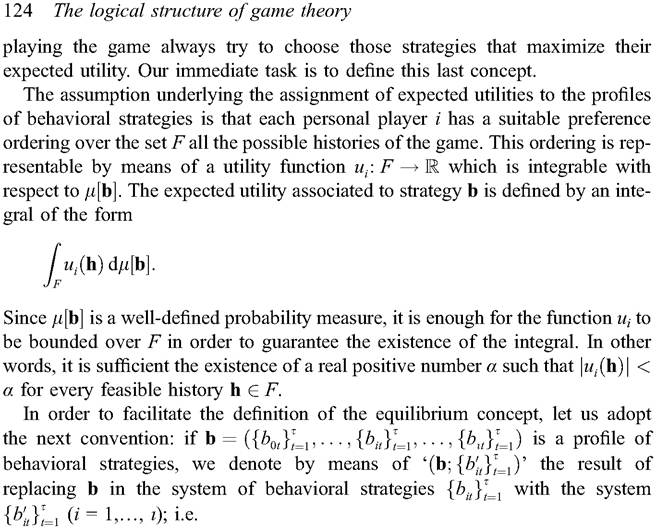

8.6.1 Definition
A profile of behavioral strategies

is an equilibrium of the game iff, Vz 2 ι∖ {0},

This concept of equilibrium is more general than the concept of a Nash equilibrium, because it covers several stages and requires for the players to act as independent agents in each stage.
Let us call adequate any set of profiles of behavioral strategies for which there exists an equilibrium. On the ground of rather restrictive assumptions, Chakra- barti (1992) has shown that there exists at least one adequate set, which is a very important result, because it establishes that the equilibrium concept is not vacuous. Nevertheless, it would be mistaken to hope that it be possible to find in advance necessary and sufficient conditions guaranteeing the existence of equilibria for all the intended applications of the theory. The theory expresses the hope that such applications will satisfy the fundamental law, which is a
The logical structure of game theory 125 guiding principle leading to search, for each intended application, certain factors to explain the observed phenomena. In the case of game theory such factors are profiles of behavioral strategies which must induce equilibria that explain the observed behavior. How must the theory represent such phenomena? What is the form of the guiding principle, the fundamental law of the theory? These questions call for a synthetic reformulation of what has been exposed to this point.
8.7