The game concept
The aim of this section is to introduce an axiomatic definition of the concept of dynamic game with finite horizon and discrete time. The leading thread of the discussion toward that definition is the question of the empirical content of the theory when its typical models are seen not as policy recommendations (in the normative mode), but as explanations of effectively observed behaviors (in the positive mode).
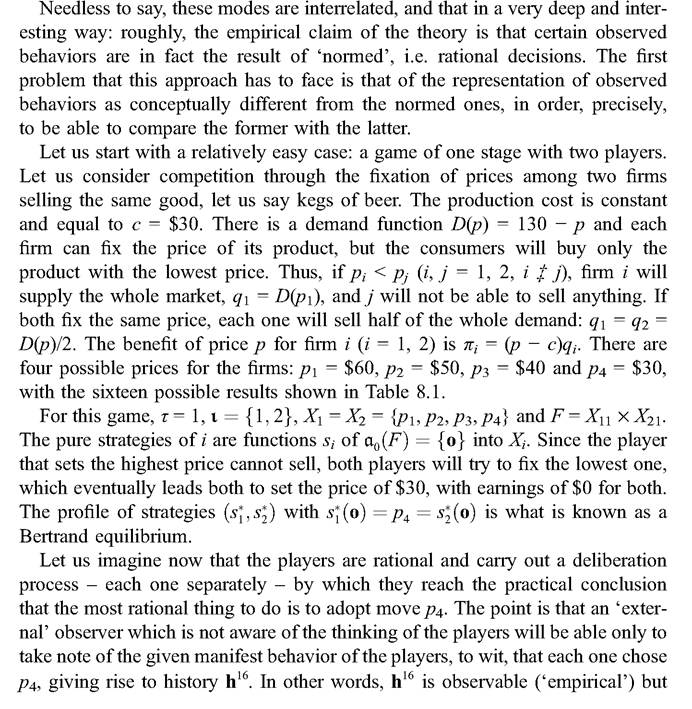
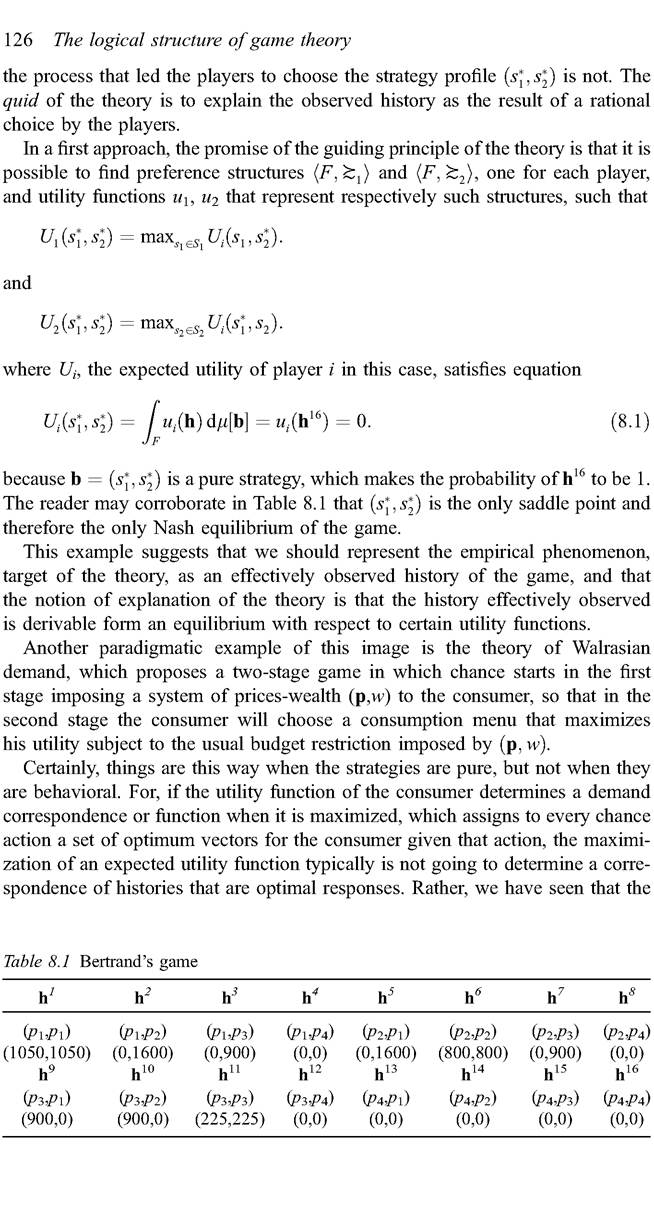
The logical structure of game theory 127 choice of a profile of behavioral strategies transforms the set of feasible histories into a probability space.
It follows that - in contradistinction with what takes place in the application known as ‘Walrasian demand theory’ - we do not get a point (history) as a result of the choice of non-pure behavioral strategies, but rather measurable sets of histories with certain probabilities. What form adopts in this case the empirical phenomenon, target of the theory? It seems clear that the empirical phenomenon must be representable as an histogram. If this is so, the guiding principle promises that there are utility functions for the personal players, and expected utility functions obtained out of these, such that the space is determined by a profile of strategies that happens to be an equilibrium of the game. This suggests that we should treat the term ‘utility’ as game-theoretic term. Hence, the partial potential models can be described as follows. I shall use the term ‘game’ as an abbreviation of ‘dynamic game with finite horizon and discrete time’ and gt as abbreviaton of ‘theory of dynamic games with finite horizon and discrete time’.
8.7.1 Definition 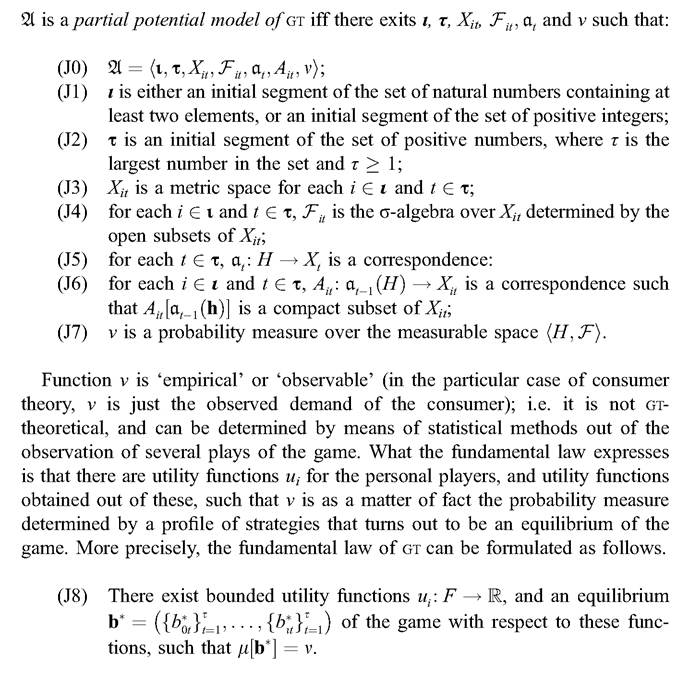
It is important to stress that the identity μ[b*] = v is not a definition, but can be false or satisfied in a merely approximate way.
The left side refers to the space determined by profile b*, whereas the right one refers to an histogram determined independently of the theory. We are now in position to define the concept of a game.8.7.2 Definition
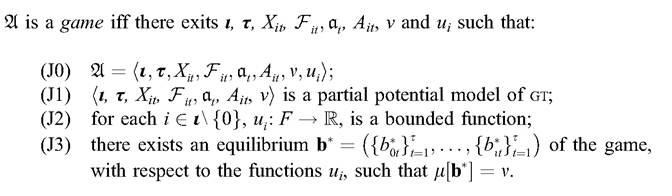
Kreps (1990: 97) has pointed out that one problem of the game-theoretic techniques is that
some (important) sorts of games have many equilibria, and the theory is of no help in sorting out whether any one is the ‘solution’ and, if one is, which one is.
Nevertheless, in the positive mode that I have adopted here, the only thing that matters is the existence of some equilibrium ‘explaining’ the observed behavior with a certain degree of approximation.
In their classical book Games and Decisions, Luce and Raiffa (1957: 50) introduced a law of behavior for the players that they formulate as follows.
Of two alternatives which give rise to outcomes, a player will choose the one which yields the more preferred outcome, or, more precisely, in terms of the utility function he will attempt to maximize expected utility. 
to accept certain experimental operations as defining “preferences” and then to attempt to verify [the] postulate.... This is basically much simpler for the experimentalist, but experience indicates that it is not always successful.
(Ibid.)
SVT solves this paradox calling the attention to the fact that the utility (or preference) concept is GT-theoretical, and so the functions cannot be determined without presupposing the fundamental law. It is possible that it was the intuition of this fact what led the mentioned authors to say that this law is a tautology. Nevertheless, since it is not possible to guarantee a priori that for every interaction describable by means of the non-GT-theoretical conceptual apparatus there will always exist utility functions satisfying the fundamental law, this law is not a tautology. Moreover, since there are no “empirical techniques” - if by “empirical” we understand techniques that do not presuppose the validity of the fundamental law - enabling the determination of the utility functions, it is not possible to ‘verify’ the postulate in that manner. Actually, such postulate is irrefutable, unless someone proves that it is impossible to find such utility functions for every case. To prove that they do not exist for some cases may turn out to be a hard task indeed.
8.8