Water flows along energy gradients
Water flows along energy gradients, from high-energy to low-energy conditions. What is an energy gradient in the context of water? Gravity represents one example that is intuitively obvious: liquid water flows downhill, following a gradient of potential energy.
Another type of energy influencing water movement is pressure. When elephants spray water out of their trunks, the water is flowing from a condition of higher energy inside the trunk (where muscles exert pressure on it) to a condition of lower energy outside of the trunk (where muscle pressure is not present).Other, less obvious factors that influence the flow of water are important to organismal water balance. When solutes are dissolved in water, the solution loses energy. Thus, if the water in a cell contains more solutes than the water surrounding it, water will flow into the cell to equilibrate the energy difference. Alternatively, solutes may flow into the surrounding medium, but most biological membranes selectively block the flow of many solutes. In biological systems, the energy associated with dissolved solutes is called osmotic potential. The energy associated with gravity is called gravitational potential, but in a biological context it is important in water movement only in very tall trees. The energy associated with the exertion of pressure is called pressure (or turgor) potential. Finally, the energy associated with attractive forces on the surfaces of large molecules inside cells or on the surfaces of soil particles is called matric potential.
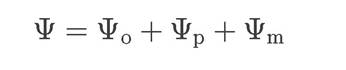
The sum of these energy components within an aqueous system determines its overall water energy status, or water potential. The water potential of a system can be defined mathematically as
(4.3)
where Ψ is the total water potential of the system (in units of pressure; usually megapascals, MPa), Ψo is the osmotic potential (a negative value because it
lowers the energy status of the water), Ψp is the pressure potential (a positive value if pressure is exerted on the system; a negative value if the system is under tension), and Ψm is the matric potential (a negative value).
Water will always move from a system of higher Ψ to a system of lower Ψ, following the energy gradient. This terminology is most often used in plant, microbial, and soil systems, but it works in animal systems as well.The atmosphere has a water potential that is related to humidity. From a biological perspective, air with a relative humidity of less than 98% of saturation has a very low water potential, so the gradient in water potential between most terrestrial organisms and the atmosphere is very high. Without some barrier to water movement, terrestrial organisms would lose water rapidly to the atmosphere. Any force that impedes the movement of water (or other substances, such as carbon dioxide) along an energy gradient is called resistance.2 Barriers that increase organisms' resistance to water loss include the waxy cuticle of plants and insects and the skin of amphibians, reptiles, birds, and mammals.