Availability and Sources
Water cap be found in liquid, solid or gaseous form at a number of places. Depending on the specific location, the residence time may vary for a few days to thousands of years (Table 5.1).
As already mentioned (sec. 2.5.2), more than 99% of Earth’s water in its natural state, is not available or is unsuitable for human use. Thus, the amount of water which is available for all people, plants (including agriculture) and animals on the earth is much less than 1 % of the total amount.Table 5.1 Global water supply
| Location (source) | Percentage of total water | Approx, average residence time |
| Oceans | 97.2 | Infinity |
| Atmosphere | 0.001 | 9 days |
| Rivers and Streams | 0.0001 | 2 weeks |
| Ground water (up to depth of 0.8 km) | 0.31 | Hundreds to thousands of years |
| Lakes (fresh water) | 0.009 | Tens of years |
| Ice caps and glaciers | 2.15 | Tens of thousands of years |
Source: US Geological Survey.
Water is the only natural resource which is used in tremendous quantities. However, the availability of water at any particular point depends on several factors in the hydrologic cycle including rates of evaporation, precipitation and transportation. With the enormous population explosion and rapid increase in agricultural procedures and industrialization, the demand for water has considerably increased.
In view of this, it becomes absolutely essential to look for other sources of water supply. Two such possibilities are the use of ground water and desalination of seawater.5.2.1 GroundWater
Ground water normally refers to the water below the water table where saturated conditions exist (up to about 800 meters depth). It constitutes about 0.31 percent of the total global water and is expected to be available for thousands of years. In some advanced countries like USA, about half the population depends on ground water for their water requirements. In India and other developing countries, ground water is the main source of water required for human consumption, agriculture and other needs. It is generally believed that ground water is pure and safe to drink. This is not true. In fact, ground water can easily be polluted. In view of this, it is necessary to take appropriate steps so that the ground water does not get polluted and if polluted it should be processed so that the harmful pollutants are removed. This aspect is dealt in Chapter 6.
Too much withdrawal of ground water creates another problem. The level of water in the earth goes down since replenishment of ground water takes a very long time.
5.2.2 Desalination of Sea Water
The oceans, as we know, account for about 97.2 percent of the total global water. However, it is saline in nature and contains dissolved salts to the extent of about 3.5% (A cubic metre of sea water as on average contains about 40 kg of salts). The seawater cannot be used for human consumption or far agricultural purposes. Before seawater can be used, it has to be desalinated. A number of processes are used in different parts of the globe where seawater is desalinated and rendered fit for human consumption. These processes that remove salt require large amount of energy resulting in a very high cost of water.
A process that can be used for desalination of seawater is reverse osmosis. In this process, the solute (water in case of sea water) is separated from dissolved salts by making it flow through a Semipermeable membrane under an applied pressure in excess of normal osmotic pressure.
The dissolved salts are retained in the Semipermeable membrane and clear water passes through. This process cannot be used on a large scale due to cost factors.The most important process of desalination involves the use of solar energy. In fact, such methods, procedures and equipments have been developed. The principle involved is to focus the sun’s energy on to a relatively small amount of water in a suitable container. The sun’s energy can be focussed with the help of mirrors. The water evaporates or gets converted into steam; the steam is condensed into water. The procedure is basically distillation. Distilled water is prepared by this process.
Desalination will always remain a costly process and can be used only when alternate water sources are not available.
5.2.3 Conservation of Water
In view of considerable increase in the consumption of water over the years, it is in the interest of mankind to conserve water. Water conservation is the careful use and protection of water resources and it involves both the quantity of water used and its quality. Conservation is an important part of sustainable water use. Broadly speaking maximum water is used in agriculture, for domestic purposes and in industrial units. Following procedures are used for conserving or reducing the use of water and achieving the results.
i. AgricultureUse
Agriculture is the largest water user. About 80% of total fresh water is used for agriculture. Improved agricultural irrigation can reduce the consumption of water by 20-30% and this could be a tremendous saving. Following procedures can be used for this purpose:
• Reduced seepage and evaporation of water by using lined or covered canals.
• Use computer monitoring and scheduled release for maximum efficiency. This procedure is used in some of the advanced and developed countries but not in under developed or developing countries.
• Irrigate at times when evaporation is minimum; for example, at night or in the early morning.
• Useimprovedirrigationsystems5Suchassprinklersordripirrigation-It applies water more effectively to crops.
• Avoid or minimise loss of water by run off. This can be achieved by improving the quality of soil to increase infiltration. If possible, use mulch around plants to retain water.
• Development of crops that use less water. This also helps in the conservation of water.
• Agricultural water should be priced to encourage conservation. Subsidising water only encourages its over use.
• In under developed or developing countries, the farmers should be made aware of the tremendous benefits that arise due to judicious use of water. This aspect is the most important one.
ii. Domestic Use
About 10% of the total fresh water is used for domestic purposes. It is mostly used in bathrooms and for washing of clothes and dishes. The consumption of water for domestic use can be considerably reduced by the following practices.
• Use more-efficient bathroom fixtures, such as low flow toilets that require 1.5 gal per flush rather than the standard 5-gal-per-flush toilet.
• Use low flow showerheads that deliver less but sufficient water.
• Tum off the water when not absolutely needed for washing, brushing teeth, shaving etc.
• Flush the toilet only when really necessary.
• All leaks should be fixed or rectified at the earliest.
• Using dishwashers or washing machines can reduce water consumption.
• Water lawns and plants in early morning, late afternoon or at night to reduce evaporation loss.
• Use drip irrigation and place water-holding mulch around garden plants.
• The concept of an individual T pay for the use of water - so why bother’ is not correct. The understanding of the concept of using minimum water to conserve water resources is most important.
iii. IndustrialUse
Industries use substantial amount of fresh water for their various activities. These not only use water but are also responsible for discharging the waste water containing various chemicals etc.
back to the water bodies causing serious water pollution problems. Following guidelines should be followed in industries:• Water removal for steam generation of electricity could be reduced by about 25% to 30% by using cooling towers that use less or no water.
• Curbing water withdrawals by restoring to in-plant treatment and recycling of water or by developing new equipment and processes that use less water.
iv. UseofWastewater
An important aspect of the conservation of water includes treatment of wastewater from households and industries before it is released or discharged into the surface water (river, lake etc). If allowed to be discharged directly into water bodies, the water gets polluted and can cause numerous health hazards (see sec. 6.5). The treated water can also be used for some other purposes like agriculture etc. Wastewater treatment is usually carried out in three stages, viz. primary treatment, secondary treatment and ultra treatment.
In the primary treatment, the raw sewage water is first passed through a couple of screens to remove large floating material. The water is then passed through chamber (called the grit chamber) which is packed with sand and small stones; this is helpful in removing the dirt, which is disposed off. The resulting filtered water then enters a sedimentation tank, in which particulate matter settles down to form the sludge. Sometimes, it is necessary to add certain chemicals (like alum), which hasten and help the settling process. The sludge is removed and used after processing as manure. The above treatment removes about 30-40% of the pollutants in the form of suspended matter.
In the secondary treatment, the water from the primary treatment, viz., from the sedimentation tank is taken to an aeration tank in which air is pumped in along with some sludge from the final (second) sedimentation tank. The sludge contains aerobic (oxygen rich environment) bacteria that consumes or break down organic material (pollutants) in the waste. After several hours in the aeration tank, the water is taken to the second or final sedimentation tank, in which most of the sludge settles down. The total sludge is subjected to microbial digestion; this process evolves methane gas which is used as a fuel. The water from the final sedimentation tank is then disinfected in disinfection tanks usually by chlorine; this removes disease-causing organisms. The treated water is discharged into water bodies or used for various purposes.
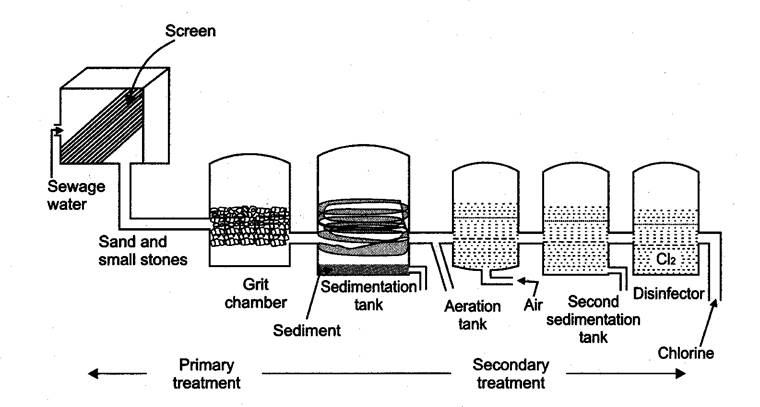
Fig. 5.1: Sewage Water Treatment
5.3
More on the topic Availability and Sources:
- Food sources differ in their chemistry and availability
- Chapter 1 dealt with the main sources of Roman private law, in the sense of the formal sources which created it.
- ENVIRONMENTAL-MEDIATED AVAILABILITY OF VITAMIN D AND IMMUNE FUNCTION
- 1 Availability of management agreements
- Variation in Water Availability
- G AVAILABILITY OF PREMISES FOR TIED LETTINGS
- NPP in aquatic ecosystems is controlled by nutrient availability
- Competition can vary in intensity depending on resource availability and type
- Perfect Information and Perverse Incentives: Publish salaries, education availability
- Direct-to-consumer (DTC) availability of genetic testing is a relatively new phenomenon, which has, until recently, largely escaped the attention of regulators.