Can Birds and Bombs Coexist? A Case Study
How could the chaos and destruction of preparing for battle be beneficial for conservation efforts? Although it may seem strange, bombing for decades on the Fort Bragg military base in the North Carolina Sandhills has inadvertently protected thousands of acres of longleaf pine savanna, aiding efforts to save the endangered red-cockaded woodpecker (FIGURE 23.1).
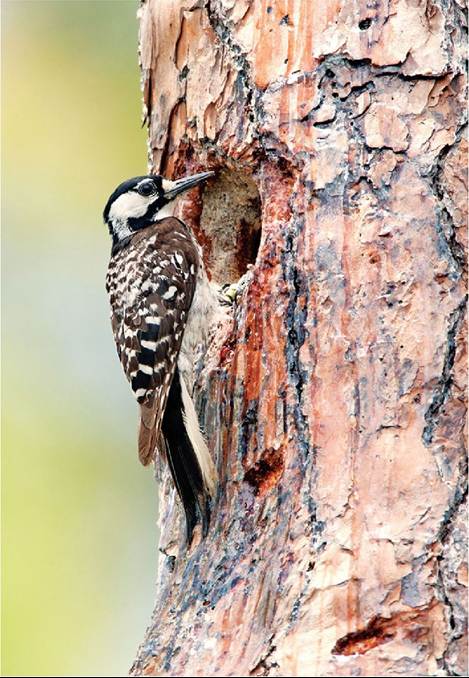
FIGURE 23.1 The Red-Cockaded Woodpecker: An Endangered Species Afemalered- cockaded woodpecker (Picoides borealis) approaches her nest cavity. This species was once abundant throughout the pine savannas (communities dominated by grasses intermixed with pine trees) of the United States but has been severely reduced in numbers by the loss of its required habitat. © William Leaman/Alamy Stock Photo View larger image
For a century, the forests of Fort Bragg have been used for military training exercises, degraded by off-road vehicles and earth-moving equipment, and set on fire by explosives. These destructive activities take place in the midst of a once common but now rare ecosystem—one that, ironically, survives in large part as a result of the military presence. How can this be? First, pine savanna depends on fire for its persistence, so the fires that result from explosions benefit rather than harm the ecosystem. Second, the designation of large blocks of forest land for military use has kept them from being converted to farmland, forest plantations, and residential uses.
While some longleaf pine savanna has been preserved at Fort Bragg and other military bases, overall, this ecosystem has been reduced to only 3% of the more than 35 million hectares (>134,000 square miles) it once covered (FIGURE 23.2). Various factors have contributed to its decline, including rapid growth of the human population; the clearing of land for large plantations where other tree species, such as loblolly pine, are grown; and fire suppression.
With the decline of the longleaf pine savanna ecosystem, several plant, insect, and vertebrate species that depend on it have also undergone substantial declines.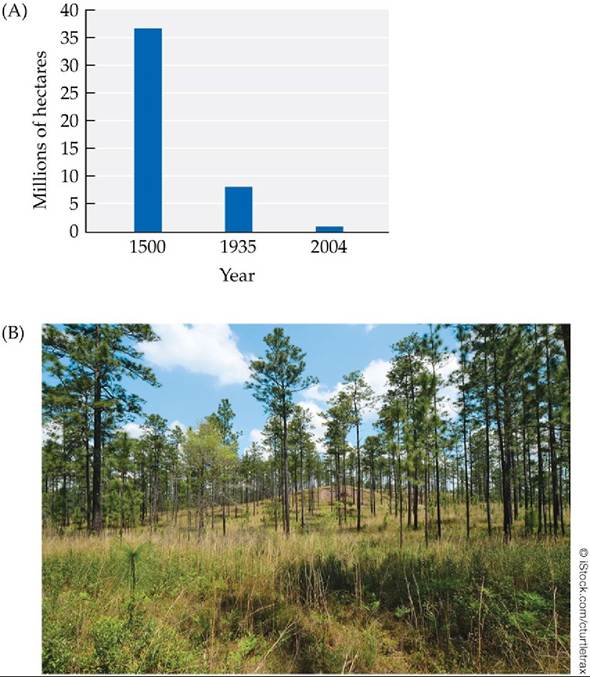
FIGURE 23.2 Decline of the Longleaf Pine Savanna Community (A)Theestimatedarea covered by Iongleaf pine savanna at different times. The cover of this community has not changed from 2004 to the present. (B) As seen in this photograph from the southeastern United States, Iongleaf pine (Pinus palustris) savanna consists of open forest with a grass understory.
Estimate the hectares of Iongleaf pine savanna that existed in 1500, 1935, and 2004. Was the annual loss of Iongleaf pine savanna greater from 1500 to 1935, or from 1935 to 2004?
(A after D. H. Van Lear et al. 2005. For Ecol Manage 211: 150-165; based on data from C. C. Frost. 1993. Tall Timbers Fire Ecol Conf 18: 17-44; W. G. Wahlenberg. 1946. Longleaf pine: Its use, ecology, regeneration, protection, growth, and management. C.L. Pack Forestry Foundation & USDA Forest Service; USDA Natural Resource Conservation Service, Longleaf Pine Initiative: Washington, DC. Accessed November 13, 2019. (⅛⅝ https://www.nrcs.usda.gov/wps/portal/nrcs/detailfull/national/home/?
&cid=nrcsdev11 023913.) View larger image
One of these species is the red-cockaded woodpecker (Picoides borealis), a small insectivorous bird that requires large tracts of open pine savanna. Once numbering around 1.3 million breeding pairs and associated helpers (known as groups living in clusters), the species currently stands at about 7,500 clusters. Whereas other woodpeckers nest in dead snags, red-cockaded woodpeckers require mature, living pine trees, especially the longleaf pine (Pinus palustris), for their nesting cavities.
Periodic fires historically helped to maintain longleaf pine savanna. Without those fires, the longleaf pine community soon undergoes succession.
As an understory of young oaks and other hardwoods grows up, red-cockaded woodpeckers abandon their nesting cavities, apparently because of a decrease in food resources. In the past, the birds would move to parts of the forest that had been more recently burned, but as the area of suitably mature longleaf pines declines, there are fewer and fewer places for the birds to go. This loss of habitat has reduced the woodpecker's populations, making them vulnerable to the problems associated with small, isolated populations that we discussed in Concept 11.3. There is evidence of genetic inbreeding among the birds, and in 1989, Hurricane Hugo killed 70% of the birds in one population.The recent history of the red-cockaded woodpecker reflects that of thousands of other imperiled species around the world that have experienced gradual population declines with extensive loss of habitat, to critically low numbers. Species that require a specific habitat that is degraded by human activities will experience reductions in populations until, in some cases, they vanish. What can be done to protect species such as the red-cockaded woodpecker? Do we have a responsibility to protect existing biodiversity and to restore some of what has been lost? If so, how can we best allocate our limited resources to be most effective in our conservation efforts?