Chemical and Photochemical Reactions in Atmosphere
The most important gases which are present in the atmosphere and undergo various types of chemical and photochemical reactions, are oxygen, nitrogen and carbon dioxide.
1. Oxygen
Oxygen originates by the process of photosynthesis and plays an important role in the troposphere and a key role in the stratosphere.
In troposphere, oxygen takes part in energy producing reactions like burning of fossil fuels. Thus, methane (in natural gas) reacts with oxygen producing carbon dioxide and liberating energy.
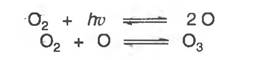
In stratosphere, oxygen is responsible for the formation or generation of ozone. The oxygen undergoes a photochemical reaction in which energy from the sun decomposes the oxygen molecule into reactive atomic oxygen, which in turn combines with molecular oxygen to form ozone.
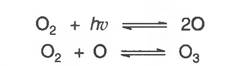
The formation of ozone is essential for sustaining life on earth by preventing the harmful UV radiations of the sun from reaching the earth.
In the upper atmosphere (viz. mesosphere, thermosphere and ionosphere), ultraviolet radiations cause photochemical dissociation and ionisation of ozone to give rise to oxygen atoms, oxygen ion and excited oxygen atoms.
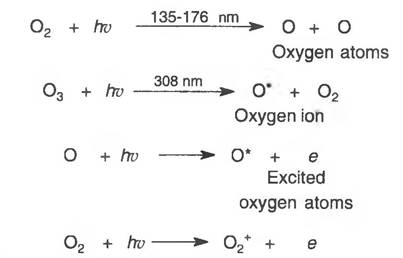
The ultraviolet radiations are not available during night; so the ions recombine with free electrons to give neutral species (O2) from which they originated.
2. Nitrogen
Nitrogen and its compounds are essential for the sustenance of life. Though nitrogen by itself is inert and un-reactive, its presence in atmosphere (to the extent of about 78%) is extremely important, since it dilutes or eliminates the harmful effects of pure oxygen (oxygen though supports life, but in pure oxygen most of the organic matter is burned.
However, oxygen in about 5-6% concentration is useful for all the jobs). The origin of nitrogen in the atmosphere is believed to be from breaking down of nitrates in the soil by the denitrification process by some soil microorganisms.
In the presence of lightening and thunderstorm, the nitrogen of the atmosphere combines with oxygen to form nitric oxide (NO), which in turn combines with oxygen to give nitrogen dioxide. 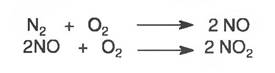
Ozone can also oxidise nitric oxide to nitrogen dioxide.

Nitrogen dioxide reacts with water vapours, producing nitric acid which is washed down to the soil in rain to give the so called acid rain (For more details, see Chapter 4).

3. Nitrous Oxide
Nitrous oxide (N2O) commonly known as laughing gas is not produced by atmospheric nitrogen, but is released into the atmosphere by a number of chemical processes which increase the N2O levels to about 10%. The N2O formed rises into the stratosphere and plays a role in the destruction of the ozone layer. The various steps involved in the process are as follows:
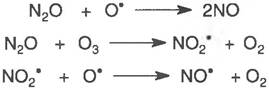
The overall reaction is

4. Carbon Dioxide
Carbon dioxide is released into the atmosphere by burning of different types of fuels and by respiration processes. The green plants absorb CO2 gas from the atmosphere to prepare food (carbohydrates) via the process of photosynthesis.

Carbon dioxide is one of the very important green house gases (the others are methane, nitrous oxide, chlorofluorocarbons etc).
It does not support life. In fact, animals and human beings kept in CO2 atmosphere die due to lack of oxygen. Though CO2 is not considered to be a pollutant but in excess amount, it has adverse effects on the climate (for details see green house effect). Before CO2 was introduced into the atmosphere, the average temperature of earth was -150C. The green house gases (particularly CO2) raised the earth’s temperature to present day value of 15oC. Thus, without green house gases, the planet earth would be uninhabitable. This aspect has been discussed subsequently.5. Ozone
Ozone is not present as such in the atmosphere. It is generated in the atmosphere from oxygen. In stratosphere, oxygen undergoes photochemical reaction in the presence of rays of sun when oxygen decomposes into reactive oxygen atoms, which in turn combines with molecular oxygen to form ozone.
Ozone can be beneficial or harmful depending on the circumstances. Ozone is an irritating toxic gas and when breathed, it produces extremely harmful effects like soar throat, general bronchial irritation, coughing and fatigue; much higher concentration can even kill. Ozone is also lethal to low forms of life including bacteria. In some countries (especially Europe), it is widely used as a disinfectant for drinking water supplies. On the other hand, the same gas (ozone) forms a life saving shield that protects us from the extremely harmful effects of ultraviolet solar radiation. In the atmosphere, ozone is present as the ozone layer that surrounds the earth (within the stratosphere) centred roughly at some 30 to 35 km from above the earth’s surface.
In the atmosphere, absorption of ultraviolet radiation by ozone molecules within the ozone layer regenerates an oxygen atom and an oxygen molecule.
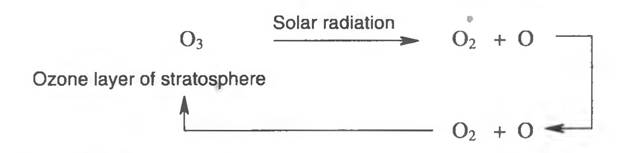
The cycling between the formation and destruction of ozone molecules results in a reasonably constant concentration of ozone that has permitted the life on earth to thrive under the invisible shield.
If chlorofluorocarbons (CFCs) are present in the atmosphere (or discharged in the atmosphere by various routes), the ozone layer is destroyed or depleted causing a number of complications. This aspect will be discussed in a subsequent section (see sec. 4.5.4).