Climate Change
The climate of earth has been changing since millions of years but the changes during the last two centuries are of very alarming nature. The trends show the following:
(1) Global temperatures are rising.
In the last century, the average land temperature has arisen by 0.45-0.6oC.(2) Precipitation has increased by 1 % over the continents in the last century. There was an increase in the rainfall in high altitude areas whereas a decrease was noticed in many tropical regions.
(3) An increase in sea level by 15-20 cm has been observed. The contribution of thermal expansion is 2-7 cm whereas melting of ice has led to 2-5 cm increase.
In Chapter 4, it has been explained that greenhouse gases such as carbon dioxide, methane, ozone, nitrous oxide and water vapour permit the passage of incoming solar radiation but partially absorb and re-emit outgoing infrared terrestrial radiation. This natural greenhouse effect raises the average temperature of the earth from - 18o C to +15o C and makes the life sustainable on earth.
Ever since the industrial revolution began about 150 years ago, the human activities have led to an increase of green house gases (GHGs) in the atmosphere. These activities are energy generation from fossil fuels which emits carbon dioxide, industrial activities, change in land use patterns such as deforestation, biomass burning etc. These activities release GHGs in the atmosphere.
Since pre-industrialization, the atmospheric concentration of CO2 has increased from nearly 280 to 358 ppmv (inl994), methane from 700 to 1720 ppbv (in 1994), N2O from 275 to 312 ppbv (in 1992) and CFC-11 from zero to 110 pptv (in 1992). The increase is about 31%, 151% and 17% in the first three cases in the period 1750-2000 as per Intergovernmental Panel on Climate Change (IPCC, 2001).
Experiments and measurement records indicate that since 1860’s the global average temperature has already increased by 0.6+ 0.2oC. The ThirdAssessment Report of IPCC states that there is new and stronger evidence that most of the warming observed over the last 50 years is attributable to human activities.
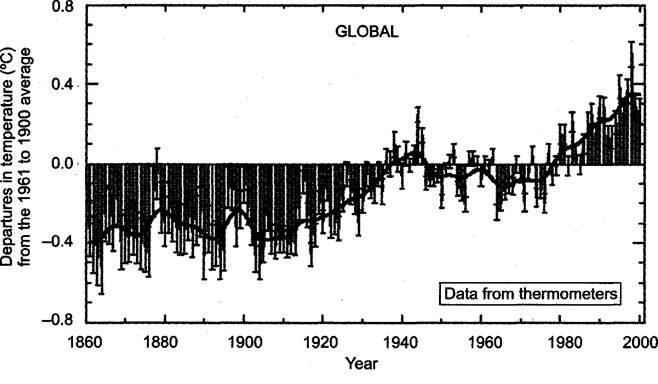
Fig 12.1: Variation of Earth’s Surface Temperature Since 1860’s
It has been observed that the last two decades of the 20th century were the warmest particularly the year 1998. Various researches and studies show that from 1990 to 2100, the surface temperature would increase by 1.40C to 5.80C. This magnitude of warming is greater than that experienced over last 10,000 years. This increase is even higher than that predicted by the SecondAssessment Report which said it to be I0C to 3.50C. Such a fast rate of change of temperature will have strong effects on the climate and the ecosystems may not be able to adapt to such fast changes.
Also, the global mean sea level is projected to rise by 0.09 to 0.88 meters. The reason being thermal expansion of the oceans and melting of glaciers as well as polar ice sheets.
12.6