Control of Air Pollution
The air pollutants pose a great danger to one and all. The harmful effects of various pollutants viz., carbon monoxide (sec. 4.3.1.1), oxides of nitrogen (sec. 4.3.2), oxides of sulphur (sec.
4.3.3), hydrogen sulphide (sec. 4.3.4), chlorine (sec. 4.3.5), ozone (sec. 4.3.6), hydrocarbons (sec. 4.3.7) and particulates (sec. 4.3.8) have been discussed at appropriate places mentioned above. Air pollution can best be described as a ‘TIME BOMB’ which may explode any time, at any place causing severe, undetermined problems. This is amply clear from the various air pollution episodes (accidents due to natural or man made causes) which have occurred since very early times. Some of the air pollution episodes are given below.(i) The first episode of severe air-pollution was recorded in 1930 in Meuse River Valley of Belgium. Due to thermal inversion, SO2 gas was trapped at 38 ppm level. Due to this episode, about 60 people died and several cattle were killed.
(ii) In 1994, Los Angeles in California experienced a serious type of air pollution caused by photochemical smog. It was characterised by reduced visibility, eye irritation and plant damages (for details see sec. 4.5.5).
(iii) In 1948, in Donora, Pennsylvania, USA 40% of the population was affected causing 20 deaths. The reason was poisoning by SO2 at 2 ppm level.
(iv) In 1952, December 5-9, heavy fog conditions prevailed for 5 days at a stretch in London and the toll was 4000-5000 people. Thousands of people were affected. The peak SO2 concentration was 1.3 ppm and smoke 4 mg m~3. Similar smog conditions recurred in December 1962 though the deaths were around 700.
(v) In November 1950, the Paza Rica air pollution episode resulted from an industrial accident of a refinery in which about 25 people died and many more became ill. The reason was the release of huge amount of H2S from the refinery which spread over the ground around the refinery and seeped into nearby homes.
(vi) In July 1976, an explosion took place in a chemical plant (at Seveso, Italy) manufacturing a herbicide (v⅛. 2,4,5-trichlorophenoxy acetate). A white cloud of TCDC (2,3,7,8-tetrachlorobenzo-10-dioxin) came out contaminating buildings, ground and soil. After three weeks, the Italian Government evacuated about 800 people from the affected area. About 200 people suffered from skin diseases and also from liver ailments. The after effect was birth of deformed and premature babies.
(vii)On December 3, 1984, an accident occurs in a Union Carbide factory manufacturing a carbamate pesticides located at Bhopal, Madhya Pradesh, India. The reactions involved in the manufacture of the carbamate are given below:
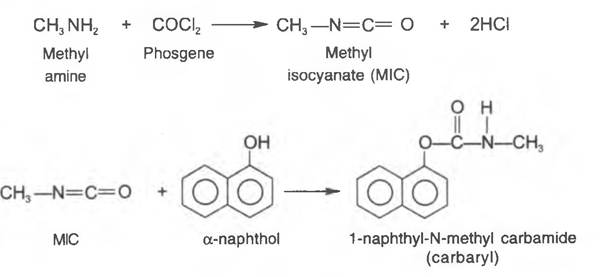
The starting material methyl isocyanate (CH3-N=C=O) (MIC), was stored at low temperature in storage tanks. On December 3, 1984, a massive leak of MIC occurred in the storage tank and caused havoc. About 22,000 people residing in the area died and a very large number (about 1,20,000) were disabled for rest of their lives.
This incident is now commonly known as the Bhopal Disaster, and Bhopal where the episode occurred is known as the city of death. Also see sec. 15.2.
(viii) On 26 April 1986, a worst nuclear catastrophe occurred at Chemobyl in the Ukraine area of the Soviet Union. It is believed to be due to human error in controlling rods.
The accident resulted in the reactor core temperature more than 20000C. Fuel and radioactive remains shot into air hitting the surrounding areas. The effect was felt over most of Europe. The accident resulted in the death of more than 2000 people. Soil, water and vegetation over 100 sq km area around Chemobyl was damaged. The neighbouring countries such as Poland were severely affected. Even after cleaning up operation and dumping tons of sand, clay etc. to bury the molten core, the radiation continuously emitted - more than 3,00,000 times the permissible dose.
(ix) A nuclear reactor in Three Mile Island, in USA made news due to an accident that took place due to a complex operational failure due to human error.
In view of the disastrous effects of atmospheric pollution, it is most important to make sure that suitable control measures should be taken to prevent the atmospheric pollution. However, in case of nuclear catastrophe, adequate precautions and steps should be taken so that such catastrophes do not occur again. Given below are some control measures for various pollutants.
A. OxidesofSulphur
The presence of sulphur dioxide in the atmosphere is very hazardous. It is very necessary to check its emission into the atmosphere. The possible approaches are the desulphurisation of the fuel (coal is the major source of SO2) and removal of SO2 from flue gases.
i. Desulphurisation of Coal
Coal contains sulphur either in inorganic form (as iron pyrites) or inorganically bound form, in approximately equal ratio. The inorganic sulphur is removed by subjecting grounded coal to hydraulic washing. Iron pyrites, being heavier settle down while the sulphur free coal floats on the surface and is collected. The organically bound sulphur is removed by passing hydrogen gas over the fuel in presence of catalyst (mixed cobalt molybdenum oxide). By this process, the organically bound sulphur is converted into hydrogen sulphide, which is absorbed in a solution of diethanolamine, subsequently H2S is oxidised to sulphur.

The organic sulphur can also be removed from coal by a microbial method using a strain designated as IGT-57. However, this method does not remove inorganic sulphur and is too slow to be of utility.
ii. Desulphurisation of Flue Gases
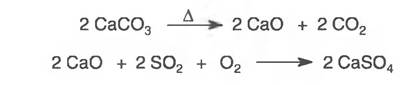
In this procedure, powdered coal and powdered lime stone are heated, when the following reactions take place. 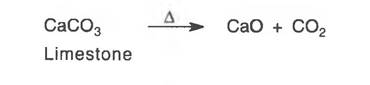
Environmental Science
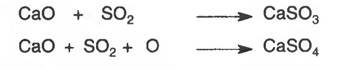
The formed calcium sulphite and calcium sulphate are removed by scrubbing

The method is economical but the disposal of waste CaSO4 in large amount creates problems.
Alternatively, SO2 in flue gases is reduced by mixing it with carbon monoxide (from another polluting unit) over a catalyst.

A number of catalysts have been used. The disadvantages of the catalytic method are the cost and deactivation of the catalyst.
Alternatively, SO2 in the exhaust gases is removed by using scrubbers. The scrubbers force the gases through a slurry of calcium carbonate, or magnesium hydroxide. The SO2 dissolves in water and reacts with CaCO3 or Mg(OH)2 to form a salt. IfMg(OH)2 is used, the MgSO3 that is formed which can be isolated and heated to regenerate SO2, which can be collected and used as a raw material for other industrial processes.

Fig.4.3 below gives a schematic diagram of a scrubber.
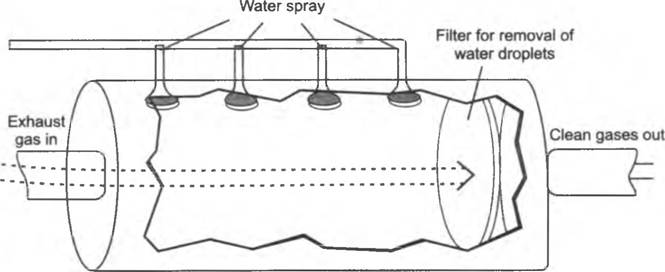
Fig. 4.3 : A scrubber (schematic diagram)
In both the above methods, the oxides of nitrogen which are invariably present in flue gases are not removed. Both oxides of nitrogen and sulphur can be removed using a single technology as described below.
B. Oxides of Nitrogen
It has already been stated that the important sources of oxides of nitrogen in the atmosphere are fossil fuel based power plants and automobile exhaust - both of which require control procedures.
i. Checking the emission of oxides of nitrogen (and simultaneous checking emission of oxides of sulphur) from coal. This is affected by the so called coal conversion technology.
The procedure involves heating powdered coal with sodium hydroxide solution under moderate pressure. This removes sulphur along with many trace elements from coal. The coal obtained is free of sulphur and will not produce oxides of sulphur on combustion.
The sulphur free coal reacts with steam to produce water gas (a mixture of carbon monoxide and hydrogen);
The water gas is sprayed with water and burned. The presence of water lowers the combustion temperature and so nitrogen and oxygen do not combine to form oxides of nitrogen.
Alternatively, fluidised-bed combustion technique is used. In this method, a bed of ash or sand is placed on a grate at the bottom of a boiler. Air is blown upwards through the grate and simultaneously crushed solid fuel is fed into the boiler. The fuel heats up the particles of ash or sand. The heat is picked up by the coils in which water is fed at the bottom and steam comes out from the top (see Fig.4.4). Subsequently, limestone is added to the mixture in the boiler. Limestone combines with the evolved SO2 from the fuel.
The system operates at 800-IOOO0C. At this low temperature, oxides of nitrogen are not formed. So, the flue gases are free from both the oxides of sulphur and nitrogen.
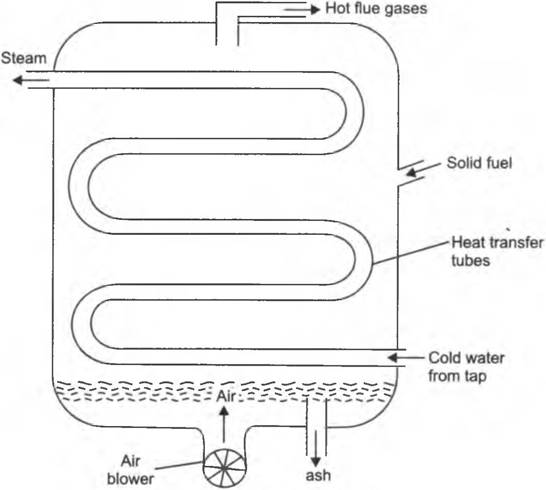
Fig. 4.4 : Fluidized bed combustion
ii. Checking the emission of nitrogen (and simultaneous carbon monoxide and unburnt hydrocarbons) from automobile exhaust.
The automobile exhaust has become a major source of atmospheric pollution (oxides of nitrogen and carbon monoxide) since the number of automobiles has increased enormously. The automobiles exhaust pollutants are controlled by installing catalytic converters in the exhaust system, so that the exhaust gases are first passed through a catalytic converter before being released into the atmosphere as harmless gases like CO2, H2O and N2. The only limitation of this procedure is that the gasoline or petrol should be unleaded since lead poisons the catalyst.
It may be appropriate to state that anti-knocking compounds like lead tetraethyl are now not added to the petrol. Instead, the composition of the petrol is so adjusted (by the addition of some branched chain hydrocarbons) so as to have the desired octane rating. The catalytic converter contains a mixture of platinum, palladium and rhodium supported on a honeycomb bed (made of ceramic or metal). Various reactions taking place in the catalytic converter are:
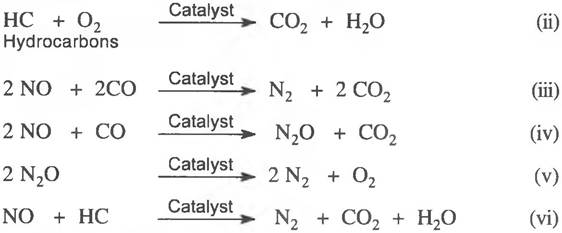
As seen, in the catalytic converter
(a) CO gets converted into CO2 (eq. (i))
(b) Hydrocarbons are oxidised into CO2 and H2O (eq. (ii))
(c) Nitric oxide reacts with CO to give N2 and CO2 (eq. (iii))
(d) Nitric oxide may also be partially reduced to N2O (eq. (iv)) and the formed N2O decomposes into N2 and O2 (eq. (v))
(e) Nitric oxide and hydrocarbons are converted into N2, CO2 and H2O (eq. (vi))
C. Carbon Monoxide
Carbon monoxide is the most harmful pollutant (being poisonous in nature) in the atmosphere. Its main sources are incomplete combustion of all carbon containing fuels particularly in automobile engines and industrial furnaces and cigarette smoking. It is removed from the source in the following way.
(i) From automobile exhaust gases- it is removed (along with oxides of nitrogen and unbumt hydrocarbons) by installing catalytic converter in the exhaust system.
(ii) Accumulation of carbon monoxide in any space (like in submarines and space flights) it is removed by providing catalytic burner to oxidise CO to CO2.
(iii) Cigarette smoking should be done only in specific area with full ventilation. However, it is not possible to control CO from the cigarette smoke. The best way is to quit smoking.
Control of pollution from polymers and plastics (sec. 4.4.1.A), asbestos (sec. 4.4.1.B) are given at appropriate places.
D. Particulates
The common sources of particulate emission into the atmosphere are the powerhouses operating on.coal. The smoke that comes out of the chimneys contains fine particles of carbon which remain suspended in air. These particulates are removed by installation of an electrostatic precipitator in the chimney. By this process when a high electrostatic potential is applied across the chimney, the carbon particles coming out of the chimney are attracted by charged electrodes. This results in the formation of soot which gets deposited in the chimney which is cleaned from time to time to remove soot. The particulates coming in the exhaust of automobiles are removed by catalytic converter.
A schematic diagram of an electrostatic precipitator is shown in Fig.4.5. As shown, the exhaust gases from power houses and other industrial houses (which used coal or other fuels as a source of energy) are passed between two charged vertical plates or electrodes. The particles pick up electrons supplied by the negative electrodes and move to the positive ore. Thus, the liquid particles (if present as in aerosols, which are small particles of liquid and solids dispersed in smoke) accumulate and flow to the bottom of the collector. The solid particles drop off with agitation.
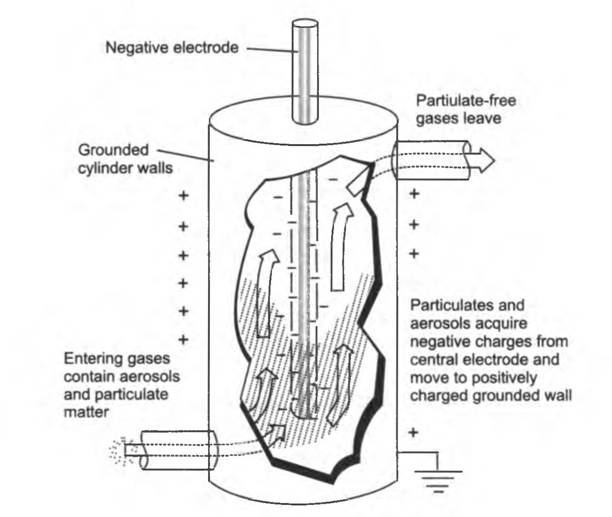
Fig. 4.5 : An Electrostatic Precipitator
In some of the industries, the filters (called the industrial filters) are used to remove particulates. These filters work like the filters used in air conditioners or