Effects of Air Pollution
The effects of pollutants (in the air or atmosphere), viz. carbon monoxide (4.3.1.1), carbon dioxide (4.3.1.2), oxides of nitrogen (4.3.2), oxides of sulphur (4.3.3), hydrogen sulphide (4.3.4), chlorine (4.3.5), ozone (4.3.6), hydrocarbons (4.3.7) and particulates (4.3.8) have already been discussed in the sections given in the parenthesis.
In addition to the above, various pollutants are responsible for the following.• Acid Rain
• Green House Effect
• Global Warming
• Depletion of Ozone
• Formation of Smog
4.5.1 AcidRain
The formation of nitric acid and sulphuric acid as secondary pollutants (sec. 4.2.3) in the atmosphere leads to acid rain. It includes all types of rain and snow whose excessive acidity causes environmental problems like destruction of vegetation and marine life and the corrosion and etching of buildings that are exposed to the atmosphere.
Chemically speaking, all rain is acidic with or without dir pbllutidn∕Γfii⅛ is due to the natural presence of carbon dioxide in the atmosphere which dissolves in rain drops or rain water (even moisture present in the atmosphere-does the same function) to form carbonic acid.

Due to the above reaction, carbon dioxide can dissolve in water until the solution becomes saturated. This results in the rainwater attaining an acidic pH of 5.6. Due to this, the purest form of rain (in the absence of any of the air pollutants) reaches the earth as an acidic solution of pH 5.6. In view of the above, the acid rain is described as rain whose pH is lower than 5.6.
How is acid rain caused?
(i) Due to the presence of oxides of nitrogen in the atmosphere During thunderstorm and lightening, atmospheric nitrogen and oxygen combine to form nitric oxide, which gets converted to nitrogen dioxide, which reacts with water to form nitric acid and is washed down as acid rain (see also sec.
4.3.2).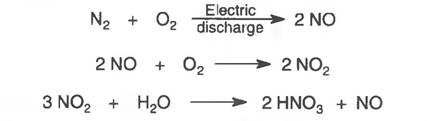
The oxides of nitrogen enter into the atmosphere from other sources also (sec. 4.3.2).
(ii) Due to the presence of sulphur dioxide in the atmosphere Sulphur dioxide is released into the atmosphere from a number of sources (see sec. 4.3.3.). In the atmosphere, sulphur dioxide reacts with atmospheric oxygen to form sulphur trioxide by photolytic and catalytic oxidation processes. The sulphur trioxide thus formed, reacts with water forming sulphuric acid which comes down on earth as acid rain.
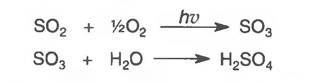
(iii) The presence of hydrogen sulphide (sec. 4.3.4) and chlorine (sec. 4.3.5) in the atmosphere also contributes to the formation of acid rain.
The acid rain is not confined to the regions where the harmful pollutants (like oxides of nitrogen and sulphur) are emitted. Since winds carry atmospheric contaminants across national borders, the acid rain may fall hundreds of miles away from the pollution sources. Acid rain, in fact, has become an international issue. It is the responsibility of all countries to make sure that the pollutants are not discharged into the atmosphere; these should be checked at the initial source only.
Harmful Effects of Acid Rain
Acid rain causes extensive damage to the environment by affecting the following:
i. Vegetation
The acid rain makes the soil acidic. This adversely affects the plants and animals. The acid rain contains H+, SO42" and NO1 ions which when added to soil, leach the nutrients from the soil. The acid rain also damages the leaves of plants and trees. This is responsible for damaging forests and other vegetation.
ii. Fertility of Soil
The activity of symbiotic nitrogen fixing bacteria, present in the nodules of leguminous family, is inhibited. This is responsible for destroying or reducing the fertility of the soil.
iii. Aquatic Life
Acid rain renders the river or even ocean waters acidic, thereby, adversely affecting marine animals. Changes in pH of fresh water affect the reproduction and survival of many species of fish.
iv. Building and Monuments
Acid rain causes extensive damage to buildings and monuments made from marble, limestone, slate and mortar. Limestone which is very common building material, is attacked readily.

Most of the monuments are made from marble which is mostly CaCO3 and so is attacked by acid rain.
The damage caused to the buildings and monuments by acid rain is irreversible. A most glaring example is slow degradation of Taj Mahal in Agra (UP, India). The pollutants in and near Agra arise from iron foundries, rubber manufacture, brick kilns, and oil refinery at Mathura.
v. Ecological Balance
Acid rain is responsible for wiping out many bacterial and blue green
algae; thereby disrupting the whole ecological balance.
vi. Human Health
Acid rain has been found to be very dangerous to human health. Acidic conditions can play havoc within human nervous system, respiratory system and digestive system by making the person an easy prey to various neurological diseases.
It is of utmost importance to control the acid rain. Short-term control of acid deposition (soil) can be achieved by using lime.
4.5.2 Green House EHect
It is the phenomenon in which the earth’s atmosphere traps the heat form the sun and prevents it from escaping into outer space. Without this effect, the average surface temperature of the earth would be about 330 C lower than it is today. The green house effect received its name because the earth’s atmosphere acts much like the glass or plastic roof and walls of a greenhouse. Sunlight enters a greenhouse through the transparent glass or plastic and heat the plants but the heat emitted by the plants in the form of infrared radiation cannot pass through the glass or plastic roof and walls.
As a result, the temperature inside increases.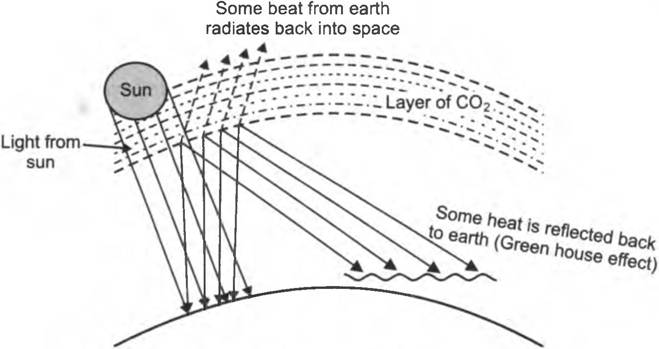
Fig. 4.1 : Green House Effect
In the atmosphere, there is a protective layer of O3 gas at a height between 15-60 km (the thickest layer of ozone exists at a height of 23 km from the surface of the earth and a blanket of CO2 gas exists in the lower part of the atmosphere (i.e. below 15 km). When sunlight consisting of ultra-violet rays, visible light and infra-red, fall on the top of the atmosphere, the harmful ultraviolet rays are absorbed by the O3 layer and so these do not reach the earth’s surface. However, the visible light and infra-red rays pass though the CO2 layer and fall on the earth. The result is that the earth gets heated due to heating effect of the infra-red radiations. As the earth becomes hot, it starts emitting heat (infra-red rays) back to the atmosphere.
The emitted infrared rays are absorbed by the CO2 layer in the atmosphere. In this way, CO2 in the atmosphere does not allow the infra-red radiation reflected by the earth’s surface to go out of the atmosphere. We can say that the layer of CO2 gas in the atmosphere traps all the infra-red radiations (heat rays) coming from the earth’s surface. These trapped infra-red rays heat the earth’s atmosphere. The heating up of the earth due to the trapping of infra-red radiations (reflected from the earth’s surface) by CO2Iayer in the atmosphere is called ‘green-house effect’. Thus, the temperature of the earth is raised. The rise in the temperature produced by the ‘green-house effect’ in the earth’s atmosphere depends on the amount (proportion) of CO2 gas in the atmosphere.
Besides CO2, which is known as the green house gas, there are some other green houses gases like methane (CH4), chlorofluorocarbons and nitrous oxide which have the same effect.
We, thus, see that the presence of excess of CO2 in the atmosphere brings about climate changes, see global wanning given below.4.5.3 GlobalWarniing
An increase in the average temperature of the earth’s atmosphere due to green house effect can have far reaching effects on the climate and consequently on the key life support systems of the planet. Since the last century, human activities, mainly burning of fossil fuel, has raised the atmospheric concentration of green house gases, which may intensify the green house effect and result in an increase in the average global temperature. Since global climate including rainfall, storms, wind patterns, ocean currents and sea level is intimately related to global heat flows and temperature patterns, there is a general expectation that the earth’s climate may be significantly modified in the next 50 years. This would, in turn, alter the earth’s delicate ecological balance.
Between the years 1878-1990, the temperature has increased from 0.45oC to 0.15oC. During 1990-2025, it may be further rise by loC and between 20252100 there may be rise of 3oC. j
Besides what has been stated above, the rise in temperature will melt all the glaciers (snow-mountains), flooding the low-lying areas of the earth. An increase in global temperature is also likely to increase the incidence of infectious diseases such as malaria, dengue, sleeping sickness and yellow fever.
Table 4.3 gives some major greenhouse gases and their sources.
Table 4.3 Sources of major greenhouse gases
| Gas | Sources |
| Carbon dioxide, CO2 | 1. Fossil fuel combustion (coal, oil, natural gas) 2. Deforestation and land use changes |
| Methane, CH4 | 1. Enteric fermentation in cattle and insects 2. Biomass burning and garbage land fills 3. Coal mines and natural gas leaks 4. Rice paddies 5. Swamps and tundra |
| Chlorofluorocarbons | 1. Aerosols (spray propellants) CFCs 2. Refrigeration and air-conditioning 3. Plastic foams 4. Industrial solvents 5. Sterilants for medical supplies |
| Nitrous Oxide, N2O | 1. Fertilizer use 2. Fossil fuel combustion 3. Biomass burning 4. Changing land use |
4.5.4 Depletion of Ozone (Ozone Hole)
The ozone layer protects life on earth by absorbing the high energy ultraviolet radiations from the sun reaching the earth. These UV radiations can cause skin cancer and also damage the crop plants. In 1987, the thinning of the ozone layer was first observed over the Antarctics, which is known as Ozone hole. The thinning or the destruction of the ozone layer or the depletion of the ozone layer may occur due to the following:
(i) The oxides of nitrogen present in the atmosphere decompose ozone into oxygen: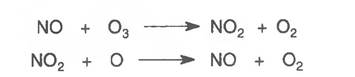
We, thus, see that the oxides of nitrogen (which are formed during thunderstorm and lightening by combination of atmospheric nitrogen and oxygen) destroy or deplete the ozone layer. It is believed that the above process destroys more than 60% of ozone in the atmosphere.
Various nuclear tests conducted in various parts of the world are also responsible for the destruction of ozone layer. Since nuclear tests produce such a high temperature that the atmospheric nitrogen and oxygen combine forming nitric oxide, which as stated above, is responsible for destroying ozone.
(ii) Depletion of ozone layer by chlorofluorocarbons (CFC’s) - As the name indicates, chlorofluorocarbons contain carbon, chlorine and fluorine. The CFC’s are non-flammable and non-toxic. They are used as refrigerants (coolants for refrigerators and air conditioners), for making polystyrene, for fire-fighting (special types of CFC’s, known as halons are used as fire extinguishers; halons are bromine containing derivatives of chlorofluorocarbons), as propellant for aerosol sprays and as blowing agents for foam plastics.
Though unreactive, the CFC’s are a major factor for ozone depletion. Being inert, CFC’s do not easily degrade in the troposphere and so they find their way into the stratosphere which contains the ozone layer. In stratosphere, the CFC’s are photo-chemically dissociated into reactive chlorine atoms. The latter catalyse the depletion of stratospheric ozone as shown below:
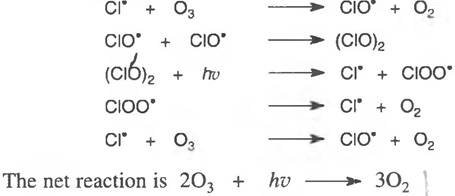
It is estimated that for every reactive chlorine atom generated in the stratosphere 1,00,000 molecules of ozone are depleted. The depletion of ozone by chlorofluorocarbons can be schematically represented below in Fig. 4.2.
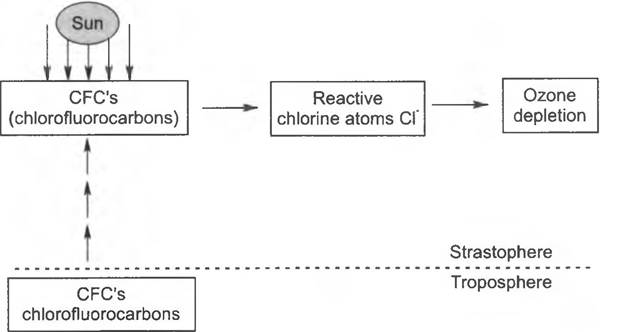
Fig. 4.2 : Ozone Depletion by CFOs
Concerned about the ozone hole (which permits harmful UV radiations to reach the earth), a protocol was signed at Montreal, Canada in 1987 in which representative of a number of developed countries reached an agreement to limit the production of CFC’s. The target set was to reduce the use of these harmful CFC’s by 50% by 1998. It was found that the ozone depletion caused by CFC’s was much more alarming. In view of this, the Montreal Convention was followed by a conference held in London in 1990 in which many more countries participated. The aim of the Montreal Protocol was affirmed and it was decided to speed up the phasing out of CFC’s.
Prevention or Minimisation of Ozone Depletion
As already discussed ozone depletion is effected by oxides of nitrogen and CFC’s. The oxides of nitrogen find their way into the atmosphere by the combination of atmospheric nitrogen and oxygen particularly during thunderstorm and lightening. There is virtually no way to prevent this mode of ozone depletion. However, using alternative substitutes can control the depletion of ozone by CFC’s.
Due to inert nature and enormous stability of CFC’s, they stay in the atmosphere for very long time. For example, the two most commonly used CFC’s viz. CFC-Il (CCl3F) and CFC-12 (CCl2F2) stay in the atmosphere for 75 and 110 years, respectively. This implies that even if the use of CFC’s is stopped, the already discharged CFC’s in the atmosphere will continue to deplete the ozone for a considerable length of time. In view of this, it is more or less essential to phase out the use of CFC’s and their substitutes must be discovered. The substitutes should have zero potential of ozone depletion and their green house potential should also be very low. It has already been stated that CFC’s are the constituents of green house gases and contribute to global warming.
The following CFC’s are most likely to replace the usual CFC’s. These are HCFC-123 (CHCl2CF3) and HFC-134 a (CH2FCF3). These have very low ozone depletion potential and their green house potentials are also quite low. However, their degradation products are toxic in nature.
It should be mentioned at this stage that certain related chemicals like carbon tetrachloride (CCl4) and trichloroethane (CH3CCl3) also have ozone depleting potential. Use of these chemicals also has to be phased out. At present, there are no substitutes for these (trichloroethane is used as a solvent and carbon tetrachloride is used as a raw material for the manufacture of CFC’s and pesticides and as a fire extinguisher).
Checking the Depletion of Ozone
It has been reported (Science, 1991, 254, 1191-1194) that the depletion of ozone could be prevented or at least minimized by injecting alkanes (e.g. ethane, propane etc.) in the stratosphere (which mainly contains ozone). The alkanes will react with ozone distroying chlorine atoms (from CFC’s) and immobilize them.
i. Classical Smog
It is commonly known simply as smog and is produced from gases like SO2 and NO2 present in air (produced by the burning of fossil fuels like coal and petrol or gasoline in homes, industries and automobiles). These gases get mixed with moisture in the tiny droplets of fog producing sulphuric acid and nitric acid, respectively.
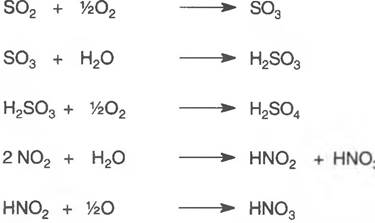
The resultant product mixture consisting of sulphuric acid and nitric acid get condensed on the solid particulate matter of smoke or dust present in the air to give colloidal dispersion called smog or classical smog.
Smog is usually formed during winter season and is present in the lower atmosphere. It decreases visibility and affects the human health. It is responsible for breathing problems like bronchitis and asthma and may contribute to heart problems. It produces irritation to eyes, nose and throat. It also reduces visibility and creates problems in road and air traffic.
It is well known that in December 1952, a dense cloud of smog was formed over London city and remained for about 5 days and resulted in death of 40005000 people, and created health problems to numerous other people. The cause of death was pneumonia, bronchitis and other respiratory problems. This smog, commonly called London Smog formed after the introduction of coal as a fuel, which produced both sulphur dioxide and smoke. The London smog is also called Reducing Smog.
ii. Photochemical Smog
This type of smog is formed by the combination of smoke, dust and fog with air pollutants particularly oxides of nitrogen and hydrocarbons. These pollutants (viz. hydrocarbons and oxides of nitrogen) originate form automobile exhaust, though they are also released in the atmosphere by other industrial activities. Some hydrocarbons like isoprene and α-pinene are also emitted from trees.
The formation of photochemical smog can be explained in the following way (see Chart 1). The various steps involved are:
(a) Hydrocarbons (which are reactive containing a C=C group) from automobiles interact with ozone to form a hydrocarbon free radical. (RCH2*). These hydrocarbon free radicals may also be formed by the reaction of hydrocarbons with atomic oxygen [evolved from NO2 by UV radiation form the sun, NO2 + UV radiation → NO + O].
(b) The free radical, RCH2*, reacts rapidly with oxygen to form another free radical, RCH2*O2.
(c) The second free radical RCH2O*, in turn, reacts with nitric oxide present in the atmosphere (either from N and O in presence of sun light or by irradiation of NO2) to produce the third free radical RCH2O* (the NO is converted into NO2).
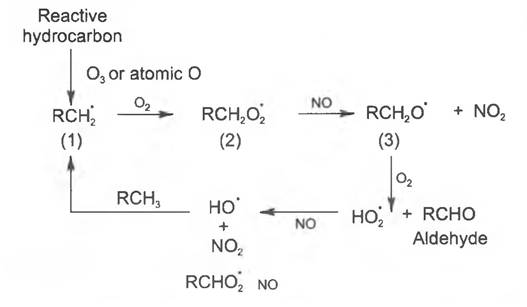
Chart 1. Steps involved in the formation of photochemical smog
(d) The third free radical (RCH2O*) subsequently reacts with oxygen yielding an aldehyde (RCHO) and generating a hydroperoxyl radical (HO2*).
(e) The hydroperoxyl radical (HO2*) reacts with nitric oxide to give NO3 and generates hydroxyl radical (HO*).
(f) The hydroxyl radical (HO*) being extremely reactive reacts with a hydrocarbon (RCH3) regenerating the hydrocarbon free radical (RCH2*). The above cycle is repeated a number of times leading to rapid build up of photochemical smog products.
(g) The aldehyde (RCHO) formed in step (d) reacts with hydroxyl radical (HO*) producing an acyl radical (RCO*), which in turn reacts with oxygen to give peroxyacyl radical (RCOO2*). The formed peroxyacyl radical finally reacts with nitrogen dioxide (NO3) to generate peroxyacetylnitrate (PAN). The steps involved in the last sequence of reactions from the aldehydes are shown in Chart 2.

Chart 2. The conversion of aldehydes to PAN
It is the Peroxyacetylnitrate (PAN), a constituent of smoke, which produces irritation in the eyes. The components of smog, e.g., ozone and PAN, affect the respiratory tract of human beings. It also causes nose and throat irritation and can lead to several problems (disease) of the eyes, lungs and heart. The photochemical smog also affects the growth of plants and causes damage to the vegetation.
Originally, the photochemical smog was observed at Los Angeles and was called Los AngeIes Smog. Due to this visibility was drastically dropped and the residents complained of eye irritation. Subsequently, it was found that this type of smog is not typical of Los Angeles and was found to be formed in other regions also.
The formation of photochemical smog can be suppressed ∙ r,-.r
(i) By preventing the release of oxides of nitrogen and hydrocarbons in the atmosphere by motor vehicles by using catalytic converters.
(ii) Some objective can be achieved by using a better quality of oil so that there is least or no emission of the oxides of nitrogen and hydrocarbon. This is possible by the use of so called Reformed gasoline, in which about 10% of the aromatic hydrocarbons are replaced by fuel oxygenates, such as methyl tertiary butyl ether. The additives make the fuel bum
more completely and efficiently. With this, the emission of volatile organic hydrocarbons is suppressed. Also, the gasoline containing oxygenates bums at a lower temperature resulting in the reduction of the emission of nitrogen oxides.
(iii) With the advancement of scientific knowledge, it is now possible to fabricate automobile engines so that there are no unbumt hydrocarbons left. This technology has been employed in most of the advanced countries.
4.6
More on the topic Effects of Air Pollution:
- The negative effects of air pollution have been known since at least the time of the ancient Greeks, when laws protected the quality of air, as indicated by its odor (Jacobson 2002).
- Control of Air Pollution
- Sources of Air Pollution
- Air Pollution
- Effects of Noise Pollution
- Moral Permissibility as a Product of Effects Over Time, Not Momentary Effects
- Environmental Pollution
- 4.3 Major Air Pollutants
- Defining pollution
- Tradeable pollution rights
- Air Ambulance Operations
- Air Ambulance Operations
- Thermal Pollution
- Fixed-Wing Air Ambulances (Airplanes)
- Fixed-Wing Air Ambulances (Airplanes)
- Criteria for Consideration of Air Versus Ground Transport