4.3 Major Air Pollutants
The major air pollutants are those which are produced in significant amounts and are responsible for a variety of health and environmental problems. Table 4.1 below describes various air pollutants.
Table 4.1 Different types of air pollutants
| Types of Pollutants | Examples |
| Gaseous pollutants | Oxides of carbon (CO, CO2) Oxides of nitrogen (NO, NO2) Oxides of sulphur (S02, SO3) |
| Particulate pollutants | Smoke, dust particles |
| Smog and photochemical smog | A colloidal dispersion of gaseous pollutants like SO2, NO2 etc. and water droplets with particulate matter |
| Metallic pollutants | Metallic particles like Pb, Hg, As, Cd, Be, Ni, V, Fe, Sn, and Al etc. released in the air by various industrial processes |
| Radiation | Released in the atmosphere by various nuclear devices etc. |
4.3.1 OxidesofCarbon
Carbon forms two oxides, viz. carbon monoxide and carbon dioxide. The former (carbon monoxide) is one of the most harmful pollutants. The later (i.e. carbon dioxide is harmless but in larger amounts, it may lead to a number of problems which will be discussed later.
4.3.1.1 Carbon Monoxide (CO)
Carbon monoxide is a colourless, odourless, tasteless and non-irritating gas. It is sparingly soluble in water and is highly toxic (poisonous) in nature. It reduces the oxygen carrying capacity of blood and can be fatal at concentrations exceeding 100 ppm. It is known as a silent killer. Major sources of carbon monoxide in the atmosphere are as follows:
(i) It is produced by the incomplete combustion of all carbon containing fuels. The incomplete combustion means combustion taking place in presence of insufficient quantity of oxygen.
Such combustion takes place in automobile engines (internal combustion engines).(ii) Industrial furnaces (e.g. blast furnace) which are used at high temperature (e.g. in the manufacture of iron).
(iii) Cigarette smoke also contains carbon monoxide. Though a single cigarette emits extremely small amount of carbon monoxide, but surely the number of people smoking a number of cigarettes every day discharge considerable amount of carbon monoxide into the atmosphere.
(iv) Carbon monoxide is also a constituent of some industrial gases. For example, coal gas, obtained by distillation of coal contains 5-10% carbon monoxide. Also, water gas (obtained by passing steam over red hot coke, H2O + C → CO + H2) contains 30-40% carbon monoxide.
(v) Besides the above sources of carbon monoxide which are due to human activities, it is also produced from some natural sources, chief amongst these are:
• Volcanic eruptions
• Forest fires
• Methane (an important and major constituent of natural gas and produced in marshy places) on oxidation under controlled conditions gives carbon monoxide.
• Decomposition or degradation of chlorophyll, the green pigment of plants.
• Marine algae and marine Siphonophore produce carbon monoxide.
Carbon Monoxide Poisoning
It is known that during breathing, the haemoglobin (Hb) present in the red blood cells of blood combines with the oxygen reversibly to form oxy-haemoglobin (HbO2).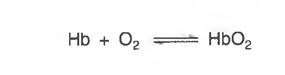
As a result of blood passing through the arteries to the tissues, the pressure of oxygen decreases and the oxygen present in the complex HbO2 is set free, where it is utilised by the body cells.
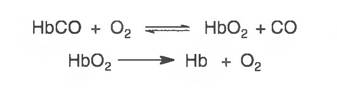
In case, the air (we breathe) contains carbon monoxide, the oxygen present in HbO2 is replaced by CO, since haemoglobin (Hb) has more affinity for CO than for O2; this results in the formation of carboxy-haemoglobin (HbCO).

Due to the formation of HbCO, the quantity of oxygen available to the body cells get reduced. In other words, carbon monoxide reduces the oxygen carrying capacity of the blood and this leads to oxygen starvation (anoxia). The deficiency of oxygen produces headache, dizziness, chocking, cardiac and pulmonary complications leading to paralysis and death.
It is well known that in winter (cold climate), when people sleep inside their homes using coal for heating, a number of cases of death have been reported due to carbon monoxide poisoning. Also, in cold climate, children are left in closed cars with heating on. There are a number of reports of children dying due to carbon monoxide poisoning (the carbon monoxide is emitted by the combustion of fuel; this CO finds way in the hot air of the heating system).
In case, carbon monoxide poisoning is detected well in time (i.e. before the person dies), it can be treated by exposing the victim to oxygen under a high pressure (2-2.5 atm). By this process, the CO present in HbCO is replaced by O2 and the victim may be revived.
Monitoring of Carbon Monoxide
The amount or the concentration of carbon monoxide in the air is generally determined by non dispersive infrared analysis. This analysis depends on the fact that carbon monoxide (which possesses a dipole moment), absorbs infrared radiation at certain specific wavelengths. The amount of infrared radiation absorbed by carbon monoxide gas is directly proportional to its concentration. This method is used if the level of carbon monoxide is up to a level of 150 ppm. In case the concentration of the gas is near 10 ppm, it can be estimated by gas chromatography, which makes use of a flame ionisation detector. However, if the concentration of carbon monoxide is less than 10 ppm, it is estimated by reducing with hydrogen gas over a nickel catalyst at 36OoC and the produced methane is estimated by flame ionisation detector.

4.3.1.2 Carbon Dioxide (CO2)
Carbon dioxide is a colourless, odourless gas and is about 1.5 times heavier than air. Though it is non-poisonous, it does not support life, but animals and human beings if kept in carbon dioxide atmosphere die not due to CO2 but due to lack of oxygen. Small amount of CO2 is considered relatively innocuous and so is not considered to be a pollutant, but its excess quantity in the atmosphere has adverse effect on the climate (see green house effect and global warming), hence it is considered to be a pollutant in large amount. Major sources of carbon dioxide in the atmosphere are as follows:
(i) It is one of the end products of burning of fossil fuels like coal, natural gas and petroleum etc. On an average, 6000 million tonnes of CO2 enters the atmosphere by such activities every year.
(ii) The cultivation of soil also releases large amount of CO2, which is produced by bacteria. This activity releases more than 2000 million tonnes of CO2 into the atmosphere every year.
(iii) A large number of industrial processes contribute to the release of large amount of CO2 into the atmosphere. These include manufacture of lime, alcohol and other fermentation units (for the manufacture of antibiotics etc).
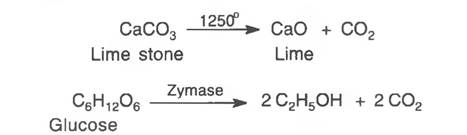
Such industrial processes contribute more than 10,000 million tonnes of CO2 to the atmosphere annually.
(iv) Some other activities like decay of dead organisms and respiration by living organisms also release CO2 into the atmosphere. Volcanic eruptions and forest fires also contribute to the release of CO2.
The major consumers of CO2 in the atmosphere are given below:
a. Green Plants
These absorb CO2 gas from the atmosphere in presence of sunlight and chlorophyll to produce their food (carbohydrates).
This process is known as Photosynthesh.
b. Oceans
The oceans dissolve CO2 gas to form carbonate rocks. In this way, both the plants and oceans keep a balance of CO2 in the atmosphere. Out of these two, green plants are more important. It is due to this that in the interest of survival of the mankind, it is essential to plant more trees and ensure that no attempt be made for cutting or felling of the trees.
Effects of CO2 in the Atmosphere
The main effects of carbon dioxide in the atmosphere are its contribution in the green house effect, global warming, acid rain, and maintaining the pH of rain water at about 5.6 (see sec. 4.5).
4.3.2 Oxides of Nitrogen
Nitrogen combines with oxygen to form a number of oxides, viz. nitric oxide (NO), nitrogen dioxide (NO2), nitrous oxide (N2O), dinitrogen trioxide (N2O3), dinitrogen tetroxide (N2O4) and dinitrogen pentoxide (N2O5). However, from the point of view of environmental pollution, the first three oxides viz. nitric oxide, nitrogen dioxide and nitrous oxide are important and are discussed here. Nitrous oxide is also a greenhouse gas (see green-house effect). Major sources of oxides of nitrogen in the atmosphere are as follows:
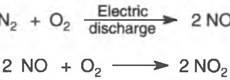
(i) During thunderstorm and lightening, atmospheric nitrogen and oxygen combine to form nitric oxide, which gets converted into nitrogen dioxide.
(ii) The exhaust gases released by the automobile engines contain NO and NO2 besides other gases.
(iiι) In fossil fuel based power plants, the combustion temperature is high and under these conditions, nitrogen and oxygen combine to give oxides of nitrogen.
(iv) Nitrogen dioxide is also obtained as a by-product during the manufacture ofexplosives.
(v) The bulk of oxides of nitrogen in the atmosphere originate from bacterial decay of organic matter by soil micro-organisms on the surface of the earth.
(vi) Nitrous oxide is produced by the action of aerobic and anaerobic bacteria in the soil on nitrogen-based fertilizers.
Function of Oxides of Nitrogen in the Atmosphere
Nitrogen and oxygen combine in the atmosphere at high temperature to give nitric oxide, which is converted into nitrogen dioxide by aerial oxidation.
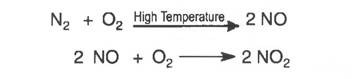
Nitric oxide can also be oxidised with ozone to give nitrogen dioxide.

Though nitrous oxide (which is produced by the action Ofbacteria in the soil on nitrogen based fertilizers) is unreactive in the lower atmosphere; in the stratosphere, it gives nitric oxide and nitrogen dioxide on photolysis.

Nitrous oxide may also give nitrogen and oxygen on photolysis.

The free oxygen atom may react with nitrous oxide producing nitric oxide, which is subsequently oxidised to nitrogen dioxide.
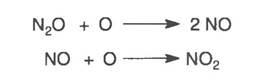
In the atmosphere, nitrogen dioxide reacts with water vapour producing nitric acid, which is washed down as acid rain (see acid rain, sec. 4.5.1).

Alternatively, nitric acid may combine with ammonia (present in the atmosphere) giving ammonium nitrate.

The acid rain (containing HNO3) on coming in contact with marble (CaCO3) of the monuments gives CO2 gas and calcium nitrate. 
In the atmosphere, nitric oxide destroys the ozone (which absorbs harmful ultraviolet radiations coming from the sun.)

Thus, we see that both nitric oxide and nitrogen dioxide destroy ozone layer. This aspect has been discussed subsequently (see ozone hole, sec. 4.5.4).
Being corrosive, nitrogen dioxide attacks skin and corrodes teeth and causes loss of appetite. It is harmful for plants and causes extensive leaf-drops. It has been found that inhalation of NO2 (15-30 ppm concentration) for about 2 hours, causes damage to lungs, heart, liver and kidney.
When associated with hydrocarbons and sunlight, oxides of nitrogen lead to the formation of photochemical smog (see sec. 4.5.5)
•—■—
Monitoring of Oxides of Nitrogen
Method 1
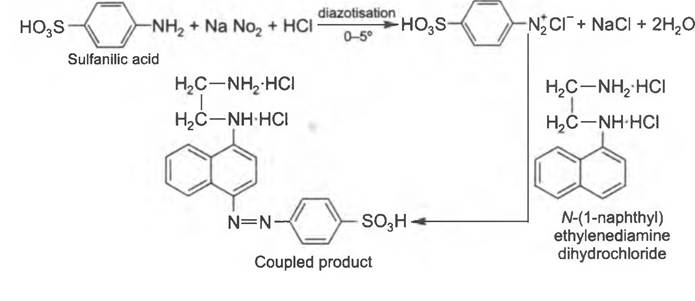
In the atmosphere, both nitric oxide and nitrous oxide are finally converted into nitrogen dioxide. So the monitoring of the oxides of nitrogens is done by monitoring nitrogen dioxide. The procedure involves, bubbling the contaminated air (containing NO2) into a solution of sodium hydroxide for a period of 24 hr. The nitrogen dioxide in the contaminated (or polluted) air is converted into sodium nitrite and sodium nitrate.

The above solution is added to a mixture of hydrogen peroxide, Sulphanilic acid, hydrochloric acid and N-( 1-naphthyl) ethylenediamine hydrochloride. The sodium nitrite formed in the reaction diazotises Sulphanilic acid. This procedure is carried out at low temperature (0-5o). The formed diazonium salt couples with N-(l-naphthyl)ethylenediamine dihydrochloride to give the coupled compound. The reactions involved are as follows:
72
Environmental Science
The coupled product absorbs at 540 nm. Its concentration is determined by Lambert-Beer’s law. One mole of coupled salt corresponds to one mole of sodium nitrite, which in turn corresponds to one mole to nitrogen dioxide.
Method 2
In an alternative procedure, the oxides of nitrogen in the atmosphere are made to react with ozone to yield electronically excited species (NO*2).
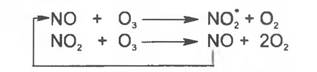
NO2* being unstable quickly returns to the ground state, forming NO2 and emitting light in the range of 600-3000 nm.

The intensity of light is directly proportional to the concentration of NO2* and hence NO molecules. The intensity of light, measured with the help of photo-multipliers gives a measure of the concentration of NO molecules.
4.3.3 OxidesofSulphur
Sulphur forms two oxides viz. sulphur dioxide (a primary pollutant) and sulphur trioxide (a secondary pollutant). The first oxide viz. SO2 is important from the point of view of atmospheric pollution.
4.3.3.1 Sulphur Dioxide (SO2)
It is the most common harmful gaseous pollutant. It is a colourless gas with suffocating smell. It irritates the respiratory system of animals and humans and damages lungs. Major sources of SO2 in the atmosphere are as follows:
(i) Sulphur dioxide is released in the atmosphere by volcanic eruptions.
,(ii) Both coal and oils contain sulphur as the impurity and on burning release SO2 into the atmosphere.
(iii) It is also produced when sulphide ores like pyrites (FeS2), copper pyrites (CuS), copper glance (Cu2S), zinc blende (ZnS), galena (PbS) etc. are roasted in air during the metallurgy of respective metals.
(iv) Large amount of SO2 are released in the atmosphere from power plants, which are coal and oil based, and also from oil refineries. Even plants manufacturing sulphuric acid release SO2 into the atmosphere.
(v) Hydrogen sulphide which is discharged into the air by natural processes is converted into SO2 by oxidation in the atmosphere (see sec. 4.3.4).
Functions of Oxides of Sulphur in the Atmosphere
In the atmosphere, sulphur dioxide reacts with oxygen to form sulphur trioxide (SO3) by photolytic and catalytic oxidation processes.
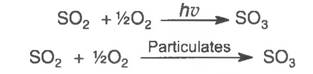
Sulphur dioxide also reacts photo-chemically with ozone producing sulphur trioxide.

Sulphur trioxide formed in the atmosphere reacts with water forming sulphuric acid.

The sulphuric acid formed comes down to the earth as acid rain (see acid rain, in sec. 4.5.1). The acid rain damages the crops and may react with ammonium salts and sodium chloride to produce sulphates.

Sulphuric acid also damages the marble monuments (as in the case of nitric acid).

At least three major environmental episodes occurred in 1930, 1948, 1952 and 1962 due to the smog conditions produced by SO2 (see sec. 4.5.5).
Prolonged exposure of plants to even small concentration of SO2 results in decolorization of the leaves. This is because the production of chlorophyll is hampered. The colour of fabrics, leather, paper and paints fade in presence of SO2.
Monitoring the Presence of Sulphur Dioxide in the Atmosphere
The concentration of sulphur dioxide in the air can be determined by bubbling the test sample of air through a dilute aqueous solution of sodium Ietrachloromercurate (II), Na2[HgCl4] (obtained by the action of HgCl2 on NaCl solution) containing Sulphamic acid (which
destroys any nitrogen oxides present in the air). Sulphur dioxide in the sample of air reacts quantitatively with sodium Ietrachloromercurate (II) and is converted into a stable complex, sodium dichlorosulphitomercurate (II), Na2EHgCl2(SO3)].

The above complex is treated with a mixture of p-rosaniline dye, formaldehyde and phosphoric acid. The p-rosaniline dye is converted to p- rosaniline methyl sulphonic acid.
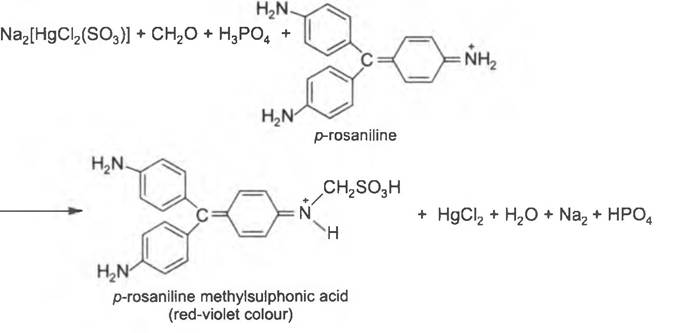
In the above procedure, phosphoric acid liberates SO2 from the complex and maintains the pH of the reaction at 1.0; it also ties-up any heavy metal ions that may be present in the environment along with SO2.
The p-rosanilinemethylsulphonic acid has a red-violet colour and at pH 1.0, it absorbs at 575 nm. Its concentration can be determined Calorimetrically using Lambert-Beer’s law. This concentration is proportional to the concentration of SO2 in the atmosphere.
4.3.4 HydrogenSuIphide(H2S)
It is a colourless gas having smell of rotten eggs. It is extremely toxic and is harmful even at low concentrations. Mild exposure to H2S can cause giddiness. It is also harmful to plants and retards their growth. An air-pollution episode due to H2S was reported in November 1950, when an accident in a refinery complex in Roza Rica released large amount of H2S gas on the ground level. The sources which emit oxides of sulphur (see sec. 4.3.3) also release hydrogen sulphide into the atmosphere.
(i) Natural decay of animal and vegetable matter
(ii) Volcanic eruptions
(iii) Some industrial processes like paper mills, oil refineries, natural gas plants and chemical manufacturing plants using sulphur inject H2S to the atmosphere.
(iv) It also enters into the atmosphere by the reduction of sulphates and organo sulphur compounds.
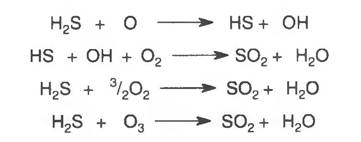
In the atmosphere, H2S is oxidised to SO2 by atomic oxygen or by molecular oxygen or by ozone.
4.3.5 Chlorine(Cl2)
Chlorine is a greenish-yellow coloured gas having disagreeable suffocating odour and is harmful even in low concentrations. It is a poisonous and toxic gas and causes irritation to mucus membrane. Exposure to chlorine may cause death. Chlorine is considered to be a pollutant. It is mostly released in the atmosphere by industrial processes from plastic industries, water treatment units and units engaged in the manufacture of caustic soda.
In the atmosphere, chlorine dissolves in moisture to give hydrochloric acid and hypochlorous acid, which comes down to the earth in the form of acid rain. 
4.3.6 Ozone(O3)
Ozone is a pale blue gas having pungent odour and is about 1.5 times heavier than air. Depending on the circumstances and the location, ozone can be beneficial or harmful. Thus, in the atmosphere near the surface of earth - in the air we breathe - ozone is an irritating, toxic gas. Even in low atmospheric concentration (about 1 ppm), formed near sparking, machinery, electrical generators and some types of photocopiers, it can lead to sore throats, bronchial irritation, coughing and fatigue. Higher concentration of ozone can be fatal. Ozone is also lethal to lower forms of life, including bacteria. Due to this reason, ozone is used as a disinfectant for water supplies (like chlorine) in some countries.
Ozone is produced in the upper part of the atmosphere (stratosphere) by the action of sunrays on oxygen.
Sun-rays
q∏ --------------------------------- ► ОГЧ
(energy) zυ3
In stratosphere, ozone forms a life saving shield that protects life from the catastrophic effects of extremely harmful ultraviolet solar radiation. Ozone also undergoes dissociation to give oxygen in the atmosphere.

During night, ultra-violet radiations are not available. This keeps a balance of the ozone layer. The oxides of nitrogen present in the atmosphere also decompose ozone into oxygen.
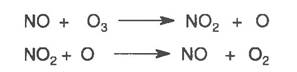
Ozone layer is also depleted by chlorofluorocarbons. This aspect will be discussed in a subsequent section. Depletion of oxygen layer produces ozone hole (see sec. 4.5.4).
4.3.7 Hydrocarbons
Hydrocarbons are compounds made up of carbon and hydrogen. These are the most important constituents of petroleum, natural gas and LPG. These are also present in the exhaust gases of the automobiles. Hydrocarbons have adverse effects on human beings and some are carcinogenic in nature.
Methane (CH4) is the major naturally occurring hydrocarbon emitted in the atmosphere. It is present to the extent of 90-95% in natural gas. It is also produced by bacteria during anaerobic decomposition of organic matter in soil, water and sediments.
Methane is one of the green house gas (see sec. 4.5.3) and thus, it contributes to the global warming. The hydrocarbons, particularly methane along with oxides of nitrogen contributes to the formation of photochemical smog (see sec. 4.5.5).
4.3.8 Particulates
The finely divided suspended solid particles in the atmosphere are called particulates. The diameter of the particulates lies in the range 0.001 - 100 μm. These cause severe health problems. Some examples particulates are as follows:
(i) Smoke emitted into air by the combustion of fuels like coal and oil in homes and factories. Power generation plants which use coke are the greatest source of smoke. The smoke basically contains particles of carbon, which remain suspended in air.
(ii) Cement dust emitted from cement factories
(iii) Insecticide dust
(iv) Coal dust
(v) Fly ash generated from power units
(vi) Milled flour
(vii) Pollen
(viii) Exhaust gases of automobiles also contain carbon particles.
The particulates are subdivided into two types, viz. primary particulates and secondary particulates.
Primary particulates are usually 1-20 μm in diameter and are directly injected into the air. Examples of this type are pollens, volcanic debris, coal dust, cement dust, fly ash and milled flour.
Secondary particulates are produced in the atmosphere as a result of reactions of primary particulates with contaminant gases. Examples of this type include vehicular emission, combustion processes and industries involving metallurgical operations. The secondary particulates are responsible for photochemical smog.
Some of the important sources of particulates are given as follows:
fι) Meteorites : These enter into the atmosphere from the outer space. On passing through the atmosphere, most of the meteorites bum up or disintegrate. The bigger particles, however, reach the earth surface in the form of meteorite dust.
(ii) Volcanoes: Volcanic eruptions inject enormous amounts of particulate matter into the atmosphere. The debris from volcanic eruptions can travel several thousand kilometres from the site of eruptions and damage the ecosystems of far-flung places.
(iii) Pollens and spores : These are injected into the atmosphere by vegetation. Being very light, these find their way in both troposphere and stratosphere.
(iv) Forest trees : In rural areas, trees discharge terpene vapours (the most important is α-pinene) which causes a blue haze in the atmosphere due to dispersion of sun light. The terpenes are easily oxidised by ozone to give peroxy radicals which are constituents of photochemical smog. The frequent occurrence of forest fires is also a source of particulates. It is well known that the forest fire in 1997 in Indonesia and in May 1998 in Mexico created a number of problems due to injection of particulates into the atmosphere. These particulates consist of polynuclear hydrocarbons (for example, naphthalene, phenanthrene, anthracene, pyrene etc.) and salts of calcium, iron, zinc and magnesium.
(v) A major source of particulates in the atmosphere is mining industry, e.g. mining of coal, asbestos, and mica and ore of metals (see sec. 4.4.3).
Adverse Effects of Particulates
Particulates produce a number of adverse effects which are as follows:
(i) Particulates play a major role in the formation of photochemical smog which is known to cause a number of problems (see sec. 4.5.5)
(ii) Particulates aggravate the deleterious effects of other air pollutants. The particulates sometimes travel across the national boundaries and so the harmful effects are felt upto thousands of kilometres from their place of origin.
игй Women exposed to fine particulate matter (having diameter less than 10 urn) have been found to deliver children having small heads and bodies. Such children are slow to Ieam and have an increased risk of developing cancer. It is believed that particulates which are coated with polynuclear hydrocarbons cause irreversible damage to the DNA of the growing fetus.
(iv) Visibility is considerable reduced.
(v) Mercury if present as particulate, produces heaviness, headache, nervousness, fatigue and a number of other problems. Prolonged exposure causes the breakdown of CNS.
(vi) The exhaust gases from automobiles discharge account to the extent of about 1% of the total mass of particulates in the atmosphere. These particulates comprise of soot, lead compounds, crank case oil and hydrocarbons (besides other gaseous pollutants like CO, CO2, oxides of nitrogen and sulphur etc).
(vii)The main components of various combustion processes are SO2 and NO2. These are converted into sulphates and nitrates via the formation of sulphuric acid and nitric acid. Incomplete combustion of fossil fuels produces soot particles. A number of combustion processes produce fly ash which is a mixture of oxides of silicon, aluminium, calcium and phosphorus.
(viii) Metallurgical processes emit fine metallic dust and oxides of metals which provide catalytic surface for a number of unwanted reactions in the atmosphere.
(ix) The presence of lead as particulate is extremely harmful. It is a cumulative poison and keeps on accumulating in the tissues of the human body and in the leaf tissues of plants. Accumulation of lead in human tissues causes malfunctioning of red blood cells leading to anaemia. Lead is known to damage organs like liver, kidneys and intestines and affects the CNS.
(x) Cadmium pollution may arise from the metallurgical processes of zinc, and copper. It causes lung irritation, vomiting and hypertension.
Following table lists some more metallic pollutants and their effects on human beings.
Table 4.2 Sources of some metallic pollutants and their effects
| S.No. | Metallic pollutant | Major sources | Harmful effects |
| L | Zinc (Zn) | Zinc refineries, galvanizing processes, brass manufacture, metal plating, and plumbing. | Zinc fumes have corrosive effect on skin and can cause irritation and damage mucous membranes. |
| ІІ. | Chromium (Cr) | Metallurgical and chemical industries, processes using chromate compounds, cement and asbestos units | Toxic to body tissues, can cause irritation, dermatitis, ulceration of skin, perforation of nasal septum. Carcinogenic action suspected. |
| ІІІ. | Arsenic (As) | Arsenic containing fungicides, pesticides and herbicides, metal smelters, by-product of mining activities, chemical wastes. | Inhalation, ingestion or absorption through skin can cause mild bronchitis, nasal irritation or dermatitis. Carcinogenic activity is also suspected. Attack -SH groups of enzymes, coagulate proteins. |
| iv. | Beryllium (Be) | Coal, nuclear power and space industries, production of fluorescent lamps, motor fuels and other industrial use. | Damage to skin and mucous membranes, pulmonary damage, perhaps carcinogenic. |
| V. | Boron (B) | Boron producing units, production and use of petroleum fuel and additives, burning coal and industrial wastes, detergent formulations. | Ingestion, inhalation as dust causes irritation and inflammation. Boron hydrides can damage CNS and may result in death. |
| vi. | Manganese (Mn) | Ferromanganese production, organo-manganese fuel additive, welding rods, incineration of manganese containing substances. | Absorption, ingestion, inhalation, or skin contact may cause manganic pneumonia. |
| vii. | Nickel (Ni) | Metallurgical industries using nickel, combustion of fuels containing nickel additives, burning of coal and oil, electroplating units using nickel salts, incineration of nickel containing substances, vanaspati manufacture. | Respiratory disorder, dermatitis, cancer of lungs and sinus. |
| viii. | Vanadium (V) | Vanadium refining, production of vanadium containing alloy’s power plants, burning of oil rich in vanadium. | Gastro-intestinal and respiratory disorders inhibition of synthesis of cholesterol, heart disease and cancer in case of chronic exposures. |
| ix. | Selenium (Se) | Burning of fuels and residual oils, fumes and gases from refinery wastes, incineration of paper and other wastes natural sources. | Irritation of gastro-intestinal and respiratory tracts, irritation of eyes, nose and throat. Damage to lungs, liver and kidneys. |
4.4